February 10, 2022
Mohenjo
Business, Enthralling, Human Interest, Photographs
amazon, business, Business News, current-events, Future, Hotels, human-rights, medicine, mental-health, research, Science, Science News, technology, Technology News, travel, vacation

Click the link below the picture
.
The Roman Forum, also known by its Latin name Forum Romanum (Italian: Foro Romano), is a rectangular forum (plaza) surrounded by the ruins of several important ancient government buildings at the center of the city of Rome. Citizens of the ancient city referred to this space, originally a marketplace, as the Forum Magnum, or simply the Forum.
For centuries the Forum was the center of day-to-day life in Rome: the site of triumphal processions and elections; the venue for public speeches, criminal trials, and gladiatorial matches; and the nucleus of commercial affairs. Here statues and monuments commemorated the city’s great men. The teeming heart of ancient Rome, it has been called the most celebrated meeting place in the world, and in all history. Located in the small valley between the Palatine and Capitoline Hills, the Forum today is a sprawling ruin of architectural fragments and intermittent archaeological excavations attracting 4.5 million or more sightseers yearly.
Many of the oldest and most important structures of the ancient city were located on or near the Forum. The Roman Kingdom’s earliest shrines and temples were located on the southeastern edge. These included the ancient former royal residence, the Regia (8th century BC), and the Temple of Vesta (7th century BC), as well as the surrounding complex of the Vestal Virgins, all of which were rebuilt after the rise of imperial Rome.
Other archaic shrines to the northwest, such as the Umbilicus Urbis and the Vulcanal (Shrine of Vulcan), developed into the Republic’s formal Comitium (assembly area). This is where the Senate—as well as Republican government itself—began. The Senate House, government offices, tribunals, temples, memorials, and statues gradually cluttered the area.
Over time the archaic Comitium was replaced by the larger adjacent Forum and the focus of judicial activity moved to the new Basilica Aemilia (179 BC). Some 130 years later, Julius Caesar built the Basilica Julia, along with the new Curia Julia, refocusing both the judicial offices and the Senate itself. This new Forum, in what proved to be its final form, then served as a revitalized city square where the people of Rome could gather for commercial, political, judicial, and religious pursuits in ever greater numbers.
Eventually much economic and judicial business would transfer away from the Forum Romanum to the larger and more extravagant structures (Trajan’s Forum and the Basilica Ulpia) to the north. The reign of Constantine the Great saw the construction of the last major expansion of the Forum complex—the Basilica of Maxentius (312 AD). This returned the political center to the Forum until the fall of the Western Roman Empire almost two centuries later.
.
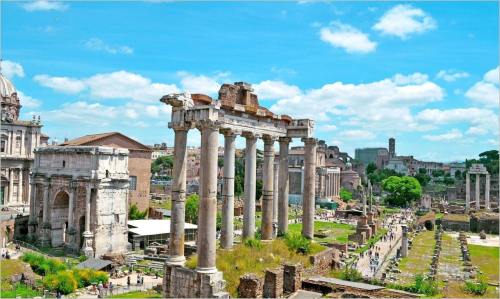 An image of the Roman Forum
.
.
Click the link below for images:
.
__________________________________________
February 9, 2022
Mohenjo
Business, Enthralling, Human Interest, Photographs
amazon, business, Business News, current-events, Future, Hotels, human-rights, medicine, mental-health, research, Science, Science News, technology, Technology News, travel, vacation
Click the link below the picture
.
Laos, officially the Lao People’s Democratic Republic, is a socialist state and the only landlocked country in Southeast Asia. At the heart of the Indochinese Peninsula, Laos is bordered by Myanmar and China to the northwest, Vietnam to the east, Cambodia to the southeast, and Thailand to the west and southwest. Its capital and largest city is Vientiane.
Present-day Laos traces its historic and cultural identity to Lan Xang, which existed from the 14th century to the 18th century as one of the largest kingdoms in Southeast Asia. Because of its central geographical location in Southeast Asia, the kingdom became a hub for overland trade and became wealthy economically and culturally. After a period of internal conflict, Lan Xang broke into three separate kingdoms—Luang Phrabang, Vientiane, and Champasak. In 1893, the three territories came under a French protectorate and were united to form what is now known as Laos. It briefly gained independence in 1945 after Japanese occupation but was re-colonized by France until it won autonomy in 1949. Laos became independent in 1953, with a constitutional monarchy under Sisavang Vong. A post-independence civil war began, which saw the communist resistance, supported by the Soviet Union, fight against the monarchy that later came under influence of military regimes supported by the United States. After the Vietnam War ended in 1975, the communist Pathet Lao came to power, ending the civil war. Laos was then dependent on military and economic aid from the Soviet Union until its dissolution in 1991.
Laos is a member of the Asia-Pacific Trade Agreement, the ASEAN, East Asia Summit, and La Francophonie. Laos applied for membership of the World Trade Organization in 1997; on 2 February 2013, it was granted full membership. It is a one-party socialist republic, espousing Marxism–Leninism and governed by the Lao People’s Revolutionary Party, under which non-governmental organizations have routinely characterized the country’s human rights record as poor, citing repeated abuses such as torture, restrictions on civil liberties, and persecution of minorities.
The politically and culturally dominant Lao people make up 53.2% of the population, mostly in the lowlands. Mon-Khmer groups, the Hmong, and other indigenous hill tribes live in the foothills and mountains. Laos’s strategies for development are based on generating electricity from rivers and selling the power to its neighbors, namely Thailand, China, and Vietnam, as well as its initiative to become a “land-linked” nation, as evidenced by the construction of four new railways connecting Laos and neighbors. Laos has been referred to as one of Southeast Asia and Pacific’s fastest-growing economies by the World Bank with annual GDP growth averaging 7.4% since 2009.
.
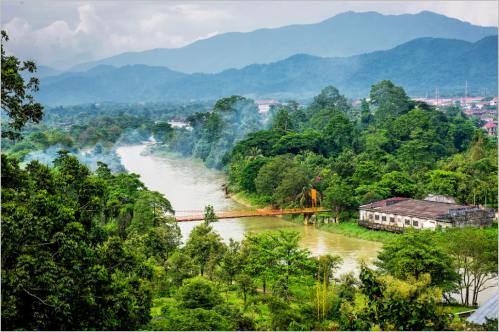 An image from Laos
.
.
Click the link below for images:
.
__________________________________________
February 8, 2022
Mohenjo
Business, Enthralling, Human Interest, Photographs
amazon, business, Business News, current-events, Future, Hotels, human-rights, medicine, mental-health, research, Science, Science News, technology, Technology News, travel, vacation
Click the link below the picture
.
Cologne is the largest city of Germany’s most populous state of North Rhine-Westphalia (NRW) and the fourth-most populous city and one of the oldest in Germany. With 3.6 million people in the urban region and 1.1 million inhabitants within its city proper, Cologne is the largest city on the river Rhine and also the most populous city of both the Rhine-Ruhr Metropolitan Region and the Rhineland. Centered on the left (west) bank of the Rhine, Cologne is about 35 km (22 mi) southeast of NRW’s state capital Düsseldorf and 25 km (16 mi) northwest of Bonn.
The city’s medieval Catholic Cologne Cathedral (Kölner Dom), the third-tallest church and tallest cathedral in the world, constructed to house the Shrine of the Three Kings, is a globally recognized landmark and one of the most visited sights and pilgrimage destinations in Europe. The cityscape is further shaped by the Twelve Romanesque churches of Cologne, and Cologne is famous for Eau de Cologne, that has been produced in the city since 1709, and “cologne” has since come to be a generic term.
There are many institutions of higher education in the city, most notably the University of Cologne, one of Europe’s oldest and largest universities; the Technical University of Cologne, Germany’s largest university of applied sciences; and the German Sport University Cologne. It hosts three Max Planck science institutes and is a major research hub for the aerospace industry, with the German Aerospace Center and the European Astronaut Centre headquarters. It also has significant chemical and automobile industry. Cologne Bonn Airport is a regional hub, the main airport for the region is Düsseldorf Airport.
Cologne was founded and established in Germanic Ubii territory in the 1st century CE as the Roman Colonia Agrippina, hence its name (Augusta Ubiorum was also used “Agrippina” was later dropped (except in Latin), and “Colonia” became the name of the city in its own right, which developed into modern German as Köln. “Cologne”, the French version of the city’s name, has become standard in English as well. Cologne functioned as the capital of the Roman province of Germania Inferior and as the headquarters of the Roman military in the region until occupied by the Franks in 462. During the Middle Ages, the city flourished as being located on one of the most important major trade routes between east and western Europe (including the Brabant Road, Via Regia, and Publica). Cologne was a free imperial city of the Holy Roman Empire and one of the major members of the trade union Hanseatic League. It was one of the largest European cities in medieval and renaissance times.
Prior to World War II, the city had undergone occupations by the French (1794–1815) and the British (1918–1926), and was part of Prussia beginning in 1815. Cologne was one of the most heavily bombed cities in Germany during World War II. The bombing reduced the population by 95%, mainly due to evacuation, and destroyed almost the entire millennia-old city center. The post-war rebuilding has resulted in a very mixed cityscape, restoring only major historic landmarks like city gates and churches (31 of them being Romanesque).
Cologne is a major cultural center for the Rhineland; it hosts more than 30 museums and hundreds of galleries. Exhibitions range from local ancient Roman archeological sites to contemporary graphics and sculpture. The Cologne Trade Fair hosts a number of trade shows such as Art Cologne, Dmexco, imm Cologne, Photokina, and Gamescom, a leading video games fair. Wikipedia
.
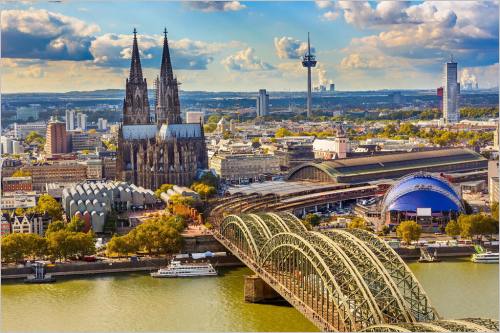 An image from Cologne Germany
.
.
Click the link below for images:
.
__________________________________________
February 7, 2022
Mohenjo
Business, Enthralling, Human Interest, Photographs
amazon, business, Business News, current-events, Future, Hotels, human-rights, medicine, mental-health, research, Science, Science News, technology, Technology News, travel, vacation
Click the link below the picture
.
Toronto is the capital city of the Canadian province of Ontario. With a recorded population of 2,731,571 in 2016, it is the most populous city in Canada and the fourth most populous city in North America. The city is the anchor of the Golden Horseshoe, an urban agglomeration of 9,245,438 people (as of 2016) surrounding the western end of Lake Ontario, while the Greater Toronto Area proper had a 2016 population of 6,417,516. Toronto is an international center of business, finance, arts, and culture, and is recognized as one of the most multicultural and cosmopolitan cities in the world.
Indigenous peoples have traveled through and inhabited the Toronto area, located on a broad sloping plateau interspersed with rivers, deep ravines, and urban forest, for more than 10,000 years. After the broadly disputed Toronto Purchase, when the Mississauga surrendered the area to the British Crown, the British established the town of York in 1793 and later designated it as the capital of Upper Canada. During the War of 1812, the town was the site of the Battle of York and suffered heavy damage by American troops. York was renamed and incorporated in 1834 as the city of Toronto. It was designated as the capital of the province of Ontario in 1867 during Canadian Confederation. The city proper has since expanded past its original limits through both annexation and amalgamation to its current area of 630.2 km2 (243.3 sq mi).
The diverse population of Toronto reflects its current and historical role as an important destination for immigrants to Canada. More than 50 percent of residents belong to a visible minority population group, and over 200 distinct ethnic origins are represented among its inhabitants. While the majority of Torontonians speak English as their primary language, over 160 languages are spoken in the city. The mayor of Toronto is elected by direct popular vote to serve as the chief executive of the city. The Toronto City Council is a unicameral legislative body, comprising 25 councilors since the 2018 municipal election, representing geographical wards throughout the city.
Toronto is a prominent center for music, theatre, motion picture production, and television production, and is home to the headquarters of Canada’s major national broadcast networks and media outlets. Its varied cultural institutions, which include numerous museums and galleries, festivals and public events, entertainment districts, national historic sites, and sports activities, attract over 43 million tourists each year. Toronto is known for its many skyscrapers and high-rise buildings, in particular the tallest free-standing structure in the Western Hemisphere, the CN Tower.
The city is home to the Toronto Stock Exchange, the headquarters of Canada’s five largest banks, and the headquarters of many large Canadian and multinational corporations. Its economy is highly diversified with strengths in technology, design, financial services, life sciences, education, arts, fashion, aerospace, environmental innovation, food services, and tourism.
.
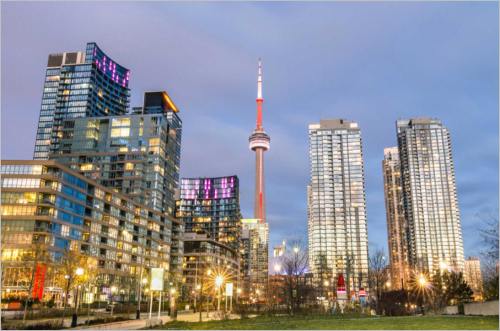 An image from Toronto Canada
.
.
Click the link below for images:
.
__________________________________________
February 5, 2022
Mohenjo
Business, Enthralling, Human Interest, Photographs
amazon, business, Business News, current-events, Future, Hotels, human-rights, medicine, mental-health, research, Science, Science News, technology, Technology News, travel, vacation
Click the link below the picture
.
Grand Canyon Village is a census-designated place (CDP) located on the South Rim of the Grand Canyon, in Coconino County, Arizona, United States. Its population was 2,004 at the 2010 Census. Located in Grand Canyon National Park, it is wholly focused on accommodating tourists visiting the canyon. Its origins trace back to the railroad completed from Williams to the canyon’s South Rim by the Santa Fe Railroad in 1901. Many of the structures in use today date from that period. The village contains numerous landmark buildings, and its historic core is a National Historic Landmark District, designated for its outstanding implementation of town design.
According to the United States Census Bureau, the CDP has a total area of 13.4 square miles (35 km2), all land.
It is located 180 miles (290 km) north of Phoenix and 168 miles (270 km) from Las Vegas.[6]
Groome Transportation provides scheduled service between Grand Canyon Village and Flagstaff, Arizona. Trans-Canyon Shuttle provides seasonal scheduled services between Grand Canyon Village and North Rim, Arizona.
The Grand Canyon Railway connects the Grand Canyon Depot in Grand Canyon Village with the Williams Depot in Williams, Arizona. Connections were offered to Amtrak’s Williams Junction station until 2017 when the station was closed.
The National Park Service operates free shuttle buses on the South Rim. Wikipedia
.
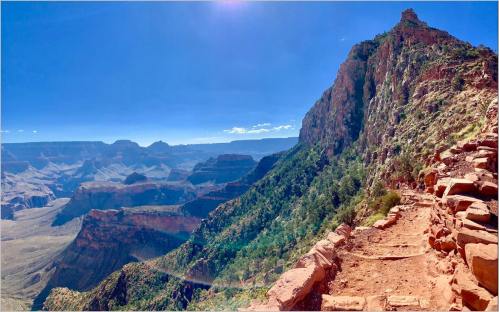 An image from Grand Canyon, Arizona
.
.
Click the link below for the image:
.
__________________________________________
February 2, 2022
Mohenjo
Business, Enthralling, Human Interest, Photographs
amazon, business, Business News, current-events, Future, Hotels, human-rights, medicine, mental-health, research, Science, Science News, technology, Technology News, travel, vacation
Click the link below the picture
.
Romania is a country at the crossroads of Central, Eastern, and Southeastern Europe. It borders Bulgaria to the south, Ukraine to the north, Hungary to the west, Serbia to the southwest, Moldova to the east, and the Black Sea to the southeast. It has a predominantly temperate-continental climate, and an area of 238,397 km2 (92,046 sq mi), with a population of around 19 million. Romania is the twelfth-largest country in Europe and the sixth-most populous member state of the European Union. Its capital and largest city is Bucharest, and other major urban areas include Iași, Cluj-Napoca, Timișoara, Constanța, Craiova, Brașov, and Galați.
The Danube, Europe’s second-longest river, rises in Germany’s Black Forest and flows in a southeasterly direction for 2,857 km (1,775 mi), before emptying into Romania’s Danube Delta. The Carpathian Mountains, which cross Romania from the north to the southwest, include Moldoveanu Peak, at an altitude of 2,544 m (8,346 ft).
Romania was formed in 1859 through a personal union of the Danubian Principalities of Moldavia and Wallachia. The new state, officially named Romania since 1866, gained independence from the Ottoman Empire in 1877. During World War I, after declaring its neutrality in 1914, Romania fought together with the Allied Powers from 1916. In the aftermath of the war, Bukovina, Bessarabia, Transylvania, and parts of Banat, Crișana, and Maramureș became part of the Kingdom of Romania. In June–August 1940, as a consequence of the Molotov–Ribbentrop Pact and Second Vienna Award, Romania was compelled to cede Bessarabia and Northern Bukovina to the Soviet Union, and Northern Transylvania to Hungary. In November 1940, Romania signed the Tripartite Pact and, consequently, in June 1941 entered World War II on the Axis side, fighting against the Soviet Union until August 1944, when it joined the Allies and recovered Northern Transylvania. Following the war and occupation by the Red Army, Romania became a socialist republic and a member of the Warsaw Pact. After the 1989 Revolution, Romania began a transition towards democracy and a market economy.
Romania is a developing country, with a high-income economy, ranking 49th in the Human Development Index. It has the world’s 47th largest economy by nominal GDP. Romania experienced rapid economic growth in the early 2000s; its economy is now based predominantly on services. It is a producer and net exporter of machines and electric energy through companies such as Automobile Dacia and OMV Petrom. Romania has been a member of the United Nations since 1955, NATO since 2004, and the European Union since 2007. The majority of Romania’s population are ethnic Romanian and religiously identify themselves as Eastern Orthodox Christians, speaking Romanian, a Romance language.
“Romania” derives from the local name for Romanian (Romanian: român), which in turn derives from Latin romanus, meaning “Roman” or “of Rome”. This ethnonym for Romanians is first attested in the 16th century by Italian humanists traveling in Transylvania, Moldavia, and Wallachia. The oldest known surviving document written in Romanian, a 1521 letter known as the “Letter of Neacșu from Câmpulung”, is notable for including the first documented occurrence of Romanian in a country name: Wallachia is mentioned as Țeara Rumânească. Wikipedia
.
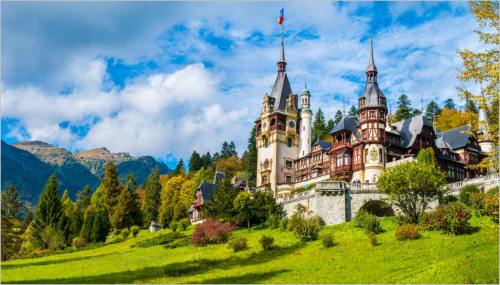 An image from Romania
.
.
Click the link below for images:
.
__________________________________________
February 1, 2022
Mohenjo
Business, Enthralling, Human Interest, Photographs
amazon, business, Business News, current-events, Future, Hotels, human-rights, medicine, mental-health, research, Science, Science News, technology, Technology News, travel, vacation
Click the link below the picture
.
Aulanko Nature Reserve is a nature reserve in Finland near the municipality of Hämeenlinna. It is a part of Finland’s National Urban Park policy introduced in the Land Use and Building Act in 1991. Wikipedia
Aulanko has been a popular destination with visitors for more than a hundred years. Nowadays, there is a lot to see in Aulanko Nature Reserve, in addition to the beautiful scenery. The forest park of Aulanko, its sights, and the view from the scenic lookout tower of Aulangonvuori Hill over the national landscape attract more than 400 000 visitors every year. The area is best suitable for day trips.
The English-style park, which forms a part of the nature reserve, was constructed in 1883 – 1938, and, with its buildings and cultural history, it is a nationally valuable site. To maintain the spacious park landscape, the forest park is actively managed. The nature reserve also includes forest landscape in its natural state.
The forest park of Aulanko has had a significant impact on the Finnish park culture. Nationalparks.fi
.
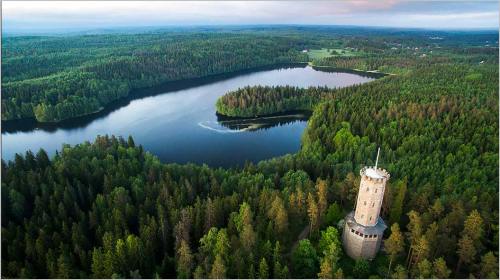 An image from the Aulanko Nature Reserve
.
.
Click the link below for images:
.
__________________________________________
January 31, 2022
Mohenjo
Business, Enthralling, Human Interest, Photographs
amazon, business, Business News, current-events, Future, Hotels, human-rights, medicine, mental-health, research, Science, Science News, technology, Technology News, travel, vacation
Click the link below the picture
.
Canada is a country in North America. Its ten provinces and three territories extend from the Atlantic to the Pacific and northward into the Arctic Ocean, covering 9.98 million square kilometers (3.85 million square miles), making it the world’s second-largest country by total area. Its southern and western border with the United States, stretching 8,891 kilometers (5,525 mi), is the world’s longest bi-national land border. Canada’s capital is Ottawa, and its three largest metropolitan areas are Toronto, Montreal, and Vancouver.
Indigenous peoples have continuously inhabited what is now Canada for thousands of years. Beginning in the 16th century, British and French expeditions explored and later settled along the Atlantic coast. As a consequence of various armed conflicts, France ceded nearly all of its colonies in North America in 1763. In 1867, with the union of three British North American colonies through Confederation, Canada was formed as a federal dominion of four provinces. This began an accretion of provinces and territories and a process of increasing autonomy from the United Kingdom. This widening autonomy was highlighted by the Statute of Westminster 1931 and culminated in the Canada Act 1982, which severed the vestiges of legal dependence on the Parliament of the United Kingdom.
Canada is a parliamentary democracy and a constitutional monarchy in the Westminster tradition. The country’s head of government is the prime minister—who holds office by virtue of their ability to command the confidence of the elected House of Commons—and is appointed by the governor-general, representing the monarch, who serves as head of state. The country is a Commonwealth realm and is officially bilingual at the federal level. It ranks among the highest in international measurements of government transparency, civil liberties, quality of life, economic freedom, and education. It is one of the world’s most ethnically diverse and multicultural nations, the product of large-scale immigration from many other countries. Canada’s long and complex relationship with the United States has had a significant impact on its economy and culture.
A highly developed country, Canada has the 24th highest nominal per capita income globally and the sixteenth-highest ranking in the Human Development Index. Its advanced economy is the ninth-largest in the world, relying chiefly upon its abundant natural resources and well-developed international trade networks. Canada is part of several major international and intergovernmental institutions or groupings including the United Nations, NATO, the G7, the Group of Ten, the G20, the Organisation for Economic Co-operation and Development (OECD), the World Trade Organization (WTO), the Commonwealth of Nations, the Arctic Council, the Organisation internationale de la Francophonie, the Asia-Pacific Economic Cooperation forum, and the Organization of American States.
.
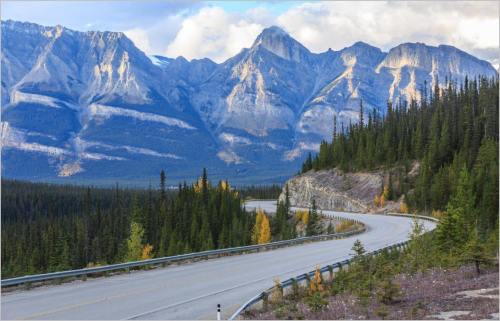 An image from Canada
.
.
Click the link below for images:
.
__________________________________________
January 29, 2022
Mohenjo
Business, Enthralling, Human Interest, Photographs
amazon, business, Business News, current-events, Future, Hotels, human-rights, medicine, mental-health, research, Science, Science News, technology, Technology News, travel, vacation
Click the link below the picture
.
Prague is the capital and largest city in the Czech Republic, the 13th largest city in the European Union, and the historical capital of Bohemia. Situated on the Vltava river, Prague is home to about 1.3 million people, while its metropolitan area is estimated to have a population of 2.7 million.] The city has a temperate oceanic climate, with relatively warm summers and chilly winters.
Prague is a political, cultural, and economic center of central Europe complete with a rich history. Founded during the Romanesque and flourishing by the Gothic, Renaissance, and Baroque eras, Prague was the capital of the Kingdom of Bohemia and the main residence of several Holy Roman Emperors, most notably of Charles IV (r. 1346–1378). It was an important city to the Habsburg Monarchy and its Austro-Hungarian Empire. The city played major roles in the Bohemian and the Protestant Reformations, the Thirty Years’ War, and in 20th-century history as the capital of Czechoslovakia between the World Wars and the post-war Communist era.
Prague is home to a number of well-known cultural attractions, many of which survived the violence and destruction of 20th-century Europe. Main attractions include Prague Castle, Charles Bridge, Old Town Square with the Prague astronomical clock, the Jewish Quarter, Petřín hill, and Vyšehrad. Since 1992, the extensive historic center of Prague has been included in the UNESCO list of World Heritage Sites.
The city has more than ten major museums, along with numerous theaters, galleries, cinemas, and other historical exhibits. An extensive modern public transportation system connects the city. It is home to a wide range of public and private schools, including Charles University in Prague, the oldest university in Central Europe.
Prague is classified as an “Alpha-” global city according to GaWC studies. In 2019, the city was ranked as 69th most livable city in the world by Mercer. In the same year, the PICSA Index ranked the city as 13th most livable city in the world. Its rich history makes it a popular tourist destination and as of 2017, the city receives more than 8.5 million international visitors annually. In 2017 Prague was listed as the fifth most visited European city after London, Paris, Rome, and Istanbul. Wikipedia
.
 An image from Prague
.
.
Click the link below for images:
.
__________________________________________
January 28, 2022
Mohenjo
Business, Enthralling, Human Interest, Photographs
amazon, business, Business News, current-events, Future, Hotels, human-rights, medicine, mental-health, research, Science, Science News, technology, Technology News, travel, vacation
Click the link below the picture
.
Charles Bridge is a medieval stone arch bridge that crosses the Vltava river in Prague, Czech Republic. Its construction started in 1357 under the auspices of King Charles IV and finished in the early 15th century. The bridge replaced the old Judith Bridge built 1158–1172 that had been badly damaged by a flood in 1342. This new bridge was originally called Stone Bridge (Kamenný most) or Prague Bridge (Pražský most), but has been referred to as “Charles Bridge” since 1870.
As the only means of crossing the river Vltava until 1841, Charles Bridge was the most important connection between Prague Castle and the city’s Old Town and adjacent areas. This land connection made Prague important as a trade route between Eastern and Western Europe.
A UNESCO World Heritage site, the bridge is 516 meters (1,693 ft) long and nearly 10 meters (33 ft) wide. Following the example of the Stone Bridge in Regensburg, it was built as a bow bridge with 16 arches shielded by ice guards. It is protected by three bridge towers, two on the Lesser Quarter side (including the Malá Strana Bridge Tower) and one on the Old Town side, the Old Town Bridge Tower. The bridge is decorated by a continuous alley of 30 statues and statuaries, most of them baroque-style, originally erected around 1700, but now all have been replaced by replicas.
The bridge is currently undergoing a twenty-year process of structural inspections, restoration, and repairs. The process started in late 2019 and is expected to cost 45–60 million CZK (USD 1.9–2.6 million).
Throughout its history, Charles Bridge has suffered several disasters and witnessed many historic events. Czech legend has it that construction began on Charles Bridge at 5:31am on 9 July 1357 with the first stone being laid by Charles IV himself. This exact time was very important to the Holy Roman Emperor because he was a strong believer in numerology and felt that this specific time, which formed a palindrome (1357 9/7 5:31), was a numerical bridge, and would imbue Charles Bridge with additional strength. The bridge was completed 45 years later in 1402. A flood in 1432 damaged three pillars. In 1496 the third arch (counting from the Old Town side) broke down after one of the pillars lowered, being undermined by the water (repairs were finished in 1503). A year after the Battle of White Mountain, when the 27 leaders of the anti-Habsburg revolt were executed on 21 June 1621, the Old Town Bridge Tower served as a deterrent display of the severed heads of the victims to stop Czechs from further resistance. During the end of the Thirty Years’ War in 1648, the Swedes occupied the west bank of the Vltava, and as they tried to advance into the Old Town the heaviest fighting took place right on the bridge. During the fighting, they severely damaged one side of the Old Town bridge tower (the side facing the river) and the remnants of almost all gothic decorations had to be removed from it afterward. During the late 17th century and early 18th century, the bridge gained its typical appearance when an alley of baroque statues was installed on the pillars. During a great flood in 1784, five pillars were severely damaged and, although the arches did not break down, the traffic on the bridge had to be greatly restricted for some time. Wikipedia
.
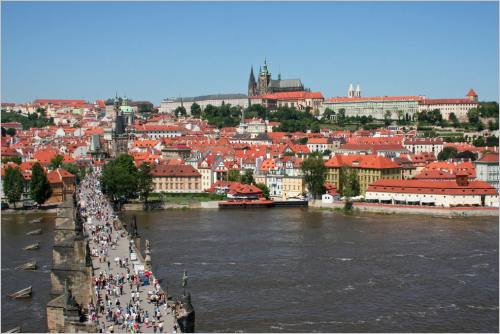 An image of the Charles Bridge Prague
.
.
Click the link below for images:
.
__________________________________________
Older Entries
Newer Entries
 James' World 2