March 28, 2022
Mohenjo
Business, Enthralling, Human Interest, Photographs
amazon, business, Business News, current-events, Future, Hotels, human-rights, medicine, mental-health, research, Science, Science News, technology, Technology News, travel, vacation

Click the link below the picture
.
India, officially the Republic of India is a country in South Asia. It is the seventh-largest country by area, the second-most populous country, and the most populous democracy in the world. Bounded by the Indian Ocean on the south, the Arabian Sea on the southwest, and the Bay of Bengal on the southeast, it shares land borders with Pakistan to the west; China, Nepal, and Bhutan to the north; and Bangladesh and Myanmar to the east. In the Indian Ocean, India is in the vicinity of Sri Lanka and the Maldives; its Andaman and Nicobar Islands share a maritime border with Thailand, Myanmar, and Indonesia.
Modern humans arrived on the Indian subcontinent from Africa no later than 55,000 years ago. Their long occupation, initially in varying forms of isolation as hunter-gatherers, has made the region highly diverse, second only to Africa in human genetic diversity. Settled life emerged on the subcontinent in the western margins of the Indus river basin 9,000 years ago, evolving gradually into the Indus Valley Civilisation of the third millennium BCE. By 1200 BCE, an archaic form of Sanskrit, an Indo-European language, had diffused into India from the northwest, unfolding as the language of the Rigveda, and recording the dawning of Hinduism in India. The Dravidian languages of India were supplanted in the northern and western regions. By 400 BCE, stratification and exclusion by caste had emerged within Hinduism, and Buddhism and Jainism had arisen, proclaiming social orders unlinked to heredity. Early political consolidations gave rise to the loose-knit Maurya and Gupta Empires based in the Ganges Basin. Their collective era was suffused with wide-ranging creativity but also marked by the declining status of women, and the incorporation of untouchability into an organized system of belief. In South India, the Middle kingdoms exported Dravidian languages scripts and religious cultures to the kingdoms of Southeast Asia.
In the early medieval era, Christianity, Islam, Judaism, and Zoroastrianism put down roots on India’s southern and western coasts. Muslim armies from Central Asia intermittently overran India’s northern plains, eventually establishing the Delhi Sultanate, and drawing northern India into the cosmopolitan networks of medieval Islam. In the 15th century, the Vijayanagara Empire created a long-lasting composite Hindu culture in south India. In the Punjab, Sikhism emerged, rejecting institutionalized religion. The Mughal Empire, in 1526, ushered in two centuries of relative peace, leaving a legacy of luminous architecture. Gradually expanding rule of the British East India Company followed, turning India into a colonial economy, but also consolidating its sovereignty. British Crown rule began in 1858. The rights promised to Indians were granted slowly, but technological changes were introduced, and ideas of education, modernity, and the public life took root. A pioneering and influential nationalist movement emerged, which was noted for nonviolent resistance and became the major factor in ending British rule. In 1947 the British Indian Empire was partitioned into two independent dominions, a Hindu-majority Dominion of India and a Muslim-majority Dominion of Pakistan, amid large-scale loss of life and an unprecedented migration.
India has been a federal republic since 1950, governed in a democratic parliamentary system. It is a pluralistic, multilingual, and multi-ethnic society. India’s population grew from 361 million in 1951 to 1.211 billion in 2011. During the same time, its nominal per capita income increased from US$64 annually to US$1,498, and its literacy rate from 16.6% to 74%. From being a comparatively destitute country in 1951, India has become a fast-growing major economy and a hub for information technology services, with an expanding middle class. It has a space program that includes several planned or completed extraterrestrial missions. Indian movies, music, and spiritual teachings play an increasing role in global culture. India has substantially reduced its rate of poverty, though at the cost of increasing economic inequality. India is a nuclear-weapon state, which ranks high in military expenditure. It has disputes over Kashmir with its neighbors, Pakistan and China, unresolved since the mid-20th century. Among the socio-economic challenges, India faces gender inequality, child malnutrition, and rising levels of air pollution. India’s land is megadiverse, with four biodiversity hotspots. Its forest cover comprises 21.7% of its area. India’s wildlife, which has traditionally been viewed with tolerance in India’s culture, is supported among these forests, and elsewhere, in protected habitats. Wikipedia
.
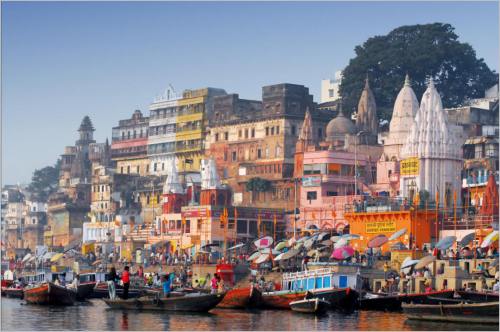 An image from India
.
.
Click the link below for images:
.
__________________________________________
March 26, 2022
Mohenjo
Business, Enthralling, Human Interest, Photographs
amazon, business, Business News, current-events, Future, Hotels, human-rights, medicine, mental-health, research, Science, Science News, technology, Technology News, travel, vacation
Click the link below the picture
.
Denali National Park and Preserve, formerly known as Mount McKinley National Park, is an American national park and preserve located in Interior Alaska, centered on Denali, the highest mountain in North America. The park and contiguous preserve encompass 6,045,153 acres (9,446 sq mi; 24,464 km2) which is larger than the state of New Hampshire. On December 2, 1980, 2,146,580-acre (3,354 sq mi; 8,687 km2) Denali Wilderness was established within the park. Denali’s landscape is a mix of forest at the lowest elevations, including deciduous taiga, with tundra at middle elevations, and glaciers, snow, and bare rock at the highest elevations. The longest glacier is the Kahiltna Glacier. Wintertime activities include dog sledding, cross-country skiing, and snowmobiling. The park received 594,660 recreational visitors in 2018.
Human habitation in the Denali Region extends to more than 11,000 years before the present, with documented sites just outside park boundaries dated to more than 8,000 years before present. However, relatively few archaeological sites have been documented within the park boundaries, owing to the region’s high elevation, with harsh winter conditions and scarce resources compared to lower elevations in the area. The oldest site within park boundaries is the Teklanika River site, dated to about 7130 BC. More than 84 archaeological sites have been documented within the park. The sites are typically characterized as hunting camps rather than settlements and provide little cultural context. The presence of Athabaskan peoples in the region is dated to 1,500 – 1,000 years before present on linguistic and archaeological evidence, while researchers have proposed that Athabaskans may have inhabited the area for thousands of years before then. The principal groups in the park area in the last 500 years include the Koyukon, Tanana, and Dena’ina people. Wikipedia
.
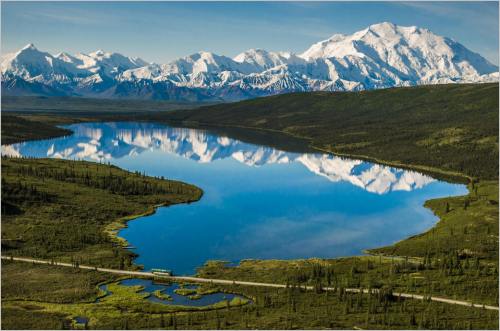 An image from Denali National Park & Preserve
.
.
Click the link below for images:
.
__________________________________________
March 25, 2022
Mohenjo
Business, Enthralling, Human Interest, Photographs
amazon, business, Business News, current-events, Future, Hotels, human-rights, medicine, mental-health, research, Science, Science News, technology, Technology News, travel, vacation
Click the link below the picture
.
Poland, officially the Republic of Poland, is a country in Central Europe. It is divided into 16 administrative provinces called voivodeships, covering an area of 312,696 km2 (120,733 sq mi). Poland has a population of over 38 million and is the fifth-most populous member state of the European Union. Warsaw is the nation’s capital and largest metropolis, and other major cities include Kraków, Łódź, Wrocław, Poznań, Gdańsk, and Szczecin.
Poland’s territory extends from the Baltic Sea in the north to the Sudeten and Carpathian Mountains in the south. The country is bordered by Lithuania and Russia to the northeast, Belarus and Ukraine to the east, Slovakia and the Czech Republic to the south, and Germany to the west. Poland also shares maritime boundaries with Denmark and Sweden.
The history of human activity on Polish soil spans thousands of years. Throughout the late antiquity period, it became extensively diverse, with various cultures and tribes settling on the vast Central European Plain. However, it was the Polans who dominated the region and gave Poland its name. The establishment of Polish statehood can be traced to 966 when the pagan ruler of a realm coextensive with the territory of present-day Poland embraced Christianity and converted to Catholicism. The Kingdom of Poland was founded in 1025 and in 1569 cemented its longstanding political association with Lithuania by signing the Union of Lublin. The latter led to the forming of the Polish–Lithuanian Commonwealth, one of the largest and most populous nations of 16th and 17th-century Europe, with a uniquely liberal political system that adopted Europe’s first modern constitution, the Constitution of 3 May 1791.
With the end of the prosperous Polish Golden Age, the country was partitioned by neighboring states at the end of the 18th century. It regained its independence in 1918 with the Treaty of Versailles and restored its position as a key player in European politics. In September 1939, the German-Soviet invasion of Poland marked the beginning of World War II, which resulted in the Holocaust and millions of Polish casualties. As a member of the Eastern Bloc, the Polish People’s Republic proclaimed forthwith was a chief signatory of the Warsaw Pact amidst global Cold War tensions. In the wake of the 1989 events, notably through the emergence and contributions of the Solidarity movement, the communist government was dissolved and Poland re-established itself as a democratic republic.
Poland is a developed market, and a middle power; it has the sixth-largest economy in the European Union by nominal GDP and the fifth-largest by GDP (PPP). It provides very high standards of living, safety, and economic freedom, as well as free university education and a universal health care system. The country has 17 UNESCO World Heritage Sites, 15 of which are cultural. Poland is a member state of the United Nations, the World Trade Organization, NATO, and the European Union (including the Schengen Area). Wikipedia
.
 An image from Poland
.
.
Click the link below for images:
.
__________________________________________
March 24, 2022
Mohenjo
Business, Enthralling, Human Interest, Photographs
amazon, business, Business News, current-events, Future, Hotels, human-rights, medicine, mental-health, research, Science, Science News, technology, Technology News, travel, vacation
Click the link below the picture
.
Palma is officially known as Palma de Mallorca 1983–88, 2006–08, 2012–16)is the capital and largest city of the autonomous community of the Balearic Islands in Spain. It is situated on the south coast of Mallorca on the Bay of Palma. The Cabrera Archipelago, though widely separated from Palma proper, is administratively considered part of the municipality. As of 2018, Palma Airport serves over 29 million passengers per year.
Palma was founded as a Roman camp upon the remains of a Talaiotic settlement. The city was subjected to several Vandal raids during the fall of the Western Roman Empire, then reconquered by the Byzantine Empire, then colonized by the Moors (who called it Medina Mayurqa) and, in the 13th century, by James I of Aragon.
After the conquest of Mallorca, the city was loosely incorporated into the province of Tarraconensis by 123 BC; the Romans founded two new cities: Palma on the south of the island, and Pollentia in the northeast – on the site of a Phoenician settlement. Whilst Pollentia acted as a port to Roman cities on the northwestern Mediterranean Sea, Palma was the port used for destinations in Africa, such as Carthage, and Hispania, such as Saguntum, Gades, and Carthago Nova. Though present-day Palma has no significant remains from this period, occasional archaeological finds are made in city center excavations. For example, the remains of the Roman Wall can be seen at Can Bordils, the Municipal Archive, and below it, at the Maimó ben Faraig Center. Wikipedia
.
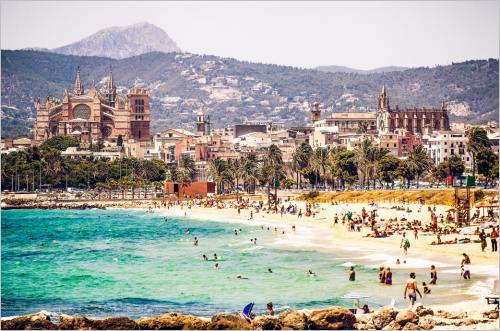 An image from Palma Mallorca
.
.
Click the link below for images:
.
__________________________________________
March 23, 2022
Mohenjo
Business, Enthralling, Human Interest, Photographs
amazon, business, Business News, current-events, Future, Hotels, human-rights, medicine, mental-health, research, Science, Science News, technology, Technology News, travel, vacation
Click the link below the picture
.
Indonesia, officially the Republic of Indonesia, is a country in Southeast Asia and Oceania between the Indian and Pacific oceans. It consists of over 17,000 islands, including Sumatra, Sulawesi, Java, and parts of Borneo and New Guinea. Indonesia is the world’s largest island country and the 14th-largest country by area, at 1,904,569 square kilometers (735,358 square miles). With about 270 million people, Indonesia is the world’s fourth-most populous country and the most populous Muslim-majority country. Java, the world’s most populous island, is home to more than half of the country’s population.
Indonesia is a presidential republic with an elected legislature. It has 34 provinces, of which five have special status. The country’s capital, Jakarta, is the world’s second-most populous urban area. Indonesia shares land borders with Papua New Guinea, East Timor, and the eastern part of Malaysia, as well as maritime borders with Singapore, Vietnam, Thailand, the Philippines, Australia, Palau, and India (Andaman and Nicobar Islands). Despite its large population and densely populated regions, Indonesia has vast areas of wilderness that support one of the world’s highest levels of biodiversity.
The Indonesian archipelago has been a valuable region for trade since at least the 7th century when Srivijaya and later Majapahit traded with entities from mainland China and the Indian subcontinent. Local rulers gradually absorbed foreign influences from the early centuries, and Hindu and Buddhist kingdoms flourished. Sunni traders and Sufi scholars brought Islam, while Christianity was brought mostly through European explorers. Although sometimes interrupted by the Portuguese and the French and British, the Dutch were the foremost colonial power for much of their 350-year presence in the archipelago. The concept of “Indonesia” as a nation-state emerged in the early 20th century, culminating later in the proclamation of Indonesian Independence in 1945. However, it was not until 1949 that the Dutch recognized Indonesia’s sovereignty following an armed and diplomatic conflict between the two.
Indonesia consists of hundreds of distinct native ethnic and linguistic groups. A shared identity has developed with the motto “Bhinneka Tunggal Ika” (“Unity in Diversity” literally, “many, yet one”), defined by a national language, ethnic diversity, religious pluralism within a Muslim-majority population, and a history of colonialism and rebellion against it. The economy of Indonesia is the world’s 16th-largest by nominal GDP and the 7th-largest by PPP. It is a regional power and is considered a middle power in global affairs. The country is a member of several multilateral organizations, including the United Nations, World Trade Organization, G20, and a founding member of the Non-Aligned Movement, Association of Southeast Asian Nations, East Asia Summit, and the Organisation of Islamic Cooperation. Wikipedia
.
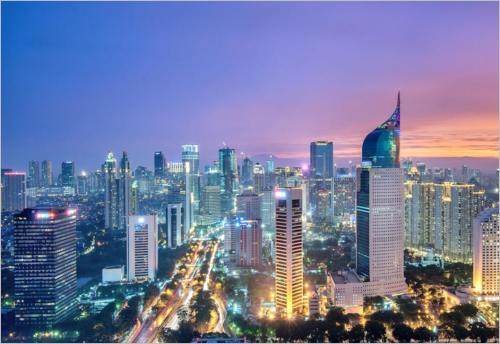 An Image from Indonesia
.
.
Click the link below for images:
.
__________________________________________
March 22, 2022
Mohenjo
Business, Enthralling, Human Interest, Photographs
amazon, business, Business News, current-events, Future, Hotels, human-rights, medicine, mental-health, research, Science, Science News, technology, Technology News, travel, vacation
Click the link below the picture
.
Mallorca, or Majorca, is the largest island in the Balearic Islands, which are part of Spain and located in the Mediterranean.
The capital of the island, Palma, is also the capital of the autonomous community of the Balearic Islands. The Balearic Islands have been an autonomous region of Spain since 1983. There are two small islands off the coast of Mallorca: Cabrera (southeast of Palma) and Dragonera (west of Palma). The anthem of Mallorca is “La Balanguera”.
Like the other Balearic Islands of Menorca, Ibiza, and Formentera, the island is an extremely popular holiday destination, particularly for tourists from Germany and the United Kingdom. The international airport, Palma de Mallorca Airport, is one of the busiest in Spain; it was used by 28 million passengers in 2017, with use increasing every year since 2012.
The name derives from Classical Latin insula maior, “larger island”. Later, in Medieval Latin, this became Maiorca, “the larger one”, in comparison to Menorca, “the smaller one”. This was then hypercorrected to Mallorca by central Catalan scribes, which later came to be accepted as the standard spelling.
Mallorca’s origin dates back to over 150 million years ago when it was apart of peninsula underwater still conjoined to Spain. Colonization according to scientists is hypothesized to have occurred between 1300 and 1000 BC. Mallorca became prevalent in 13th Century when the Moors and the Catalan people engaged in conflict over control of the territory with ultimately the Catalan people taking control. Mallorca was prime location because of its position along the Silk Road trading route. Controlling this territory would present great trading opportunities. Wikipedia
.
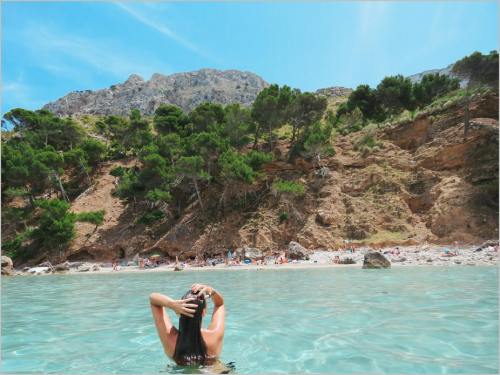 An image from Cala Na Clara Mallorca
.
.
Click the link below for the article:
.
__________________________________________
March 21, 2022
Mohenjo
Business, Enthralling, Human Interest, Photographs
amazon, business, Business News, current-events, Future, Hotels, human-rights, medicine, mental-health, research, Science, Science News, technology, Technology News, travel, vacation
Click the link below the picture
.
Germany, officially the Federal Republic of Germany, is a country in Central Europe. It is the second-most populous country in Europe after Russia and the most populous member state of the European Union. Germany is situated between the Baltic and North seas to the north, and the Alps to the south; it covers an area of 357,022 square kilometers (137,847 sq mi), with a population of over 83 million within its 16 constituent states. Germany borders Denmark to the north, Poland and the Czech Republic to the east, Austria and Switzerland to the south, and France, Luxembourg, Belgium, and the Netherlands to the west. The nation’s capital and largest city is Berlin, and its financial center is Frankfurt; the largest urban area is the Ruhr.
Various Germanic tribes have inhabited the northern parts of modern Germany since classical antiquity. A region named Germania was documented before AD 100. In the 10th century, German territories formed a central part of the Holy Roman Empire. During the 16th century, northern German regions became the center of the Protestant Reformation. Following the Napoleonic Wars and the dissolution of the Holy Roman Empire in 1806, the German Confederation was formed in 1815. In 1871, Germany became a nation-state when most of the German states unified into the Prussian-dominated German Empire. After World War I and the German Revolution of 1918–1919, the Empire was replaced by the semi-presidential Weimar Republic.
The Nazi seizure of power in 1933 led to the establishment of a dictatorship, World War II, and the Holocaust. After the end of World War II in Europe and a period of Allied occupation, Germany was divided into the Federal Republic of Germany, generally known as West Germany, and the German Democratic Republic, East Germany. The Federal Republic of Germany was a founding member of the European Economic Community and the European Union, while the German Democratic Republic was a communist Eastern Bloc state and member of the Warsaw Pact. After the fall of communism, German reunification saw the former East German states join the Federal Republic of Germany on 3 October 1990—becoming a federal parliamentary republic.
Germany is a great power with a strong economy; it has the largest economy in Europe, the world’s fourth-largest economy by nominal GDP, and the fifth-largest by PPP. As a global leader in several industrial, scientific and technological sectors, it is both the world’s third-largest exporter and importer of goods. As a developed country, which ranks very high on the Human Development Index, it offers social security and a universal health care system, environmental protections, and a tuition-free university education. Germany is a member of the United Nations, NATO, the G7, the G20, and the OECD. It has the third-greatest number of UNESCO World Heritage Sites. Wikipedia
.
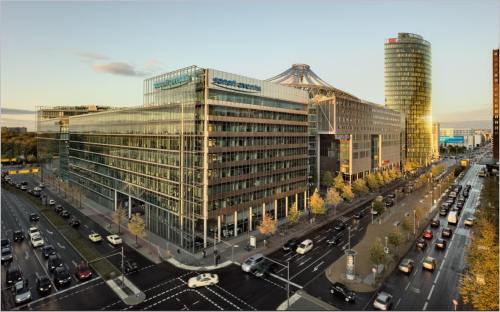 An image from Modern Germany
.
.
Click the link below for images:
.
__________________________________________
March 19, 2022
Mohenjo
Business, Enthralling, Human Interest, Photographs
amazon, business, Business News, current-events, Future, Hotels, human-rights, medicine, mental-health, research, Science, Science News, technology, Technology News, travel, vacation
Click the link below the picture
.
Wulingyuan is a scenic and historical site in the Wulingyuan District of South Central China’s Hunan Province. It was inscribed as a UNESCO World Heritage Site in 1992. It is noted for more than 3,000 quartzite sandstone pillars and peaks across most of the site, many over 200 meters (660 ft) in height, along with many ravines and gorges with picturesque streams, pools, lakes, rivers, and waterfalls. It features 40 caves, many with large calcite deposits, and a natural bridge named Tianqiashengkong (meaning ‘bridge across the sky’), which is one of the highest natural bridges in the world. The site also provides habitat for many vulnerable species, including the dhole, Asiatic black bear, and Chinese water deer.
The site is situated in Zhangjiajie City and lies about 270 kilometers (170 mi) to the northwest of Changsha, the capital of Hunan Province. The park covers an area of 690 square kilometers (266 square miles). Wulingyuan forms part of the Wuling Mountain Range. The scenic area consists of four national parks, which are the Zhangjiajie National Forest Park, Suoxi Valley Nature Reserve, Tianzi Mountain Nature Reserve, and the recently added Yangjiajie Scenic Area. Overall there are over 560 attraction sights to view.
The quartzite sandstone pillars and the surrounding regions were formed during the Devonian period (400 to 350 million years ago) from a combination of tectonic uplift and water erosion. The highest area in the park is Huang Shi Zhai (黃石寨). It reaches a height of 3,450 feet (1,050 m) and is accessible via cable car or a set of stairs. Wikipedia
.
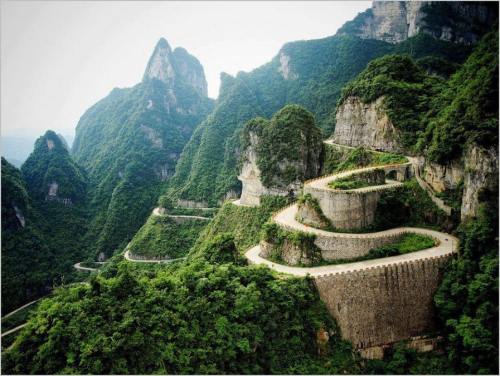 An image from Wulingyuan
.
.
Click the link below for images:
.
__________________________________________
March 18, 2022
Mohenjo
Business, Enthralling, Human Interest, Photographs
amazon, business, Business News, current-events, Future, Hotels, human-rights, medicine, mental-health, research, Science, Science News, technology, Technology News, travel, vacation
Click the link below the picture
.
Croatia, officially the Republic of Croatia is a country at the crossroads of Central and Southeast Europe. It shares a coastline along the Adriatic Sea and borders Slovenia to the northwest, Hungary to the northeast, Serbia to the east, Bosnia and Herzegovina and Montenegro to the southeast, and shares a maritime border with Italy to the west and southwest. Croatia’s capital and largest city, Zagreb, forms one of the country’s primary subdivisions, with twenty counties. The country spans an area of 56,594 square kilometers (21,851 square miles), with a population of nearly 3.9 million.
The Croats arrived in the 6th century and organized the territory into two duchies by the 9th century. Croatia was first internationally recognized as independent on 7 June 879 during the reign of Duke Branimir. Tomislav became the first king by 925, elevating Croatia to the status of a kingdom. During the succession crisis after the Trpimirović dynasty ended, Croatia entered a personal union with Hungary in 1102. In 1527, faced with Ottoman conquest, the Croatian Parliament elected Ferdinand I of Austria to the Croatian throne. In October 1918, the State of Slovenes, Croats, and Serbs, independent from Austria-Hungary, was proclaimed in Zagreb, and in December 1918, merged into the Kingdom of Yugoslavia. Following the Axis invasion of Yugoslavia in April 1941, most of Croatia was incorporated into a Nazi-installed puppet state, the Independent State of Croatia, which committed genocide against Serbs, Jews, and Roma. A resistance movement led to the creation of the Socialist Republic of Croatia, which after the war became a founding member and constituent of the Socialist Federal Republic of Yugoslavia. On 25 June 1991, Croatia declared independence, and the War of Independence was fought for four years following the declaration.
A sovereign state, Croatia is a republic governed under a parliamentary system. It is a member of the European Union, the United Nations, the Council of Europe, NATO, the World Trade Organization, and a founding member of the Union for the Mediterranean. An active participant in United Nations peacekeeping, Croatia has contributed troops to the International Security Assistance Force and took a nonpermanent seat on the United Nations Security Council for the 2008–2009 term. Since 2000, the Croatian government has invested in infrastructure, especially transport routes and facilities along the Pan-European corridors.
Croatia is classified by the World Bank as a high-income economy and ranks very high on the Human Development Index. Service, industrial sectors, and agriculture dominate the economy, respectively. Tourism is a significant source of revenue, with Croatia ranked among the 20 most popular tourist destinations. The state controls a part of the economy, with substantial government expenditure. The European Union is Croatia’s most important trading partner. Croatia provides social security, universal health care, and tuition-free primary and secondary education while supporting culture through public institutions and corporate investments in media and publishing. Wikipedia
.
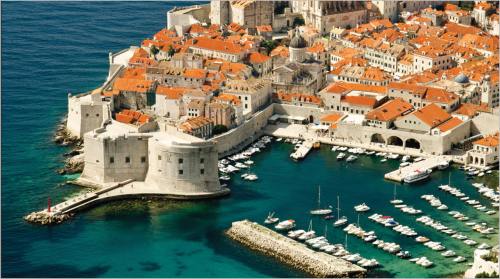 An image from Croatia
.
.
Click the link below for images:
.
__________________________________________
March 17, 2022
Mohenjo
Business, Enthralling, Human Interest, Photographs
amazon, business, Business News, current-events, Future, Hotels, human-rights, medicine, mental-health, research, Science, Science News, technology, Technology News, travel, vacation
Click the link below the picture
.
Grand Teton National Park is an American national park in northwestern Wyoming. At approximately 310,000 acres (1,300 km2), the park includes the major peaks of the 40-mile-long (64 km) Teton Range as well as most of the northern sections of the valley known as Jackson Hole. Grand Teton National Park is only 10 miles (16 km) south of Yellowstone National Park, to which it is connected by the National Park Service–managed John D. Rockefeller Jr. Memorial Parkway. Along with surrounding national forests, these three protected areas constitute the almost 18-million-acre (73,000-square-kilometer) Greater Yellowstone Ecosystem, one of the world’s largest intact mid-latitude temperate ecosystems.
The human history of the Grand Teton region dates back at least 11,000 years when the first nomadic hunter-gatherer Paleo-Indians began migrating into the region during warmer months pursuing food and supplies. In the early 19th century, the first white explorers encountered the eastern Shoshone natives. Between 1810 and 1840, the region attracted fur trading companies that vied for control of the lucrative beaver pelt trade. U.S. Government expeditions to the region commenced in the mid-19th century as an offshoot of exploration in Yellowstone, with the first permanent white settlers in Jackson Hole arriving in the 1880s.
Efforts to preserve the region as a national park began in the late 19th century, and in 1929 Grand Teton National Park was established, protecting the Teton Range’s major peaks. The valley of Jackson Hole remained in private ownership until the 1930s when conservationists led by John D. Rockefeller Jr. began purchasing land in Jackson Hole to be added to the existing national park. Against public opinion and with repeated Congressional efforts to repeal the measures, much of Jackson Hole was set aside for protection as Jackson Hole National Monument in 1943. The monument was abolished in 1950 and most of the monument land was added to Grand Teton National Park.
Grand Teton National Park is named for Grand Teton, the tallest mountain in the Teton Range. The naming of the mountains is attributed to early 19th-century French-speaking trappers—les trois tétons (the three teats) was later anglicized and shortened to Tetons. At 13,775 feet (4,199 m), Grand Teton abruptly rises more than 7,000 feet (2,100 m) above Jackson Hole, almost 850 feet (260 m) higher than Mount Owen, the second-highest summit in the range. The park has numerous lakes, including 15-mile-long (24 km) Jackson Lake as well as streams of varying length and the upper main stem of the Snake River. Though in a state of recession, a dozen small glaciers persist at the higher elevations near the highest peaks in the range. Some of the rocks in the park are the oldest found in any American national park and have been dated at nearly 2.7 billion years.
Grand Teton National Park is an almost pristine ecosystem and the same species of flora and fauna that have existed since prehistoric times can still be found there. More than 1,000 species of vascular plants, dozens of species of mammals, 300 species of birds, more than a dozen fish species, and a few species of reptiles and amphibians inhabit the park. Due to various changes in the ecosystem, some of them human-induced, efforts have been made to provide enhanced protection to some species of native fish and the increasingly threatened whitebark pine.
Grand Teton National Park is a popular destination for mountaineering, hiking, fishing, and other forms of recreation. There are more than 1,000 drive-in campsites and over 200 miles (320 km) of hiking trails that provide access to backcountry camping areas. Noted for world-renowned trout fishing, the park is one of the few places to catch Snake River fine-spotted cutthroat trout. Grand Teton has several National Park Service–run visitor centers, and privately operated concessions for motels, lodges, gas stations, and marinas. Wikipedia
.
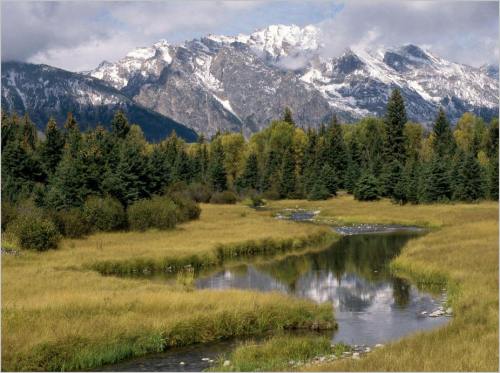 An image from Grand Teton National Park, Wyoming
.
.
Click the link below for images:
.
__________________________________________
Older Entries
Newer Entries
 James' World 2