December 18, 2021
Mohenjo
Business, Enthralling, Human Interest, Photographs
amazon, business, Business News, current-events, Future, Hotels, human-rights, medicine, mental-health, research, Science, Science News, technology, Technology News, travel, vacation

Click the link below the picture
.
The Cabo Blanco Absolute Natural Reserve is a Nature Reserve of Costa Rica, part of the Tempisque Conservation Area in the province of Puntarenas, covering an area of 3,140 acres (12.7 km2) terrestrial and 4,420 acres (17.9 km2) marine on the southern tip of the Nicoya Peninsula near Montezuma-Cabuya and Mal Pais.
The site is home to the San Miguel Biological Station which was developed to promote and support teaching, research, and environmental education and has facilities that include classrooms, laboratories, and a reference library. The reserve was created in 1963 due to a campaign started by Olof Wessberg and was the first major conservation project in the country.
Up to the 1960s the lands that now constitute the Cabo Blanco Nature Reserve were being depleted of their natural forests for use as farm and pasture land. The emphasis in those days was to develop and increase agricultural production and cattle, and little concern was given to conservation of natural habitats.
Olof Wessberg (known as Nicolas) and Karen Mogensen arrived in Costa Rica in the 1960s in the pursuit of Karen’s dream of finding happiness in harmony with nature. They chose to establish themselves in the Nicoya Peninsula.
Soon after establishing themselves in a farm near the Montezuma area, they set up on an expedition to the Cabo Blanco area in search for native tree seeds to reforest their newly acquired farm. Upon arriving to the area, he was amazed at the abundant wildlife and the size of the trees in the area. This was like an oasis in the midst of a desert as all lands around had been devastated to give way to low-yield pasture and agricultural lands. Wikipedia
.
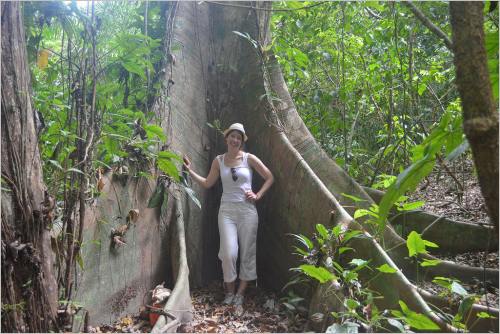 An image from CaboBlanco Absolute Natural Reserve Costa Rica
.
.
Click the link below for images:
.
__________________________________________
December 17, 2021
Mohenjo
Business, Enthralling, Human Interest, Photographs
amazon, business, Business News, current-events, Future, Hotels, human-rights, medicine, mental-health, research, Science, Science News, technology, Technology News, travel, vacation
Click the link below the picture
.
The Casbah (Arabic: قصبة, qaṣba, meaning citadel) is the citadel of Algiers in Algeria and the traditional quarter clustered around it. In 1992, the United Nations Educational, Scientific and Cultural Organization (UNESCO) proclaimed Kasbah of Algiers a World Cultural Heritage site, as “There are the remains of the citadel, old mosques, and Ottoman-style palaces as well as the remains of a traditional urban structure associated with a deep-rooted sense of community.”
More generally, a kasbah is the walled citadel of many North African cities and towns. The name made its way into English from French in the late 19th century (the Oxford English Dictionary states 1895), and can be spelled “kasbah” or “casbah.”
The Casbah of Algiers is founded on the ruins of old Icosium in the 10th century. It was a city built on a hill, stretching towards the sea, divided into the “High city” and the “Low city”. One finds there masonry and mosques dating from the 17th century: Ketchaoua Mosque (built-in 1794 by the Dey Baba Hassan) flanked by two minarets; Djama’a al-Djedid (1660, at the time of the Ottomans) with its large finished ovoid cupola points some and its four cupolas; Djamaâ el Kebir (the oldest of the mosques), built by Almoravid ruler Yusuf ibn Tashfin; and Ali Bitchin Mosque (Raïs, 1623). The Casbah also contained several palaces, including Dar Aziza, Dar Mustapha Pacha, Palace of the Dey, and Dar Hassan Pacha which was built in 1791 to house the Pasha, who lived there for eight years. Wikipedia
.
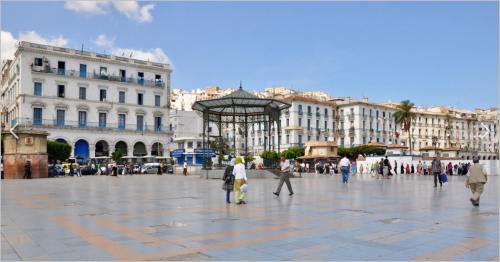 An image from Casbah of Algiers
.
.
Click the link below for images:
.
__________________________________________
December 16, 2021
Mohenjo
Business, Enthralling, Human Interest, Photographs
amazon, business, Business News, current-events, Future, Hotels, human-rights, medicine, mental-health, research, Science, Science News, technology, Technology News, travel, vacation
Click the link below the picture
.
Dugi Otok is the seventh-largest island in the Adriatic Sea, part of Croatia. It is located off the Dalmatian coast, west of Zadar. It is the largest and westernmost of the Zadarian Islands and derives its name from its distinctive shape: it is 44.5 km (27.7 miles) long by 4.8 km (3.0 miles) wide, with an area of 114 square kilometers (44 sq mi). Its elevation reaches 300 m; and many of its higher portions contain stands of Maritime Pine.
The western coast is tall and rugged, and many of the towns are clustered on the eastern side, including Sali, the largest, Zaglav, Žman, Luka, Savar, Brbinj, Dragove, Božava, Soline, Verunić (Verona), and Veli Rat. A nature park, Telašćica, covers the southern part of the island and is adjacent to Kornati Islands National Park. There are six islets and rocks in the Telašćica Bay: Korotan, Galijola, Gozdenjak, Farfarikulac, Gornji Školj and Donji Školj.
The island has been inhabited since prehistoric times, as evidenced by many archeological sites that have still not been fully investigated. The earliest findings date back to Paleolithic, and numerous hillforts and gravesites are evidence of continuous settlement throughout Eneolithic, Bronze Age, and Iron Age.
The Byzantine Emperor Constantine VII in the 10th century mentioned it under the name of Pizuh, and later it was called Insula Tilagus in documents (“pelagos” in Greek means sea), and its Latin name was Insula maior. In the 15th century, it was registered as Veli otok.
The old and main settlement on the island was located in the southern area. It has only been inhabited significantly since the Turkish invasions (15th-16th centuries). Until then the island belonged to Zadar monasteries and citizens. Nowadays there is a total of 11 settlements on the island, and they are all on the north-eastern side of the island concerned primarily with fishing, although salt was once produced here.
The village of Veli Rat is also home to the Veli Rat lighthouse, another spectacular sight. The beautiful island of Dugi Otok, with a Mediterranean climate and ancient Croatian culture, receives very few visitors. Olive oil, figs, cheese, and wine accompany the seafood in the natives’ diet. A definite step back in time, the island boasts an ancient church and some Roman ruins. It is in close proximity to Kornati. Wikipedia
.
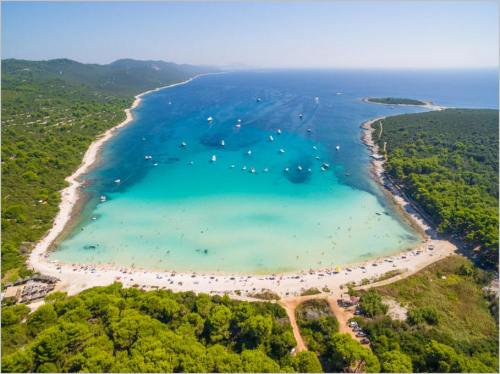 An image from Dugi Otok Croatia
.
.
Click the link below for images:
.
__________________________________________
December 15, 2021
Mohenjo
Business, Enthralling, Human Interest, Photographs
amazon, business, Business News, current-events, Future, Hotels, human-rights, medicine, mental-health, research, Science, Science News, technology, Technology News, travel, vacation
Click the link below the picture
.
The Cathedral Basilica of St. Augustine is a historic cathedral in St. Augustine, Florida, and the seat of the Catholic Bishop of St. Augustine. It is located at 38 Cathedral Place between Charlotte and St. George Streets. Constructed over five years (1793–1797), it was designated a U.S. National Historic Landmark on April 15, 1970. Its congregation, established in 1565, is the oldest Christian congregation in the contiguous United States.
In the mid-1560s, as the Spanish Empire expanded northward from the Caribbean to unexplored Florida, it founded the colony of St. Augustine, which has become the oldest continuously occupied European settlement on the United States mainland. Spanish settlers immediately established a shrine of the Catholic Church, the religion essential to the Spanish monarchy throughout its history. From the mid-1500s to the mid-1600s, the kingdom was undergoing a Catholic Revival in opposition to the Protestant Reformation.
As the early colonists were mostly sailors or soldiers with little expertise in architecture, the first church of St. Augustine was simply designed and rapidly built of disparate materials. The original parish was short-lived, burning to the ground in a 1586 attack on the town by the Englishman Sir Francis Drake. As two decades previously, the colonists hastily built a new church of straw and palmetto, which deteriorated quickly in the humid climate and burned down in 1599.
A tithe was raised in Spain, and in 1605 a third church was built, this time more permanently of timber by experienced architects and builders who had begun to make their way to the New World. For 95 years it stayed intact, though in disrepair, before again burning down in 1702 during a failed English attempt on the city by South Carolina colonist James Moore. Wikipedia
.
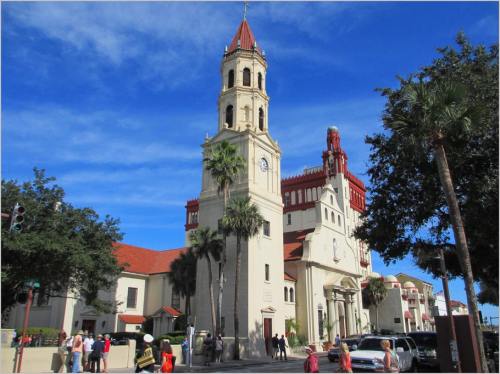 An image of Saint Augustin Basilica
.
.
Click the link below for images:
.
__________________________________________
December 14, 2021
Mohenjo
Business, Enthralling, Human Interest, Photographs
amazon, business, Business News, current-events, Future, Hotels, human-rights, medicine, mental-health, research, Science, Science News, technology, Technology News, travel, vacation
Click the link below the picture
.
Croatia, officially the Republic of Croatia, is a country at the crossroads of Central and Southeast Europe on the Adriatic Sea. Croatia borders Slovenia to the northwest, Hungary to the northeast, Serbia to the east, Bosnia and Herzegovina and Montenegro to the southeast, and shares a maritime border with Italy to the west and southwest. Its capital and largest city, Zagreb, forms one of the country’s primary subdivisions, with twenty counties. Croatia has an area of 56,594 square kilometers (21,851 square miles) and a population of 4.07 million.
The Croats arrived in the 6th century and organized the territory into two duchies by the 9th century. Croatia was first internationally recognized as independent on 7 June 879 during the reign of Duke Branimir. Tomislav became the first king by 925, elevating Croatia to the status of a kingdom. During the succession crisis after the Trpimirović dynasty ended, Croatia entered a personal union with Hungary in 1102. In 1527, faced with Ottoman conquest, the Croatian Parliament elected Ferdinand I of Austria to the Croatian throne. In October 1918, the State of Slovenes, Croats, and Serbs, independent from Austria-Hungary, was proclaimed in Zagreb, and in December 1918, merged into the Kingdom of Yugoslavia. Following the Axis invasion of Yugoslavia in April 1941, most of Croatia was incorporated into a Nazi-installed puppet state, the Independent State of Croatia. A resistance movement led to the creation of the Socialist Republic of Croatia, which after the war became a founding member and constituent of the Socialist Federal Republic of Yugoslavia. On 25 June 1991, Croatia declared independence, and the War of Independence was fought for four years following the declaration.
A sovereign state, Croatia is a republic governed under a parliamentary system. It is a member of the European Union, the United Nations, the Council of Europe, NATO, the World Trade Organization, and a founding member of the Union for the Mediterranean. An active participant in United Nations peacekeeping, Croatia has contributed troops to the International Security Assistance Force and took a nonpermanent seat on the United Nations Security Council for the 2008–2009 term. Since 2000, the Croatian government has invested in infrastructure, especially transport routes and facilities along the Pan-European corridors.
Croatia is classified by the World Bank as a high-income economy and ranks very high on the Human Development Index. Service, industrial sectors, and agriculture dominate the economy, respectively. Tourism is a significant source of revenue, with Croatia ranked among the 20 most popular tourist destinations. The state controls a part of the economy, with substantial government expenditure. The European Union is Croatia’s most important trading partner. Croatia provides social security, universal health care, and tuition-free primary and secondary education while supporting culture through public institutions and corporate investments in media and publishing. Wikipedia
.
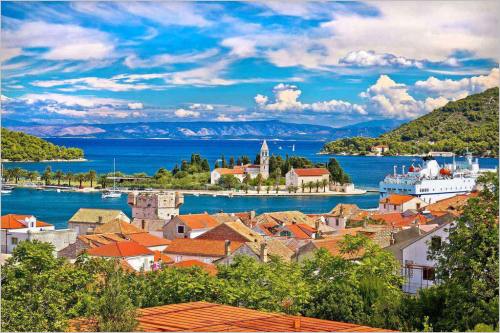 An image of Croatia Coastline
.
.
Click the link below for images:
.
__________________________________________
December 13, 2021
Mohenjo
Business, Enthralling, Human Interest, Photographs
amazon, business, Business News, current-events, Future, Hotels, human-rights, medicine, mental-health, research, Science, Science News, technology, Technology News, travel, vacation
Click the link below the picture
.
Central Kalahari Game Reserve is an extensive national park in the Kalahari Desert of Botswana. Established in 1961 it covers an area of 52,800 square kilometers (20,400 sq mi) (larger than the Netherlands, and almost 10% of Botswana’s total land area), making it the second-largest game reserve in the world.
The Bushmen, or San, have inhabited the lands for thousands of years since they roamed the area as nomadic hunters. However, since the mid-1990s the Botswana government has tried to relocate the Bushmen from the reserve, claiming they were a drain on financial resources despite revenues from tourism. In 1997, three-quarters of the entire San population were relocated from the reserve, and in October 2005 the government had resumed the forced relocation into resettlement camps outside of the park leaving only about 250 permanent occupiers. In 2006 a Botswana court proclaimed the eviction illegal and affirmed the Bushmen’s right to return to living in the reserve. However, as of 2015 most Bushmen are blocked from access to their traditional lands in the reserve. A nationwide ban on hunting made it illegal for the Bushmen to practice their traditional hunter-gatherer lifestyle, despite allowing private game ranches to provide hunting opportunities for tourists.
In 2014 a diamond mine called Ghaghoo operated by Gem Diamonds opened in the southeast portion of the reserve. The company estimated that the mine could yield $4.9 billion worth of diamonds. The Rapaport Diamond Report, a diamond-industry pricing guide, stated, “Ghaghoo’s launch was not without controversy […] given its location on the ancestral land of the Bushmen”.
A huge bush fire in and around the park in the middle of September 2008 burnt around 80 percent of the reserve. The origin of the fire remains unknown.
This park contains wildlife such as giraffe, elephant, white rhinoceros, Cape buffalo, spotted hyena, brown hyena, honey badger, meerkat, yellow mongoose, warthog, cheetah, caracal, Cape wild dog, black-backed jackal, bat-eared fox, cape fox, leopard, lion, wildebeest, zebra, eland, sable antelope, gemsbok, springbok, steenbok, impala, greater kudu, aardvark, cape ground squirrel, cape hare, cape porcupine, chacma baboon, red hartebeest, and ostrich. The land is mostly flat, and gently undulating covered with bush and grasses covering the sand dunes, and areas of larger trees. Many of the river valleys are fossilized with salt pans. Four fossilized rivers meander through the reserve including Deception Valley which began to form around 16,000 years ago. Wikipedia
.
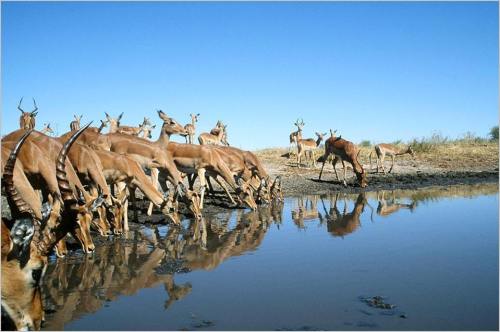 An image from Central Kalahari Game Reserve
.
.
Click the link below for images:
.
__________________________________________
December 11, 2021
Mohenjo
Business, Enthralling, Human Interest, Photographs
amazon, business, Business News, current-events, Future, Hotels, human-rights, medicine, mental-health, research, Science, Science News, technology, Technology News, travel, vacation
Click the link below the picture
.
Torres del Paine National Park is a national park encompassing mountains, glaciers, lakes, and rivers in southern Chilean Patagonia. The Cordillera del Paine is the centerpiece of the park. It lies in a transition area between the Magellanic subpolar forests and the Patagonian Steppes. The park is located 112 km (70 mi) north of Puerto Natales and 312 km (194 mi) north of Punta Arenas. The park borders Bernardo O’Higgins National Park to the west and the Los Glaciares National Park to the north in Argentine territory. Paine means “blue” in the native Tehuelche (Aonikenk) language and is pronounced PIE-nay, while Torres means “towers”.
Torres del Paine National Park is part of the Sistema Nacional de Áreas Silvestres Protegidas del Estado de Chile (National System of Protected Forested Areas of Chile). In 2013, it measured approximately 181,414 hectares (700 sq mi). It is one of the largest and most visited parks in Chile. The park averages around 252,000 visitors a year, of which 54% are foreign tourists, who come from many countries all over the world. It is also part of the End of the World Route, a tourist scenic route.
The park is one of the 11 protected areas of the Magallanes Region and Chilean Antarctica (together with four national parks, three national reserves, and three national monuments). Together, the protected forested areas comprise about 51% of the land of the region (6,728,744 hectares (25,980 sq mi)).
The Torres del Paine are the distinctive three granite peaks of the Paine mountain range or Paine Massif. From left to right they are known as Torres d’Agostini, Torres Central and Torres Monzino. They extend up to 2,500 meters (8,200 ft) above sea level and are joined by the Cuernos del Paine. The area also boasts valleys, rivers such as the Paine, lakes, and glaciers. The well-known lakes include Grey, Pehoé, Nordenskiöld, and Sarmiento. The glaciers, including Grey, Pingo, and Tyndall, belong to the Southern Patagonia Ice Field.
Lady Florence Dixie, in her book published in 1880, gave one of the first descriptions of the area and referred to the three towers as Cleopatra’s Needles. She and her party are sometimes credited as being the first “foreign tourists” to visit the area that is now called Torres del Paine National Park. Wikipedia
.
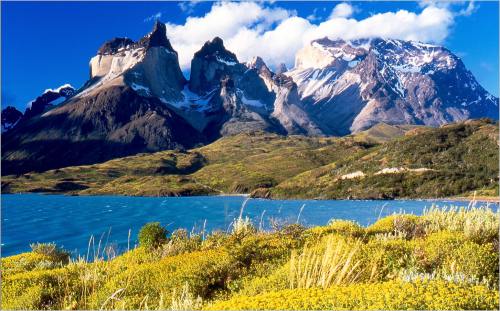 An image from Torres Del Paine National Park
.
.
Click the link below for images:
.
__________________________________________
December 10, 2021
Mohenjo
Business, Enthralling, Human Interest, Photographs
amazon, business, Business News, current-events, Future, Hotels, human-rights, medicine, mental-health, research, Science, Science News, technology, Technology News, travel, vacation
Click the link below the picture
.
Lafayette is a city in and the county seat of Tippecanoe County, Indiana, United States, located 63 miles (101 km) northwest of Indianapolis and 125 miles (201 km) southeast of Chicago. West Lafayette, on the other side of the Wabash River, is home to Purdue University, which contributes significantly to both communities. Together, Lafayette and West Lafayette form the core of the Lafayette, Indiana Metropolitan Statistical Area.
According to the 2010 United States Census, the population of Lafayette was 67,140, a 19% increase from 56,397 in 2000. Meanwhile, the 2010 Census pegged the year-round (excluding Purdue University students) population of West Lafayette at 29,596 and the Tippecanoe County population at 172,780.
Lafayette was founded in 1825 on the southeast bank of the Wabash River near where the river becomes impassable for riverboats upstream, though a French fort and trading post had existed since 1717 on the opposite bank and three miles downstream. It was named for the French general Marquis de Lafayette, a revolutionary war hero.
When European explorers arrived at this area, it was inhabited by a tribe of Miami Indians known as the Ouiatenon or Weas. In 1717, the French government established Fort Ouiatenon across the Wabash River and three miles (5 km) south of present-day Lafayette. The fort became the center of trade for fur trappers, merchants, and Indians. An annual reenactment and festival known as Feast of the Hunters’ Moon is held there each autumn.
The town of Lafayette was platted in May 1825 by William Digby, a trader. It was designated as the county seat of the newly formed Tippecanoe County the following year. Like many frontier towns, Lafayette was named for General Lafayette, a French officer who significantly aided George Washington’s Continental Army during the American Revolutionary War. Lafayette toured the United States in 1824 and 1825.
.
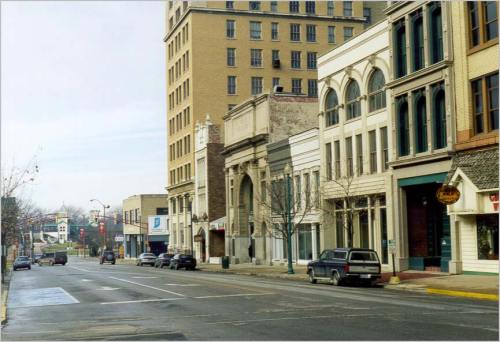 An image from
.
.
Click the link below for images:
.
__________________________________________
December 9, 2021
Mohenjo
Business, Enthralling, Human Interest, Photographs
amazon, business, Business News, current-events, Future, Hotels, human-rights, medicine, mental-health, research, Science, Science News, technology, Technology News, travel, vacation
Click the link below the picture
.
Devil’s Bridge is a term applied to dozens of ancient bridges, found primarily in Europe. Most of these bridges are stone or masonry arch bridges and represent a significant technological achievement in ancient architecture. Due to their unusual design, they were an object of fascination and stories in antiquity and medieval Europe.
Each of the Devil’s bridges typically has a corresponding Devil-related myth or folktale regarding its origin. These stories vary widely depending on the region and beliefs. Some have the Devil as the builder of the bridge, relating to the precariousness or impossibility of such a bridge to last or exist in the first place, so much so that only the Devil himself could have built it. Others have the knowledge to build such bridges given to mankind as a gift from the Devil as part of a deal, pact or bargain between the Devil and local populace, usually in exchange for their souls.
The bridges that fall into the Devil’s Bridge category are so numerous that the legends about them form a special category in the Aarne-Thompson classification system for folktales (Number 1191). Some legends have elements of related folktale categories, for example Deceiving the Devil (AT #1196), The Devil’s Contract (AT #756B), and The Master Builder legends.
One version of the tale presents the bridge builder and the Devil as adversaries. This reflects the fact that frequently, such as in the case of the Teufelsbrücke at the St Gotthard Pass, these bridges were built under such challenging conditions that successful completion of the bridge required a heroic effort on the part of the builders and the community, ensuring its legendary status.
Other versions of the legend feature an old lady or a simple herder who makes a pact with the Devil. In this version, the devil agrees to build the bridge, and in return, he will receive the first soul to cross it. After building the bridge (often overnight) the devil is outwitted by his adversary, for example by throwing bread to lure a dog over the bridge first, and is last seen descending into the water, bringing peace to the community.
.
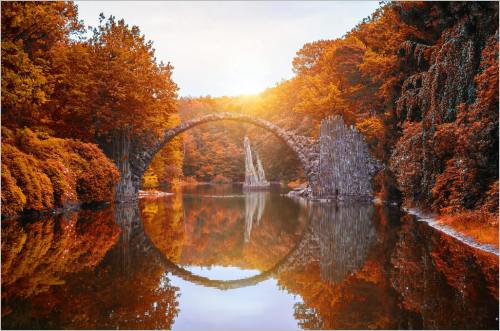 An image of the Arch Bridge (Rakotzbrucke or Devils Bridge) in Kromlau, Germany
.
.
Click the link below for images:
.
__________________________________________
December 8, 2021
Mohenjo
Business, Enthralling, Human Interest, Photographs
amazon, business, Business News, current-events, Future, Hotels, human-rights, medicine, mental-health, research, Science, Science News, technology, Technology News, travel, vacation
Click the link below the picture
.
Uluṟu-Kata Tjuṯa National Park is a protected area in the Northern Territory of Australia. The park is home to both Uluru and Kata Tjuta. It is located 1,943 kilometers (1,207 mi) south of Darwin by road and 440 kilometers (270 mi) southwest of Alice Springs along the Stuart and Lasseter Highways. The park covers 1,326 square kilometers (512 sq mi) and includes the features it is named after Uluru and, 40 kilometers (25 mi) to its west, Kata Tjuta. The location is listed as a UNESCO World Heritage Site for natural and cultural landscape.
Uluru is recognized as “Australia’s most natural icon” and has become a focal point for Australia and the world’s acknowledgment of Australian indigenous culture. The sandstone monolith stands 348 meters (1,142 ft) high with most of its bulk below the ground. To Anangu (local indigenous people), Uluru is a place name, and this “Rock” has a number of different landmarks where many ancestral beings have interacted with the landscape and/or each other, some even believed to still reside here. Kata Tjuta, meaning ‘many heads’, is a sacred place relating to knowledge that is considered very powerful and dangerous, only suitable for initiated men. It is made up of a group of 36 conglomerate rock domes that date back 500 million years.
Anangu are the traditional Aboriginal owners of Uluru-Kata Tjuta National Park. They believe that their culture was created at the beginning of time by ancestral beings. Uluru and Kata Tjuta provide physical evidence of feats performed during the creation period. They often lead walking tours to inform visitors about the local flora and fauna, bush foods, and the Aboriginal Dreamtime stories of the area.
.
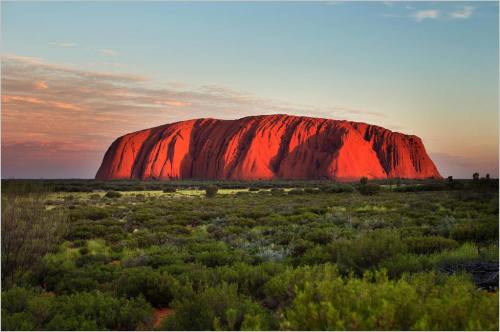 An image from Uluru-Kata Tjuta National Park Australia
.
.
Click the link below for images:
.
__________________________________________
Older Entries
Newer Entries
 James' World 2