January 11, 2022
Mohenjo
Business, Enthralling, Human Interest, Photographs
amazon, business, Business News, current-events, Future, Hotels, human-rights, medicine, mental-health, research, Science, Science News, technology, Technology News, travel, vacation

Click the link below the picture
.
Royal Natal National Park is an 80.94-square-kilometer (31.25 sq mi) park in KwaZulu-Natal province, South Africa, and forms part of the uKhahlamba Drakensberg Park World Heritage Site. Notwithstanding the name, it is actually not a South African National Park managed by the SANParks, but rather a Provincial Park managed by Ezemvelo KZN Wildlife. This park is now included in the Maloti-Drakensberg Transfrontier Conservation Area Peace Park.
The Drakensberg Mountains were once the hunting ground of the San people (bushmen). Though the San no longer live in the area, they recorded their exploits in the form of remarkable rock paintings.
The main features of the park are the Drakensberg Amphitheatre, a rock wall 5 kilometers (3.1 mi) long by up to 1,200 meters (3,900 ft) high, Mont-Aux-Sources peak where the Orange and Tugela rivers have their source, and the 948-meter (3,110 ft) Tugela Falls, the world’s second-highest waterfall. A distinctive rock feature and popular hiking destination in the park is the so-called “Policeman’s Helmet”. Wikipedia
.
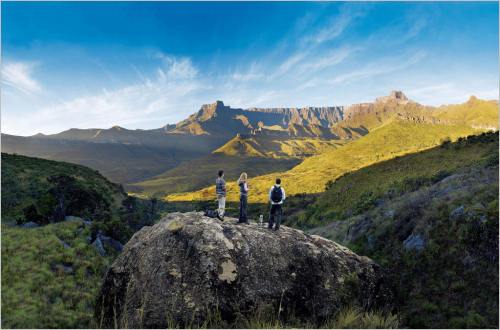 An image from Royal Natal National Park
.
.
Click the link below for images:
.
__________________________________________
January 10, 2022
Mohenjo
Business, Enthralling, Human Interest, Photographs
amazon, business, Business News, current-events, Future, Hotels, human-rights, medicine, mental-health, research, Science, Science News, technology, Technology News, travel, vacation
Click the link below the picture
.
The king penguin is the second largest species of penguin, smaller, but somewhat similar in appearance to the emperor penguin. There are two subspecies: A. p. patagonicus and A. p. halli; patagonicus is found in the South Atlantic and halli in the South Indian Ocean (at the Kerguelen Islands, Crozet Island, Prince Edward Islands, and Heard Island and McDonald Islands) and at Macquarie Island.
King penguins mainly eat lanternfish, squid, and krill. On foraging trips, king penguins repeatedly dive to over 100 meters (300 ft) and have been recorded at depths greater than 300 meters (1,000 ft). Predators of the king penguin include giant petrels, skuas, the snowy sheathbill, the leopard seal, and the orca.
King penguins breed on the Subantarctic islands at the northern reaches of Antarctica, South Georgia, and other temperate islands of the region.
The king penguin stands at 70 to 100 cm (28 to 39 in) tall and weighs from 9.3 to 18 kg (21 to 40 lb). Although female and male king penguins are monomorphic they can be separated by their calls. Males are also slightly larger than females. The mean body mass of adults from Marion Island was 12.4 kg (27 lb) for 70 males and 11.1 kg (24 lb) for 71 females. Another study from Marion Island found that the mean mass of 33 adults feeding chicks was 13.1 kg (29 lb). The king penguin is approximately 25% shorter and weighs around 1/3rd less than the emperor penguin.
At first glance, the king penguin appears very similar to the larger, closely related emperor penguin, with a broad cheek patch contrasting with surrounding dark feathers and yellow-orange plumage at the top of the chest. However, the cheek patch of the adult king penguin is a solid bright orange whereas that of the emperor penguin is yellow and white, and the upper chest tends to be more orange and less yellowish in the king species. Both have colorful markings along the side of their lower mandible, but these tend towards pink in emperor penguins and orange in king penguins. Emperor and king penguins typically do not inhabit the same areas in the wild, with the possible exception of vagrants at sea, but the two can readily be distinguished from one another by the king’s longer, straighter bill, larger flippers, and noticeably sleeker body. The juvenile king penguin with its long bill and heavy dark brown down are completely different in appearance from the mostly grey emperor chick with its distinctive black and white mask. Once molted of its brown juvenile plumage, the king chick resembles the adult but is somewhat less colorful.
king penguins often breed on the same large, circumpolar islands as at least half of all living penguins, but it is easily distinguished from other species by its much larger size and taller frame, distinctive colorful markings, and grizzled sooty-greyish rather than blackish back. Wikipedia
.
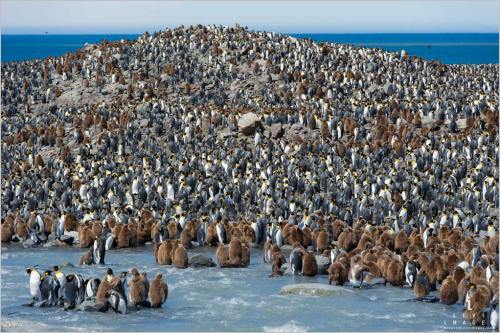 An image of a King Penguin Colony South Georgia Island
.
.
Click the link below for images:
.
__________________________________________
January 7, 2022
Mohenjo
Business, Enthralling, Human Interest, Photographs
amazon, business, Business News, current-events, Future, Hotels, human-rights, medicine, mental-health, research, Science, Science News, technology, Technology News, travel, vacation
Click the link below the picture
.
The Paraná River is a river in south Central South America, running through Brazil, Paraguay, and Argentina for some 4,880 kilometers (3,030 mi). It is second in length only to the Amazon River among South American rivers. It merges with the Paraguay River and then farther downstream with the Uruguay River to form the Río de la Plata and empties into the Atlantic Ocean.
The first European to go up the Paraná River was the Venetian explorer Sebastian Cabot, in 1526, while working for Spain.
In 2021 a drought has hit the river causing a 77-year low.
In eastern South America there is “an immense number of river names containing the element para- or parana-“, from Guarani language words meaning “river” or “sea”; attempts to derive a more precise meaning for the name of this, the largest of them, e.g. “kin of the sea”, have been discounted.
The course is formed at the confluence of the Paranaiba and Rio Grande rivers in southern Brazil. From the confluence, the river flows in a generally southwestern direction for about 619 km (385 mi) before encountering the city of Saltos del Guaira, Paraguay. This was once the location of the Guaíra Falls (Sete Quedas waterfalls, where the Paraná fell over a series of seven cascades. This natural feature was said to rival the world-famous Iguazu Falls to the south. The falls were flooded, however, by the construction of the Itaipu Dam, which began operating in 1984.
For approximately the next 200 km (120 mi) the Paraná flows southward and forms a natural boundary between Paraguay and Brazil until the confluence with the Iguazu River. Shortly upstream from this confluence, however, the river is dammed by the Itaipu Dam, the second-largest hydroelectric power plant in the world (following the Three Gorges Dam in the People’s Republic of China), and creating a massive, shallow reservoir behind it. Wikipedia
.
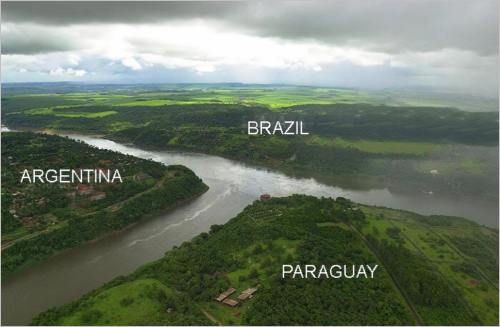 An image of the Parana River
.
.
Click the link below for images:
.
__________________________________________
January 6, 2022
Mohenjo
Business, Enthralling, Human Interest, Photographs
amazon, business, Business News, current-events, Future, Hotels, human-rights, medicine, mental-health, research, Science, Science News, technology, Technology News, travel, vacation
Click the link below the picture
.
Fernando de Noronha (Brazilian Portuguese: [feʁˈnɐ̃du d(ʒ)i noˈɾoɲɐ]) is an archipelago in the Atlantic Ocean, part of the State of Pernambuco, Brazil, and located 354 km (220 mi) offshore from the Brazilian coast. It consists of 21 islands and islets, extending over an area of 26 km2 (10 sq mi). Only the eponymous main island is inhabited; it has an area of 18.4 km2 (7.1 sq mi) and a population estimated at 3,101 in 2020.
The islands are administratively unique in Brazil. They form a “state district” (Portuguese: distrito estadual) that is administered directly by the government of the state of Pernambuco (despite being closer to the state of Rio Grande do Norte). The state district’s jurisdiction also includes the very remote Saint Peter and Saint Paul Archipelago, located 625 km (388 mi) northeast of Fernando de Noronha. 70% of the islands’ area was established in 1988 as a national marine park.
In 2001, UNESCO designated it as a World Heritage Site because of its importance as a feeding ground for tuna, sharks, turtles, and marine mammals. Its time zone is UTC−02:00 all year round.
Fernando de Noronha’s occupation dates to the early 16th century. Due to its geographical position, the archipelago was one of the first lands sighted in the New World, being shown in a nautical chart in 1500 by the Spanish cartographer Juan de La Cosa, and in 1502 by the Portuguese Alberto Cantino, in the latter with the name “Quaresma”.
Based on the written record, Fernando de Noronha island was discovered on August 10, 1503, by a Portuguese expedition, organized and financed by a private commercial consortium headed by the Lisbon merchant Fernão de Loronha. The expedition was under the overall command of captain Gonçalo Coelho and carried the Italian adventurer Amerigo Vespucci aboard, who wrote an account of it. The flagship of the expedition hit a reef and foundered near the island, and the crew and contents had to be salvaged. On Coelho’s orders, Vespucci anchored at the island, and spent a week there, while the rest of the Coelho fleet went on south. In his letter to Soderini, Vespucci describes the uninhabited island and reports its name as the “island of St. Lawrence” (August 10 is the feast day of St. Lawrence; it was a custom of Portuguese explorations to name locations by the liturgical calendar). Wikipedia
.
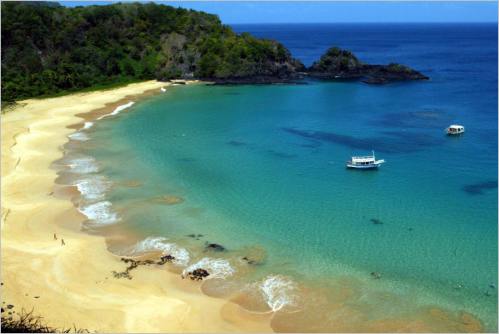 An image from Fernando de Noronha
.
.
Click the link below for images:
.
__________________________________________
January 5, 2022
Mohenjo
Business, Enthralling, Human Interest, Photographs
amazon, business, Business News, current-events, Future, Hotels, human-rights, medicine, mental-health, research, Science, Science News, technology, Technology News, travel, vacation
Click the link below the picture
.
Cape Le Grand National Park is a national park in Western Australia, 631 km (392 mi) south-east of Perth and 56 km (35 mi) east of Esperance. The park covers an area of 31,801 hectares (78,580 acres) The area is an ancient landscape which has been above sea level for well over 200 million years and remained unglaciated. As a result, the area is home to many primitive relict species. Established in 1966, the park is managed by the Department of Parks and Wildlife. The name Le Grand is from one of the officers on L’Espérance, one of the ships in the 1792 expedition of Bruni d’Entrecasteaux.
The largely granite shoreline and white sand beaches are picturesque features of the area. The park is used for fishing, off-roading, tourism, and hiking. Beaches within the Park include those at Lucky Bay, Rossiter Bay, Hellfire Bay, Le Grand Beach, and Thistle Cove. The islands and waters to the south of the park are known as the Recherche Archipelago Nature Reserve, another protected area of the Recherche Archipelago and nearby coastal regions. The Cape Arid National Park is located to the east. The southwest section of the Park is dominated by rock outcrops of gneiss and granite. These form a distinctive chain of peaks including Mount Le Grand (345 m), Frenchman Peak (262 m), and Mississippi Hill (180 m, named after the Mississippi, a French whaler). Further inland, the park comprises mostly heath-covered sandplain, interspersed with swamps and pools of fresh water.
The sandplains support dense stands of banksias (Banksia speciosa and Banksia pulchella).
Other flora that can be found around the park include Melaleucas, Grevilleas, sheoaks, Christmas trees, and grass trees. Wildflower blooms peak in the austral spring, lasting until October, and species such as blue china orchid Cyanicula gemmata, Diuris corymbosa, Hakea laurina, Thysanotus sparteus, and Thelymitra macrophylla are represented within the park.
Fauna that are commonly found within the park include bandicoots, pygmy honey possums, ring-tailed possums, quenda, and western grey kangaroos. Some of the relict species with gondwanan links that are found within the park include legless lizards, like the common scaly-foot Pygopus lepidopodus, and Delma fraseri, Delma australis, and Aprasia striolata. The ancient, although non-gondwanan, blind snake Ramphotyphlops australis is also found within the park. Endemic frogs found within the area include the |quacking frog Crinia georgiana, the banjo frog Limnodynastes dorsalis, and the humming frog Neobatrachus pelobatoides. Wikipedia
.
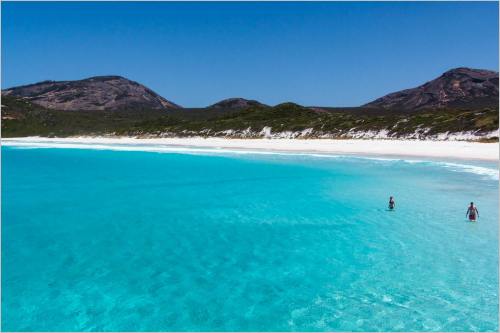 An image from Cape Le Grand National Park
.
.
Click the link below for images:
.
__________________________________________
January 4, 2022
Mohenjo
Business, Enthralling, Human Interest, Photographs
amazon, business, Business News, current-events, Future, Hotels, human-rights, medicine, mental-health, research, Science, Science News, technology, Technology News, travel, vacation
Click the link below the picture
.
Chobe National Park is Botswana’s first national park, and also the most biologically diverse. Located in the north of the country, it is Botswana’s third-largest park, after Central Kalahari Game Reserve and Gemsbok National Park, and has one of the greatest concentrations of game in all of Africa.
This park is noted for having a population of lions which prey on elephants, mostly calves or juveniles, but also subadults.
The original inhabitants of this area were the San bushmen (also known as the Basarwa people in Botswana). They were nomadic hunter-gatherers who were constantly moving from place to place to find food sources, namely fruits, water, and wild animals. Nowadays one can find San paintings inside rocky hills of the park.
At the beginning of the 20th century, the region that would become Botswana was divided into different land tenure systems. At that time, a major part of the park’s area was classified as crown land. The idea of a national park to protect the varied wildlife found here as well as promote tourism first appeared in 1931. The following year, 24,000 km2 (9,300 sq mi) around Chobe district were officially declared non-hunting area; this area was expanded to 31,600 km2 (12,200 sq mi) two years later.
In 1943, heavy tsetse infestations occurred throughout the region, delaying the creation of the national park. By 1953, the project received governmental attention again: 21,000 km2 (8,100 sq mi) were suggested to become a game reserve. Chobe Game Reserve was officially created in 1960, though smaller than initially desired. In 1967, the reserve was declared a national park.
At that time there were several industrial settlements in the region, especially at Serondela, where the timber industry proliferated. These settlements were gradually moved out of the park, and it was not until 1975 that the whole protected area was exempt from human activity. Nowadays traces of the prior timber industry are still visible at Serondela. Minor expansions of the park took place in 1980 and 1987. Wikipedia
.
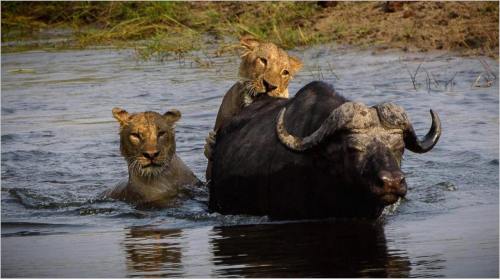 An image from Chobe National Park
.
.
Click the link below for images:
.
__________________________________________
January 3, 2022
Mohenjo
Business, Enthralling, Human Interest, Photographs
amazon, business, Business News, current-events, Future, Hotels, human-rights, medicine, mental-health, research, Science, Science News, technology, Technology News, travel, vacation
Click the link below the picture
.
The Eduardo Avaroa Andean Fauna National Reserve (Reserva Nacional de Fauna Andina Eduardo Avaroa; Spanish acronym: REA) is located in Sur Lípez Province. Situated in the far southwestern region of Bolivia, it is the country’s most visited protected area. It is considered the most important protected area in terms of tourist influx in the Potosí Department.
Located at an altitude between 4,200 m (13,800 ft) and 5,400 m (17,700 ft) in Bolivia, it extends over an area of 714,745 hectares (1,766,170 acres) and includes the Laguna Colorada National Wildlife Sanctuary. Categorized under IUCN Category IV, it is primarily for the protection of birds that inhabit the different lagoons in the reserve. The reserve protects part of the Central Andean dry puna (oligothermic) ecoregion. The reserve’s major attractions are erupting volcanoes, hot springs, geysers, lakes, fumaroles, mountains, and its three endemic species of flamingos in particular.
Established in 1973, the national park is named after Eduardo Avaroa (1838–1879), the Bolivian war hero of the 19th century. It was created by Supreme Decree (SD) of 13 December 1973 and extended on May 14, 1981. Since 2009, the entire reserve is part of the larger Los Lípez Ramsar site.
The reserve is situated in the southern region of Andean mountains in southwestern Bolivia. The mountains rise to heights varying from 3,500–5,000 m (11,500–16,400 ft). The basin features depict active volcanoes, hot springs, geysers, and fumaroles, and a parallel has been drawn with the Yellowstone National Park in the US. Its water resources are limited to lakes and saltwater lagoons due to very low rainfall of 76 mm (3.0 in) annually. Two communities, Quetena Chico and Quetena Grande lie within the reserve.
Lakes include Laguna Verde, Laguna Colorada, Laguna Salada, Laguna Busch and Laguna Hedionda. Laguna Colorada lies at an altitude of 4,278 m (14,035 ft) and covers 60 km2 (23 sq mi). It is named after the effect of wind and sun on the micro-organism that live in it. The lake is very shallow, less than 1 m (3 ft 3 in) deep, and supports some 40 bird species, providing pink algae to population of rare James’s flamingoes who can walk across it. Wikipedia
.
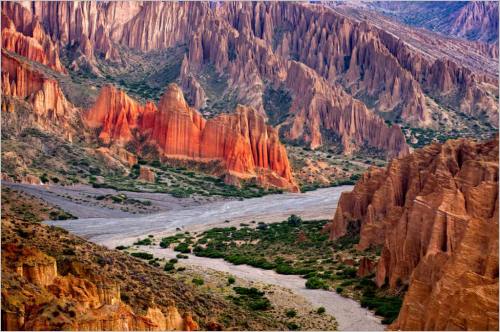 An image from Eduardo Avaroa National Reserve Bolivia
.
.
Click the link below for images:
.
__________________________________________
January 2, 2022
Mohenjo
Business, Enthralling, Human Interest, Photographs
amazon, business, Business News, current-events, Future, Hotels, human-rights, medicine, mental-health, research, Science, Science News, technology, Technology News, travel, vacation
Click the link below the picture
.
Gobustan State Reserve located west of the settlement of Gobustan, about 40 miles (64 km) southwest of the center of Baku was established in 1966 when the region was declared as a national historical landmark of Azerbaijan in an attempt to preserve the ancient carvings, mud volcanoes and gas-stones in the region.
Gobustan State Reserve is very rich in archeological monuments, the reserve has more than 6,000 rock carvings, which depict people, animals, battle-pieces, ritual dances, bullfights, boats with armed oarsmen, warriors with lances in their hands, camel caravans, pictures of sun and stars, on the average dating back to 5,000-20,000 years.
Gobustan State Historical and Cultural Reserve acquired national status in 2006 and were added to the UNESCO World Social Legacy List in 2007.
The rock carvings and petroglyphs at the site display mesmerizing images of prehistoric life in the Caucasus. The well-preserved sketches display ancient populations traveling on reed boats; men hunting antelope and wild bulls, and women dancing. The controversial Norwegian anthropologist Thor Heyerdahl returned many times to Azerbaijan between 1961 and his death in 2002 to study the site in his “Search for Odin”.
The language of the ancient population of Gobustan is disputed, but the petroglyphs still give information about the lives of prehistoric people who lived there. More than 4,000 pictures of animals, humans, natural life experiences, hunting, and dancing were carved over a span of thousands of years. Most of the petroglyphs are on large cliffs, divided among multiple ancient residences, and in some cases, they have been carved over older images. The first carvings depicted natural human and animal figures, often irregularly, but over time they began to more closely resemble the measurements and proportions of their subjects, including such details as the foot muscles of people in hunting scenes. The heads of the human figures tend to be small and carved without noses, mouths, eyes, or ears. However, experts do not interpret this lack of facial features as an indication that the Gobustan artists lacked technical skill, since some of the carvings demonstrate a higher degree of complexity and detail. Many scenes from tribal life are depicted among the petroglyphs, and images from the Seven Beauties cave suggest that women may have participated in hunting.
It’s estimated that 300 of the planet’s estimated 700 mud volcanoes sit in Gobustan, Azerbaijan, and the Caspian Sea. Many geologists as well as locals and international mud tourists trek to such places as the Firuz Crater, Gobustan, Salyan and end up happily covered in mud which is thought to have medicinal qualities. Wikipedia
.
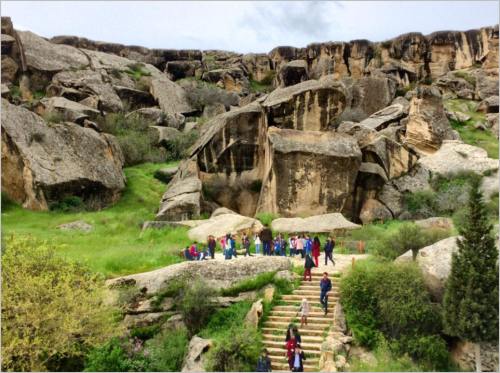 An image from Gobustan National Park
.
.
Click the link below for images:
.
__________________________________________
January 1, 2022
Mohenjo
Business, Enthralling, Human Interest, Photographs
amazon, business, Business News, current-events, Future, Hotels, human-rights, medicine, mental-health, research, Science, Science News, technology, Technology News, travel, vacation
Click the link below the picture
.
The Sámi people are an indigenous Finno-Ugric-speaking people inhabiting the region of Sápmi (formerly known as Lapland), which today encompasses large northern parts of Norway, Sweden, Finland, and of the Murmansk Oblast, Russia, most of the Kola Peninsula in particular. The Sámi have historically been known in English as Lapps or Laplanders, but these terms are regarded as offensive by some Sámi people, who prefer the area’s name in their own languages, e.g. Northern Sami Sápmi. Their traditional languages are the Sámi languages, which are classified as a branch of the Uralic language family.
Traditionally, the Sámi have pursued a variety of livelihoods, including coastal fishing, fur trapping, and sheep herding. Their best-known means of livelihood is semi-nomadic reindeer herding. Currently, about 10% of the Sámi are connected to reindeer herding, which provides them with meat, fur, and transportation. 2,800 Sámi people are actively involved in reindeer herding on a full-time basis in Norway. For traditional, environmental, cultural, and political reasons, reindeer herding is legally reserved for only Sámi people in some regions of the Nordic countries.
Speakers of Northern Sámi refer to themselves as Sámit (the Sámis) or Sápmelaš (of Sámi kin), the word Sápmi being inflected into various grammatical forms. Other Sámi languages use cognate words. As of around 2014, the current consensus among specialists was that the word Sámi was borrowed from the Proto-Baltic word *žēmē, meaning ‘land’ (cognate with Slavic zemlja (земля), of the same meaning).
The word Sámi has at least one cognate word in Finnish: Proto-Baltic *žēmē was also borrowed into Proto-Finnic, as *šämä. This word became modern Finnish Häme (Finnish for the region of Tavastia; the second ä of *šämä is still found in the adjective Hämäläinen). The Finnish word for Finland, Suomi, is also thought probably to derive ultimately from Proto-Baltic *žēmē, though the precise route is debated and proposals usually involve complex processes of borrowing and reborrowing. Suomi and its adjectival form suomalainen must come from *sōme-/sōma-. In one proposal, this Finnish word comes from a Proto-Germanic word *sōma-, itself from Proto-Baltic *sāma-, in turn borrowed from Proto-Finnic *šämä, which was borrowed from *žēmē.
The Sámi institutions — notably the parliaments, radio and TV stations, theatres, etc. — all use the term Sámi, including when addressing outsiders in Norwegian, Swedish, Finnish, or English. In Norwegian and Swedish, the Sámi are today referred to by the localized form Same. Wikipedia
.
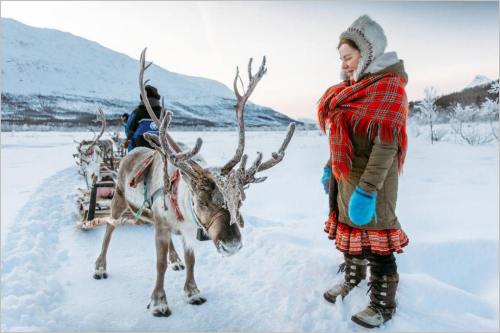 An image of Sami from Norway
.
.
Click the link below for images:
.
__________________________________________
December 31, 2021
Mohenjo
Business, Enthralling, Human Interest, Photographs
amazon, business, Business News, current-events, Future, Hotels, human-rights, medicine, mental-health, research, Science, Science News, technology, Technology News, travel, vacation
Click the link below the picture
.
Old City or Inner City is the historical core of Baku, the capital of Azerbaijan. The Old City is the most ancient part of Baku, which is surrounded by walls which were easily defended. In 2007, the Old City had a population of about 3000 people. In December 2000, the Old City of Baku, including the Palace of the Shirvanshahs and Maiden Tower, became the first location in Azerbaijan to be classified as a UNESCO World Heritage Site.
It is widely accepted that the Old City, including its Maiden Tower, date at least to the 12th century, with some researchers contending that construction dates as far back as the 7th century. The question has not been completely settled.
During this medieval period of Baku, such monuments as the Synyg Gala Minaret (11th century), the fortress walls and towers (11th–12th centuries), the Maiden Tower, the Multani Caravanserai and Hajji Gayyib bathhouse (15th century), the Palace of the Shirvanshahs (15th–16th centuries), the Bukhara Caravanserai and Gasimbey bathhouse (16th century) were built.
In 1806, when Baku was occupied by the Russian Empire during the Russo-Persian War (1804–13), there were 500 households and 707 shops, and a population of 7,000 in the Old City (then the only neighborhood of Baku) whom were almost all ethnic Tats. Between 1807 and 1811, the city walls were repaired and the fortifications extended. The city had two gates: the Salyan Gates and the Shemakha Gates. The city was protected by dozens of cannons set on the walls. The port was re-opened for trade, and in 1809 a customs office was established.
It was during this period that Baku started to extend beyond the city walls, and new neighborhoods emerged. Thus the terms Inner City (Azerbaijani: İçəri Şəhər) and Outer City (Azerbaijani: Bayır Şəhər) came into use. Referring to the early Russian rule, Bakuvian actor Huseyngulu Sarabski wrote in his memoirs: Wikipedia
.
 An image from Old City (Baku)
.
.
Click the link below for images:
.
__________________________________________
Older Entries
Newer Entries
 James' World 2