August 15, 2022
Mohenjo
Business, Enthralling, Human Interest, Photographs
amazon, business, Business News, current-events, Future, Hotels, human-rights, medicine, mental-health, research, Science, Science News, technology, Technology News, travel, vacation

Click the link below the picture
.
Lecco is a city of 48,131 inhabitants in Lombardy, northern Italy, 50 kilometers (31 mi) north of Milan. It lies at the end of the south-eastern branch of Lake Como (the branch is named Lake of Lecco / Lago di Lecco). The Bergamo Alps rise to the north and east, cut through by the Valsassina of which Lecco marks the southern end.
The lake narrows to form the river Adda, so bridges were built to improve road communications with Como and Milan. There are four bridges crossing the river Adda in Lecco: the Azzone Visconti Bridge (1336–1338), the Kennedy Bridge (1956), the Alessandro Manzoni Bridge (1985), and a railroad bridge.
Lecco was also Alpine Town of the Year in 2013.
Elevated to province by decree of the President of the Republic of March 6, 1992, Lecco obtained the title of city on June 22, 1848.
Known for being the place where the writer Alessandro Manzoni set “The Betrothed”, the city is located in one of the vertexes of the Larian Triangle. It overlooks the eastern branch of Lake Como and is included in the Orobic Prealps, between the Grigne mountain chain and the Resegone.
As strategic crossroads for Valtellina, Lecco assumed increasing importance during the Middle Ages when it was annexed to the Duchy of Milan following the Peace of Constance. During the second half of the 19th century, under the Austrian dominion, the city went through a particularly flourishing period during which palaces and arcades in neoclassical style were constructed. After the Unity of Italy, Lecco established itself as one of the most important industrial centers of the nation thanks to the development of the steel industries, already active in the 12th century. For this reason, Lecco is also called “the Iron city”.
The origin of the toponym Lecco is not certain: it probably has a Celtic origin (Lech or Loch) words that mean lake. Shortly before the year 1000 B.C., some populations of Gauls and Celts migrated to the territory of Lecco for trades. Leucos was the name given by the Gauls who inhabited these areas until Romans transformed the denomination into Leucum under Julius Caesar’s domination around 200 B.C.; so the hypothesis put forward by historians who have identified in Lecco the Roman city founded in 95 b.C. by Licinius Crassus in the Larian area with the name of Leucera was excluded.
Other theories, perhaps legendary, trace etymology back to the Greek therm leukos (white), probably because of the white limestone rocks that can be found in Lecco; from the Latin lucus (forest) and/or lacus (lake). Other theories report a derivation from the Old Indian lokas (country) or Lithuanian laukas (open field). However, the existence of the city was first documented in 845 named Leuco.
.
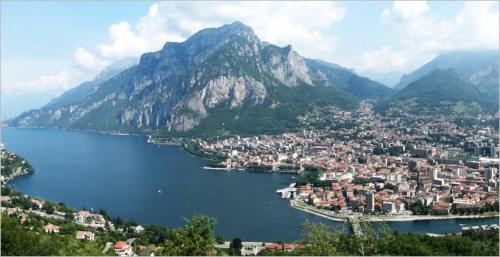 An image from Lecco, Italy
.
.
Click the link below for images:
.
__________________________________________
August 13, 2022
Mohenjo
Business, Enthralling, Human Interest, Photographs
amazon, business, Business News, current-events, Future, Hotels, human-rights, medicine, mental-health, research, Science, Science News, technology, Technology News, travel, vacation
Click the link below the picture
.
Kyoto was the capital of Japan for over a millennium and carries a reputation as its most beautiful city and the nation’s cultural capital. However, visitors may be surprised by how much work they will have to do to see Kyoto’s beautiful side. Most first impressions of the city will be of the urban sprawl of central Kyoto, around the ultra-modern glass-and-steel train station, which is itself an example of a city steeped in tradition mixing with the modern world.
Nonetheless, the persistent visitor will soon discover Kyoto’s hidden beauty in the temples and parks which ring the city center, and find that the city has much more to offer than immediately meets the eye. There are over 2000 temples and shrines in the city, and nobody sees it all in one visit (or two, or three…) – nor should you even try. It would take months if not years to see all that Kyoto has to offer, and many places are especially beautiful during certain seasons, like the plum blossoms, cherry blossoms, autumn leaves, etc. These give very different impressions and appearances, and you can visit Kyoto again and again, yet still, be amazed to see something new. Wikitravel
.
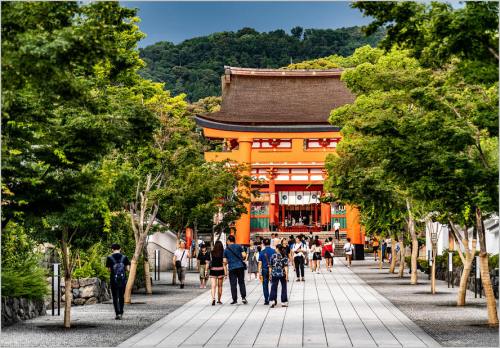 An image from Historic Monuments of Ancient Kyoto
.
.
Click the link below for images:
.
__________________________________________
August 12, 2022
Mohenjo
Business, Enthralling, Human Interest, Photographs
amazon, business, Business News, current-events, Future, Hotels, human-rights, medicine, mental-health, research, Science, Science News, technology, Technology News, travel, vacation
Click the link below the picture
.
Milan is a city in northern Italy, capital of Lombardy, and the second-most populous city proper in Italy after Rome. The city proper has a population of about 1.4 million, while its metropolitan city has 3.26 million inhabitants. Its continuously built-up urban area (whose outer suburbs extend well beyond the boundaries of the administrative metropolitan city and even stretch into the nearby country of Switzerland) is the fourth largest in the EU with 5.27 million inhabitants. According to national sources, the population within the wider Milan metropolitan area (also known as Greater Milan), is estimated between 8.2 million and 12.5 million making it by far the largest metropolitan area in Italy and one of the largest in the EU.
Milan is considered a leading alpha global city, with strengths in the fields of art, chemicals, commerce, design, education, entertainment, fashion, finance, healthcare, media (communication), services, research, and tourism. Its business district hosts Italy’s stock exchange (Italian: Borsa Italiana), and the headquarters of national and international banks and companies. In terms of GDP, Milan is the wealthiest city in Italy, has the third-largest economy among EU cities after Paris and Madrid, and is the wealthiest among EU non-capital cities. Milan is viewed along with Turin as the southernmost part of the Blue Banana urban development corridor (also known as the “European Megalopolis”), and one of the Four Motors for Europe.
The city’s role as a major political center dates back to the late antiquity, when it served as the capital of the Western Roman Empire, while from the 12th century until the 16th century, Milan was one of the largest European cities, and a major trade and commercial center, consequently becoming the capital of the Duchy of Milan, which was one of the greatest political, artistic and fashion forces in the Renaissance. Despite losing much of its political and cultural importance in the early modern period, the city regained its status as a major economic and political center, being considered today as the industrial and financial capital of Italy.
The city has been recognized as one of the world’s four fashion capitals (the others being London, New York, and Paris) thanks to several international events and fairs, including Milan Fashion Week and the Milan Furniture Fair, which are among the world’s biggest in terms of revenue, visitors and growth. It hosted the Universal Exposition in 1906 and 2015. The city hosts numerous cultual institutions, academies, and universities, with 11% of the national total of enrolled students. Milan received 10 million visitors in 2018, with the largest numbers of foreign visitors coming from China, United States, France, and Germany. The tourists are attracted by Milan’s museums and art galleries that include some of the most important collections in the world, including major works by Leonardo da Vinci. The city is served by many luxury hotels and is the fifth-most starred in the world by Michelin Guide. Milan is also home to two of Europe’s most successful football teams, A.C. Milan and Inter Milan, and one of Europe’s main basketball teams, Olimpia Milano. Milan will host the Winter Olympic and Paralympic games for the first time in 2026, together with Cortina d’Ampezzo. Wikipedia
.
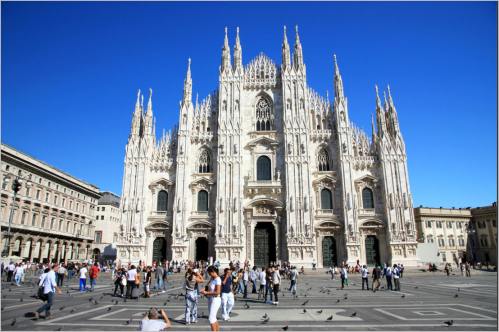 An image from Milan, Italy
.
.
Click the link below for images:
.
__________________________________________
August 11, 2022
Mohenjo
Business, Enthralling, Human Interest, Photographs
amazon, business, Business News, current-events, Future, Hotels, human-rights, medicine, mental-health, research, Science, Science News, technology, Technology News, travel, vacation
Click the link below the picture
.
Ashoro is a town located in Tokachi Subprefecture, Hokkaido, Japan.
As of September 2016, the town has an estimated population of 7,150 and a density of 5.1 persons per km2. The total area is 1,408.09 km2.
It was the largest municipality in Japan until the merger of Takayama City, Gifu Prefecture on February 1, 2005. Main industries of the town include dairying and farming of sugar beet and wheat.
Lake Onnetō is a major attraction of the town and is a part of Akan National Park.
As of January 31, 2015, the total population of The Town of Ashoro is 7,339, with a total of 3,540 men and 3,799 women. The Town of Ashoro’s population density is 5.09 people per square kilometer. The county of Ashoro’s, Ashoro-gun, population is 9,692 with a population density of 4.81per square km. Like many communities in the Tokachi prefecture, the Town of Ashoro has seen a decline in population. The 1999 census concluded there were 9,409 people living in Ashoro. The total area is 1,408.09 km2Ashoro is located in the northeastern part of the Tokachi. Kushiro and Shiranuka is to the east and to the south are Honebestu and Obihiro. Kamishiro is to the west and to the north is Oketo, Rikubestu, and Tsubetsu. Ashoro is Ashoro consists of rolling foothills and is nestled at the base of Mount Meakan. Ashoro-gun is 66.5 km wide and 48.2 km long and is 1,408.09K m2. Ashoro is considered a wide town. 83 percent of the town’s land is forested. Ashoro is influenced by the Tokachi inland climate; temperature differences are large with less precipitation but have many sunny days. On average Ashoro receives 846.5 mm of rain with August being the wettest month, 151 mm of precipitation, and February being the dries, 4.5 mm of precipitation. On average temperatures vary from 23.2 degrees Celsius in August and dropping to -8 in January. Wikipedia
.
 An image from Ashoro-cho Hokkaido Japan
.
.
Click the link below for images:
.
__________________________________________
August 10, 2022
Mohenjo
Business, Enthralling, Human Interest, Photographs
amazon, business, Business News, current-events, Future, Hotels, human-rights, medicine, mental-health, research, Science, Science News, technology, Technology News, travel, vacation
Click the link below the picture
.
Lombardy is one of the twenty administrative regions of Italy. It has an extent of 23,844 km2 (9,206 sq mi) in the northern-central part of the country, and a population of about 10 million people, constituting more than one-sixth of the population of Italy. Over a fifth of the Italian gross domestic product is produced in the region.
The metropolitan area of Milan is the largest in the country and is among the largest in the European Union. Of the fifty-eight UNESCO World Heritage Sites in Italy, eleven are in Lombardy. Virgil, Pliny the Elder, Ambrose, Caravaggio, Claudio Monteverdi, Antonio Stradivari, Cesare Beccaria, Alessandro Volta, Alessandro Manzoni, and popes John XXIII and Paul VI are among those with origins in the area now known as Lombardy.
The word Lombardy comes from Lombard, which in turn is derived from Late Latin Longobardus, Langobardus (“a Lombard”), derived from the Proto-Germanic elements *langaz + *bardaz; equivalent to long beard. Some scholars suggest the second element instead derives from Proto-Germanic *bardǭ, *barduz (“axe”), related to German Barte (“axe”), or that the whole word comes from the Proto-Albanian *Lum bardhi “white river” (Compare modern Albanian lum i bardhë).
During the early Middle Ages, “Lombardy” referred to the Kingdom of the Lombards (Latin: Regnum Langobardorum), a kingdom ruled by the Germanic Lombards who had controlled most of Italy since their invasion of Byzantine Italy in 568. As such “Lombardy” and “Italy” were almost interchangeable; by the mid-8th century, the Lombards ruled everywhere except the Papal possessions around Rome (roughly modern Lazio and northern Umbria), Venice, and some Byzantine possessions in the south (southern Apulia and Calabria; some coastal settlements including Amalfi, Gaeta, Naples, and Sorrento; Sicily and Sardinia). The term was also used until around 965 in the form Λογγοβαρδία (Longobardia) as the name for the territory roughly covering modern Apulia which the Byzantines had recovered from the Lombard rump Duchy of Benevento.
With a surface area of 23,861 km2 (9,213 sq mi), Lombardy is the fourth-largest region of Italy. It is bordered by Switzerland (north: Canton Ticino and Canton Graubünden) and by the Italian regions of Trentino-Alto Adige/Südtirol and Veneto (east), Emilia-Romagna (south), and Piedmont (west). Three distinct natural zones can be easily distinguished in Lombardy: mountains, hills, and plains—the last being divided into Alta (high plains) and Bassa (low plains). Wikipedia
.
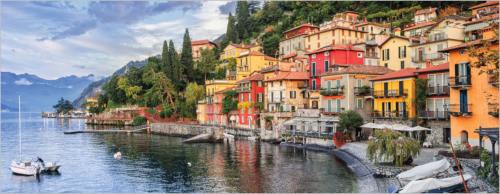 am image from Lombardy, Italy
.
.
Click the link below for images:
.
__________________________________________
August 9, 2022
Mohenjo
Business, Enthralling, Human Interest, Photographs
amazon, business, Business News, current-events, Future, Hotels, human-rights, medicine, mental-health, research, Science, Science News, technology, Technology News, travel, vacation
Click the link below the picture
.
Mount Taranaki, less commonly known as Mount Egmont, is a dormant stratovolcano in the Taranaki region on the west coast of New Zealand’s North Island. It is the second highest point in the North Island, after Mount Ruapehu. The 2,518-metre (8,261 ft) mountain has a secondary cone, Fanthams Peak (Māori: Panitahi), 1,966 meters (6,450 ft), on its south side.
The name Taranaki comes from the Māori language. The Māori word tara means mountain peak, and Naki is thought to come from ngaki, meaning “shining”, a reference to the snow-clad winter nature of the upper slopes. It was also named Pukehaupapa and Pukeonaki by iwi who lived in the region in “ancient times”.
Captain Cook named it Mount Egmont on 11 January 1770 after John Perceval, 2nd Earl of Egmont, a former First Lord of the Admiralty who had supported the concept of an oceanic search for Terra Australis Incognita. Cook described it as “of a prodigious height and its top covered with everlasting snow,” surrounded by a “flat country … which afforded a very good aspect, being clothed with wood and verdure”.
When the French explorer Marc-Joseph Marion du Fresne saw the mountain on 25 March 1772 he named it Pic Mascarin. He was unaware of Cook’s earlier visit.
It appeared as Mount Egmont on maps until 29 May 1986, when the name officially became “Mount Taranaki or Mount Egmont” following a decision by the Minister of Lands. The Egmont name still applies to the national park that surrounds the peak and geologists still refer to the peak as the Egmont Volcano.
As part of the treaty settlement with Ngā Iwi o Taranaki the mountain will be officially named Taranaki Maunga. As of 18 July 2021, the settlement has not yet been completed.
Taranaki is geologically young, having commenced activity approximately 135,000 years ago. The most recent volcanic activity was the production of a lava dome in the crater and its collapse down the side of the mountain in the 1850s or 1860s. Between 1755 and 1800, an eruption sent a pyroclastic flow down the mountain’s northeast flanks, and a moderate ash eruption occurred about 1755, of the size of Ruapehu’s activity in 1995/1996. The last major eruption occurred around 1655. Recent research has shown that over the last 9,000 years minor eruptions have occurred roughly every 90 years on average, with major eruptions every 500 years. Wikipedia
.
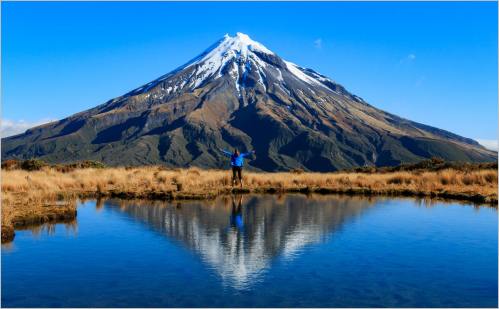 An image of Mount Taranaki
.
.
Click the link below for images:
.
__________________________________________
August 8, 2022
Mohenjo
Business, Enthralling, Human Interest, Photographs
amazon, business, Business News, current-events, Future, Hotels, human-rights, medicine, mental-health, research, Science, Science News, technology, Technology News, travel, vacation
Click the link below the picture
.
Bellagio is a lovely town with a great deal of character on the shores of Lake Como in Lombardy. It is also one of the popular ferry stops on the lake so most visitors to Lake Como will find themselves here sooner or later!
The town is situated quite centrally on Lake Como at the point where the lake divides into two ‘branches’ towards the south-east and south-west and is often referred to as the ‘pearl of the lake’, partly because of its beauty and partly because of this position between the two branches of the lake. Source: Italy This Way
.
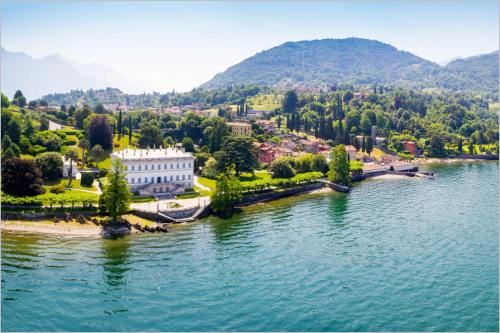 An image from Bellagio, Italy
.
.
Click the link below for images:
.
__________________________________________
August 6, 2022
Mohenjo
Business, Enthralling, Human Interest, Photographs
amazon, business, Business News, current-events, Future, Hotels, human-rights, medicine, mental-health, research, Science, Science News, technology, Technology News, travel, vacation
Click the link below the picture
.
Lake Mangamahoe is such a great place to take a hike. The trails are well marked, easy to access, and can be amped up if you wanted to ru around the lake. The views are spectacular and the songs of the birds are quite peaceful as you wander along the lake. Tripadvisor
.
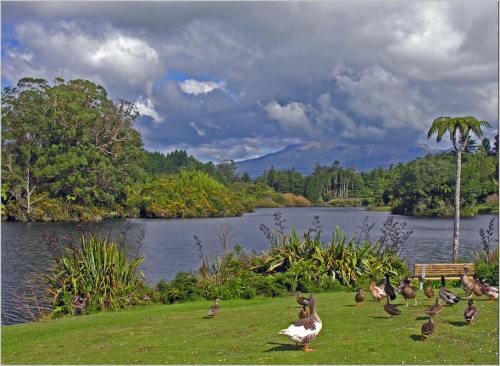 An image from Lake Mangamahoe New Zealand
.
.
Click the link below for images:
.
__________________________________________
August 5, 2022
Mohenjo
Business, Enthralling, Human Interest, Photographs
amazon, business, Business News, current-events, Future, Hotels, human-rights, medicine, mental-health, research, Science, Science News, technology, Technology News, travel, vacation
Click the link below the picture
.
Como is a city and comune in Lombardy, Italy. It is the administrative capital of the Province of Como.
Its proximity to Lake Como and to the Alps has made Como a tourist destination, and the city contains numerous works of art, churches, gardens, museums, theatres, parks, and palaces: the Duomo, seat of the Diocese of Como; the Basilica of Sant’Abbondio; the Villa Olmo; the public gardens with the Tempio Voltiano; the Teatro Sociale; the Broletto or the city’s medieval town hall; and the 20th-century Casa del Fascio.
With 215,320 overnight guests in 2013, Como was the fourth-most visited city in Lombardy after Milan, Bergamo, and Brescia. In 2018, Como surpassed Bergamo becoming the third most visited city in Lombardy with 1.4 million arrivals.
Como was the birthplace of many historical figures, including the poet Caecilius mentioned by Catullus in the first century BCE, writers Pliny the Elder and Pliny the Younger, Pope Innocent XI, scientist Alessandro Volta, and Cosima Liszt, second wife of Richard Wagner and long-term director of the Bayreuth Festival, and Antonio Sant’Elia (1888–1916), a futurist architect and a pioneer of the modern movement.
The hills surrounding the current location of Como were inhabited, since at least the Iron Age, by a Celtic tribe known as the Orobii. Remains of settlements are still present on the wood-covered hills to the southwest of town.
Around the first century BC, the territory became subject to the Romans. The town center was situated on the nearby hills, but it was then moved to its current location by order of Julius Caesar, who had the swamp near the southern tip of the lake drained and laid the plan of the walled city in the typical Roman grid of perpendicular streets. The newly founded town was named Novum Comum and had the status of municipium. In September 2018, Culture Minister Alberto Bonisoli announced the discovery of several hundred gold coins in the basement of the former Cressoni Theater (Teatro Cressoni) in a two-handled soapstone amphora, coins struck by emperors Honorius, Valentinian III, Leo I the Thracian, Antonio and Libius Severus dating to 474 AD.
In 774, the town surrendered to invading Franks led by Charlemagne, and became a center of commercial exchange.
.
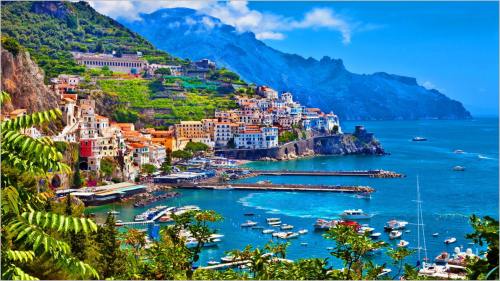 An image from Como, Italy
.
.
Click the link below for images:
.
__________________________________________
August 4, 2022
Mohenjo
Business, Enthralling, Human Interest, Photographs
amazon, business, Business News, current-events, Future, Hotels, human-rights, medicine, mental-health, research, Science, Science News, technology, Technology News, travel, vacation
Click the link below the picture
.
The Italian Lakes are a group of large lakes lying on the south side of the Alps, in the basin of the river Po and the Mediterranean Sea. As their name suggests, they are essentially located in northern Italy, however, they are also partly located in southern Switzerland. They are all glacial lakes that formed after the retreat of the glaciers at the end of the last ice age. The group is composed of (from west to east): Lake Orta, Lake Maggiore, Lake Varese, Lake Lugano, Lake Como, Lake Iseo, Lake Idro and Lake Garda.The three largest are all well over 100 km2, they are Lake Garda (largest in Italy), Lake Maggiore (largest in southern Switzerland), and Lake Como.
The lakes are located in the Italian regions of Piedmont, Lombardy, Veneto, and Trentino-Alto Adige/Südtirol, and in the Swiss canton of Ticino. They are all located at least partly in Italy, while two of them (Maggiore and Lugano) are partly in Switzerland.
The Italian Lakes constitute a popular tourist destination since the Roman Era for their mild climate and their view of the Alps.
At latitudes between 45° and 46° North and at elevations below 400 meters above sea level, the Italian Lakes enjoy a lot of sunshine and a very mild weather. The region is known for its sub-Mediterranean climate, making it the warmest area of Switzerland and significantly warmer than most regions of northern Italy. There sub-tropical plants can grow all the year round in the numerous gardens, notably those of the Borromean and Brissago Islands. During winter, the lakes help to maintain a higher temperature in the surrounding regions (since water releases heat energy more slowly than air) with snowfalls being erratic and primarily affecting the higher elevations around the lakes. Rainfall is lowest during the winter months and heaviest around summer, peaking in spring and autumn.
The particularly mild climate of the Italian Lakes favors the growth of some hardy Mediterranean plants, including the olive tree, parasol pine, mediterranean cypress, chinese windmill palm, and Canary Island Date Palm. On Lake Lugano (Gandria) is one of the few places in Switzerland where olives are grown. Some hardy Citrus trees, such as hardy lemons and satsuma can also be found around Lake Garda, which are extremely rare at this latitude.
.
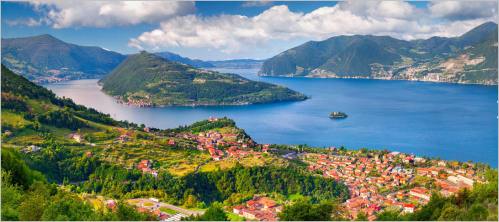 An image of a Lake in Italy
.
.
Click the link below for images:
.
__________________________________________
Older Entries
Newer Entries
 James' World 2