Sometimes, being a leader means making tough calls—ones that aren’t popular, and sometimes even get misunderstood. You’ve probably heard the saying, “If everyone likes you, you’re not really leading.” Fair enough. But what do you do when you hear that no one wants to work with you?
Maybe it comes up in passing from a colleague, or maybe it hits harder in a 360 review. Either way, that kind of feedback can sting. It’s that gut-punch moment where you think, Wait . . . what? You’ve been putting in the work, prioritizing the team (at least in your mind), but somehow people aren’t seeing it. They don’t get the pressure you’re under, the decisions you’ve had to make, or why things played out the way they did.
Here’s the hard truth: Perception is reality. You might feel like you’re doing everything right, but if your team feels disconnected or frustrated, their experience is what matters most. It’s time to pause, reflect, and figure out how things veered off course.
No, it’s not fair. And no, you can’t fix it overnight. But you can make a plan to rebuild trust, reconnect with your team, and start turning things around—one step at a time.
Get the data
Yeah, this part’s going to be uncomfortable—but if you’ve heard that no one wants to work with you, it’s time to figure out why. You’ve got a couple of options. If you haven’t already done a 360 review, that’s a good place to start. Or you can reach out to a trusted advisor or mentor and ask for some honest feedback.
One thing you don’t want to do? March straight over to your team and start digging for answers. That’ll likely come off as defensive—or worse, accusatory—and it won’t help your case. Instead, talk to someone outside the situation. Ideally, someone who knows you well but isn’t directly impacted by your leadership style. You want perspective, not more tension.
I worked with one client who’s a strong, passionate leader, but sometimes that passion got the best of him. For instance, when his team would present him with ideas, my client would shout them down if he thought those ideas wouldn’t work. His team felt overwhelmed, and eventually, no one wanted to work with him. My client wasn’t aware of the pattern and had no idea his team felt so discouraged. His 360 revealed to him how much his reactions were demoralizing his team; my client learned to soften his delivery, slow down, and listen more.
It is rare to read about “spectacular progress” or a “once-in-a-century” result in mathematics. That’s for good reason: if a problem has not had a solution for many years, then completely new approaches and ideas are usually needed to tackle it. This is also the case with the innocent-looking “Kakeya conjecture,” which relates to the question of how to rotate a needle in such a way that it takes up as little space as possible.
Experts have been racking their brains over the associated problems since 1917. But in a preprint paper posted in February, mathematician Hong Wang of New York University and her colleague Joshua Zahl of the University of British Columbia finally proved the three-dimensional version of the Kakeya conjecture. “It stands as one of the top mathematical achievements of the 21st century,” said mathematician Eyal Lubetzky of N.Y.U. in a recent press release.
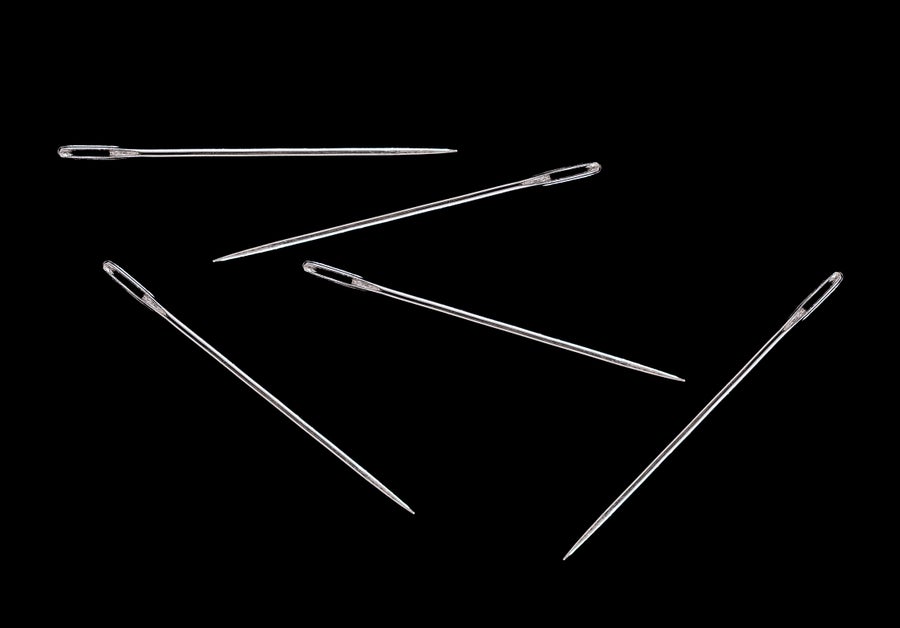
Suppose there is an infinitely narrow needle on a table. Now you want to rotate it 360 degrees so that the tip of the needle points once in each direction of the plane. To do this, you can hold the needle in the middle and rotate it. As it rotates, the needle then covers the surface of a circle.
But if you are clever, the needle can make its 360-degree journey while taking less space. In 1917, mathematician Sōichi Kakeya wanted to investigate the smallest area required to rotate the needle. For example, by rotating not only the outer end of the needle but also its center, you can obtain an area that corresponds to a triangle with curved sides.Years later, mathematician Abram Besicovitch made an unexpected discovery. If you keep moving the needle back and forth like a complex parallel parking maneuver, the surface that the infinitely narrow needle covers can actually have a total area of zero.
The Dimension of an Area of Zero?
From there, experts began to wonder what dimension this “Kakeya surface” has. Usually surfaces in a plane, such as a rectangle or a circle, are two-dimensional. But there are exceptions: fractals, for example, can also have fractional dimensions, meaning they can be 1.5-dimensional, for instance.
Because the Kakeya surfaces can look very jagged, the question of dimensionality is an obvious one. In fact, it has implications for many other areas of mathematics, including harmonic analysis, which breaks down complicated mathematical curves into sums of simpler functions, and geometric measure theory.
In fact, in 1971 mathematician Roy Davies was able to prove that the Kakeya surface is always two-dimensional, even if its area vanishes. But in mathematics, people are interested in general results. The experts wanted to solve the problem in n dimensions—does a needle that is rotated along all n spatial directions always cover an n-dimensional volume? This hypothesis is now known as the Kakeya conjecture.
The White House and DOGE have sought to eliminate thousands of jobs from the Forest Service. The wildland firefighting force is one of many targets within the agency.
President Donald Trump’s executive orders shrinking the federal workforce make a notable exception for public safety staff, including those who fight wildland fires. But ongoing cuts, funding freezes, and hiring pauses have weakened the nation’s already strained firefighting force by hitting support staff who play crucial roles in preventing and battling blazes.
Most notably, about 700 Forest Service employees terminated in mid-February’s “Valentine’s Day massacre” are red-card-carrying staffers, an agency spokesperson confirmed to ProPublica. These workers hold other full-time jobs in the agency, but they’ve been trained to aid firefighting crews, such as by providing logistical support during blazes. They also assist with prescribed burns, which reduce flammable vegetation and prevent bigger fires, but the burns can only move forward if there’s a certain number of staff available to contain them. (Non-firefighting employees without a red card cannot perform such tasks.)
Red-card-carrying employees are the “backbone” of the firefighting force, and their loss will have “a significant impact,” said Frank Beum, a board member of the National Association of Forest Service Retirees who spent more than four decades with the agency and ran the Rocky Mountain Region. “There are not enough primary firefighters to do the full job that needs to be done when we have a high fire season.”
ProPublica spoke to employees across the Forest Service, which manages an area of land nearly twice the size of California, including staff working in firefighting, facilities, timber sales, and other roles, to learn how sweeping personnel changes are affecting the agency’s ability to function. The employees said cuts, which have hit the agency’s recreation, wildlife, IT, and other divisions, show the Trump administration is shifting the agency’s focus away from environmental stewardship and toward industry and firefighting.
But notwithstanding Trump’s stated guardrails, the cuts have affected the Forest Service’s more than 10,000-person-strong firefighting force. Hiring has slowed as there are fewer employees to get new workers up to speed, and people are confused about which job titles can be hired. Other cuts have led to the cancellation of some training programs and prescribed burns.
“It’s all really muddled in chaos, which is sort of the point,” one Forest Service employee told ProPublica.
“This agency is no longer serving its mission,” another added.
The employees asked not to be named for fear of retribution.
The Forest Service did not respond to questions about the impact of cuts other than to clarify the number of terminated employees. The Forest Service spokesperson said about 2,000 probationary employees — typically new staff and those who were recently promoted, groups that have fewer workplace protections — were fired in February. Others with knowledge of the terminations, including a representative of a federal union and a Senate staffer, said the original number of terminated employees was 3,400, but that decreased, likely as workers were brought back in divisions such as timber sales.
The White House and a representative from the Department of Government Efficiency did not respond to requests for comment.
In early March, an independent federal board that reviews employees’ complaints compelled the Department of Agriculture, the Forest Service’s parent department, to reinstate more than 5,700 terminated probationary employees for 45 days. During their first weeks back on the payroll, many, including Forest Service personnel, were put on paid administrative leave and given no work.
The administration and DOGE continue working toward layoffs amid court challenges to their moves. Word circulated throughout the Forest Service in March that departmental leadership had compiled lists containing the names of thousands of additional Forest Service employees who could be soon laid off, according to some workers.
Additionally, understaffing in the agency’s information technology unit is threatening firefighting operations, according to an agency employee. In December, the branch chief overseeing IT for the agency’s fire and aviation division left the job. The Department of Agriculture posted the job opening, describing the division as providing “support to the interagency wildland fire community’s technical
needs.” This includes overseeing software that firefighting crews use to request equipment — everything from fire-resistant clothing to hoses — from the agency’s warehouses so first responders have uninterrupted access to lifesaving equipment.
.
Photo illustration by Emily Scherer. Source images: Forest Service, Department of Agriculture.
Is micro-management, a lack of career progression, and workplace boredom getting you down? The answer may lie in understanding the symptoms of ‘rust-out’. According to the old adage, if you love what you do, you’ll never work a day in your life. However, most of us know that’s not strictly true. Even if you enjoy aspects of your job, it’s combined with stress and pressure, whether that’s urgency overload or feeling like an outsider in your workplace. Throw in a toxic boss and the rise of quiet quitting, and it’s easy to see how just a few taxing elements can build into overwhelm and disillusion.
We know already that burnout is a giant generational problem impacting almost half of UK adults, but experts are also now pointing to a rise in ‘rust-out’: the condition of being chronically under-stimulated, uninspired, and unsatisfied at work.
“Do you find yourself clock-watching as the end of the workday approaches, counting down until finish time? Are Monday mornings a particular grind as you find it difficult to motivate yourself to get going because nothing feels challenging or stimulating? If so, you might be experiencing rust-out,” explains Sharon Peake, founder of gender equality consultancy Shape Talent.
According to Peake, when we are in roles that provide the right level of immersion and stimulation in our work, we experience a phenomenon called ‘flow’, where the level of challenge of the work aligns with our capability and motivation and we become completely absorbed in our work, leading to a sense of wellbeing and positive energy connected with our job. With burnout, the demands of the role exceed our time, ability, and resources; however, and when the demands of the role are lower than our skills and ability, we can experience boredom, frustration, and, ultimately, rust-out.
Rust-out is also more likely to affect women than men due to the unique workplace barriers that women experience, such as the double burden of paid and unpaid (domestic) work. This often leads highly capable and experienced women to return to work part-time, working at a lower level of responsibility after maternity leave, or even opting out of the workforce.
“Rust-out can leave employees feeling uninspired at work and stagnant in their careers, with repetitive meetings and admin taking a mental toll,” adds Becca Moore, associate director at recruitment consultancy Michael Page. “Our recent survey of 5,000 UK workers revealed that ‘a sense of purpose’ was a key driver for happiness in the workplace (48%), but concerningly, just a quarter of UK workers (24%) say they are hugely passionate about their career.”
It doesn’t just affect our morale. As Sarah Markham, a workplace culture expert and founder of Calm In A Box, tells Stylist, when we lose a sense of purpose or feel our work isn’t meaningful, it can cause us to ‘doom loop’, when we repeat unhelpful stories about ourselves. Of course, this doesn’t mean that we should fear every office lull and less-than-fascinating project. Most of us will experience some kind of tedium at work, but rust-out relates to chronic boredom that is so serious it can be detrimental to both your mental and physical health.
How to navigate rust-out at work
In 2023, a Gallup study found that only 33% of employees feel like they are thriving at work. And with micromanaging bosses, the deskilling of jobs, unnecessary bureaucracy, and fewer promotion opportunities, it’s easy to see why.
As Peake explains, the impact of being under-stimulated at work leads to a lack of engagement, boredom, reduced workplace performance, and in some cases, it can even result in anxiety and diminished confidence as the individual starts to question their own capability. So it’s important to act as soon as you sense rust building.
Moore agrees: “When you start to feel the impact of rust-out, it’s critical that you act sooner rather than later. What are the tasks that you used to love doing? What would you like to do more of? What excites and challenges you? Set up some time with your manager to talk through the areas that you’d like to develop and anything that you might like to change.
According to Moore, being open and honest about what motivates you will help your manager delegate tasks and opportunities that better align with your goals and sense of purpose. “It’s a win-win, as they will end up receiving better quality work from you as a result,” she says.
“Finding ways to get better alignment between your capability and work challenges is key,” Peake continues. “Could you get involved in special projects or assignments that will stretch you more? Sometimes extracurricular learning, such as a course of study, can help to provide the missing stimulus. But if none of this is right for you, then it may be time to find a new job and workplace that better meets your needs.”
CLIMATEWIRE | President Donald Trump on Tuesday made an unprecedented peacetime intervention in the electricity sector, using executive orders to force aging coal-burning plants to stay open and feed soaring energy demand from American tech companies.
At a White House signing ceremony that resembled a campaign-style rally, Trump signed orders squarely aimed at reviving coal mining and coal power, which have both been in decline for more than a decade. Among other things, they direct Secretary of Energy Chris Wright to identify which regions are at risk of electricity shortages and bar the shutdowns of coal plants deemed essential.
“Unlike wind and solar, coal plants can run 24 hours a day in rain, sleet or snow,” Trump said, flanked by rows of coal miners donning hard hats. “From now on, we’ll ensure our critically needed coal plants … remain online and fully operational.”
The president signed a total of four executive orders after a speech that downplayed the danger of climate change, blasted the “green new scam,” lauded “beautiful clean coal,” and attacked past administrations pursuing tough pollution standards and for making it harder to mine for coal.
The announcement was quickly followed by a slew of policy shifts, including the Interior Department’s lifting of a ban on leasing in the Powder River Basin, one of the biggest coal-producing hubs in the nation. Conservation groups immediately warned the orders would catapult carbon emissions and dangerous pollution.
“Trump’s attempt to bail out coal is a recipe for raising prices for consumers,” said Jenny Rowland-Shea, public lands director at the Center for American Progress. “Coal’s decline was a problem of economics, and its revival only works if prices increase. These executive orders threaten to make energy costs higher for Americans while continuing to ignore real solutions to energy independence.”
Through his order, Trump reiterated the need to meet the demand of the tech industry build-out of data centers. The nation’s ability “to remain at the forefront of technological innovation depends on a reliable supply of energy from all available electric generation sources and the integrity of our nation’s electric grid,” Trump’s order states.
But the pace of electricity demand to serve future data centers is still guesswork. The centers could consume between 7 percent and 12 percent of U.S. electricity output in 2028, from 4.4 percent now, according to estimates. Total peak power demand for centers could range from 74,000 to 132,000 megawatts in 2028.
In the meantime, tens of thousands of megawatts of coal plant capacity were expected to shut down through the end of the decade. Coal generation that accounted for half of U.S. electricity in 2001 is now at about 15 percent. Most of the planned or proposed generation to replace it has been solar or wind power, along with battery storage. But the projects have struggled to get under construction. And they now face a more hostile Trump administration.
Power companies looking to build new natural gas generation are also seeing longer wait times for turbines. That makes the next few years a time of unusual risk for power operations, according to the North American Electric Reliability Corp., the interstate grid’s security monitor.
‘Go through hell’
Wright’s review of what coal generation is needed and where is due in 90 days. No other deadline were set for taking action under the order. Trump’s action is tied to a 90-year-old provision in the Federal Power Act, section 202(c), that was written for wartime use, according to legal scholars, but has been used in recent decades in short-duration grid emergencies.
.
President Donald Trump speaks Tuesday during an executive order signing ceremony related to expand the mining and use of coal in the United States in the East Room of the White House. Anna Moneymaker/Getty Images
One of the most paralyzing lies in modern entrepreneurship is the belief that you need to find your purpose before you build your business. I hear it all the time: “I’m still trying to figure out my why,” or “Once I discover my purpose, then I’ll know what to create.”
But what if purpose isn’t something you find? What if purpose is something you build — through action, through service, and through consistent effort?
This mindset shift is critical. Purpose isn’t a destination waiting to be uncovered; it’s a direction you choose, refine, and reinforce every single day. It’s the outcome of commitment, not the prerequisite for starting.
The trap of purpose-driven procrastination
We live in a time where purpose is romanticized. Social media is filled with content urging people to “follow their passion” or “never settle for less than your purpose.” While well-intentioned, this advice often causes paralysis.
Instead of taking small steps toward clarity, many people keep waiting for a lightning bolt of inspiration. They’ll postpone launching that product, starting that service or building that team until they feel 100% aligned with some abstract higher calling.
This is what I call purpose-driven procrastination. And it’s killing real businesses before they’re even born. People feel guilty for starting something that doesn’t yet feel “meaningful enough,” not realizing that meaning is created through action, not imagination.
Real purpose comes from real practice
When I launched Coworking Smart, I didn’t start with a fully defined purpose statement. I started with a simple intention: to help entrepreneurs operate professionally, spend less, and grow more.
Over time, through daily work and real interactions with real clients, the deeper purpose emerged. The testimonials. The feedback. The impact. All of these gave shape to a purpose I could never have “found” sitting on a couch waiting for clarity.
Purpose is revealed in motion, not in stillness. You earn alignment through doing the work, paying attention, and staying present with what’s unfolding.
The data doesn’t lie: Sustainable beats inspirational
According to CB Insights, the #1 reason startups fail is lack of market need, not lack of purpose. And a study by Business Insider found that 87% of self-made millionaires built wealth from traditional businesses, not passion projects.
Meanwhile, data from MIT Sloan shows that consistent, incremental improvement is a stronger predictor of success than initial vision.
This tells us something powerful: While purpose feels personal, business success often hinges on how well we execute repeatable systems that create value for others.
3 shifts to build purpose through action
1. Replace the quest for clarity with a commitment to learning
You don’t need a perfect vision to begin. What you need is the willingness to learn. The pursuit of knowledge, especially through practical questions, is where strategy begins.
As Peter Drucker famously said, “The most serious mistakes are not being made as a result of wrong answers. The truly dangerous thing is asking the wrong questions.”
The Trump administration is preparing to eliminate the Federal Emergency Management Agency (FEMA), the agency that leads the nation’s disaster response. We predict this move will have the unintended consequence of bankrupting some small towns and accelerating the relocation of people out of high-risk areas. Cutting off the post-disaster financial assistance that FEMA provides to states will drive up taxes, drive down services, and drive out residents and small businesses. This “climate doom loop” poses the very real risk of destroying small-town America.
The number of billion-dollar disasters in the U.S. is increasing. A recent report says FEMA made a disaster declaration somewhere in the U.S. every four days, on average, in 2024. Disasters have displaced anywhere between one million and four million Americans per year in recent years; an estimated 20 percent of these people never return home. Some move in with family and friends, whereas others either cannot afford to return home or they have nothing left to lose by moving elsewhere in the search for a better life.
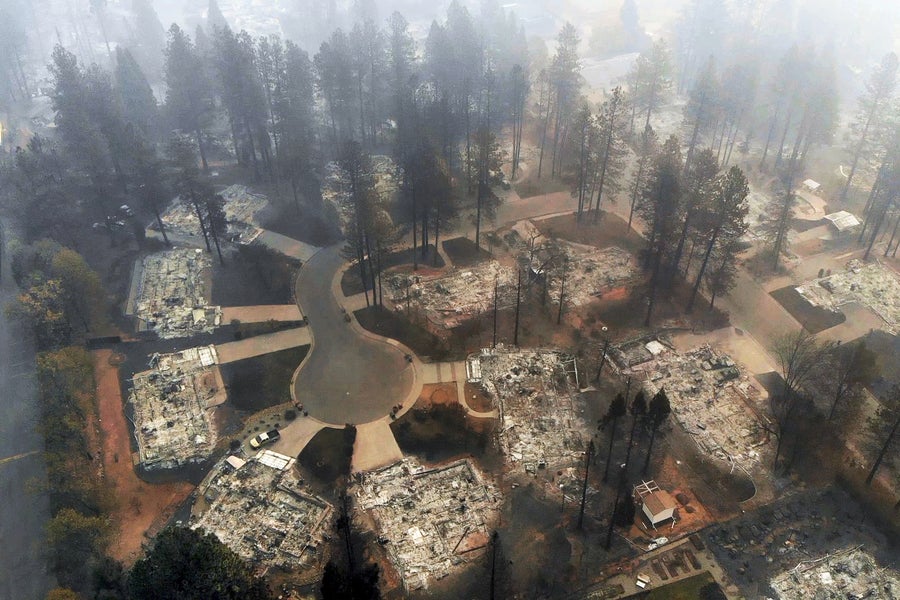
Then there are significant challenges for local governments associated with accommodating displaced households, whether individuals or families. They must extend resources to accommodate new students in schools and manage crowding-out pressures associated with rapid inflation in home prices and rents. From Chico, Calif., to Orlando, Fla., cities where people have relocated after disasters have faced significant pressures from the influx. After the 2018 Camp Fire all but destroyed the town of Paradise, Calif., 20,000 people moved to Chico. The sudden relocation caused a 21 percent spike in housing prices and triggered a homelessness surge that the city still struggles with seven years later. Disasters are not just local events.
Even California, with one of the largest economies in the world, cannot afford individual assistance grants that shelter and feed its own residents. The state most certainly cannot afford to replace the federal public assistance dollars that repair and replace the basic infrastructure for turning on the lights and flushing the toilets. Without FEMA’s financial support, state and local governments will be forced to borrow more money, increase taxes, and even privatize public infrastructure. Many small towns will be forced to scale back critical services, including closing schools, libraries, park,s and solid waste facilities, because they are limited in how much money they can borrow and how much they can tax residents.
Increased taxes and utility bills on top of skyrocketing insurance costs are already pushing people to move. The situation is so dire with natural disasters and spiraling insurance costs in Louisiana that Moody’s Investor Service is concerned that the ongoing and projected loss of working-age people represents a material credit risk for the state. Even wealthy states such as Florida face significant credit risks without FEMA’s financial assistance, particularly as tax rolls shrink with waning property values in high-risk counties. Florida is only a few catastrophic hurricanes away from an income tax, which would have a chilling impact on its population growth. Florida already experiences more deaths than births, and its future is entirely reliant on people moving to the Sunshine State.
Natural hazards and climate-attributed extreme events are wrecking havoc on communities and local economies across the Sun Belt. People initially moved there for warm weather, but the real reason for the region’s growth since the 1990s has been centered on the readily available supply of affordable housing. Recent research has even found evidence that some people are beginning to move away from the Sunbelt, particularly retirees and younger households who are rethinking where they want to plant their roots in the long term. These people are sensitive to the unexpected costs of disasters and insurance eating into their hard-earned wealth just as they are attempting to retire or build families. When people move, they take their tax revenue with them.
The cost of living will no doubt continue to increase in higher-risk areas across the Sunbelt and beyond, and without FEMA, those costs will skyrocket. FEMA does not just help coordinate recovery. The agency also invests in risk-reduction infrastructure, and it sets rules that offer predictability and keep costs down for insurance policies and mortgages. FEMA also provides grants and affordable loans for infrastructure projects that keep schools safe and hospitals accessible for tens of millions of American households. Without FEMA, municipal bond and mortgage investors on Wall Street will decide who gets to rebuild and who gets left behind.
Those local governments that do begin the long process of rebuilding will still face the erosion of both their local population and their economy. The costs of debris removal, toxic cleanup, and infrastructure recovery are so significant that one in five county governments impacted by disasters have to borrow money and implement public funding cuts while they wait for FEMA assistance. These events drain so much cash that even the City of Los Angeles faced a negative credit outlook from its credit rating agency after recent wildfires, meaning there was concern about the city’s ability to meet financial obligations.
.
An aerial view of a neighborhood destroyed by the Camp Fire in Paradise, California, on Nov. 15, 2018. Carolyn Cole/Los Angeles Times via Getty Images
How can you measure productivity you can’t see? When we try to evaluate whether someone is “killing it” in their role simply by hearing them mansplain their digital transformation strategy or their AI-powered journey of innovation, it’s hard to disentangle facts from fiction, competence from confidence, and talent from, well, BS.
The harder it is to decipher what someone is doing, the easier it is to fake it. Ironically, this means that the more you get paid for doing what you do, because specialized skills and in-demand jobs tend to involve operating in abstract, intellectual, and symbolic processes rather than visible, tangible, observable work, the harder it is to know if you are any good at it.
Welcome to the modern workplace, where the line between working and pretending to work is not just thin, it’s vanishing. This is particularly true with the advent of AI, which produces content indistinguishable from what humans produce, if not better. If knowledge workers are merely promptly AI and instructing the AI agents to work for them, are humans still working?
When work became hard to see
One of the great historical transitions in the knowledge economy is that as work became more “intellectual,” it also became less visible. Unlike a farmer’s harvest or a blacksmith’s horseshoe, knowledge work is abstract. You can’t see a PowerPoint deck’s impact (if we could, we would probably not devote so many hours in our life to create slides), or touch a well-formatted spreadsheet (though we can admire it, sure). And when results are ambiguous, evaluations become subjective. More importantly, the connection between the behaviors people perform or display (typing, thinking, reading, writing) and the desirable work or organizational outcomes (growth, productivity, innovation, performance) is invisible, which allows people to brag about their apparent accomplishments on LinkedIn and their resumés: “during my tenure we increased profits by 25%” . . .. because of you, despite you, or coincidentally while you were there?
The modern office was once thought to be a factory of ideas, but more often, it is a theater of activity. Slack pings, emails sent at 11:47 p.m., and meetings scheduled for no good reason serve as proxies for productivity. As psychologist Adam Grant noted, we confuse responsiveness with competence. Presence—whether physical or digital—is misread as performance, or even talent.
Even performance reviews have become more performative than evaluative. As my colleagues and I have shown, most managers are bad at assessing performance—biased by recent events, likability, and self-confidence. The upshot? It’s easier to reward those who are good at appearing to work than those who are actually working. And our notion of “adding value” is conflated with being rewarding to deal with.
Confidence over competence
It gets worse. As work becomes more cerebral, we also become better at gaming the system. Impression management has become a meta-skill: not the work itself, but the ability to make others believe that we are working, and working well.
This isn’t just anecdotal. Psychological studies repeatedly show that people are poor judges of competence, often mistaking confidence for ability. One study shows that speaking more than others in group settings predicts being selected as leader to that group: Yes, there is an ROI to mansplaining!
In fact, in a world where perception trumps reality, those who can tell a compelling story about their work often outperform those who quietly produce real results. This explains why buzzwords thrive in business: “leveraging synergies” sounds more important than “talking to another department.” And therein lies the tragedy: The more time you devote to pretending to work, which by definition decreases the time you can devote to actually working, the more successful you may be in an organizational setting.
As our skills evolved to navigate complex knowledge ecosystems, so did our capacity to appear productive. This is a uniquely modern skill, honed through LinkedIn updates, Zoom facial expressions, and the subtle art of replying-all. For all the talks of “authenticity” and being yourself at work, as my upcoming book documents, there is hardly ever a reward for being honest and transparent when you are up against masters of deceptions and deception eclipses reality. Those who confess that they prefer to have their achievements speak for themselves are no doubt noble and ethical—but they will generally go unnoticed compared to people who proactively engaged in politics, self-promotion, and sucking up to their boss.
The rise of meaningless work
In Bullshit Jobs, the late anthropologist David Graeber describes a category of work so pointless that even the people doing it can’t justify its existence. Entire industries—corporate compliance, middle management, strategic communications—are filled with people who aren’t sure what their job is for, but are sure it requires a calendar full of meetings.
Researchers have created the largest and most detailed wiring diagram of a mammalian brain to date, by mapping cells in a cubic millimetre of a mouse’s brain tissue. In a landmark achievement, the diagram also details the activity of individual neurons on a large scale―a neuroscience first.
The high-resolution 3D map contains more than 200,000 brain cells, around 82,000 of which are neurons. It also includes more than 500 million of the neuronal connection points called synapses and more than 4 kilometres of neuronal wiring, all found in a tiny block of tissue in a brain region involved in vision. The only brain map of comparable scale is that of a cubic millimetre of human brain, which included 16,000 neurons and 150 million synapses. The new map also captured the activity of tens of thousands of neurons firing signals and interacting with each other to process visual information.
This brain-activity map, combined with the wiring diagram, marks a milestone in connectomics, a field that aims to show how brains process and organize information. Behind the massive efforts are more than 150 researchers in the Machine Intelligence from Cortical Networks (MICrONS) project, who described their work in a package of eight papers published today in Nature and Nature Methods. The MICrONS project has made its resources available for the neuroscience community online, and other teams are already exploring them in different studies.
“They managed to do something that we haven’t done as a neuroscience community in basically all of our history, which is to be able to map the activity of neurons onto the wiring on a very large population of neurons,” says Mariela Petkova, a neuroscientist at Harvard University in Cambridge, Massachusetts, who is not involved with the project. “We have never seen it at this scale.”
The data “are really stunningly beautiful,” says Forrest Collman, a neuroscientist at the Allen Institute for Brain Science in Seattle, Washington, who co-authored the studies. “Looking at it really gives you an awe about the sense of complexity in the brain that is very much akin to looking up at the stars of night.”
Mouse in a matrix
To create the breakthrough map, researchers first recorded the firing of almost 76,000 neurons in the visual cortex of a mouse as the animal watched various videos, including clips from The Matrix, for two hours. Then they sliced up a cubic millimetre of the mouse’s brain into thousands of tissue slices, each about one four-hundredth the width of a human hair.
The scientists imaged each slice and assembled the images into a 3D map. Finally, they used artificial intelligence and machine-learning algorithms to annotate the neurons, their branching projections, and their synapses. The team also matched the neurons in the map with their recordings of brain cells in action.
Moritz Helmstaedter, a neuroscientist at the Max Planck Institute for Brain Research in Frankfurt, Germany, says “the combination of function and structure at that scale” is unprecedented. It’s “a very impressive endeavour and success”.
Fire together, wire together
The work yielded insights into the basic rules that shape neural circuits in the mouse brain. For example, the authors found that neurons in the cortex that respond to similar types of visual feature—such as certain shapes or directions of movement—often form more connections with one another, no matter how far apart they are, than they do with neurons that specialize in a different type of feature.
.
A rendering of more than 1,000 brain cells out of the those reconstructed from analysis of a cubic millimetre of brain tissue from a mouse. Allen Institute
Film and Writing Festival for Comedy. Showcasing best of comedy short films at the FEEDBACK Film Festival. Plus, showcasing best of comedy novels, short stories, poems, screenplays (TV, short, feature) at the festival performed by professional actors.



 Sean Gladwell/Getty Images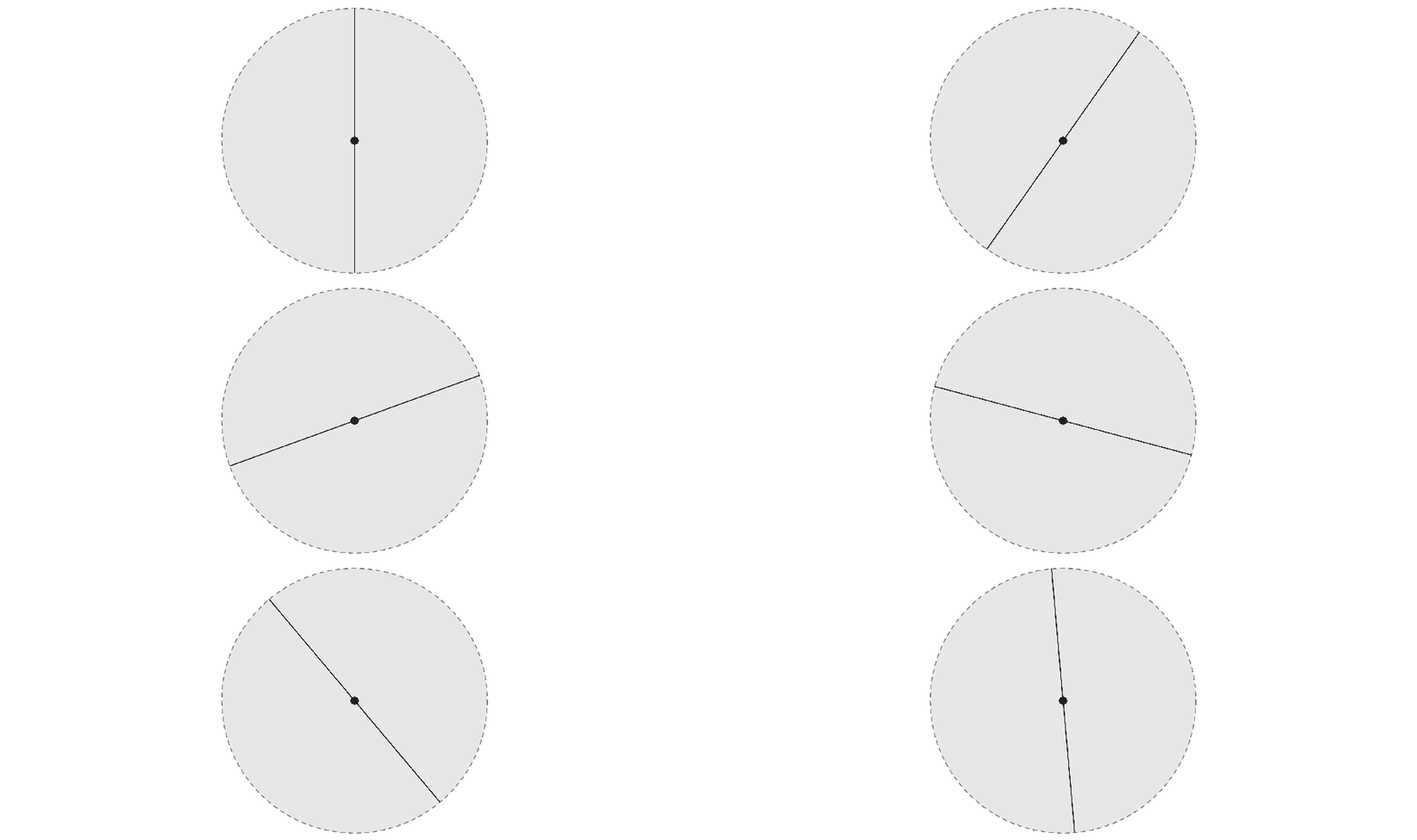



 Credit: Getty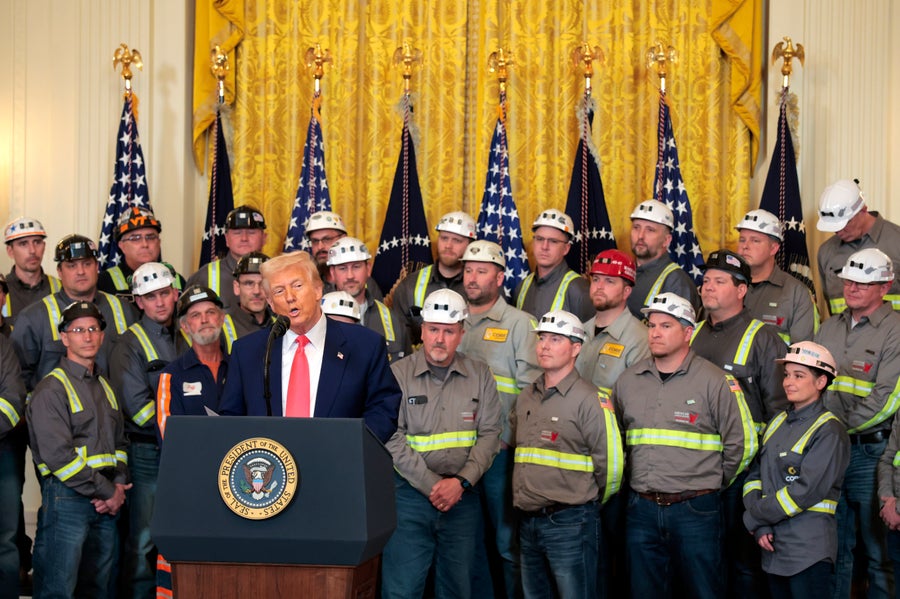
 [Source Photo: Freepik]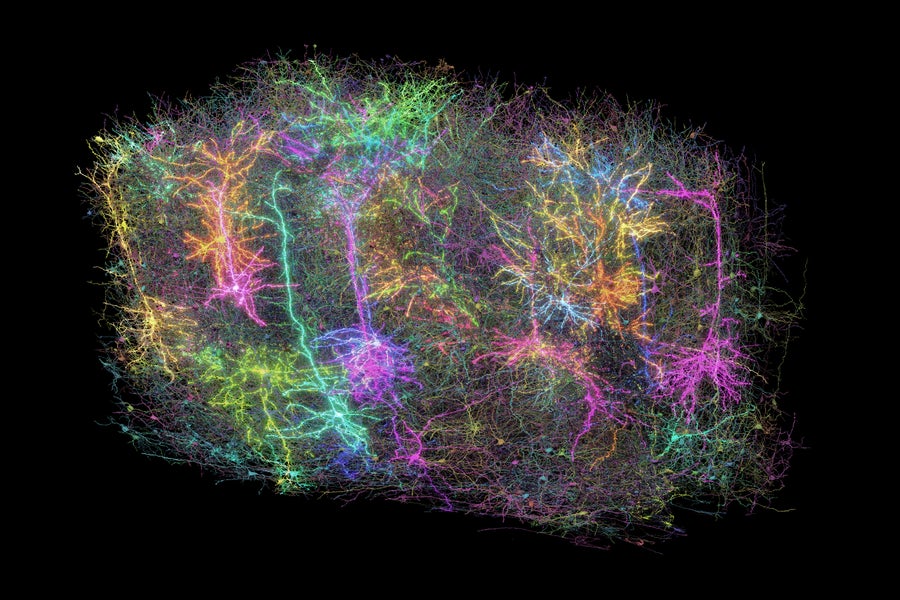
 James' World 2