During the pandemic housing boom, housing demand surged rapidly amid ultralow interest rates, stimulus relief, and the remote work boom—which increased demand for space and unlocked “WFH arbitrage” as high earners were able to keep their income from a job in, say, New York City or Los Angeles, and buy a home in, say, Austin or Tampa.
Federal Reserve researchers estimate that “new construction would have had to increase by roughly 300% to absorb the pandemic-era surge in demand.” Unlike housing demand, housing stock supply isn’t as elastic and can’t ramp up as quickly. As a result, the heightened pandemic-era demand drained the market of active inventory and overheated home prices, with U.S. home prices rising a staggering 43.2% between March 2020 and June 2022.
Of course, a lot has changed since then.
Not long after mortgage rates spiked in 2022 and return-to-office mandates gained a bit of momentum, national demand in the for-sale market pulled back, and the pandemic housing boom fizzled out.
The longer we’ve remained in this strained housing demand environment, the more the total number of U.S. active sellers is outmatching the total number of active homebuyers.
According to a recent Redfin analysis, there were nearly 490,041 more U.S. home sellers than buyers in April 2025. That’s the most that home sellers have outmatched homebuyers in over a decade.
For comparison, at the height of the pandemic housing boom in April 2022, there were 436,106 more U.S. homebuyers than sellers.
“The balance of power in the U.S. housing market has shifted toward buyers, but a lot of sellers have yet to see or accept the writing on the wall. Many are still holding out hope that their home is the exception and will fetch top dollar,” writes Redfin economist Asad Khan. “But as sellers see their homes sit longer on the market and notice fewer buyers coming through on tour, more of them will realize that the market has adjusted and reset their expectations accordingly.”
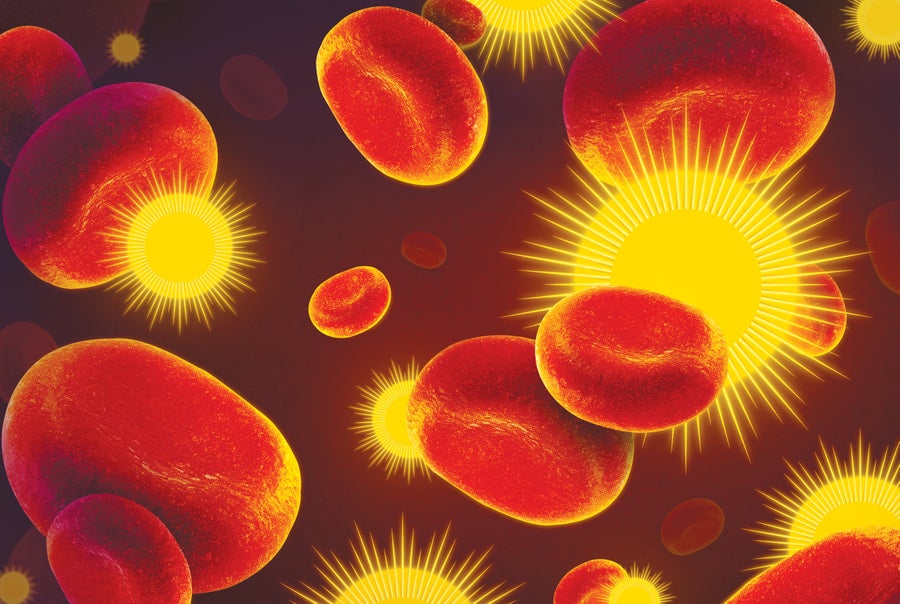
Every morning, Kathy Reagan Young steps out of the shower in her Virginia Beach home, towels off, dons a pair of protective goggles, and stands nine inches from a light box the size of a small space heater. Young presses a button, and the box’s bulbs begin to glow a ghostly purple. She briefly bathes her torso in the ultraviolet rays coming from the bulbs, four minutes per side. Then she goes about her day.
That Young can have an ordinary day is remarkable. In 2008, she was diagnosed with multiple sclerosis (MS), a terrible malady in which the body’s own immune system attacks the sheaths that insulate the nerves, destroying them bit by bit. Symptoms begin with weakness, spasms, vision and speech problems, intense fatigue, and what Young calls “cog fog”—chronic low-grade cognitive impairment. Flare-ups can lead to periods of motor-control loss and paralysis. Young, an advocate for MS patients and creator of a popular podcast, has suffered through many such episodes. But things improved with the arrival of her light box.
Ultraviolet (UV) light boxes, which emit only a narrow bandwidth of light that is not linked to skin cancer, have been used for years in the treatment of psoriasis. Young got a prescription from her doctor, and the box was sent to her by a medical-device company called Cytokind that is hoping to expand such use to MS and other autoimmune diseases and was looking for some practical patient feedback. She tried out the device and gave them some pointers: make it smaller and easier to hold because MS often makes your hands go numb, and build in timed reminders to overcome the cog fog. Then, to her surprise, she found that her fatigue disappeared a few months after she started using it.
For years, Young had been forced to rest in bed many times a day, but that stopped with what she calls her UV-fueled rebirth. “I was in a meeting, and someone said to me, ‘Wow, you seem like you’re pretty high energy!’” Young says. “And I guess I hadn’t really thought about it. And then two days later, my daughter said to me, ‘Mom, what are you on?’ I think we were all a little surprised by how quickly and definitively it happened.” Her MS Disease Activity (MSDA) score, which rates MS severity based on the levels of key inflammatory molecules in the blood, was a 1 out of 10, the best possible score, and it has stayed low for more than a year. MS has no cure, and Young still suffers from transient pain and tingling, but the return of her vitality has made it all more bearable. “It’s incredible,” she says. “My friends used to invite me to things, and I’d say yes, but I always canceled because I was wiped out. Well, not anymore.”
Young is one of the first people in the U.S. to test UV phototherapy as an MS treatment, but she may be at the forefront of a revolution in how we think about light and a huge class of diseases. Autoimmune diseases such as MS and type 1 diabetes occur when our natural defenses—our immune systems—viciously turn against our own bodies and organs. These illnesses are estimated to affect more than 350 million people worldwide. Treatments have been elusive.
Although only a handful of clinical trials for MS light therapy have been conducted in people, evidence from a number of medical studies now shows that UV light, the highest-energy part of the solar spectrum that reaches Earth’s surface, has a surprising ability to calm an immune system that has bolted out of control. The new studies offer tantalizing hints that UV therapy might also work for other autoimmune diseases such as type 1 diabetes, rheumatoid arthritis, Crohn’s disease, and colitis. All are more common in people who get very little sun exposure, as are maladies such as Alzheimer’s and cardiovascular disease that appear to have some immune system and inflammatory connections.
Now, scientists are hoping to decipher the pathways through which UV light causes the immune system to back down from its alarm state. They are tracking the way molecules in the skin, such as urocanic acid and lumisterol, which can affect immune system activity, respond to a shot of photons by triggering a cascade of signals that reach every organ in the body. Advocates say this work might lead to a blockbuster drug, an Ozempic for autoimmunity.
They only need one name. Whoopi. Will. Viola. Denzel. Cynthia. Morgan. Legends who carved their names into Hollywood’s highest peaks—often without a safety net. Before they were box-office draws, they were underdogs, fighting for roles that weren’t just afterthoughts, battling Hollywood’s narrow definition of “marketability,” and rewriting the script for what Black talent looks like on screen.
It’s easy to believe the war is over. In an era where Lupita Nyong’o wins an Oscar for her breakout role, where Jordan Peele reinvents horror, and where Beyoncé drops a Renaissance film that sells out theaters worldwide, it almost seems like we’ve arrived. But anyone who’s lived through Hollywood’s cycle of short-term amnesia knows better.
That’s exactly why Academy Award nominee Reginald Hudlin and Shola Lynch set out to make Number One on the Call Sheet. The film sets out to remind us that Black actors aren’t just here; they’ve been here, fighting for space, legacy, and respect since the dawn of cinema. Directed by Hudlin (House Party, Boomerang) and Lynch (Free Angela and All Political Prisoners) and executive producer Bryan Smiley (HARTBEAT), the two-part documentary digs into the unfiltered reality of being Black in Hollywood. Not just the wins, but the near-misses, the coded rejection, and glass ceilings that, though cracked, haven’t fully shattered. Featuring over 30 actors, the doc unpacks what it really means to be number one on the call sheet when the system wasn’t built for you in the first place.
Pulling off a project of this scale? It took the “Avengers,” as the directors call them, to get these stars to sit down. Hudlin shares, “A lot of it came down to personal relationships. It was me either calling the person or Datari calling the person, calling their agent, calling their publicist.”
For many, the title alone says it all. The phrase “number one on the call sheet” carries weight—it’s a distinction that comes with prestige and responsibility. It means you’re the lead, the face of the production, the one everything revolves around. However, for Black actors, that title has historically been elusive. It’s a seat at the table that, for too long, felt reserved for someone else.
“The battles fought by the previous generation paved the way for us. Now, it’s our turn to fight,” Hudlin says.
The documentary dives deep into those journeys, tracing a history that starts long before today’s stars. Before Denzel’s commanding presence or Viola’s gut-wrenching monologues, there was Sam Lucas, the first Black actor to play Uncle Tom in a 1914 silent film. There was Hattie McDaniel, who won an Oscar for Gone with the Wind in 1940 but was forced to sit in a segregated section of the ceremony. There was Sidney Poitier, who carried the weight of dignity and grace in every role he took. Dorothy Dandridge, who dazzled Hollywood but was cast aside too soon. Every step forward was hard won, and every door cracked open had to be pried wide. “One of the lines I love in the men’s film is, what do you do when you get to the top of the mountain? Make more mountains. You gotta keep going. You can’t stop dreaming,” Lynch says.
The project is split into two films—one focusing on men, the other on women—and each takes a different lens to what it means to lead while Black. The men’s segment, Number One on the Call Sheet: Black Leading Men in Hollywood, directed by Hudlin and produced by Jamie Foxx, Kevin Hart, Datari Turner and Dan Cogan, takes on the evolution of Black male stardom, from trailblazers like Richard Roundtree in Shaft to Will Smith redefining what a global movie star could be.
A haze of ice crystals in the air created a halo around the low sun as three snowmobiles thundered onto the sea ice on a February morning in far northern Canada. Wisps of snow blew across the white expanse. It was –26 degrees Celsius as we left Cambridge Bay, an Inuit village in a vast archipelago of treeless islands and ice-choked channels. This temperature was relatively warm, six degrees C above average. The winter had been the mildest in 75 years. The sea ice covering the Arctic Ocean was at its smallest extent on record. Scientists predict that within the next 15 years, this ice cap will disappear in summer for the first time in millennia, accelerating global warming. The U.K. company Real Ice, whose heavily bundled team was bouncing around on the other two snowmobiles ahead of mine, hopes to prevent that outcome with an effort that has been called extremely ambitious, insane, or even dangerous.
At a spot seven kilometers from the village, Real Ice co-founder Cían Sherwin, an Irishman with a red beanie and scraggy goatee, hopped off his snowmobile and started drilling with a long electric auger. A gob of water and frozen shavings sloshed up and out of the hole as he punctured the underside of the ice more than a meter below. Inuit guide David Kavanna widened the opening with a spearlike ice saw, then placed a wood box around it. Sherwin lowered an aluminum pump, which looked like a large coffee urn attached to a curved rubber hose, through the hole. He plugged a cable into a battery pack. After a few seconds, water began pouring out of the hose, spilling onto the ice in an ethereal shade of blue. As it congeals, “the water acts almost like lava,” Sherwin said. “The ice formation starts almost instantly.”
Thin, broad sheets of ice expand from the ice cap’s edges in winter, when it’s dark and cold, and melt away in summer, when the sun shines 24 hours a day. The ice acts like a giant mirror, reflecting up to 90 percent of the sun’s radiation back toward space. Ocean water, in contrast, absorbs 90 percent of sunlight. The ice cap’s core of so-called multiyear ice, which persists year-round, has shrunk by about 40 percent in four decades, kicking off a vicious cycle: as more ice melts, more ocean water is exposed, and that water warms further, melting even more ice. If the ice starts disappearing entirely in summer, global temperatures could rise an extra 0.19 degrees C by 2050.
Real Ice is trying to thicken seasonal ice so it lasts longer into the warm months, keeping the planet cool. Sherwin hopes pumping could someday refreeze a million square kilometers of both seasonal and multiyear ice—an area the size of Texas and New Mexico combined and about a fifth of what’s now left in summer—to stop the ice cap’s death spiral. All it would take, Real Ice says, is half a million ice-making robots.
Polar geoengineering on such an enormous scale could help slow warming until the world finally weans itself off coal, oil, and natural gas. Many scientists think it will never work. The researchers at Real Ice argue we no longer have any option but to try; studies suggest that even slashing fossil-fuel use may not save summertime sea ice. “It’s sad that it’s ended up that way, but we’ve got to do something about it,” Sherwin said to me out on the frozen plain. “Emissions reduction is just not enough anymore.”Cambridge Bay, which British explorers named for a 19th-century Duke of Cambridge, is a town of 1,800 mostly Inuit inhabitants located across from the Canadian mainland on Victoria Island, one of the world’s largest islands. When I landed at the one-room airport on a twin-engine turboprop, I was greeted by a stuffed musk ox and a placard about the 1845 British naval expedition of John Franklin. Cambridge Bay lies along the Northwest Passage, an icy sea route between Europe and Asia sought by explorers for 400 years. Franklin’s two ships, Erebus and Terror, were trapped in the polar sea ice that surges down toward Cambridge Bay in winter, buckling into ridges up to 10 meters high. All 129 men onboard died of cold, starvation, or disease. These days, cruise ships coast through the passage every year, often visiting the grave sites of Franklin expedition members.
.
A team with Real Ice prepares to drill through sea ice in the Canadian Arctic, having already flooded a nearby patch (darker blue) to thicken it. Taylor Roades
Over glasses of merlot in 2003, the journalist Jonathan Rauch was asked about his religious beliefs. He nearly answered “atheist,” then paused.
God never made sense to Rauch. As a child in Hebrew school, he went through the motions but was unable to believe. In his teens, he heard pastors on AM radio rail against gay people like himself, calling them “a stench in the nostril of God.” His atheism hardened.
But now, sipping wine in his early 40s, the idea of calling himself an “atheist” seemed to imply he still cared about religion one way or the other. He hadn’t for years. Then it hit him: “I’m … an apatheist!” he replied, getting a chuckle.
Rauch told that story in a 2003 essay published in The Atlantic. His essay celebrated the decline of religion in American life, pointing to falling church attendance and broad changes not so much in what Americans believed but how: with a shrug, increasingly. Calling religion “the most divisive and volatile of social forces,” Rauch was heartened that religion seemed to be losing its grip on American public life.
“I believe that the rise of apatheism,” he wrote, “is to be celebrated as nothing less than a major civilizational advance.”
Today, Rauch calls that essay “the dumbest thing” he’s ever written. His latest book, Cross Purposes: Christianity’s Broken Bargain with Democracy, sets out to correct it.
Cross Purposes is no come-to-Jesus moment for Rauch. It is humbly meant to be one for, well, Christians — especially white evangelicals, who, Rauch argues, have become misaligned with the virtues of Christ, and therefore misaligned with the virtues that liberalism (in the classical sense) depends on.
The book is also intended to be a wake-up call for nonbelievers like Rauch who have underappreciated Christianity’s role in “stabilizing” America’s liberal democracy, a role the Founders wrote about centuries ago.
So, Rauch writes, secular America should greet religion not with apathy but arms wide open. “We should even, perhaps, cherish religion.”
Christianity’s crisis
Cross Purposes argues that Christianity is in crisis, both in numbers and spirit. Drawing on interviews with pastors and analyses from previous books on religion in America, the book diagnoses the problem in two broad ways: Churches are “thinning” (losing members and distinctiveness from the outside world), while some are also “sharpening” (becoming politicized, partisan, confrontational, and divisive).
The trouble started decades ago when Protestant churches made decisions that caused them to become more secularized and politicized. First, the mainline churches aligned themselves with the center-left progressivism of the mid-20th century, focusing less on theology and more on issues like poverty and civil rights. Then, in the late 1970s, white evangelical churches and the Republican party formed an alliance with each side believing it had something to gain: Christian-friendly policies and a loyal voting bloc, respectively.
These shifts had different motivations but a similar effect: Churches became more open to the influence of external culture as Christians focused less on scripture and more on worldly issues.
“The mainline ecumenical churches and the more conservative evangelical churches are, for different reasons, too secular to really distinguish themselves from the outside cultural and political world,” Rauch tells Big Think.
(Rauch has put it like this: People can do good deeds or talk politics on their own time, so why give up their Sunday mornings?)
As churches drifted away from theology, Christians drifted away from churches. From 2000 to 2020, the share of Americans identifying as “practicing Christians” dropped by nearly half. Today, “nones” — an amorphous group that spans from zealous atheists to the vaguely spiritual — account for nearly 30% of the American population, an all-time high representing a cohort larger than all American evangelicals.
Christianity’s rapid decline caught most by surprise.
“I don’t think in 2003 we had any idea how rapid and dramatic the next 20 years would be,” Rauch says. “It’s really unprecedented.”
The early 21st century saw another collapse, too: Americans’ trust in institutions, politics, democracy, and each other (a deterioration reflected in rising rates of affective polarization, where people view opposing political tribes with growing hostility while viewing theirs more favorably).
These declines happened concurrently but not purely coincidentally, according to Rauch. As churches became less able to provide people with a sense of meaning, transcendence, and identity, many Americans filled the void with politics.
“And that’s an absolutely terrible place to get your sense of identity,” Rauch says.
The apatheism argument assumed Christianity’s fall would make American society less divisive, and that the secular world would build something more stable and enlightened atop the rubble of churches.
I always wanted to understand life. What moves us? What allows us to heal and thrive? And what goes wrong when we get sick or when we eventually stop breathing and die? My search for answers to these stupendously ambitious questions led me, it now seems inexorably, to mitochondria.
In biology classes from high school through university, I learned that mitochondria are little objects that reside within each cell and serve as “powerhouses,” combining oxygen and food to yield energy for the body. This idea of mitochondria being little batteries with a built-in charger, about as interesting as the one in my phone, left me unprepared for the vital reality of these organelles when I first saw them under a microscope in 2011. They were luminous because of a glowing dye I had put in them, and they were dynamic—constantly moving, stretching, morphing, touching one another. They were beautiful. That night, a graduate student alone in a dark laboratory in Newcastle upon Tyne in England, I became a mitochondriac: hooked on mitochondria.
A profound insight by biologist Lynn Margulis helped me make some sense of what I was seeing. She postulated in 1967 that mitochondria descend from a bacterium that was engulfed by a larger ancestral cell about 1.5 billion years ago. Instead of consuming this tidbit, the larger cell let it continue living within. Margulis called this event endosymbiosis, which means, roughly, “living or working together from the inside.” The host cell had no energy source that used oxygen, which, thanks to plants, was already abundant in the atmosphere; mitochondria filled this gap. The unlikely union allowed cells to communicate and cooperate and let their awareness expand beyond their own boundaries, enabling a more complex future in the form of multicellular animals. Mitochondria made cells social, binding them in a contract whereby the survival of each cell depends on every other one, and thus made us possible.
Amazingly, my co-workers and I have discovered that mitochondria are themselves social beings. At least, they foreshadow sociality. Like the bacterium they descended from, they have a life cycle: old ones die out, and new ones are born out of existing ones. Communities of these organelles live within each cell, usually clustered around the nucleus. Mitochondria communicate, both within their own cells and among other cells, reaching out to support one another in times of need and generally helping the community flourish. They produce the heat that keeps our bodies warm. They receive signals about aspects of the environment in which we live, such as air pollution levels and stress triggers, and then integrate this information and emit signals such as molecules that regulate processes within the cell and, indeed, throughout the body.
When our mitochondria thrive, so do we. When they malfunction—when, for instance, their ability to change energy into forms required for biochemical reactions is impaired—we may experience conditions as diverse as diabetes, cancer, autism, and neurodegenerative disorders. And as mitochondria accumulate defects over a lifetime of stress and other insults, they contribute to aging and, ultimately, death. To understand these processes—to see how to sustain physical and mental health—it helps to understand how energy moves through our bodies and minds. That requires a deeper look into mitochondria and their social lives.
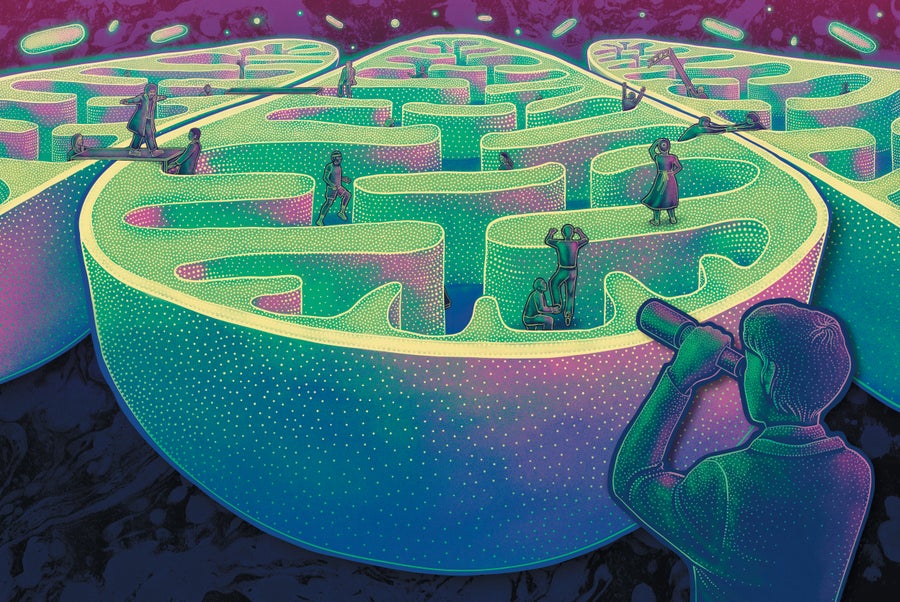
Long before I got my first glimpse of mitochondria, I had boned up on the basics of their structure and biology. We inherit our mitochondria from our mother—from the egg cell, to be precise. Mitochondria have their own DNA, which consists of only 37 genes, compared with the thousands of genes in the spiraling chromosomes inside the cell nucleus. This ring of mitochondrial DNA, or mtDNA, is sheltered within two membranes. The outer shell, shaped like the skin of a sausage, encases the mitochondrion and selectively allows molecules to enter or exit. The inner membrane is made of densely packed proteins and has many folds, called cristae, which serve as a site for chemical reactions, much like the plates suspended inside a battery.
Rather than being like battery chargers, mitochondria are more like the motherboard of the cell.
In the 1960s, British biochemists Peter Mitchell and Jennifer Moyle discovered how electrons derived from carbon in food combine with oxygen in the cristae, releasing a spark of energy that is captured as a gradient in electrical voltage across the membrane. This voltage provides the driving force for all processes in the body and brain, from warming to manufacturing molecules to thinking. Mitochondria also produce a molecule called adenosine triphosphate, which serves as a portable unit of energy that powers hundreds of biochemical reactions within each cell.
A series of court rulings have thrown the centerpiece of President Donald Trump’s economic agenda into chaos by first blocking the bulk of his sweeping tariffs and then allowing them to resume, at least for now.
Here’s what to know about where the legal battle stands, and where it could go from here.
What have the courts ruled?
Trump was handed a win on Thursday when a federal appeals court ruled in favor of his Administration and paused a Wednesday night ruling from the U.S. Court of International Trade, allowing his tariffs to remain in place for the time being.
A three-judge panel for the trade court had ruled that the President does not have “unbounded authority” to issue tariffs under the International Emergency Economic Powers Act (IEEPA). The 1977 law, which Trump drew on to levy tariffs against almost every country in the world under national emergencies related to fentanyl and trade deficits, enables the President to oversee economic transactions in the case of a national emergency, such as during an “unusual and extraordinary threat” to the economy, foreign policy, or national security.
The ruling halted a 30% tariff on China, a 25% tariff on certain goods from Mexico and Canada, and 10% baseline tariffs on most of the rest of the world, but did not affect import taxes on steel, aluminum, or automakers, which Trump levied under a different law.
The Administration swiftly appealed, and the Thursday decision to grant its emergency motion has temporarily reinstated the tariffs that were halted while the appeals court considers the case.
Adding to the confusion of the back-and-forth rulings, a federal judge issued a ruling in a separate case earlier on Thursday to bar the Trump Administration from collecting tariffs imposed under IEEPA from two Illinois educational toy companies, but paused his injunction for two weeks. The Administration has appealed that decision as well.
What comes next?
The future of Trump’s tariffs is still in limbo. The appeals court directed the plaintiffs in the case, a group comprised of U.S. businesses affected by the tariffs, to respond to federal officials’ motion to stay the trade court’s ruling by June 5. The federal government must then respond by June 9.
The appeals process could ultimately reach as far as the Supreme Court, where the Trump Administration had previously said it would pursue “emergency relief” should the lower court not reinstate the President’s tariff powers.
The levies Trump has imposed under IEEPA have also been challenged in several other lawsuits.
Prior to the reinstatement of the blocked tariffs, White House Press Secretary Karoline Leavitt told reporters at a press briefing on Thursday that the President had “other legal authorities” he could use to impose import taxes on foreign countries.
Leavitt did not specify further, but the U.S. Court of International Trade itself named another law that grants the President limited power to impose tariffs in its ruling. Section 122 of the Trade Act of 1974, it noted, allows the President to levy tariffs of up to 15% for as long as 150 days in response to “fundamental international payment problems,” including “large and serious balance-of-payments deficits,” and unfair trading practices.
Trump has himself used other laws to impose import taxes in both of his terms. His steel, aluminum, and auto tariffs, for instance, draw on his authority under Section 232 of the Trade Expansion Act of 1962, which empowers the President to put tariffs in place in response to national security threats.
.
U.S. Court of International Trade in New York City, August 22, 2022.Getty Images
Hail the size of grapefruit shattered car windows in Johnson City, Texas. In June, 2024, a storm chaser found a hailstone almost as big as a pineapple. Even larger hailstones have been documented in South Dakota, Kansas, and Nebraska. Hail has damaged airplanes and even crashed through the roofs of houses.
How do hailstones get so large, and are hailstorms getting worse?
As an atmospheric scientist, I study and teach about extreme weather and its risks. Here’s how hail forms, how hailstorms may be changing, and some tips for staying safe.
How does hail get so big?
Hail begins as tiny crystals of ice that are swept into a thunderstorm’s updraft. As these ice embryos collide with supercooled water – liquid water that has a temperature below freezing – the water freezes around each embryo, causing the embryo to grow.
Supercooled water freezes at different rates, depending on the temperature of the hailstone surface, leaving layers of clear or cloudy ice as the hailstone moves around inside a thunderstorm. If you cut open a large hailstone, you can see those layers, similar to tree rings.
The path a hailstone takes through a thunderstorm cloud, and the time it spends collecting supercooled water, dictates how large it can grow.
Rotating, long-lived, severe thunderstorms called supercells tend to produce the largest hail. In supercells, hailstones can be suspended for 10-15 minutes or more in strong thunderstorm updrafts, where there is ample supercooled water, before falling out of the storm due to their weight or moving out of the updraft.
Hail is most common during spring and summer when a few key ingredients are present: warm, humid air near the surface; an unstable air mass in the middle troposphere; winds strongly changing with height; and thunderstorms triggered by a weather system.
Larger hail, more damage
Hailstorms can be destructive, particularly for farms, where barrages of even small hail can beat down crops and damage fruit.
As hailstones get larger, their energy and force when they strike objects increases dramatically. Baseball-sized hail falling from the sky has as much kinetic energy as a typical major league fastball. As a result, property damage, such as to roofs, siding, windows, and cars, increases as hail gets larger than the size of a quarter.
A federal court in New York handed President Donald Trump a big setback Wednesday, blocking his audacious plan to impose massive taxes on imports from almost every country in the world.
A three-judge panel of the U.S. Court of International Trade ruled that Trump overstepped his authority when he invoked the 1977 International Emergency Economic Powers Act to declare a national emergency and justify the sweeping tariffs.
The tariffs overturned decades of U.S. trade policy, disrupted global commerce, rattled financial markets, and raised the risk of higher prices and recession in the United States and around the world.
The U.S. Court of International Trade has jurisdiction over civil cases involving trade. Its decisions can be appealed to the U.S. Court of Appeals for the Federal Circuit in Washington and ultimately to the Supreme Court, where the legal challenges to Trump’ tariffs are widely expected to end up.
Which tariffs did the court block?
The court’s decision blocks the tariffs Trump slapped last month on almost all U.S. trading partners and levies he imposed before that on China, Mexico, and Canada.
On April 2, Trump imposed so-called reciprocal tariffs of up to 50% on countries with which the United States runs a trade deficit and 10% baseline tariffs on almost everybody else. He later suspended the reciprocal tariffs for 90 days to give countries time to agree to reduce barriers to U.S. exports. But he kept the baseline tariffs in place. Claiming extraordinary power to act without congressional approval, he justified the taxes under IEEPA by declaring the United States’ longstanding trade deficits “a national emergency.”
In February, he’d invoked the law to impose tariffs on Canada, Mexico and China, saying that the illegal flow of immigrants and drugs across the U.S. border amounted to a national emergency and that the three countries needed to do more to stop it.
The U.S. Constitution gives Congress the power to set taxes, including tariffs. But lawmakers have gradually let presidents assume more power over tariffs, and Trump has made the most of it.
The tariffs are being challenged in at least seven lawsuits. In the ruling Wednesday, the trade court combined two of the cases — one brought by five small businesses and another by 12 U.S. states.
The ruling does leave in place other Trump tariffs, including those on foreign steel, aluminum, and autos. But those levies were invoked under a different law that required a Commerce Department investigation and could not be imposed at the president’s own discretion.
Why did the court rule against the president?
The administration had argued that courts had approved then-President Richard Nixon’s emergency use of tariffs in a 1971 economic and financial crisis that arose when the United States suddenly devalued the dollar by ending a policy that linked the U.S. currency to the price of gold. The Nixon administration successfully cited its authority under the 1917 Trading With Enemy Act, which preceded and supplied some of the legal language later used in IEPPA.
The court disagreed, deciding that Trump’s sweeping tariffs exceeded his authority to regulate imports under IEEPA. It also said the tariffs did nothing to deal with problems they were supposed to address. In their case, the states noted that America’s trade deficits hardly amount of a sudden emergency. The United States has racked them up for 49 straight years in good times and bad.
So where does this leave Trump’s trade agenda?
Wendy Cutler, a former U.S. trade official who is now vice president at the Asia Society Policy Institute, says the court’s decision “throws the president’s trade policy into turmoil.”
.
President Donald Trump speaks during a swearing-in ceremony for interim U.S. Attorney General for the District of Columbia Jeanine Pirro, Wednesday, May 28, 2025, in Washington. (AP Photo/Evan Vucci)
CLIMATEWIRE | Public officials have started pleading with the Trump administration for help in recovering from deadly disasters as President Donald Trump triggers frustration in states struck by tornadoes, floods, and storms by taking no action on requests for aid.
Trump has left states, counties and tribes in limbo as he delays making decisions on formal requests for millions of dollars in Federal Emergency Management Agency funding. Some areas that are still reeling from extreme weather are unable to start cleanup.
“We’re at a standstill and waiting on a declaration from FEMA,” said Royce McKee, emergency management director in Walthall County, Mississippi, which was hit by tornadoes in mid-March.
The county of 13,000 people can’t afford to clean up acres of debris, McKee said, and is waiting for Trump to act on a disaster request that was submitted by Gov. Tate Reeves, a Republican, on April 1 after the tornadoes killed seven people, destroyed or damaged 671 homes, and caused $18.2 million in public damage.
“I’m disappointed, especially for the people that lost their houses,” McKee said.
Trump himself assailed FEMA in January for being “very slow.”
The frustration over Trump’s handling of disasters is the latest upheaval
involving FEMA. Trump recently canceled two FEMA grant programs that gave states billions of dollars a year to pay for protective measures against disasters. The move drew protests from Republican and Democratic lawmakers.
On May 8, Trump fired FEMA leader Cameron Hamilton and replaced him with David Richardson, a former Marine Corps officer who has no experience in emergency management.
At a congressional hearing on Tuesday, Missouri Sen. Josh Hawley, a Republican, pleaded with Homeland Security Secretary Kristi Noem to push Trump to approve three disaster requests that Missouri Gov. Mike Kehoe, a Republican, had sent to Trump beginning April 2.
“We are desperate for assistance in Missouri,” Hawley said as Noem pledged to help. Her department oversees FEMA.
St. Louis Mayor Cara Spencer, whose city was badly damaged by tornadoes earlier this week, told MSNBC: “What we need right now is federal assistance. This is where FEMA and the federal government have got to come in and help communities. Our city can’t shoulder this alone.”
Trump has not acted on 17 disaster requests, a high number for this time of year, according to a FEMA daily report released Wednesday. On the same date eight years ago, during Trump’s first presidency, only three disaster requests were awaiting presidential action, the FEMA report from May 21, 2017, shows.
Eleven of the 17 pending disaster requests were sent to Trump more than a month ago.
“This looks to me like, until FEMA’s role is clarified, then we’re just going to sit on it,” said a former senior FEMA official who was granted anonymity to speak candidly.
Trump has indicated that he wants to shrink the agency, which distributes about $45 billion in disaster aid a year, helps with as many as 100 disasters at a time and, he said, “has been a very big disappointment.”
.
A man is comforted by a family friend while cleaning up the debris of his house on May 18, 2025, in the community of Sunshine Hills outside of London, Kentucky. A tornado struck the neighborhood of Sunshine Hills just after midnight on May 17, 2025, in London, Kentucky. Michael Swensen/Getty Images
Film and Writing Festival for Comedy. Showcasing best of comedy short films at the FEEDBACK Film Festival. Plus, showcasing best of comedy novels, short stories, poems, screenplays (TV, short, feature) at the festival performed by professional actors.

 [Source Photo: Thirdman/Pexels]
 Taylor Callery
 Photography By: Xavier Scott Marshall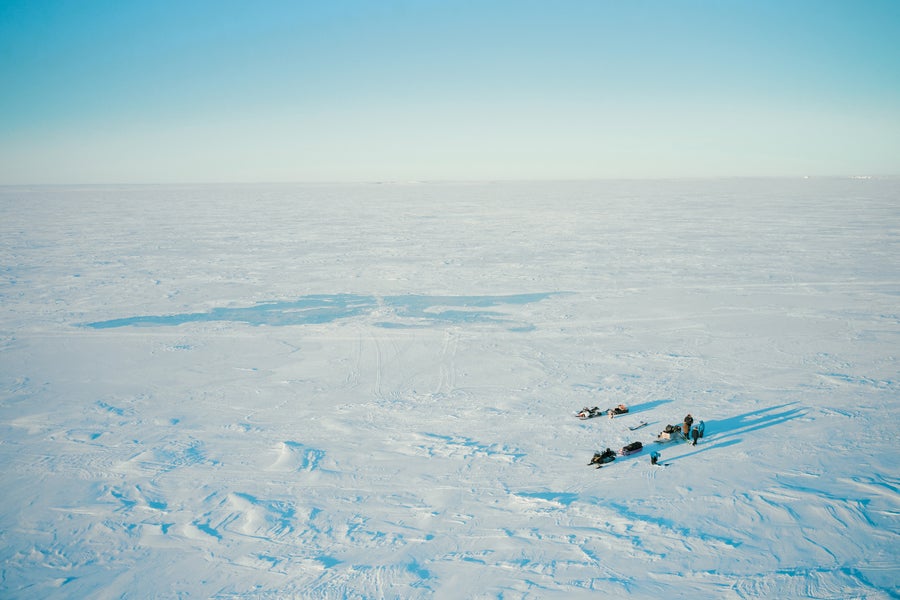

 pozdeevvs / Adobe Stock / Jacob Hege / Big Think
 Jennifer N.R. Smith

 ljphoto7/Getty Images
 President Donald Trump speaks during a swearing-in ceremony for interim U.S. Attorney General for the District of Columbia Jeanine Pirro, Wednesday, May 28, 2025, in Washington. (AP Photo/Evan Vucci)
 James' World 2