Ole Ginnerup Schytz, an engineer in Denmark’s sleepy Vindelev agricultural area, had used a metal detector only a handful of times when he found a bent clump of metal in a friend’s barley field. He figured it was the lid from a container of tinned fish and tossed it in his junk bag with the other bits of farm trash that had set his metal detector beeping: rusty nails, screws, scrap iron. A few paces away he dug up another shiny circle. Someone had clearly enjoyed a lot of tinned fish here—into the sack it went. But when Ginnerup found a third metal round, he stopped to take a closer look. Wiping the mud from its surface, he suddenly found himself face-to-face with a Roman emperor. At that point he had to admit “they weren’t food cans,” Ginnerup recalls with a chuckle.
After a brief intermission for an online Teams meeting for work that December day in 2020, Ginnerup dug up 14 glittering gold disks—some as big as saucers—that archaeologists say were buried about 1,500 years ago, during a time of chaos after ash clouds from a distant volcanic eruption created a miniature ice age. Four medallions feature Roman emperors, and several bear intricate geometric patterns. But the real showstopper is an amulet called a bracteate with two stylized designs: a man in profile, his long hair pulled back in a braid, and a horse in full gallop. An expert in ancient runes says she was awestruck when she finally made out the inscription on top: “He is Odin’s man.”
These embossed runes are the oldest known written mention of Odin, the Norse god of war and ruler of Valhalla. Ginnerup’s bracteate, which archaeologists describe as the most significant Danish find in centuries, extended the worship of Odin back 150 years—and it’s all because Ginnerup received a metal detector as a birthday present from his father-in-law.
Many other European countries have prohibited or heavily restricted hobbyist metal detecting, but Denmark has embraced it, creating a system for members of the public to hand over finds to government archaeologists. The result has been an embarrassment of riches, with more than 20,000 items turned in annually in recent years. The curators assigned to identify and catalog the artifacts can’t dream of keeping up, but the fruits of their collective labor are clear: whereas neighboring countries have only vague sketches of the past, metal detectorists have filled in the ancient map of Denmark with temple complexes, trade routes and settlements that would have otherwise been lost to history.“
Private detectorists have rocketed Denmark ahead of its neighbors in archaeological research,” says Torben Trier Christiansen, curator of archaeology at Denmark’s North Jutland Museums. “There’s nothing ‘amateur’ about them.”
Denmark has been inhabited since the end of the last ice age, when nomadic hunter-gatherers from southern Europe arrived following the migration of reindeer and retreating glaciers as early as 12,500 years ago. The ancestors of modern ethnic Danes showed up some 5,000 years ago, journeying from the steppes of what is now Ukraine and southwestern Russia. Their descendants lived in small farming communities across Scandinavia for thousands of years, building megaliths and barrows for their honored dead and making human sacrifices in bogs to appease their gods.
In the early centuries of the common era, these farming communities coalesced into a series of Germanic tribes—the Cimbri, the Teutons, the Jutes, the Angles, and the Danes—who became skilled seafarers, explorers, and metalworkers. Because precious metals—including silver, gold, and the components of bronze—do not occur naturally in what is now Denmark, its denizens had to barter for or steal these metals from abroad. They traded extensively with the Roman Empire, which never reached as far north as Scandinavia.
.
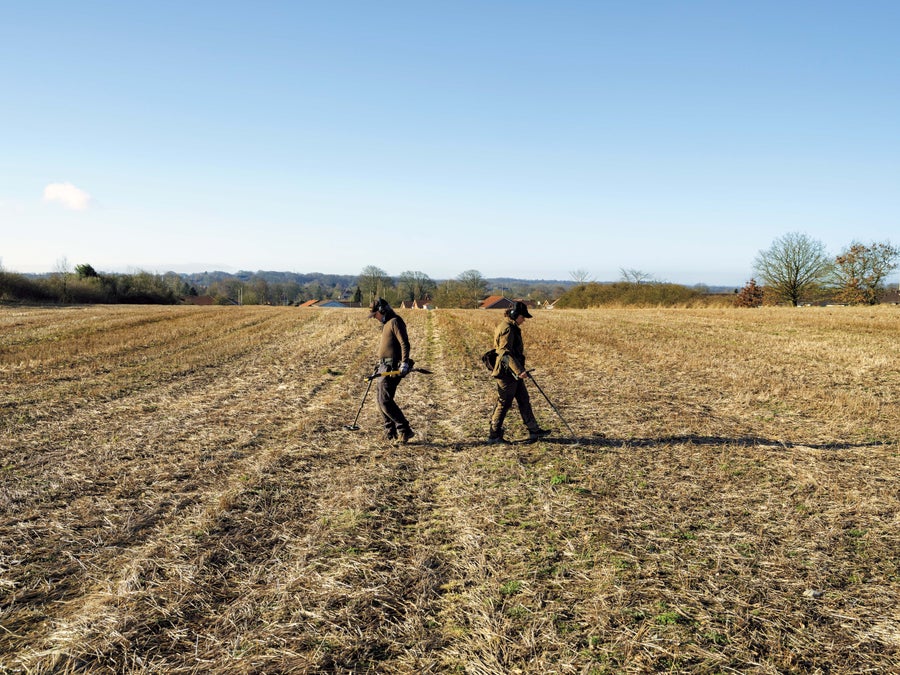
Kristen Nedergaard Driøe (left) and Marie Aagard Larsen (right) swing their metal detectors over a field where grain is typically grown in southern Denmark. Alastair Philip Wiper
The “Godfather of AI” says that some fields are safer than others when it comes to being replaced by AI.
Geoffrey Hinton, 78, is often referred to as the Godfather of AI due to his pioneering work on neural networks, which began in the late 1970s. He won the 2024 Nobel Prize in Physics for his work on machine learning and is currently a professor emeritus in computer science at the University of Toronto.
In a recent interview on the podcast “Diary of a CEO” that aired on Monday, Hinton said AI has the potential to cause mass joblessness.
“I think for mundane intellectual labor, AI is just going to replace everybody,” Hinton said. “Mundane intellectual labor” refers to white-collar jobs. He specified that the replacement would take the form of “a person and an AI assistant” doing the work that “ten people did previously.”
Hinton gave one example, noting that paralegals were at risk of losing their jobs to AI, and said that he would be “terrified” to work in a call center right now, due to the potential for automation. However, he pointed out that blue-collar work would take a longer time to be replaced by AI.
“I’d say it’s going to be a long time before it [AI] is as good at physical manipulation,” Hinton said in the podcast. “So, a good bet would be to be a plumber.”
In the interview, Hinton also challenged the notion that AI would create new jobs, stating that if AI automated intellectual tasks, there would be few jobs left for people to do.
“You’d have to be very skilled to have a job that it [AI] just couldn’t do,” Hinton said.
AI has the potential to decrease hiring, especially for entry-level jobs. A report released last month from venture capital firm SignalFire found that big tech companies have stopped hiring new graduates for entry-level roles as much as they did in the past, and AI is a significant reason for the decline.
The report found that the percentage of new graduate hires at companies like Meta and Google dropped by 25% from 2023 to 2024, reaching just 7% in 2024.
It’s not just the tech industry — Wall Street also shows signs of being impacted by AI. In March, Morgan Stanley announced layoffs of 2,000 employees, intending to replace some with AI. A report released in January from Bloomberg Intelligence showed that AI could cause as many as 200,000 job cuts across 93 major banks, including Citigroup and JPMorgan, within the next five years.
.
Geoffrey Hinton. Photo By Ramsey Cardy/Sportsfile for Collision via Getty Images
Astrophysics is, as many astrophysicists will tell you, the story of everything. The nature and evolution of stars, galaxies, galaxy clusters, dark matter, and dark energy—and our attempts to understand these things—allow us to pose the ultimate questions and reach for the ultimate answers. But the practitioners of these arts, as the late astronomer Vera Rubin wrote in her autobiography’s preface, “too seldom stress the enormity of our ignorance.”
“No one promised that we would live in the era that would unravel the mysteries of the cosmos,” Rubin wrote. And yet a new observatory named for her, opening its eyes soon, will get us closer than ever before to unraveling some of them. This will be possible because the Vera C. Rubin Observatory will do something revolutionary, rare, and relatively old-fashioned: it will just look out at the universe and see what there is to see.
Perched on a mountaintop in the Chilean Andes, the telescope is fully assembled and operating, although scientists are not able to use it just yet. A few weeks of testing remain to ensure that its camera—the largest in astronomical history, with a more than 1.5-meter lens—is working as it should. Engineers are monitoring how Earth’s gravity causes the telescope’s three huge glass mirrors to sag and how this slight slumping will affect the collection and measurement of individual photons, including those that have traveled for billions of light-years to reach us. They are also monitoring how the 350-metric-ton telescope will rapidly pan across seven full moons’ worth of sky, stabilize and go completely still, and take two 15-second exposures before doing it all over again all night long.
In this fashion, the scope plans to canvas the entire sky visible from Earth’s Southern Hemisphere every three nights, remaking an all-sky map over and over again and noticing how it changes. And computer scientists are finalizing plans for how to sift through 20 terabytes of data every night, which is 350 times more than the data collected by the vaunted James Webb Space Telescope each day. Others are making sure interesting objects or sudden cosmic surprises aren’t missed among Rubin Observatory’s constant stream of images. Software will search for differences between each map and send out an alert about each one; there could be as many as 10 million alerts a night about potential new objects or changes in the maps.
From finding Earth-grazing asteroids and tiny failed stars called brown dwarfs to studying the strangely smooth rotation of entire galaxies sculpted by dark matter, the Rubin Observatory’s mission will encompass the entire spectrum of visible-light astronomy. The telescope will continue mapping the sky for 10 years. It may be better poised to answer astrophysicists’ deepest questions than any observatory built to date.
“The potential for discovery is immense,” said Christian Aganze, a galactic archaeologist at Stanford University, who will use the observatory’s data to study the history of the Milky Way.
The Rubin Observatory’s Mission
The observatory’s goal was not always so broad. Originally named the Large Synoptic Survey Telescope (LSST), the Rubin Observatory was initially proposed as a dark-matter hunter. Vera Rubin found the first hard evidence for what we now call dark matter, a gargantuan amount of invisible material that shapes the universe and the way galaxies move through it. She and her colleague, the late astronomer Kent Ford, were studying the dynamics of galaxies when they made the discovery in the 1970s.
.
View of Rubin Observatory at sunset in May 2024. The 8.4-meter Simonyi Survey Telescope at Rubin Observatory, equipped with the LSST camera, the largest digital camera in the world, will take enormous images of the Southern Hemisphere sky, covering the entire sky every few nights. Olivier Bonin/SLAC National Accelerator Laboratory
A doctor in Florida has used a robot to remotely perform surgery on a cancer patient thousands of miles away in Africa.
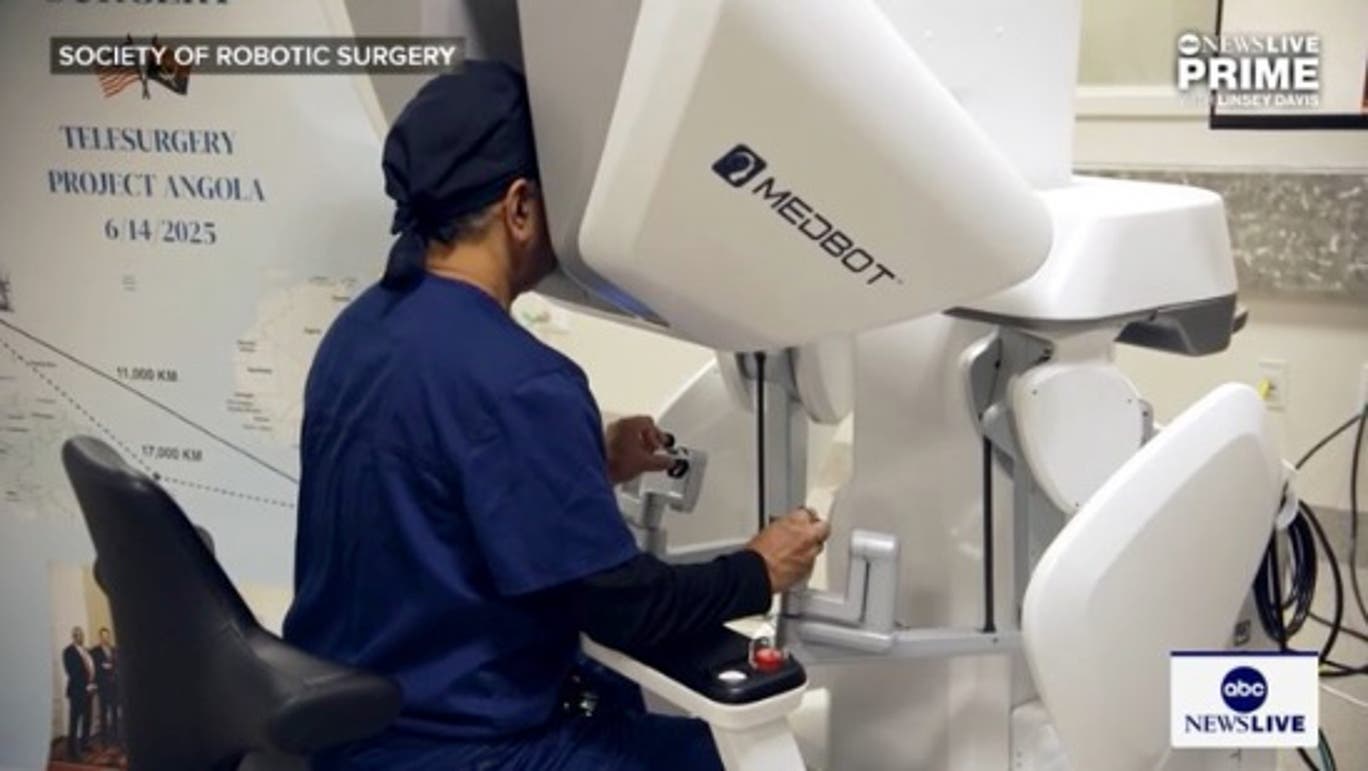
Vipul Patel, the medical director of the Global Robotic Institute at Orlando’s Advent Health, recently performed a prostatectomy, which removes part or all of the prostate, on Fernando da Silva of Angola, ABC News reported in an exclusive story from medical correspondent Dr. Darien Sutton on Tuesday.
Da Silva, 67, was diagnosed with prostate cancer in March, and in June, Patel cut out the cancer using transcontinental robotic telesurgery. The surgery was a success, according to ABC News.
Prostate cancer is very prevalent in Africa, Patel told the network, adding, “In the past, they really haven’t monitored it well or they haven’t had treatments.”
“We’ve been working on this really for two years,” Patel said. “We traveled the globe, looking at the right technologies.”
Da Silva was the first patient in a human clinical trial approved by the Food and Drug Administration to test this technology.
Surgeons have used a multimillion-dollar robot to operate on patients using “enhanced visuals and nimble controls” before, ABC News reported, but they are often near their patients when operating the machine.
Patel used fiber optic cables to test the technology at a long distance from his patient. “There was no perceptible delay in my brain,” the doctor said.
His surgical team was in the operating room with Da Silva just in case they had to jump in.
“We made sure we had plan A, B, C, and D. I always have my team where the patient is,” the doctor said.
In case something went awry with the telecommunications, “the team would just take over and finish the case and do it safely,” he said.
Reflecting on the surgery, Patel called it “a small step for a surgeon, but it was huge leap for health care.”
.
Dr. Vipul Patel in Florida used a robot to remotely perform surgery on a cancer patient thousands of miles away in Africa
Subatomic particles such as quarks can pair up when linked by ‘strings’ of force fields — and release energy when the strings are pulled to the point of breaking. Two teams of physicists have now used quantum computers to mimic this phenomenon and watch it unfold in real time.
The results, described in two Nature papers on June 4, are the latest in a series of breakthroughs towards using quantum computers for simulations that are beyond the ability of any ordinary computers.
“String breaking is a very important process that is not yet fully understood from first principles,” says Christian Bauer, a physicist at the Lawrence Berkeley National Laboratory (LBNL) in Berkeley, California. Physicists can calculate the final results of particle collisions that form or break strings using classical computers, but cannot fully simulate what happens in between. The success of the quantum simulations is “incredibly encouraging,” Bauer says.
String simulations
Each experiment was conducted by an international collaboration involving academic and industry researchers — one team at QuEra Computing, a start-up company in Cambridge, Massachusetts, and another at the Google Quantum AI Lab in Santa Barbara, California.
The researchers using QuEra’s Aquila machine encoded information in atoms that were arranged in a 2D honeycomb pattern, each suspended in place by an optical ‘tweezer’. The quantum state of each atom — a qubit that could be excited or relaxed — represented the electric field at a point in space, explains co-author Daniel González-Cuadra, a theoretical physicist now at the Institute for Theoretical Physics in Madrid. In the other experiment, researchers encoded the 2D quantum field in the states of superconducting loops on Google’s Sycamore chip.
The teams used diametrically opposite quantum-simulation philosophies. The atoms in Aquila were arranged so that the electrostatic forces between them mimicked the behaviour of the electric field, and continuously evolved towards their own states of lower energy — an approach called analogue quantum simulation. The Google machine was instead used as a ‘digital’ quantum simulator: the superconducting loops were made to follow the evolution of the quantum field ‘by hand’, through a discrete sequence of manipulations.
.
The Aquila magneto-optical trap in QuEra’s facilities. QuEra Computing Inc.
The man suspected of opening fire on two Minnesota legislators and their spouses on 14 June, killing one legislator and her husband, was apprehended late on Sunday night and charged with two counts of murder and two of attempted murder, the state’s governor, Tim Walz, said at a news conference.
Vance Boelter, 57, is suspected of fatally shooting the Democratic state representative Melissa Hortman and her husband, Mark, at their residence early on Saturday. Boelter is also suspected of shooting the state senator John Hoffman and his wife, Yvette, at their home, seriously injuring them.
“One man’s unthinkable actions have altered the state of Minnesota,” the state’s governor, Tim Walz, said at a news conference.
Boelter was arrested in a rural area in Sibley County, southwest of Minneapolis, according to police, who added that he was armed when he was taken into custody.
A criminal complaint unsealed Sunday night said Boelter faces two counts of second-degree murder and two counts of attempted second-degree murder in the deaths of the Hortmans and the wounding of Hoffman and his wife.
Authorities alleged Boelter fled on foot after police responded to a shooting at Hortman’s house. Authorities alleged Boelter was wearing a police uniform that so closely resembled an actual law enforcement uniform that most civilians wouldn’t be able to tell the difference.
Earlier Sunday, Drew Evans, superintendent of the Bureau of Criminal Apprehension, said at a news conference a nationwide warrant had been issued for the suspect’s arrest.
Evans said authorities found a car very early Sunday, they believed Boelter was using, a few miles from his home in Green Isle, in the farm country about an hour west of Minneapolis. He also said they found evidence in the car that was relevant to the investigation, but did not provide details.
The superintendent also said authorities interviewed Boelter’s wife and other family members in connection with Saturday’s shootings. He said they were cooperative and were not in custody.
The FBI had issued a reward of up to $50,000 for information leading to his arrest and conviction. They circulated a photo taken Saturday of Boelter wearing a tan cowboy hat and asked the public to report sightings.
On Sunday evening, US Senator Amy Klobuchar shared a statement from Yvette Hoffman expressing appreciation for the outpouring of public support.
“John is enduring many surgeries right now and is closer every hour to being out of the woods,” Yvette Hoffman said in a text that Klobuchar posted on social media. “He took 9 bullet hits. I took 8, and we are both incredibly lucky to be alive. We are gutted and devastated by the loss of Melissa and Mark.”
Warnings of a potentially dangerous invasive ant have popped up on news sites and social media this week. You’d be forgiven for thinking a new threat had arrived. But this insect, the Asian needle ant (Brachyponera chinensis), is no newcomer—just a master of remaining inconspicuous.
The ant is getting attention after University of Georgia (UGA) entomologist Dan Suiter issued a warning that its sting can be remarkably painful and sometimes cause a serious allergic reaction called anaphylaxis. The ant is not new or spreading any faster than it used to, Suiter says. Rather, as a UGA Cooperative Extension entomologist, he’s been getting calls about people being stung by the ant and needing hospital care. With summer in full swing, the insect is active, and people are likely to be in the woods or in their gardens where they might encounter it, prompting Suiter to raise awareness of the species.
“By this time last year, I had fielded three calls of people who had been stung by an Asian needle ant—they knew it was an Asian needle ant—and suffered anaphylaxis,” Suiter says. The problem, he adds, is that the insect is small, black, and nondescript. “You’re not thinking that ‘this tiny little creature right here could have consequences if it stung me.’”
The Asian needle ant is native to Japan, Korea, and China. It arrived in the U.S. around or before the 1930s, probably in ships carrying plants and livestock, “before we even realized that is a great way to spread things around,” says Theresa Dellinger, a diagnostician at the Insect Identification Lab at Virginia Tech. It’s not clear precisely where the ant has spread within the U.S., but it’s plentiful in the Southeast and appears to range as far north as Massachusetts, according to sightings on the community science app iNaturalist. It’s not often seen farther west than Missouri, probably because it’s not well-adapted to arid conditions, Dellinger says.
Studies have found that when Asian needle ants move into an area, they outcompete native ants, reducing ant diversity.
These ants don’t lay down pheromone trails to lead their colony to food, so you won’t see them marching in a line like the little black ant (Monomorium minimum). Instead, when an Asian needle ant finds food, it will return to its colony, pick up another worker and physically carry it to the jackpot, says Christopher Hayes, an entomologist at North Carolina State University.
And unlike fire ants, Asian needle ants don’t build big nest mounds. Instead they love nesting in damp wood, such as fallen logs or wet mulch. While they aren’t particularly aggressive, they will sting to protect their nest, making them a danger to the home gardener.
Their sting is initially more painful than a fire ant sting, Hayes says, but also irritatingly persistent, like fiberglass under the skin. The pain can also come and go. Hayes’s two-year-old son recently got a sting. The little boy was fine after a few minutes, Hayes says, but then woke up after midnight that night crying about the pain again.
In their native range, Asian needle ant bites are associated with a 2 percent risk of anaphylaxis compared with a 0.5 to 1.5 percent risk from the bites of fire ants, Hayes says.
.
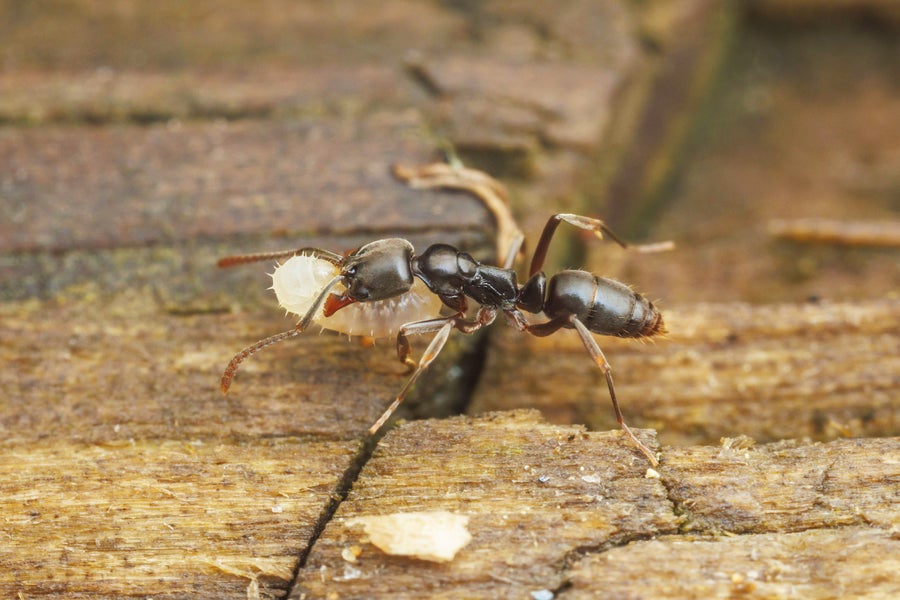
An Asian Needle Ant (Brachyponera chinensis) worker moves a larva from a disturbed nest. Clarence Holmes Wildlife/Alamy Stock Photo
My family tree has always felt more like an orchard. I have two half-siblings who are unrelated to each other, but I’m so close to both of them you’ll never catch me using that term again. Ashley is nine years older than me, and my little brother, Garrett, is 20 years my junior. Now that I’m a mom to a 4-year-old boy, I hear many parents wondering if they should have more kids now, “you know, so they’re close in age.”
I’m not sure where that comes from, this pervasive idea that in order for siblings to have a close relationship, they have to be close in age. That has never been my reality. When I was a baby, our mom had to tell Ashley to stop carrying me everywhere or I’d never learn how to walk. She continued her diligent older sister duties in new ways, though, teaching me to read and write before I’d started preschool, my bubbly big letters matching hers almost exactly.
Early on, we quibbled like all siblings do. When I was a toddler, she convinced me my family had rescued me from a dumpster behind the hospital; that’s why I didn’t look like her or mom. I repaid her on other occasions, like the time I slammed her face into an alphabet peg puzzle. She was trying to convince me the M was a W so I hissed, “Don’t mess with the baby,” and let her have it.
Once everyone’s frontal lobe developed more fully, we didn’t fight much at all. I think this was because, at nine years apart, there was never any competition between us. I coveted everything she owned, sure, from her Abercrombie & Fitch clothes to the Bath & Body Works Cucumber Melon body spray she was allowed to wear to school. It didn’t matter that my mom said it smelled like stale fruit salad and made her roll down her window for the whole drive. To me, Ashley was the epitome of everything pretty and cool, and I wanted to be just like her. When she’d let me sit in her room while she straightened my hair, and I didn’t even care how many times she clamped the tops of my ears with the hot iron in the process, I was at the height of my glory.
Like all siblings, we had secrets just between us. After she’d moved out of the house and gotten a car — a decrepit Ford Taurus with a hole in the bumper — she’d pick me up from fourth grade or drive me to our grandparents’ house. We’d cruise across the causeway between the barrier island and Florida’s mainland, windows down, Ash rapping the lyrics to an absolutely vile Nate Dogg song I knew Mom would loathe. (I tracked it down and put it on my iPod as soon as I got one.)
If you have another baby in five, seven, 10 more years, your firstborn will still be close with their sibling — just not in age.
Sometimes I blabbed her secrets, like once when I was 7 and she had her boyfriend over to hang out when she was supposed to be watching me. I’m pretty sure she’s never told a single one of mine, though. Once she had a job and was all moved in with Jason, her high school sweetheart and now husband, in their first apartment, cobbling together her own life, she still came to all of my award ceremonies, birthday parties, and science fair events. My favorite picture of my college graduation is one my friend snapped of my face on the Jumbotron while crossing the stage, my mom and sister’s hands thrown up to the sky in front of it, both of them screaming, I’m sure.
Then, when I was 20, my little brother was born — my dad and the woman I considered my stepmom had told me she was pregnant shortly after my 19th birthday. I was shocked but excited. I spent my entire spring break hanging around their house, waiting for him to come. When I met him in the hospital, I thought he was the cutest thing I’d ever seen.
.
You don’t have to have kids close together for them to be close at all.
In the predawn darkness on Friday local time, Israeli military aircraft struck one of Iran’s uranium-enrichment complexes near the city of Natanz. The warheads aimed to do more than shatter concrete; they were meant to buy time, according to news reports. For months, Iran had seemed to be edging ever closer to “breakout,” the point at which its growing stockpile of partially enriched uranium could be converted into fuel for a nuclear bomb. (Iran has denied that it has been pursuing nuclear weapons development.)
But why did the strike occur now? One consideration could involve the way enrichment complexes work. Natural uranium is composed almost entirely of uranium 238, or U-238, an isotope that is relatively “heavy” (meaning it has more neutrons in its nucleus). Only about 0.7 percent is uranium 235 (U-235), a lighter isotope that is capable of sustaining a nuclear chain reaction. That means that in natural uranium, only seven atoms in 1,000 are the lighter, fission-ready U-235; “enrichment” simply means raising the percentage of U-235.
U-235 can be used in warheads because its nucleus can easily be split. The International Atomic Energy Agency uses 25 kilograms of contained U-235 as the benchmark amount deemed sufficient for a first-generation implosion bomb. In such a weapon, the U-235 is surrounded by conventional explosives that, when detonated, compress the isotope. A separate device releases a neutron stream. (Neutrons are the neutral subatomic particle in an atom’s nucleus that adds to their mass.) Each time a neutron strikes a U-235 atom, the atom fissions; it divides and spits out, on average, two or three fresh neutrons, plus a burst of energy in the form of heat and gamma radiation. And the emitted neutrons in turn strike other U-235 nuclei, creating a self-sustaining chain reaction among the U-235 atoms that have been packed together into a critical mass. The result is a nuclear explosion. By contrast, the more common isotope, U-238, usually absorbs slow neutrons without splitting and cannot drive such a devastating chain reaction.
To enrich uranium so that it contains enough U-235, the “yellowcake” uranium powder that comes out of a mine must go through a lengthy process of conversions to transform it from a solid into the gas uranium hexafluoride. First, a series of chemical processes refine the uranium, and then, at high temperatures, each uranium atom is bound to six fluorine atoms. The result, uranium hexafluoride, is unusual: below 56 degrees Celsius (132.8 degrees Fahrenheit) it is a white, waxy solid, but just above that temperature, it sublimates into a dense, invisible gas.
During enrichment, this uranium hexafluoride is loaded into a centrifuge: a metal cylinder that spins at tens of thousands of revolutions per minute, faster than the blades of a jet engine. As the heavier U-238 molecules drift toward the cylinder wall, the lighter U-235 molecules remain closer to the center and are siphoned off. This new, slightly U-235-richer gas is then put into the next centrifuge. The process is repeated 10 to 20 times as ever more enriched gas is sent through a series of centrifuges.
Enrichment is a slow process, but the Iranian government has been working on this for years and already holds roughly 400 kilograms of uranium enriched to 60 percent U-235. This falls short of the 90 percent required for nuclear weapons. But whereas Iran’s first-generation IR-1 centrifuges whirl at about 63,000 revolutions per minute and do relatively modest work, its newer IR-6 models, built from high-strength carbon fiber, spin faster and produce enriched uranium far more quickly.
.
Men work inside of a uranium conversion facility just outside the city of Isfahan, Iran, on March 30, 2005. The facility in Isfahan made hexaflouride gas, which was then enriched by feeding it into centrifuges at a facility in Natanz, Iran. Getty Images
Film and Writing Festival for Comedy. Showcasing best of comedy short films at the FEEDBACK Film Festival. Plus, showcasing best of comedy novels, short stories, poems, screenplays (TV, short, feature) at the festival performed by professional actors.


 Geoffrey Hinton. Photo By Ramsey Cardy/Sportsfile for Collision via Getty Images

 Dr. Vipul Patel in Florida used a robot to remotely perform surgery on a cancer patient thousands of miles away in Africa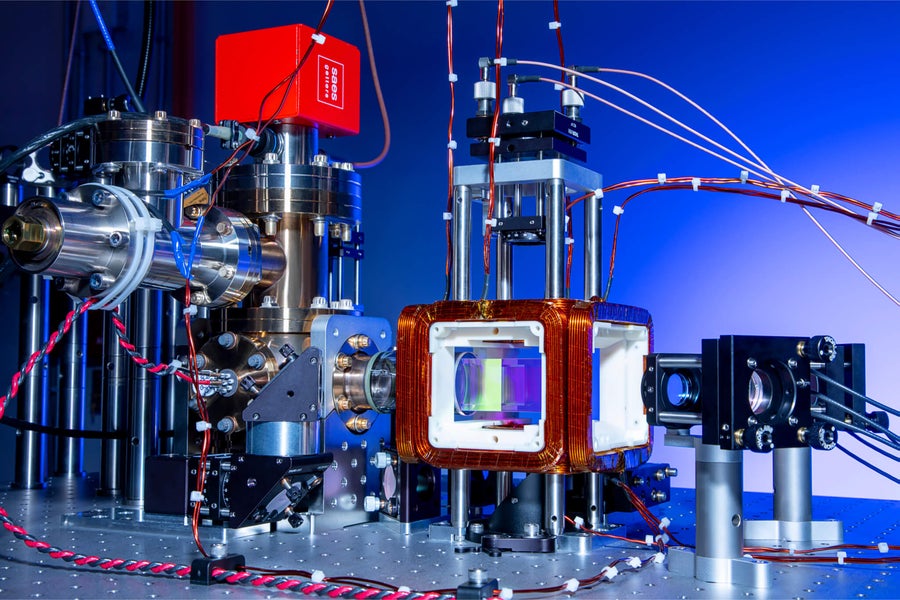





 You don’t have to have kids close together for them to be close at all.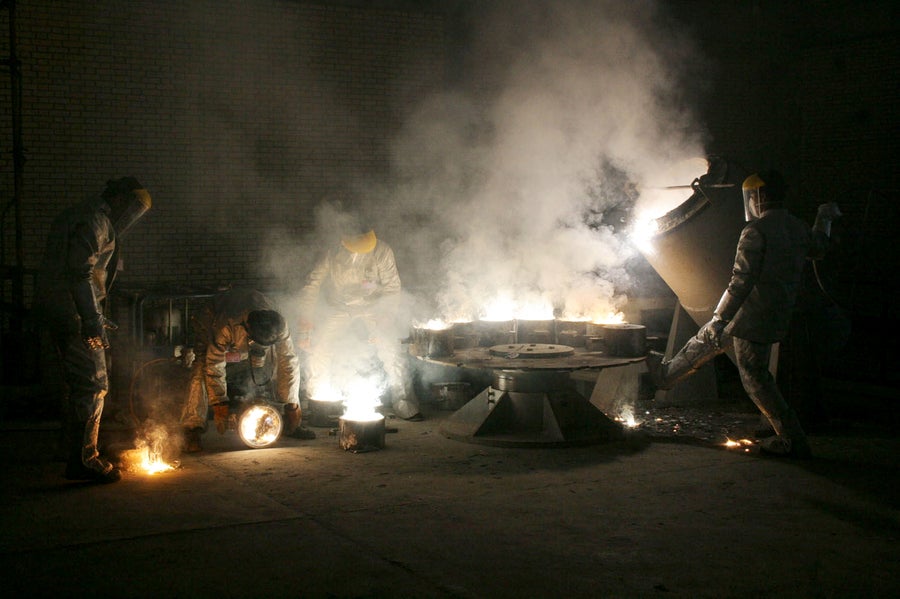
 James' World 2