Home

A Journey Through the Ages: The Global History of UFO Sightings

Leave a comment

Click the link below the picture

.

With all the talk of drones and unexplained theatrics in the skies as of late you have to wonder. Have aliens walked among us since the dawn of time? As a fan of the shows Ancient Aliens, Skinwalker Ranch and of course E.T., like many I’ve always been fascinated with the idea of extra-terrestrials. The history of UFO sightings spans centuries, encompassing a wide range of phenomena that have intrigued, puzzled, and sometimes alarmed people across the globe. This article will take you through the evolution of UFO sightings, from ancient accounts to modern-day encounters, highlighting significant incidents that have contributed to the ongoing debate and fascination with unidentified flying objects.

Ancient Beginnings

The story of UFO sightings begins in ancient times. Texts, artworks, and even cave paintings from different cultures hint at encounters with celestial phenomena or beings that could not be explained by the knowledge at the time.

For instance, ancient Indian texts such as the Mahabharata and the Ramayana mention vimanas, flying machines that were used by the gods.

The Middle Ages to the Renaissance

During the Middle Ages and the Renaissance, there were numerous accounts of mysterious objects seen in the sky.

Chronicles from this period describe sightings of strange stars, fiery globes, and cross-shaped objects traversing the heavens, often interpreted through a religious lens as signs from God or omens.

One of the most famous sightings occurred in Nuremberg, Germany, in 1561.

Residents observed what they described as an aerial battle, followed by the appearance of a large black triangular object and a crash-landing outside the city.

This event was documented in the local newspaper, the Nuremberg Gazette.

The 19th Century: Airship Sightings

The 19th century saw a series of “airship” sightings across the United States, particularly during the 1896-1897 period.

Witnesses reported seeing powered, dirigible-like vehicles equipped with searchlights and sometimes occupants piloting them.

These sightings occurred before human flight was a reality, making them particularly puzzling and sensational at the time.

Echoes of Impermanence: The Rise and Fall of Ancient Civilizations and Their Lessons for Today (msn.com)

The Modern Era of UFOs

The modern era of UFO sightings began in earnest in the 20th century, with two pivotal events that shaped public and governmental interest in the phenomenon. 

1947, Kenneth Arnold Incident: The term “flying saucer” was coined after private pilot Kenneth Arnold reported seeing nine crescent-shaped objects flying at high speeds near Mount Rainier, Washington.

This incident garnered national media attention and is often considered the start of the modern UFO era.

1947, Roswell Incident: Perhaps the most famous UFO incident in history occurred near Roswell, New Mexico.

A rancher discovered mysterious wreckage on his land, leading to claims of a recovered alien spacecraft.

The U.S. military stated it was a crashed weather balloon, but the incident has remained at the heart of UFO conspiracy theories.

US says UFO sightings likely secret military tests (bbc.com)

Government Involvement

The increasing number of ‘UFO’ sightings over the years led to governmental investigations.

In the United States, projects such as Project Blue Book (1952-1969) were initiated by the U.S. Air Force to study UFO sightings.

Although officially it concluded that most sightings were misidentifications of natural phenomena or conventional aircraft, the closure of such projects only fueled more speculation and conspiracy theories about government cover-ups.

22 Items You Will Need In Case of a Societal Collapse

Global Sightings

UFO sightings are not limited to the United States; they are a global phenomenon.

From the mass sighting over the Nuremberg skies in the 16th century to the Westall UFO encounter in Australia in 1966, where over 200 students and teachers witnessed an unexplained object land and then take off at incredible speed, to the recent 2004 Nimitz encounter recorded by U.S. Navy pilots, UFO sightings continue to captivate the public’s imagination worldwide.

Conclusion

As we can see, the history of UFO sightings is rich and varied, spanning several different eras and cultures. While many sightings can be explained through scientific analysis as natural phenomena or human-made objects, a small percentage remain unexplained, continuing to intrigue both the public and researchers. With the U.S. government’s recent acknowledgment of unidentified aerial phenomena (UAP) and the release of declassified videos, interest in UFOs has surged, suggesting that the fascination with what might be flying in our skies is far from over.

What are your thoughts? Let me know in the comments!

Next read>>>13 Modern Civilizations Least to Most Likely to Collapse (10 – 50 years)

.https://img-s-msn-com.akamaized.net/tenant/amp/entityid/AA1x46NL.img?w=768&h=439&m=6&x=372&y=61&s=45&d=45

.

.

Click the link below for the complete article:

https://www.msn.com/en-us/news/world/a-journey-through-the-ages-the-global-history-of-ufo-sightings/ar-BB1kuV6o?ocid=widgetonlockscreen&cvid=7aea6c51c82946529353d5296470959c&ei=10

.

__________________________________________

The New Materials that Could Ease Climate Impacts

Leave a comment

Click the link below the picture

.

Though his lab in Skokie, Illinois, is thousands of miles from the deserts of Africa, Timur Islamoglu spends his days thinking about how to find enough water in that arid environment. 

Islamoglu, a lead research scientist at the Materials Discovery Research Institute (MDRI), is working to develop substances with just the right combination of qualities to capture moisture from dry air and turn it into a sustainable source of drinking water. He’s targeting arid regions with relative humidities below 30 percent. “Those are the areas that require these technologies, because climate change is expected to exacerbate droughts and reduce precipitation in these already dry regions, intensifying the need for alternative water sources,” Islamoglu says.  

Sustainability is the primary focus for MDRI, the newest division of UL Research Institutes (ULRI). Launched in 2022, MDRI opened its state-of-the-art laboratory in September 2024, complete with equipment for automating chemical synthesis and data collection for use with machine-learning techniques. The lab’s goal is to tackle the problems of climate change and energy storage with projects aimed at providing safe drinking water, removing excess carbon, and finding more efficient ways to create, store, and use hydrogen as an alternative and clean fuel source. 

“Everyone in the world deserves safe drinking water,” says Stuart Miller, vice president and executive director of MDRI, and providing cheap access to power has great potential to lift people out of poverty. “The greatest challenge that we have now is, how do we do that and still be good stewards of the planet so that we don’t add any carbon dioxide?” Miller says. Developing better materials can help.

Digital-first materials 

In the 170 years since the beginning of the Industrial Revolution, humans have developed all sorts of useful materials to create our modern world. Many of them are petroleum-based. But with carbon from fossil fuels rapidly heating the planet, and a population that could reach 10 billion in the 2050s, humanity needs to move away from petroleum and discover new materials for energy storage and production, Miller says. Finding candidates through trial and error would involve sifting through many combinations of different materials, “and we don’t have the time,” he says. “We don’t have 170 years.” 

So MDRI is taking what its leaders call a digital-first approach. That means combining the expertise of materials scientists and chemists with automated equipment for synthesizing chemicals; a nanoprinter for uniting the generation, combination and deposition of nanoparticle catalysts in one automated process for renewable-energy applications; and sensors that collect a wide range of data, including the humidity in a given lab on a given day. All  that is fed into machine-learning models that can accelerate the discovery process.

To supply arid regions with water, Islamoglu is working on porous materials that can draw moisture out of low-humidity air much as a sponge would. The approach is material-agnostic, so the MDRI team is looking for an inexpensive candidate to capture water from the air. The trick lies in finding the right balance of various characteristics: for example, in low-humidity conditions, the pores have to be small enough to capture the water molecules and concentrate them so they can condense. The materials can’t be too hydrophobic—water-repellent—or they won’t collect the moisture. But they can’t hold the water too tightly, either, or they’d require high temperatures (200 to 300 degrees Celsius) to release it, and generating the energy to reach such temperatures would be expensive. 

Because different climates, such as mildly or highly humid regions, often require different porous-material specifications to optimize water harvesting from the air, that’s also an active research area at MDRI. Water shortages are a growing problem, even in the U.S. and Europe, where food production consumes large quantities of fresh water and climate change alters rainfall patterns. A recent United Nations report lists several developed countries that could suffer from water scarcity by 2040. 

Water into fuel  

A slightly different version of the same material could capture carbon dioxide either directly from air or industrial sources; then it could be converted into something harmless or used to produce new petrochemicals without extracting more oil from the ground. For carbon capture, the pore size of a material is less important than its chemical composition, which allows it to interact with and trap the carbon dioxide, Islamoglu says.

Another way to combat carbon emissions is to use hydrogen-fed fuel cells to produce energy. One important component of a hydrogen-based system is the electrolyzer, which splits water into hydrogen and oxygen. At MDRI, lead scientist Jeff Wu is working to develop better catalysts that make the splitting process more efficient. Existing electrolyzers use rare and expensive precious metals, including platinum and ruthenium. Wu is searching for catalysts that work just as well but are made of cheaper and more abundant metals, such as iron, nickel, or copper.

.

https://static.scientificamerican.com/dam/m/477a4e8ced2152bf/original/gettyimages-1160645020-170667a.jpg?m=1741803923.772&w=900

New chemicals and materials are needed to make the world sustainable.  piranka/E+/Getty Images

.

.

Click the link below for the complete article:

https://www.scientificamerican.com/custom-media/ul-research-institutes/the-new-materials-that-could-ease-climate-impacts/

.

__________________________________________

Can a Parent Not Like Their Kids the Same, But Still Love Them Equally?

Leave a comment

Click the link below the picture

.

With a provocative title and over 175 comments at the time of writing, a thread in the r/Parenting subreddit is getting a lot of attention because a parent has admitted to loving their kids equally, but not liking them all the same.

In the post titled, “The dirty secret my parents never told me,” the Redditor says they believed growing up in a “somewhat large family” that their parents loved all the kids equally. “Now that I’ve been a parent, I think that actually was true,” they add.

Then, the poster goes on to drop the bombshell confession: “But what I didn’t understand, until I had my own kids, is that I wouldn’t like them all equally.”

Loving Your Children vs. Liking Them

The Redditor says one of their kids is a lot like them in all the good ways, while the other reminds them of themselves “in all the cringe-worthy ways.” For instance, this child is “emotionally needy” and “high maintenance.” A third child “is always lying and getting into trouble, and fighting with the rest of their siblings.”

Again, the poster stresses that all the kids are loved equally. “But do I like being around them all equally? Hell no.” They then go on to share that although this realization used to cause a lot of guilt, having the same feelings about your children is “just not the way it works out.”

Finally, the Redditor says that being your kids’ friend is not the primary job of a parent. “It’s to love them and get them ready to function on their own in the world. And I don’t need to like being around them in order to do that,” the poster says.

The Post Was a Conversation Starter For Sure!

Not surprisingly, the hot-button post has divided commenters. 

Many can relate hard to what the poster said, with one sharing, “I have four kids. I love and enjoy them all for different reasons. They also all uniquely irritate me in their own ways.”

Many comments were in a similar vein to this one: “I love all my kids the same, and quite honestly, they all take turns stressing me out or melting my heart completely. I literally couldn’t tell you which ones I like better on a consistent basis because it’s always changing!”

Dozens of commenters agreed that which of their kids they like the most varies by the day, hour, or even minute, and often it’s age and stage-related. For instance, teenagers and toddlers understandably make liking your kids all the time a challenge for so many parents who responded to this thread.

But many Reddit users reacted differently to the share, with one cautioning the original poster, “I hope you do a good job not letting it show though.” Meanwhile, another noted that kids can sense how their parents feel about them versus their siblings.

“It’s not nice growing up in a house where you know you’re liked a lot less than your siblings,” someone else acknowledged, while another poster agreed, “My entire life, I felt this from my mom. I’ve always said that she loves me because she’s my mom and has to, but doesn’t actually like me. We can always tell.”

Yet another Reddit user had an even more pointed message for the poster, writing, “You have a favorite, and just by how you describe your other child, it’s probably pretty obvious to everyone around you, including that child… which is probably why they’re acting out.”

To be fair, the post was commended by several Redditors, like one who said, “This is really insightful. It makes so much sense that love and liking can be different emotions. It’s tough to balance those feelings as a parent. I admire your honesty in sharing this struggle.”

And someone else defended the poster against critics by saying in part, “I know you’re a great parent. S****y parents aren’t making posts on Reddit second guessing themselves on how they’re doing as parents.”

.

https://www.parents.com/thmb/LE4Hcd4P711LlfM3ZO3ascbLfdc=/750x0/filters:no_upscale():max_bytes(150000):strip_icc()/Parents-LovevsLikeYourKids-88d5385b1c7f4fc08b413c15ad7d6005.jpgPhoto:  Parents / Zing Images via Getty Images

.

.

Click the link below for the complete article:

https://www.parents.com/parent-loves-kids-equally-but-doesnt-like-them-the-same-8753872

.

__________________________________________

Scientists Find Universe’s Missing Matter in Intergalactic ‘Cosmic Fog’

2 Comments

Click the link below the picture

.

Half of the universe’s ordinary matter was missing — until now.

Astronomers have used mysterious but powerful explosions of energy called fast radio bursts (FRBs) to detect the universe’s missing “normal” matter for the first time.

This previously missing stuff isn’t dark matter, the mysterious substance that accounts for around 85% of the material universe but remains invisible because it doesn’t interact with light. Instead, it is ordinary matter made out of atoms (composed of baryons) that does interact with light but has until now just been too dark to see.

Though this puzzle might not quite get as much attention as the dark matter conundrum — at least we knew what this missing matter is, while the nature of dark matter is unknown — but its AWOL status has been a frustrating problem in cosmology nonetheless. The missing baryonic matter problem has persisted because it is spread incredibly thinly through halos that surround galaxies and in diffuse clouds that drift in the space between galaxies.

Now, a team of astronomers discovered and accounted for this missing everyday matter by using FRBs to illuminate wispy structures lying between us and the distant sources of these brief but powerful bursts of radio waves.

“The FRBs shine through the fog of the intergalactic medium, and by precisely measuring how the light slows down, we can weigh that fog, even when it’s too faint to see,” study team leader Liam Connor, a researcher at the Center for Astrophysics, Harvard & Smithsonian (CfA), said in a statement.

How FRBs Illuminate Missing Matter

FRBs are pulses of radio waves that often last for mere milliseconds, but in this brief time they can emit as much energy as the sun radiates in 30 years. Their origins remain something of a mystery. That’s because the short duration of these flashes and the fact that most occur only once make them notoriously hard to trace back to their source.

Yet for some time, their potential to help “weigh” the matter between galaxies has been evident to astronomers. Though thousands of FRBs have been discovered, not all were suitable for this purpose. That’s because, to act as a gauge of the matter between the FRB and Earth, the energy burst has to have a localized point of origin with a known distance from our planet. Thus far, astronomers have only managed to perform this localization for about 100 FRBs.

Connor and colleagues, including California Institute of Technology (Caltech) assistant professor Vikram Ravi, utilized 69 FRBs from sources at distances of between 11.7 million to about 9.1 billion light-years away. The FRB from this maximum distance, FRB 20230521B, is the most distant FRB source ever discovered.

Of the 69 FRBs used by the team, 39 were discovered by a network of 110 radio telescopes located at Caltech’s Owen Valley Radio Observatory (OVRO) called the Deep Synoptic Array (DSA). The DSA was built with the specific mission of spotting and localizing FRBs to their home galaxies.

Once this had been done, instruments at Hawaii’s W. M. Keck Observatory and at the Palomar Observatory near San Diego were used the measure the distance between Earth and these FRB-source galaxies.

Many of the remaining FRBs were discovered by the Australian Square Kilometre Array Pathfinder (ASKAP), a network of radio telescopes in Western Australia that has excelled in the detection and localization of FRBs since it began operations.

As FRBs pass through matter, the light that comprises them is split into different wavelengths. This is just like what happens when sunlight passes through a prism and creates a rainbow diffraction pattern.

.

https://static.scientificamerican.com/dam/m/6a87420de91f17d3/original/cosmic_web_large_scale_structure_of_universe.jpg?m=1750181730.389&w=900

Astronomers have long struggled to see and study the dilute, dark gas and dust between galaxies, depicted in this artist’s concept as blue and purple filaments in a vast ‘cosmic web.’  Mark Garlick/Science Photo Library/Getty Images

.

.

Click the link below for the complete article:

https://www.scientificamerican.com/article/scientists-find-universes-missing-matter-in-intergalactic-cosmic-fog/

.

__________________________________________

The Unstoppable Lauren Sánchez Bezos has the money to send her to space, but Sánchez is the gravitational force.

Leave a comment

Click the link below the picture

.

In 2016, Lauren Sánchez, then 46, was flying high. The daughter of an aviation specialist, she had a helicopter pilots’ license but had found herself wanting more. She wasn’t tight on cash — she was married to Patrick Whitesell, a Hollywood superagent known for helping launch the careers of such talent as Ben Affleck and Matt Damon — and she purchased an Astar chopper, a famously tricky aircraft, nicknamed the Squirrel because of how dodgy it feels to land. Then she sought out Steve Stafford, an Astar expert, for advanced training. Stafford had never before encountered a woman who wanted to fly the Squirrel. Learning the proper techniques was grueling work, but Sánchez was unfazed. “I really couldn’t believe her energy level,” he said. “She just never ran out of gas. I mean, if she could take a helicopter and fly it to the surface of the moon, she’d do that.”

Back on land, Sánchez would soon prove similarly unshakeable. Sometime in the coming months, she would began an extramarital relationship with Jeff Bezos. By the summer of 2018, when Bezos had become the richest man on earth, Sánchez’s estranged brother, Michael, was in conversations with the Enquirer, arranging to publish private text messages between the illicit couple. When the lid finally blew off, that January, Sánchez appeared steady and smiling. She and Bezos leaned headfirst into the attention, and this is the way the pair has lived since: publicly, proudly, and with pomp, as though to get ahead of their own tailwind.

When the affair first came to light, Bezos was still married to MacKenzie Scott, the brainy and discreet Princeton alum with whom he shared four children, who’d helped him get Amazon off the ground back in 1994. Sánchez, who had three children of her own — two with Whitesell and one with her ex-boyfriend, the former NFL tight end Tony Gonzalez — was a sharp pivot. A broadcaster and a glitzed-up woman about town in Hollywood, she was an easy target for anyone prone to slinging gold-digger accusations. Amazon shareholders were spooked by news of the scandal, and the company’s stock price fell 5 percent. The whole thing seemed likely to be a short-lived, tawdry incident.

In 2016, Lauren Sánchez, then 46, was flying high. The daughter of an aviation specialist, she had a helicopter pilots’ license but had found herself wanting more. She wasn’t tight on cash — she was married to Patrick Whitesell, a Hollywood superagent known for helping launch the careers of such talent as Ben Affleck and Matt Damon — and she purchased an Astar chopper, a famously tricky aircraft, nicknamed the Squirrel because of how dodgy it feels to land. Then she sought out Steve Stafford, an Astar expert, for advanced training. Stafford had never before encountered a woman who wanted to fly the Squirrel. Learning the proper techniques was grueling work, but Sánchez was unfazed. “I really couldn’t believe her energy level,” he said. “She just never ran out of gas. I mean, if she could take a helicopter and fly it to the surface of the moon, she’d do that.”

Back on land, Sánchez would soon prove similarly unshakeable. Sometime in the coming months, she would began an extramarital relationship with Jeff Bezos. By the summer of 2018, when Bezos had become the richest man on earth, Sánchez’s estranged brother, Michael, was in conversations with the Enquirer, arranging to publish private text messages between the illicit couple. When the lid finally blew off, that January, Sánchez appeared steady and smiling. She and Bezos leaned headfirst into the attention, and this is the way the pair has lived since: publicly, proudly, and with pomp, as though to get ahead of their own tailwind.

When the affair first came to light, Bezos was still married to MacKenzie Scott, the brainy and discreet Princeton alum with whom he shared four children, who’d helped him get Amazon off the ground back in 1994. Sánchez, who had three children of her own — two with Whitesell and one with her ex-boyfriend, the former NFL tight end Tony Gonzalez — was a sharp pivot. A broadcaster and a glitzed-up woman about town in Hollywood, she was an easy target for anyone prone to slinging gold-digger accusations. Amazon shareholders were spooked by news of the scandal, and the company’s stock price fell 5 percent. The whole thing seemed likely to be a short-lived, tawdry incident.

The couple, however, doubled down, announcing their respective divorces and setting out on a world tour of PDA and aggressively good times. There they were, enjoying burgers and pizza together in the West Village. There they were, canoodling behind the royals at Wimbledon. There they were, in

the prime-center orchestra seats of Hadestown on Broadway. The couple became so ubiquitous that by 2020, they could go to happy hour at Tribeca watering hole Weather Up and enjoy drinks without attracting much of a fuss.

Next week, the Sánchez-Bezos scandal will finally be reborn as a blessed union. The exact location of the ceremony has yet to be confirmed, but it will reportedly take place in the vicinity of the San Giorgio Maggiore Island in Venice — where, according to local news, the two have booked dozens of the city’s water taxis, as well as its most lavish hotels, including the Gritti Palace and Aman.

Some see it all as a coup for Sánchez. “This seems, to me, to be the pinnacle of a long career of social climbing,” said Matt Belloni, the Hollywood reporter behind the podcast The Town and the entertainment newsletter “What I’m Hearing,” from Puck. “She did it. She made it.”

But Sánchez is not just any arriviste. She is, by many accounts, an untamable force: her drive met by equal charm, sociability, and intelligence. One Hollywood producer I spoke with compared her and her ex-husband, Whitesell: He was “charming … but as vapid as you can get.” Sánchez, on the other hand, well, “I would go to basketball games with her, and think … Okay, she can hang out. She could talk.”

.

Photo-Illustration: Joe Darrow/Source Photographs: Getty Images

.

.

Click the link below for the complete article:

https://www.thecut.com/article/lauren-sanchez-jeff-bezos-girlfriend-relationship-unstoppable.html

.

__________________________________________

Storm chaser jumps into action during bridge collapse amid historic North Carolina tropical rainstorm

Leave a comment

Click the link below the picture

.

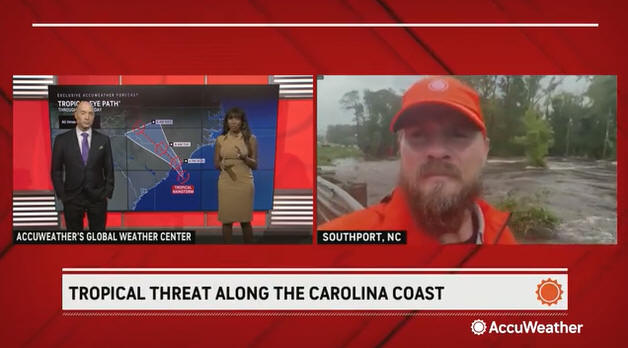
In Southport, North Carolina, the realities of a historic storm played out in real time during AccuWeather’s live broadcast when veteran storm chaser Aaron Jayjack witnessed a man’s SUV sinking into the bridge

Though the tropical rainstorm that rolled through North Carolina on Monday won’t be named, residents across the state, particularly along the coast, will remember this storm for a long time. Coastal counties like Brunswick and New Hanover received more than 20 inches of rain, with some locations receiving 4-5 inches of rain per hour.

In Southport, North Carolina, which received some 23 inches in 48 hours, the realities of the storm played out in real-time. During AccuWeather’s live broadcast, veteran storm chaser Aaron Jayjack was reporting from a bridge above a creek when a portion of the bridge collapsed, taking a man’s SUV with it.

Jayjack told AccuWeather broadcasters Bernie Rayno and Bree Guy that he needed to help that man, a good example of how storm chasers can also serve as vital first responders. When he was able to return to live reporting, Jayjack delivered good news: with the help of other bystanders, he was able to rescue the motorist, who only had minor injuries.

Videos shot by AccuWeather reporters on the scene show cars and roads underwater in Southport and Carolina Beach. And just after noon, the town of Oak Island, 25 miles southwest of Wilmington, North Carolina, declared a state of emergency.

On the ground, Jayjack, who has been studying, chasing and tracking severe weather since the 1990s, put the historic storm in perspective.

“I feel like this is the most intense rain band I’ve ever experienced,” Jayjack said. “It was pure chaos for 30-45 minutes as that band came through.”

He added that some parking lots looked like lakes.

The incident also serves as an important lesson. Jayjack said he saw a dozen or even two dozen cars go through the same spot within the previous half hour before the bridge eventually gave way.

“That’s why it’s important not to drive through floodwaters because you never know what’s going on underneath,” he emphasized.

.

Storm chaser Aaron Jayjack was live on the AccuWeather Network when a bridge collapsed beneath a vehicle trying to cross a flooded bridge. Fortunately, the driver was able to be pulled out.

.

.

Click the link below for the complete article:

https://www.accuweather.com/en/severe-weather/storm-chaser-jumps-into-action-during-bridge-collapse-amid-historic-north-carolina-tropical-rainstorm/1692646

.

__________________________________________

Flesh-Eating ‘Screwworm’ Parasites Are Headed to the U.S.

Leave a comment

Click the link below the picture

.

Officials in nine countries are trying to get a handle on the New World screwworm, a fly whose larvae eat the living flesh of livestock.

The pest is marching northward at an alarming rate and has now moved some 1,400 miles from southern Panama to southern Mexico in about two years. Screwworms are disastrous for ranchers, whose cattle can become infected when the flies lay eggs in cuts or wounds, after which their resulting larvae burrow, or screw, into that flesh. The northernmost sighting is currently about 700 miles south of the U.S. border. 

Since the insect overpowered local containment efforts in Panama’s province of Darién in 2023, it has moved through Central America and is now found as far north as the Mexican state of Oaxaca. Thousands of animals have been infected, and officials have reported dozens of human cases in Costa Rica, Nicaragua, Honduras, and Mexico this year.

As the fly spreads northward from the narrow Darién Gap in Panama and up the funnel of Central America, it becomes harder to control. Agricultural departments suppress fly populations by releasing millions of sterile male flies per week into the environment throughout Central America. These males are raised in a facility in Panama jointly run by that country’s agricultural department and the U.S. Department of Agriculture. Because female screwworms mate only once in their lifetime, this population of infertile males reduces the size of the next generation of flies. Consistent application of this sterile insect technique eradicated the screwworm from the U.S. in 1966 and from regions north of the Darién Gap in 2006.

That invisible wall holding the screwworm back has crumbled, however. “I don’t know how it got away so quickly,” says Maxwell Scott, an entomologist at North Carolina State University, who studies genetic methods to control populations of the fly. “There had to be some movement of infested livestock, particularly through the middle [of Central America]…. It just moved too fast,” Scott says about the swift speed of the screwworm spread. 

On their own, the flies can usually fly no more than about 12 miles in their monthlong lifetime, says Sonja Swiger, an entomologist at Texas A&M University. But the screwworm larvae can travel great distances while developing inside (and gnawing on the flesh of) their hosts. A new generation reaches sexual maturity every week to two weeks, and females can lay up to 2,800 eggs over the course of their lifespan, according to the California Department of Food & Agriculture.

Most people aren’t at risk of screwworm infections, which are rare compared with those in livestock. But cases have appeared in Central America since the breach of the Darién Gap. Nicaragua first detected the parasite in livestock in March 2024; by February 2025, health officials there confirmed 30 human cases. Costa Rica saw 42 confirmed cases between January and May 2025 and at least two deaths, according to the country’s health ministry. Honduras has reported 40 human cases and three deaths, according to the public health network EpiCore, while Guatemala reported its first human case in May. The Mexican Ministry of Health has confirmed eight human cases.

In humans, infection with fly larvae is known as myiasis. Those who are most at risk for screwworm myiasis are people who work closely with livestock or who sleep outdoors. Treatment involves removing the larvae, sometimes with surgery. 

Screwworms haven’t made it back into the U.S. yet. How quickly this might happen depends on whether agricultural officials can hold the line in Mexico or push the fly southward. On May 27, U.S. Department of Agriculture officials announced $21 million in funding to retrofit a fruit fly production plant in Metapa, Mexico, to produce sterile screwworm flies. When operational, the plant will churn out between 60 million and 100 million additional flies a week to help suppress the breeding population in Mexico.

While the sterile insect technique is likely to remain the key tool in the arsenal against screwworms for years to come, new genetic methods of insect control could eventually come to bear against the problem. In May ethicists and entomologists, including Scott, wrote in a paper in Science that the screwworm is a good candidate for complete elimination with gene drive technology, which involves genetic engineering to ensure that a deadly mutation will be included in an animal’s sperm and egg cells and thus will be passed on to the next generation. The loss of screwworms does not seem to substantially affect the ecosystem, the researchers wrote, and death by the insect is painful and slow.

.

https://static.scientificamerican.com/dam/m/7ab149ec38784481/original/cattle_rancher_in_mexico.jpg?m=1750170101.555&w=900

Screwworm parasites are getting closer and closer to the U.S. border. The parasites primarily infect cows.  Ferrantraite/Getty Images

.

.

Click the link below for the complete article:

https://www.scientificamerican.com/article/flesh-eating-screwworm-parasites-are-headed-to-the-u-s/

.

__________________________________________

Breaking With Trump, Bacon Says He Won’t Follow His Party ‘Off the Cliff’

Leave a comment

Click the link below the picture

.

Representative Don Bacon, Republican of Nebraska, has publicly accused President Trump of treating Russia with “velvet gloves,” criticized him for gutting AmeriCorps and questioned his power to impose tariffs without congressional approval.

He has described Defense Secretary Pete Hegseth’s use of Signal to share sensitive military operations as “unacceptable.” And he was the sole House Republican to vote “no” on a bill to rename the Gulf of Mexico as the “Gulf of America.” He said he thought it was stupid.

Mr. Bacon’s willingness to publicly disagree with the president make him an anomaly in the tribal House Republican Conference, where members tend to fall in line behind Mr. Trump’s agenda and actively seek out ways to demonstrate their loyalty to him. In a Republican-led Congress that has been reluctant to challenge Mr. Trump on almost anything, the Nebraskan is among the last of a disappearing breed in his party. And his recent statements and actions strongly suggest he may be headed for the exits.

While Mr. Bacon has shown an independent streak in his statements, he still often backs down from his “red lines” on policy and votes with his party. After telling the White House that he would not vote for a bill that included more than $500 billion in Medicaid cuts, he ultimately voted “yes” for legislation carrying Mr. Trump’s domestic agenda that included far more.

And after telling The New York Times and House Republican leaders that he was a firm “no” on any cuts to a global anti-AIDS program, he ultimately voted “yes” this week on a package that would claw back $9 billion in spending already approved by Congress and targeted by the Department of Government Efficiency for cuts, including to the President’s Emergency Plan for AIDS Relief.

Still, he is more independent than most of his colleagues. In an interview in his office last week, Mr. Bacon, at 61, serving his fifth term in Congress, would not say whether he voted for Mr. Trump last year. He also likened members of his party to people following someone off a cliff, compared himself to Winston Churchill speaking out against Adolf Hitler in the 1930s, and criticized the billionaire tech tycoon Elon Musk, who has bankrolled many of his Republican colleagues.

“I sort of blame him for that disaster,” he said of Mr. Musk, referring to Mr. Musk’s exhorting Republicans late last year to tank a spending deal that was intended to avert a government shutdown. On one level, Mr. Bacon is making a fairly obvious statement: Mr. Musk did play a crucial role in killing the spending bill. But it is the kind of obvious statement that most Republicans on Capitol Hill are not willing to make these days, for fear of jeopardizing their political futures as Mr. Musk has threatened retribution against anyone who fails to vote the way he believes they should.

In the coming weeks, Mr. Bacon, who represents a center-leaning district in the otherwise deeply red state of Nebraska that both former President Joseph R. Biden Jr. and former Vice President Kamala Harris won by more than 4 percentage points, plans to announce whether or not he will seek a sixth term in Congress.

His retirement would be welcome news for Democrats, who have long viewed Nebraska’s Second Congressional District as one of their best opportunities to pick up a seat. They have consistently been denied because of Mr. Bacon’s strong, independent brand and unique electoral strength. Last month, a Democrat unseated a three-term Republican in the Omaha mayor’s race. The morning after that race was called, Representative Hakeem Jeffries, Democrat of New York and minority leader, told the House Democratic Caucus that they were officially on “Don Bacon retirement watch,” and the room erupted in cheers, according to a person familiar with the meeting.

Mr. Bacon would not discuss his plans, but his recent record of criticizing Mr. Trump and Mr. Musk suggests that he does not have a re-election campaign in mind. Still, in the interview, he said he had not given up on politics or on the Republican Party.

.

https://static01.nyt.com/images/2025/06/06/multimedia/00dc-bacon-TOP-mblq/00dc-bacon-TOP-mblq-superJumbo.jpg?quality=75&auto=webpKenny Holston/The New York Times

.

.

Click the link below for the complete article:

https://www.nytimes.com

.

__________________________________________

What Is Your Cat Trying to Say? These AI Tools Aim to Decipher Meows

Leave a comment

Click the link below the picture

.

Meeaaaoow rises like a question mark before dawn. Anyone living with a cat knows their sounds: broken chirrups like greetings, low growls that warn, purrs stitched into sleepy conversation. Ethologists have organized feline sounds that share acoustic and contextual qualities into more than 20 groupings, including the meow, the hiss, the trill, the yowl, and the chatter. Any individual meow belongs, academically speaking, to a broad “meow” category, which itself contains many variations. The house cat’s verbal repertoire is far greater than that of its largely silent wild cousins. Researchers have even begun to study whether cats can drift into regional dialects, the way human accents bend along the Hudson or the Thames. And just as humans gesticulate, shrug, frown, and raise their eyebrows, cats’ fur and whiskers write subtitles: a twitching tail declares excitement, flattened ears signal fear, and a slow blink promises peace. Felis catus is a chatty species that, over thousands of years of domestication, has pivoted its voice toward the peculiar primate that opens the fridge. Now imagine pointing your phone at that predawn howl and reading: “Refill bowl, please.” Last December, Baidu—a Chinese multinational company that

specializes in Internet services and artificial intelligence—filed a patent application for what it describes as a method for transforming animal vocalizations into human language. (A Baidu spokesperson told Reuters last month that the system is “still in the research phase.”) The proposed system would gather animal signals and process them: it would store kitten or puppy talk for “I’m hungry” as code, then pair it not only with motion-sensing data such as tail swishes but also with vital signs such as heart rate and core temperature. All of these data would get whisked through an AI system and blended before emerging as plain-language phrases in English, Mandarin, or any other tongue.

The dream of decoding cat speech is much older than deep learning. By the early 20th century, meows had been recorded on wax cylinders, and in the 1970s John Bradshaw, a British anthrozoologist, began more than four decades of mapping how domestic cats tell us—and each other—what they mean. By the 1990s, he and his then doctoral student Charlotte Cameron-Beaumont had established that the distinct domestic “meow,” largely absent between adults in feral colonies, is a bespoke tool for managing humans. Even domestic cats rarely use it with each other, though kittens do with their mothers. Yet for all that anecdotal richness, the formal literature remained thin: there were hundreds of papers on bird song and dozens on dolphin whistles, but only a scattering on feline phonology until machine learning revived the field in the past decade.

One of the first hints that computers might crack the cat code came in 2018, when AI scientist Yagya Raj Pandeya and his colleagues released CatSound, a library of roughly 3,000 clips covering 10 types of cat calls labeled by the scientists, from hiss and growl to purr and mother call. Each clip went through software trained on musical recordings to describe a sound’s “shape”—how its pitch rose or fell and how long it lasted—and a second program cataloged them accordingly. When the system was tested on clips it hadn’t seen during training, it identified the right call type around 91 percent of the time. The study showed that the 10 vocal signals had acoustic fingerprints a machine can spot, giving researchers a proof of concept for automated cat-sound classification and eventual translation.

Momentum built quickly. In 2019 researchers at the University of Milan in Italy published a study focused on the one sound aimed squarely at Homo sapiens. The research sliced the meow into three situational flavors: “waiting for food,” “isolation in an unfamiliar environment,” and “brushing.” By turning each meow into a set of numbers, the researchers revealed that a “feed me” meow had a noticeably different shape from a “where are you?” meow or a “brush me” meow. After they trained a computer program to spot those shapes, the researchers tested the system much as Pandeya and colleagues had tested theirs: it was presented with meows not seen during training, all hand-labeled based on circumstances such as hunger or isolation. The system correctly identified the meows up to 96 percent of the time, and the research confirmed that cats really do tweak their meows to match what they’re trying to tell us.

The research was then scaled to smartphones, turning kitchen-table curiosity into consumer AI. Developers at software engineering company Akvelon, including a former Alexa engineer, teamed up with one of the study’s researchers to create the MeowTalk app, which they claim can translate meows in real time. MeowTalk has used machine learning to categorize thousands of user-submitted meows by common intent, such as “I’m hungry,” “I’m thirsty,” “I’m in pain,” “I’m happy,” or “I’m going to attack.” A 2021 validation study by MeowTalk team members claimed success rates near 90 percent. But the app also logs incorrect translation taps from skeptical owners, which serves as a reminder that the cat might be calling for something entirely different in reality. Probability scores can simply reflect pattern similarity, not necessarily the animal’s exact intent.

.

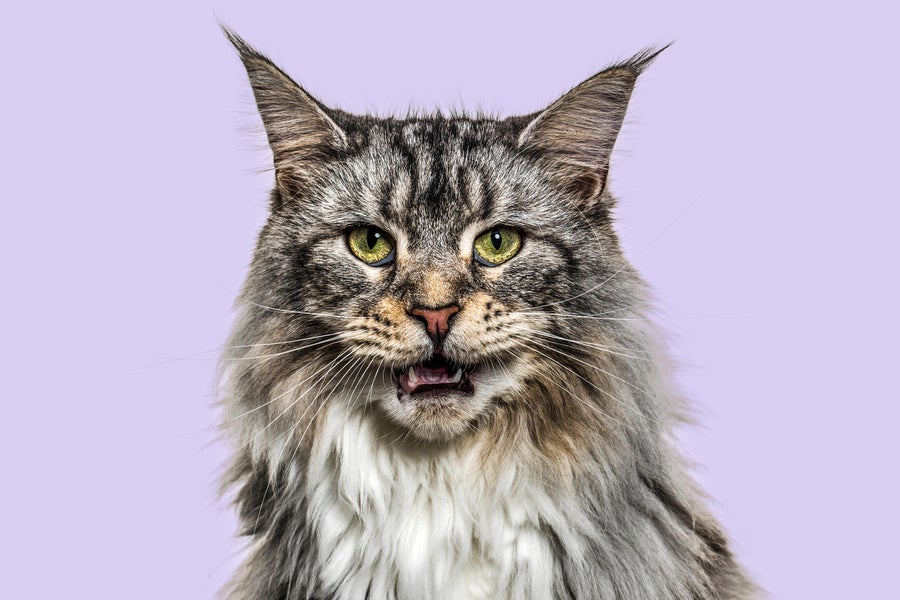
https://static.scientificamerican.com/dam/m/7f01b6ab88c068aa/original/main-coon-cat.jpg?m=1750133799.186&w=900Life on white/Alamy Stock Photo

.

.

Click the link below for the complete article:

https://www.scientificamerican.com/article/what-is-your-cat-trying-to-say-these-ai-tools-aim-to-decipher-meows/

.

__________________________________________

Unlearning Racism: Resources for Teaching Anti-Racism

Leave a comment

Click the link below the picture

.

People are not born racist. As former U.S. President Barack Obama, quoting Nelson Mandela, former president of South Africa, tweeted shortly after the tragic events in Charlottesville August 12, 2017 in which the university town was overtaken by white supremacists and hate groups, resulting in the killing of a counter protester, Heather Heyer, “No one is born hating another person because of the color of his skin or his background or his religion. People must learn to hate, and if they can learn to hate, they can be taught to love, for love comes more naturally to the human heart than its opposite.”

Very young children do not naturally choose friends based on the color of their skin. In a video created by the BBC children’s network CBeebies, Everyone’s Welcome, pairs of children explain the differences between themselves without referring to the color of their skin or ethnicity, even though those differences exist. As Nick Arnold writes in What Adults Can Learn About Discrimination From Kids, according to Sally Palmer, Ph.D., lecturer in the Department of Human Psychology and Human Development at University College London, it is not that they don’t notice the color of their skin, it is that the color of their skin is not what is important to them.

Racism is Learned

Racism is learned behavior. A 2012 study by Harvard University researchers showed that children as young as three years of age can adopt racist behavior when exposed to it, even though they may not understand “why.” According to renowned social psychologist Mazarin Banaji, Ph.D., children are quick to pick up on racist and prejudicial cues from adults and their environment. When white children were shown faces of different skin colors with ambiguous facial expressions, they showed a pro-white bias. This was determined by the fact that they ascribed a happy face to a perceived white skin color and an angry face to a face that they perceived to be black or brown. In the study, Black children who were tested showed no color-bias. Banaji maintains that racial bias can be unlearned, though, when children are in situations where they are exposed to diversity and they witness and are part of positive interactions between different groups of people acting as equals. 

Racism is learned by the example of one’s parents, caregivers, and other influential adults, through personal experience, and through the systems of our society that promulgate it, both explicitly and implicitly. These implicit biases permeate not only our individual decisions but also our societal structure. The New York Times has created a series of informative videos explaining implicit biases. 

There are Different Types of Racism

According to social science, there are seven main forms of racism: representational, ideological, discursive, interactional, institutional, structural, and systemic. Racism can be defined in other ways as well — reverse racism, subtle racism, internalized racism, colorism.

In 1968, the day after Martin Luther King was shot, the anti-racism expert and former third-grade teacher, Jane Elliott, devised a now-famous but then-controversial experiment for her all-white third-grade class in Iowa to teach the children about racism, in which she separated them by eye color into blue and brown, and showed extreme favoritism toward the group with blue eyes. She has conducted this experiment repeatedly for different groups since then, including the audience for an Oprah Winfrey show in 1992, known as The Anti-Racism Experiment That Transformed an Oprah Show. People in the audience were separated by eye color; those with blue eyes were discriminated against while those with brown eyes were treated favorably. The reactions of the audience were illuminating, showing how quickly some people came to identify with their eye color group and behave prejudicially, and what it felt like to be the ones who were being treated unfairly. 

Microaggressions are another expression of racism. As explained in Racial Microagressions in Everyday Life, “Racial microaggressions are brief and commonplace daily verbal, behavioral, or environmental indignities, whether intentional or unintentional, that communicate hostile, derogatory, or negative racial slights and insults toward people of color.” An example of microaggression falls under “assumption of criminal status” and includes someone crossing to the other side of the street to avoid a person of color. This list of microaggressions serves as a tool to recognize them and the messages they send. 

Unlearning Racism

Racism in the extreme is manifested by groups such as the KKK and other white supremacist groups. Christoper Picciolini is the founder of the group Life After Hate. Picciolini is a former member of a hate group, as are all the members of Life After Hate. On Face the Nation in Aug. 2017, Picciolini said that the people who are radicalized and join hate groups are “not motivated by ideology” but rather “a search for identity, community, and purpose.” He stated that “if there’s a brokenness underneath that person, they tend to search for those in really negative pathways.” As this group proves, even extreme racism can be unlearned, and the mission of this organization is to help counter violent extremism and to help those participating in hate groups find pathways out of them.

.

https://www.thoughtco.com/thmb/YKUpgV0YR4VpILDQShHprDPagBU=/750x0/filters:no_upscale():max_bytes(150000):strip_icc()/TeachingAnti-Racism-59a4732b6f53ba0011b9eb30.jpgMulti-ethnic young adults’ hands holding pieces from the same puzzle. Nullplus/E+/Getty Images

.

.

Click the link below for the complete article:

https://www.thoughtco.com/teaching-anti-racism-4149582

.

__________________________________________

Older Entries Newer Entries

Heart of Loia `'.,°~

so looking to the sky ¡ will sing and from my heart to YOU ¡ bring...

Michael Ciullo

CEO and Founder of Nsight Health

MRS. T’S CORNER

https://www.tangietwoods

Nelson MCBS

Catholic News, Prayers, HD Images, Rosary, Music, Videos, Holy Mass, Homily, Saints, Lyrics, Novenas, Retreats, Talks, Devotionals and Many More

Global geopolitics

Decoding Power. Defying Narratives.

Talk Photo

A creative collaboration introducing the art of nature and nature's art.

Movie Burner Entertainment

The Home Of Entertainment News, Reviews and Reactions

Le Notti di Agarthi

Hollow Earth Society

C r i s t i a n a' s Fine Arts ⛄️

•Whenever you are confronted with an opponent, conquer him with love.(Gandhi)

TradingClubsMan

Algotrader at TRADING-CLUBS.COM

Comedy FESTIVAL

Film and Writing Festival for Comedy. Showcasing best of comedy short films at the FEEDBACK Film Festival. Plus, showcasing best of comedy novels, short stories, poems, screenplays (TV, short, feature) at the festival performed by professional actors.

Bonnywood Manor

Peace. Tranquility. Insanity.

Warum ich Rad fahre

Take a ride on the wild side

Madame-Radio

Découvre des musiques prometteuses dans la sphère musicale française (principalement, mais pas que...).

Ir de Compras Online

No tiene que Ser una Pesadilla.

Kana's Chronicles

Life in Kana-text (er... CONtext)

Cross-Border Currents

Tracking money, power, and meaning across borders.

Jam Writes

Where feelings meet metaphors and make questionable choices.

emotionalpeace

Finding hope and peace through writing, art, photography, and faith in Jesus.

WearingTwoGowns.COM

MOVING FORWARD...That's how WINNING is done!”-Rocky Balboa

...

love each other like you're the lyric to their music

Luca nel laboratorio di Dexter

Comprendere il mondo per cambiarlo.

Tales from a Mid-Lifer

Mid-Life Ponderings

Creative

Travel,Tourism, Life style "Now in hundreds of languages for you."

freedomdailywriting

I speak the honest truth. I share my honest opinions. I share my thoughts. A platform to grow and get surprised.

The Green Stars Project

User-generated ratings for ethical consumerism

Cherryl's Blog

Travel and Lifestyle Blog

Sogni e poesie di una donna qualunque

Questo è un piccolo angolo di poesie, canzoni, immagini, video che raccontano le nostre emozioni

My Awesome Blog

“Log your journey to success.” “Where goals turn into progress.”

pierobarbato.com

scrivo per dare forma ai silenzi e anima alle storie che il mondo dimentica.

Thinkbigwithbukonla

“Dream deeper. Believe bolder. Live transformed.”

Vichar Darshanam

Vichar, Motivation, Kadwi Baat ( विचार दर्शनम्)

Komfort bad heizung

Traum zur Realität

Chic Bites and Flights

Savor. Style. See the world.

ومضات في تطوير الذات

معا نحو النجاح

Broker True Ratings

Best Forex Broker Ratings & Reviews

Blog by ThE NoThInG DrOnEs

art, writing and music by James McFarlane and other musicians

fauxcroft

living life in conscious reality

Srikanth’s poetry

Freelance poetry writing

JupiterPlanet

Peace 🕊️ | Spiritual 🌠 | 📚 Non-fiction | Motivation🔥 | Self-Love💕

Sehnsuchtsbummler

Reiseberichte & Naturfotografie