July 5, 2025
Mohenjo
Business, Food For Thought, Human Interest, Political, Science, Technical
amazon, business, Business News, current-events, Future, Hotels, human-rights, medicine, mental-health, research, Science, Science News, technology, Technology News, travel, vacation

Click the link below the picture
.
CLIMATEWIRE | Temperatures are finally falling in the eastern U.S. as a vicious heat dome begins to subside. But such sweltering early-summer heat will only get more frequent in the years to come.
That’s because this week’s heat wave — which tumbled century-old temperature records in some areas — was clearly influenced by climate change, scientists say. The heat dome is just one consequence of the “stuck” weather patterns that are on the rise as the planet warms.
A recent study, published June 16 in the scientific journal Proceedings of the National Academy of Sciences, warns of the rising dangers of such long-lasting weather patterns, which can prompt not just heat waves but also heavy rainfall and floods.
This week, the heat index — or what the temperature actually feels like to human skin — rose well above 100 degrees in many areas. Minneapolis also broke a daily high last set in 1910 when the city hit 96 degrees Saturday, and New York City tied its 1888 record of 96 degrees in Central Park on Monday.
The new study suggests that the phenomenon behind such extreme weather may have a surprising origin: rapid warming, hundreds of miles away, in the icy Arctic.
Researchers from the University of Pennsylvania and Lawrence Berkeley National Laboratory investigated natural atmospheric patterns known as planetary waves. These wobbly air currents meander up and down as they circle the globe — and when they intensify, they sometimes lead to storms or heat domes stagnating in place for days at a time.
The study looked at the frequency of planet wave “resonance events,” or temporary intensifications. They found that these kinds of stalled atmospheric patterns have tripled over the last 70 years. At the same time, extreme summer weather — like heat waves and floods — have also grown more common.
Climate models have long predicted that these patterns would occur more frequently with climate change. But the new study is the first to demonstrate that it’s already happening, the authors say.
Still, the exact causes of these planetary wave events are an active research topic.
Some research suggests that rapid warming in the Arctic — which is heating up as much as four times faster than the rest of the globe — is altering the atmosphere in ways that shift the jet stream south and affect the planetary waves. Other studies suggest that tropical warming may actually yank the jet stream poleward. And some researchers say planetary waves may be impacted by a tug-of-war between these two influences.
Computer models aren’t always able to fully simulate these physical responses, making it a difficult subject to study. Scientists have been investigating — and debating — the exact physical effects of global warming on atmospheric circulation patterns for years.
But the new study adds to the evidence that Arctic warming plays a role. It shows that periods of warmer temperatures in the high latitudes are associated with increases in planetary wave resonance events. It also demonstrates that the growing global contrast between land temperatures and ocean temperatures — since land is warming faster than water worldwide — has also played a part.
.

The sun rises over Manhattan on June 24, 2025, in New York City as the first heat wave of the year moves across parts of the Midwest and East Coast. Spencer Platt/Getty Images
.
.
Click the link below for the complete article:
.
__________________________________________
July 5, 2025
Mohenjo
Business, Food For Thought, Human Interest, Political, Science, Technical
amazon, business, Business News, current-events, Future, Hotels, human-rights, medicine, mental-health, research, Science, Science News, technology, Technology News, travel, vacation

Click the link below the picture
.
Ken Casey, the founder and front man of the Celtic punk band Dropkick Murphys, is the physical, attitudinal, and linguistic personification of Boston. Proof of this can be found in the way he pronounces MAGA. To wit: “Magger,” as in, “This Magger guy in the audience was waving his fucking Trump hat in people’s faces, and I could just tell he wanted to enter into discourse with me.” A second proof is that “enter into discourse” is a thing Ben Affleck would say in a movie about South Boston right before punching someone in the face. The third is Casey’s articulation of what I took to be a personal code: “I’m not going to shut up, just out of spite.
”The aforementioned discourse took place at a show in Florida in March. Video of the incident has moved across the internet, and it has provoked at least some Dropkick Murphy fans—white, male, and not particularly predisposed to the Democratic Party in its current form—to abandon the band. Casey accepts this as the price for preserving his soul. “I think everything we’ve been doing for the past 30 years was a kind of warm-up for the moment we’re in,” he told me. The band is most famous for its furious, frenzied anthem “I’m Shipping Up to Boston,” but it is also known, among certain high-information voters and union activists, as a last repository of working-class values. As white men have lurched to the right, the band is on a mission to convince them that they’re being played by a grifter. “Thirty years ago, the Reagan era, everyone was in lockstep with what we were saying,” he said. “Now people say our message is outdated or elite or we’re part of some machine.”
.
 Justin Kaneps for The Atlantic
.
.
Click the link below for the complete article:
.
__________________________________________
July 5, 2025
Mohenjo
Business, Food For Thought, Human Interest, Political, Science, Technical
amazon, business, Business News, current-events, Future, Hotels, human-rights, medicine, mental-health, research, Science, Science News, technology, Technology News, travel, vacation

Click the link below the picture
.
On April 8th, the Ministry of Tourism and Antiquities of Egypt announced the discovery of “The Rise of Aten,” a city in Luxor buried under layers of sand for 3,000 years, dating back to the reign of Amenhotep III. This city, used during the reigns of Amenhotep III, Akhenaten, Tutankhamun, and King Ay, was revealed through mudbrick walls and everyday life objects. Important finds include hieroglyphic inscriptions on wine vessel caps, rings, scarabs, colored pottery vessels, and mud bricks with seals of Amenhotep III. In just seven months of excavations, several neighborhoods have been uncovered, including a bakery with ovens and storage pottery, and an administrative district with larger units and a rare zigzag wall. A workshop for mudbrick production was also discovered, featuring the cartouche of King Amenhotep III (Neb Maat Ra). The city’s streets are lined with houses, some walls reaching up to three meters in height, extending westward to Deir el-Medina. #RiseOfAten #LostGoldenCity #CityDiscoveredLuxor
.
 Kaylee
.
.
Click the link below for the complete video (sound on):
.
__________________________________________
July 4, 2025
Mohenjo
Business, Food For Thought, Human Interest, Political, Science, Technical
amazon, business, Business News, current-events, Future, Hotels, human-rights, medicine, mental-health, research, Science, Science News, technology, Technology News, travel, vacation
 .
.
__________________________________________
July 4, 2025
Mohenjo
Business, Food For Thought, Human Interest, Political, Science, Technical, Uncategorized
amazon, business, Business News, current-events, Future, Hotels, human-rights, medicine, mental-health, research, Science, Science News, technology, Technology News, travel, vacation
Hmmmm…
.
Estimates suggest that the Trump administration’s spending practices, including wasteful expenditures and corruption, have led to significant financial losses for taxpayers, with reports indicating potential losses of between $233 billion and $521 billion annually due to fraud and inefficiency. Specific figures on total waste are difficult to pinpoint, but the administration’s actions have been widely criticized for lacking accountability and transparency. DuckDuckAi
The White House
Wikipedia
Overview of Spending Under Trump
During Donald Trump’s presidency, significant increases in federal spending and national debt occurred, raising concerns about wasteful expenditures.
National Debt Increase
The national debt rose by approximately $7.8 trillion during Trump’s time in office.
This increase is nearly twice the total amount of consumer debt (excluding mortgages) owed by Americans.
Major Spending Areas
The largest portions of federal spending during Trump’s presidency included:
Category Description
Military and Veterans Direct payments and operational costs
Social Security Payments to retirees and disabled individuals
Medicare and Medicaid Health care for seniors and low-income families
Interest on Debt Payments on the growing national debt
Wasteful Spending Claims
Trump’s administration faced criticism for extravagant spending by Cabinet members, including private flights and costly office upgrades.
The Department of Government Efficiency (DOGE) claimed to have saved $160 billion by cutting smaller programs, but many of these cuts were politically motivated and did not address larger spending areas.
Transparency Initiatives
Trump signed a memorandum aimed at increasing transparency regarding wasteful spending, requiring federal agencies to disclose details about canceled contracts and programs.
Overall, while efforts were made to cut spending, the national debt and claims of wasteful expenditures suggest a complex financial legacy.
.
__________________________________________
July 4, 2025
Mohenjo
Business, Food For Thought, Human Interest, Political, Science, Technical
amazon, business, Business News, current-events, Future, Hotels, human-rights, medicine, mental-health, research, Science, Science News, technology, Technology News, travel, vacation

Click the link below the picture
.
It appears our solar system is getting more popular with out-of-towners.
Astronomers may have found a third interstellar object, something that has origins beyond our own solar system.
The first interstellar object was ‘Oumuamua, discovered in 2017. The second was a comet called 2I Borisov.
This new object, named 3I/ATLAS, or C/2025 N1 (ATLAS) by the International Astronomical Union’s Minor Planet Center, was discovered using a survey telescope called the Asteroid Terrestrial-impact Last Alert System (ATLAS), which serves as an asteroid impact early warning system.
3I/ATLAS is not believed to pose any danger to Earth.
“We now have observations from over a week or so that indicate that its orbit is pretty clearly interstellar,” said Paul Weigert, a professor at Western University’s department of physics and astronomy in London, Ont. “It’s travelling too fast to be bound to the sun, and so it has presumably come to us from outside our solar system.”
When first discovered, ‘Oumuamua was believed to be an oblong asteroid, but followup observations confirmed that it was a comet, just as 2I Borisov was later.
Astronomers with new observations have seen some signs of a tail on this new object, meaning it is also likely a comet.
The reason that astronomers believe3I/ATLAS comes from beyond our solar system is due to something called its eccentricity.
Objects with high eccentricities indicate that they come from beyond the solar system. In this case, it’s currently estimated that 3I/ATLAS has an eccentricity of six. As astronomers gather more data over time, this number is likely to change.
So what do we know?
“Right now, it’s beyond the orbit of Mars, so it’s fairly far away,” Weigert said. “It’s almost at Jupiter’s orbit, but it is coming inwards. It won’t get much closer than Mars’ orbit … It’ll be at that closest point in October, so a few months from now, and then it will leave and start heading out of the solar system.”
Good news for Earth.
As for its size, more will be known over time, but right now the indication is that it’s a big one.
“It’s probably about 10 kilometres across,” Weigert said, which would make it the biggest of the three interstellar visitors observed so far.
So are we sure it’s not an Unidentified Flying Object (UFO) or an Unidentified Anomalous Phenomena (UAP), a term used by scientists to describe things observed in the sky that remain unexplained?
“Well, certain as we can be,” Weigert said. “It has not demonstrated any unusual behaviour. It’s just travelling through the solar system in exactly the way we would expect for an interstellar object … There’s no indication that it’s in any way unusual in that sense.”
Bummer for UAP enthusiasts.
Whatever it is, you can be certain that all the major telescopes now have their sights on 3I/ATLAS. It’s also an exciting time as the new Vera C. Rubin Observatory in Chile has just become operational. Weigert says it’s expected to discover one to 10 of these objects every year.
.
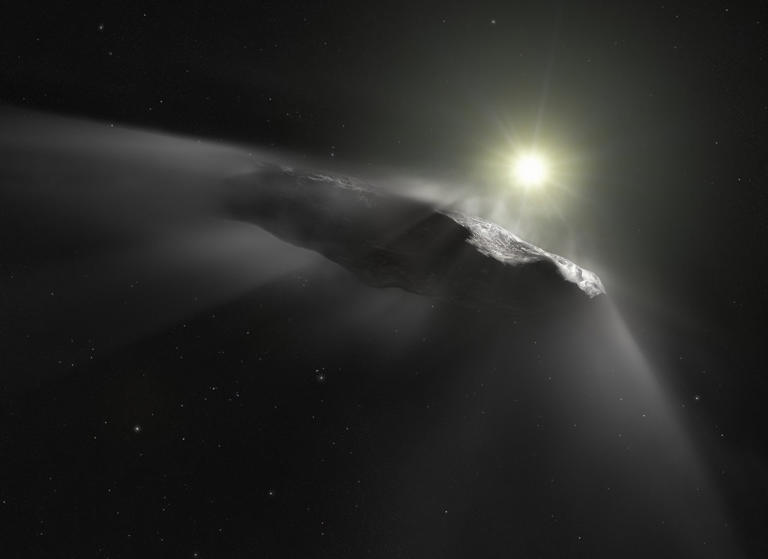 An artist’s illustration of the interstellar object ‘Oumuamua, which scientists now suspect is a comet, not an asteroid. (ESA/Hubble, NASA, ESO, M. Kornmesser)
.
.
Click the link below for the complete article:
.
__________________________________________
July 4, 2025
Mohenjo
Business, Food For Thought, Human Interest, Political, Science, Technical
amazon, business, Business News, current-events, Future, Hotels, human-rights, medicine, mental-health, research, Science, Science News, technology, Technology News, travel, vacation

Click the link below the picture
.
An “interstellar object” is speeding toward the inner solar system, where Earth is located, astronomers have confirmed.
The object — likely a comet — was first detected in data collected between by the Asteroid Terrestrial-impact Last Alert System, or ATLAS — an asteroid impact early warning system in Rio Hurtado, Chile, funded by NASA, the space agency announced on Tuesday.
Properties such as a marginal coma and short tail indicate signs of cometary activity, according to the Minor Planet Center.
Numerous telescopes have reported additional observations since the object was first reported, NASA said. Observations from three different ATLAS telescopes around the world — as well as the Zwicky Transient Facility at the Palomar Observatory in San Diego County, California — dating back to June 14 were gathered and provided data that supports the existence of the comet, according to a NASA update released Wednesday.
It appears to be originating from interstellar space, arriving from the direction of the constellation Sagittarius, and is currently about 420 million miles from Earth, according to NASA.
The comet poses no threat to Earth and will remain at a distance of at least 150 million miles, astronomers said. It is estimated to reach its closest approach to the sun around Oct. 30, where it will cross at about 130 million miles away, just inside the orbit of Mars, according to NASA.
The object, dubbed “A11pl3Z” or “3I/ATLAS,” spans approximately 25 miles, Josep Trigo-Rodriguez, as astrophysicist at the Institute of Space Sciences near Barcelona, Spain, told The Associated Press.
It’s traveling at a speed of about 152,000 mph and approaching the inner solar system from the bar of the Milky Way, Live Science reported. Its trajectory suggests it did not originate in this solar system, according to EarthSky.org.
This is only the third time in history that an interstellar object entering the inner solar system has been recorded.
A cigar-shaped interstellar object called “Oumuamua,” the Hawaiian word for “scout,” was detected in 2017. And in 2019, an object named “21/Borisov” — a comet that likely strayed from another star system — was located.
.
Interstellar object A11pI3Z captured, June 2, 2025, by David Rankin, engineer at the Catalina Sky Survey at the University of Arizona. Astronomers on June 2 confirmed the discovery of an interstellar object racing through our solar system — only the third ever spotted, though scientists suspect many more may slip past unnoticed. David Rankin, Saguaro Observatory/AFP via Getty Images
.
.
Click the link below for the complete article:
.
__________________________________________
July 4, 2025
Mohenjo
Business, Food For Thought, Human Interest, Political, Science, Technical
amazon, business, Business News, current-events, Future, Hotels, human-rights, medicine, mental-health, research, Science, Science News, technology, Technology News, travel, vacation
Click the link below the picture
.
The so-called moderate Republicans promised they would not slash Medicaid. Conservatives vowed not to explode the national debt. Party leaders insisted that they would not lump a jumble of unrelated policies into a single enormous piece of legislation and rush that bill through Congress before any reasonable person had time to read it.
But President Donald Trump wanted his “big, beautiful bill” enacted in time to sign it with a celebratory flourish on America’s birthday. And so nearly all GOP lawmakers in the House and Senate, setting aside these and many other pledges, principles, and policy demands, did what the president desired.
.
 Kent Nishimura / Bloomberg / Getty
.
.
Click the link below for the complete article:
.
__________________________________________
July 4, 2025
Mohenjo
Business, Food For Thought, Human Interest, Political, Science, Technical
amazon, business, Business News, current-events, Future, Hotels, human-rights, medicine, mental-health, research, Science, Science News, technology, Technology News, travel, vacation
Hmmmm…This administration is placing the USA behind the rest of the world in science!
Click the link below the picture
.
We tend to think something is either alive or not–unless we’re discussing Schrödinger’s cat. For something to be considered alive, we often think of anything that can reproduce, produce its own energy, and have homeostasis – from humans, to animals, to plants, and even single-celled organisms. However, the challenge comes when trying to define a virus. They don’t grow, or reproduce on their own, nor can make their own energy. But when it infects a host, they can do some pretty population-altering things, as we saw with COVID-19. Now, researchers from Canada and Japan have found something virus-like, but more ‘alive’ (Picture: Getty Images)
.
 (Picture: Getty Images)
.
.
Click the link below for the complete Slideshow:
.
__________________________________________
July 3, 2025
Mohenjo
Business, Food For Thought, Human Interest, Political, Science, Technical
amazon, business, Business News, current-events, Future, Hotels, human-rights, medicine, mental-health, research, Science, Science News, technology, Technology News, travel, vacation
Click the link below the picture
.
Within an hour of receiving a COVID-19 vaccination in November 2020, Utah preschool teacher Brianne Dressen felt pins and needles through her arms and legs. In the medical odyssey that followed, she suffered double vision, chronic nausea, brain fog, and profound weakness. Once a rock climber, she became a couch potato.
Although Dressen’s symptoms were rare in that season of hundreds of millions of COVID-19 vaccinations, they were common enough to draw the attention of a National Institutes of Health neuroscientist named Avindra Nath, who examined Dressen and more than 30 other people with a similar syndrome in 2021. He recommended Dressen take steroids and antibodies — treatments that saved her life, she said.
And then, according to emails reviewed by KFF Health News, Nath said he couldn’t help anymore. His clinical study was ending. He directed the patients to seek local help. But, Dressen said, there wasn’t any.
Nath declined to speak to KFF Health News for this article. The FDA searched international vaccine safety databases for small-fiber neuropathy, one of the most common symptoms he mentioned in a write-up of the patients, and found it was less prevalent in vaccinated than in unvaccinated patients, said Peter Marks, who led the FDA division responsible for vaccines until Health and Human Services Secretary Robert F. Kennedy Jr. forced him out in May.
While it’s possible that Nath’s patients suffered covid vaccine injuries, Marks said, their symptoms were so varied it was hard to characterize a possible syndrome.
But for Dressen and others convinced the vaccines injured them, their experiences were symptomatic of a well-intentioned but flawed U.S. system for monitoring the rare ill effects of vaccines. The system isn’t well-funded enough to answer questions that people urgently want answered, and that can feed vaccine hesitancy, safety experts say.
Its shortcomings were on particular display during the mass vaccination campaigns of the pandemic, when even rare, serious side effects could affect thousands of people.
Now, some leading vaccine scientists are calling for more resources to research vaccine safety and support people with claims of injury, and asking Kennedy, who has a history as an anti-vaccine activist, to step up.
“Spending money on vaccine safety is not saying vaccines aren’t safe; it’s showing a commitment to continued improvement,” said Y. Tony Yang, a professor of health policy at George Washington University’s Milken Institute School of Public Health.
So far, they’ve been disappointed. While Kennedy gives the public the impression that vaccines are harmful, he hasn’t talked about ways to make them safer. And he’s made the problem worse by cutting programs and dismissing scientists who are most knowledgeable about the problems, according to numerous vaccine experts.
.

Health and Human Services Secretary Robert F. Kennedy, Jr., testified before the Senate Committee on Health, Education, Labor and Pensions in May 2025. Anna Moneymaker/Getty Images
.
.
Click the link below for the complete article:
.
__________________________________________
Older Entries
Newer Entries
 James' World 2