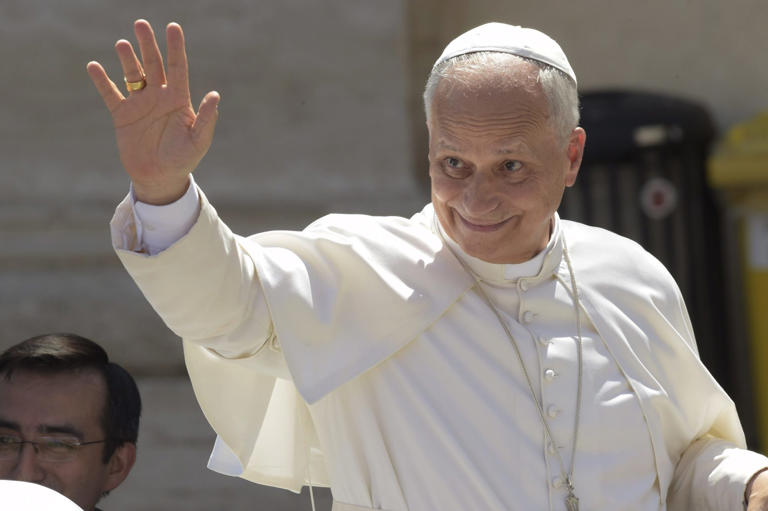
Pope Leo XIV is sounding the alarm over the growing wealth inequality between CEOs and workers—and he’s singling out Elon Musk’s path to trillionaire status. In his first formal interview since being named pontiff, Pope Leo says soaring executive paychecks may be putting the world in “big trouble.” This comes as a recent report warns that many billionaire signers of Warren Buffett and Bill and Melinda French Gates’ The Giving Pledge are behind in their philanthropy promises.
If Pope Leo XIV had a seat on Tesla’s board, Elon Musk’s newly proposed trillion-dollar paycheck would be dead on arrival.
The 70-year-old pontiff slammed the widening income gap between the working class and the wealthy—specifically calling out the Tesla CEO as an egregious example of executive excess.
“CEOs that 60 years ago might have been making four to six times more than what the workers are receiving, the last figure I saw, it’s 600 times more than what average workers are receiving,” he told Catholic news site Crux in an interview released Sunday.
“Yesterday, the news that Elon Musk is going to be the first trillionaire in the world: What does that mean and what’s that about? If that is the only thing that has value anymore, then we’re in big trouble.”
The Pope’s critique comes as Tesla’s board has proposed a $1 trillion pay package for Musk—contingent on his ability to grow the electric vehicle company by eightfold over the next decade. Just this morning, Musk purchased $1 billion worth of Tesla stock, an indication that he’s sticking around, according to CNN.
While Pope Leo is entitled to an over $400,000 yearly salary, on par with U.S. presidents and university chancellors, his concerns reflect broader anxiety about executive compensation. Among the 100 S&P 500 corporations with the lowest median worker pay, the average CEO compensation hit $17.2 million in 2024 as compared to an average median worker pay of $35,570, according to the Institute for Policy Studies. That’s a ratio of 632 to 1.
Billionaires’ wealth is booming—but their philanthropic giving isn’t
While everyday workers continue to struggle with inflation, wage stagnation, and a tightening job market, the wealth of the ultrarich soars. Billionaire wealth increased three times faster in 2024 than it did in 2023, according to Oxfam. And over the last decade, the top 1% increased their wealth by nearly $34 trillion—enough to eliminate annual poverty 22 times over at the highest poverty line.
ust last week, Larry Ellison broke the record for the biggest one-day increase ever recorded in the history of Bloomberg’s Billionaire Index—with his net worth soaring $89 billion thanks to his tech firm Oracle’s rapid growth.
At the same time, many billionaires are behind on their pledges to give away their money through The Giving Pledge—the commitment launched in 2010 by Warren Buffett as well as Bill and Melinda French Gates, to give away at least 50% of their wealth to philanthropy during their lifetimes or in their wills.
Among the 256 signers, just nine have followed through with the pact, and even among those who donate, it’s largely given to intermediaries, according to the Institute for Policy Studies. Of an estimated $206 billion donated by the original 2010 Pledgers, roughly 80%, or $164 billion, has gone into private foundations.
And while The Giving Pledge told Fortune the IPS report “paints a misleading picture of the impact and intent of Giving Pledge signatories and the spirit and intent of the Giving Pledge,” the organization admitted there remain important questions that aim to “encourage greater giving.”
Forty years after global policymakers began grappling with the crisis posed by a gaping hole in Earth’s protective ozone layer over Antarctica, the damage is continuing to heal, according to a new report from the World Meteorological Organization.
Found between about nine and 19 miles above Earth’s surface, the ozone layer is a broad region of the stratosphere where the molecule, which contains three oxygen atoms, is particularly concentrated. Here, ozone plays a vital role in blocking the sun’s ultraviolet radiation—essentially acting as a planetary sunscreen of a sort.
In the 1980s, scientists realized that a massive hole was developing in the ozone layer over Antarctica every southern spring and then tied the observation back to earlier research that discovered that a group of chemicals called chlorofluorocarbons (CFCs) were able to eat away at atmospheric ozone. Nations came together to develop an agreement called the Montreal Protocol on Substances That Deplete the Ozone Layer, adopted in 1987, to stop the production of these chemicals.
“The Montreal Protocol is the best environmental agreement we’ve ever created,” says Durwood Zaelke, an environmental policy expert at the University of California, Santa Barbara, and founder and president of the Institute of Governance & Sustainable Development, an organization that is focused on addressing short-lived but high-powered climate pollutants. These include hydrofluorocarbons (HFCs), which do not harm the ozone layer and replaced many CFCs as they were phased out. The agreement has garnered global signatories, several rounds of successful amendments and the near-total elimination of the chemicals that break down ozone. “This is a hell of an agreement,” Zaelke says.
The result is an ozone layer that scientists predict will recover the health it had in 1980 over the tropics and midlatitudes by 2040, over the Arctic by 2045, and over the Antarctica by around 2066. “It takes a long time to heal stratospheric ozone,” Zaelke says.
The new 2024 report from the World Meteorological Organization proves that slow process is continuing as scientists have expected, says A. R. Ravishankara, an atmospheric chemist at Colorado State University. The report shows that, over 2024, total levels of ozone in the atmosphere were above the 2003–2022 average for most of the planet—just a strip near the equator and a small patch of the Antarctic coastline south of Africa were below that marker.
A particularly notable change came over Antarctica, where ozone depletion was notably lower than those from the years between 2020 and 2023. The 2024 ozone hole also formed relatively slowly and recovered relatively quickly—a good sign for the future of the ozone layer, according to the report.
Ravishankara notes that on the long road to recovery, scientists expect to see some better years and some worse years. “One year does not make a trend,” he says. Ravishankara adds that the new report and other observations of ozone in the atmosphere do show slow but steady ozone replenishment.
Ozone is produced primarily at latitudes nearer the equator. And from there, it must disperse out toward the poles, where production is much slower because of reduced sunlight, Ravishankara says. The production and transportation of ozone can be influenced by larger happenings in atmospheric phenomena, including the natural climate phenomenon called El Niño, the sun’s level of activity, the large-scale movement of the atmosphere, and of course, climate change.
An additional complication is that ozone in the lowest part of the atmosphere, called the troposphere, still blocks sunlight but also acts as a pollutant that is harmful to human health. “You need to know not only the total amount of ozone above your head but also where it is and how it is changing in different parts of the atmosphere,” Ravishankara says.
That’s why different forms of monitoring—both by satellites and from the ground—are so vital to understanding the status of the ozone layer. “This is what I call the accountability phase of the Montreal Protocol, where you want to make sure the results you want are being achieved,” Ravishankara says. “It is going to get better unless we screw up something else.”
Zaelke worries that the Montreal Protocol, like international agreements generally, won’t fare well under President Donald Trump—even though, at the request of industry groups, he signed U.S. legislation that joined the nation to the latest amendment of the protocol, Zaelke says. Still, he thinks that the global infrastructure dedicated to ozone recovery should be sufficient to withstand the administration’s tendency away from global partnerships. “While the world will miss the U.S. leadership,” Zaelke says, “it will survive.”
.
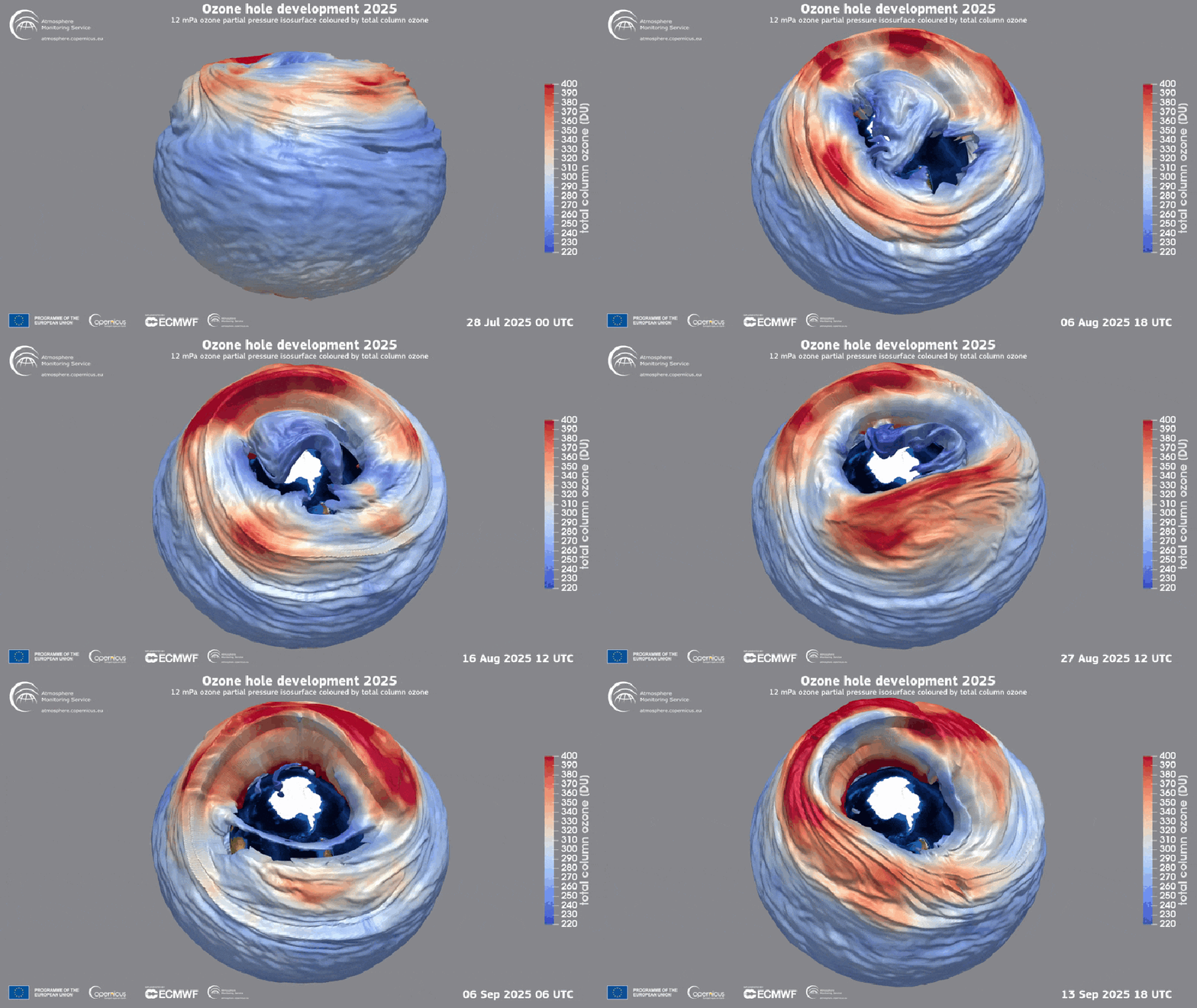
A 3D rendering of the ozone hole evolution in 2025. CAMS
Just Security notes that 21 lawsuits have been filed against the U.S. Attorney General Pam Bondi’s Department of Justice and 12 lawsuits reveal Linda McMahon’s Department of Education as the litigant. Legal challenges have been placed against each of the 21 Cabinet members’ respective endeavors. This news, in and of itself, lays bare the fact that the majority of our 100 Senators failed to do their due diligence in approving Mr. Trump’s nominees for Cabinet positions.
The volume of legal battles poses significant long-term risks to American democracy, let alone the cost to Americans like you and me who will have to pay attorney fees to defend Donald J. Trump, Cabinet members, and other officials’ actions.
On May 13, I asked three people elected to represent me (i.e., Iowans’ Sen. Chuck Grassley, Sen. Joni Ernst, and Rep. Ashley Hinson) to provide an “approximate cost that Americans will have to pay legal counsel to defend Trump 2.0’s 328 lawsuits filed to date.” No reply has been received from any of my elected delegates. So, there goes accountability by Congress to the electorate and representation by, for, and of the people, a core principle of a representative democracy.
You might like to know the average hourly rate for lawyers in the U.S. is $341 and a mere $462/hour for attorneys at law in Washington, D.C. (Clio Report, 2024).
A Perplexity AI research-based inquiry noted—as compared to more recent presidents like Richard Nixon, Gerald Ford, Jimmy Carter, Ronald Reagan, George H.W. Bush, Bill Clinton, George W. Bush, Barack Obama, and Joe Biden—“The Trump 2.0 administration has faced an unprecedented volume of litigation.”
Lawsuits are not novel to Mr. Trump. According to a comprehensive review by USA Today, published nine years ago (July 7, 2016), Donald Trump has been involved in at least 4,095 lawsuits where he was the defendant. These include a wide range of civil and criminal cases, relating to business disputes, defamation, political campaigns, casinos, taxes, golf clubs, real estate, government investigations, and sexual abuse. And, Mr. Trump has filed a documented minimum of 1,600 lawsuits against other individuals and organizations. In summation, Donald John Trump has encountered at least 5,695 lawsuits in his lifetime.
Besides the cost of Trump 2.0-related lawsuits that you and I — one way or another — will pay for, the long-term risks to American democracy seem unending, and they include:
1. The Brookings Institution independent research group noted that if the Trump administration disregards court rulings and/or pressures the Department of Justice and/or Supreme Court to act politically, America’s revered checks and balances will be eroded along with our 250-year understanding of what democracy represents.
2. If Donald Trump and the Trump administration disobey a Supreme Court order, the following legal consequences are possible: civil contempt of court, criminal contempt of court, monetary fines, imprisonment, constitutional crisis, and impeachment as the president is constitutionally required to ensure the faithful execution of the laws.
3. Congress’s failure to counter funding freezes or unconstitutional orders is already destabilizing the separation of powers for now and future presidencies, ushering in — with their non-action — an authoritarian, dictatorship, and fascist-oriented country. Our do-nothing 119th Congress (Jan. 2025-Jan. 2027) is a disgrace!
4. A Harvard Law Review article claims lawsuits challenging voting rights will exacerbate public distrust in the electoral system, discouraging voter participation.
5. The Emory Law Journal reports that litigation used as a political strategy could deepen partisan division and stall critical legislative reforms.
6. The Brookings Institution, along with the Campaign Legal Center, cites that executive abuses will test our 535 elected delegates to the U.S. Capitol to see if they will or will not strengthen anti-corruption laws like closing Citizens United loopholes, protecting the 74 statutory and independent Inspector Generals, and clarifying judicial enforcement mechanisms.
The cost of defending Trump 2.0’s 328 lawsuits is unknown, but the long-term risks to democracy are frightening. The future of democracy to withstand the legal perils brought about by Mr. Trump and his Cabinet appointees lies in the hands of 100 Senators, 435 Representatives, 74 Inspector Generals, 94 U.S. District Courts, the Court of International Trade, the Supreme Court, and, most importantly … you and me.
.
A person filling out paperwork relating to a lawsuit. Getty Images, boonchai wedmakawand
The 22-year-old man accused of assassinating Charlie Kirk said in text messages to his romantic partner that he had “had enough of his hatred” and that “some hate can’t be negotiated out,” according to prosecutors who filed a murder charge against the suspect on Tuesday.
The text message exchange between the suspect, Tyler Robinson, and his romantic partner provides the clearest explanation yet into a motivation for the killing of Mr. Kirk, a conservative political activist.
Mr. Robinson was charged with aggravated murder on Tuesday, as well as several crimes related to his direction to his partner to delete “incriminating” text messages and not to talk to the police. No lawyer is listed for Mr. Robinson in court records.
A charging document filed by prosecutors in court said that Mr. Robinson’s mother told investigators that her son had grown more political, and that his political views had moved to the left over the last year or so. She also told the police that he had become “more pro-gay and trans-rights oriented.” Mr. Robinson’s partner, who was living with him, had been transitioning to being a woman from a man, prosecutors said.
The text exchange between Mr. Robinson and his partner was reproduced by prosecutors in the charging document. It showed that Mr. Robinson had texted his partner shortly after the shooting on Wednesday about a note left under his keyboard, which read, “I had the opportunity to take out Charlie Kirk and I’m going to take it.”
The partner reacted with shock, asking him if he was joking. “You weren’t the one who did it right????” the partner wrote. “I am, I’m sorry,” Mr. Robinson responded.
When Mr. Robinson’s partner asked why he had done it, Mr. Robinson wrote: “I had enough of his hatred. Some hate can’t be negotiated out.” Mr. Robinson then texted about trying to grab his rifle from where he had left it, near the scene.
Mr. Robinson was raised by Republican parents in southwestern Utah, a conservative stronghold, but had never voted in any election, according to Washington County election officials. In the text messages to his partner, Mr. Robinson mentioned that his father “has been pretty die-hard MAGA” since President Trump had been re-elected.
A series of phrases were etched into ammunition found with the rifle, prosecutors said, including “Hey Fascist! Catch!” on a fired cartridge and “If you Read This, You Are GAY Lmao” on one of three unfired cartridges. In the text message exchange, Mr. Robinson said the messages were “mostly a big meme.”
He said that he had been planning the shooting for a bit over a week and “had hoped to keep this secret till I died of old age”; he also apologized for involving his partner. Gov. Spencer Cox of Utah has said that the authorities believe Mr. Robinson acted alone, and that Mr. Robinson’s partner was cooperating with the police.
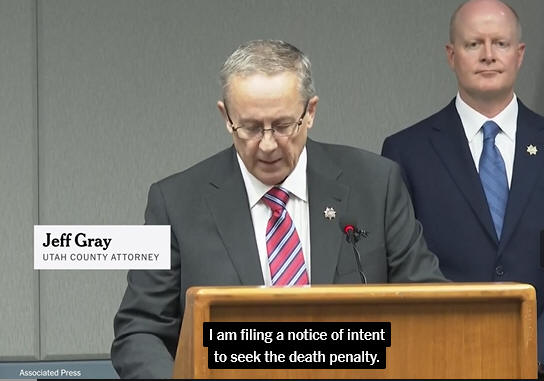
The text messages are illuminating, but they do not show Mr. Robinson discussing which specific views of Mr. Kirk’s he found to be hateful. Jeff Gray, the Utah County attorney, was asked directly at a news conference on Tuesday whether transgender issues played a role in the shooting. When he was shot, Mr. Kirk was debating a person on the subject of shootings carried out by transgender people.
“I’m going to stick to what I just stated in our” court documents, Mr. Gray said. “I think that is pretty much set forth there.”
Hmmmm… of 8.2 billion people in the world, 15% are white.
Click the link below the picture
.
The Trump administration has ordered the removal of signs and exhibits related to slavery at multiple national parks, according to four people familiar with the matter, including a historic photograph of a formerly enslaved man showing scars on his back.The individuals, who spoke on the condition of anonymity because they were not authorized to speak with the media, said the removals were in line with President Donald Trump’s March executive order directing the Interior Department to eliminate information that reflects a “corrosive ideology” that disparages historic Americans. National Park Service officials are broadly interpreting that directive to apply to information on racism, sexism, slavery, gay rights or persecution of Indigenous people.
Following Trump’s order, Interior Department officials issued policies ordering agency employees to report any information, including signage and gift shop items, that might be out of compliance. Trump officials also launched an effort asking park visitors to report offending material, but they mostly received criticisms of the administration and praise for the parks.
The latest orders include removing information at Harpers Ferry National Historic Park in West Virginia, two people familiar with the matter said, where the abolitionist John Brown led a raid seeking to arm slaves for a revolt. Staff have also been told that information at the President’s House Site in Philadelphia, where George Washington kept slaves, does not comply with the policy, according to a third individual.
Jonathan Zimmerman, a University of Pennsylvania professor who studies the history of education, said this is the latest installment in the Trump administration’s unprecedented interference with the nation’s civic institutions — a campaign which also includes Trump’s takeover of the Kennedy Center and attempts to pressure the Smithsonian.
“This represents an enormous increase in federal power and control over the things we learn,” Zimmerman said. “Brought to you by the team that says education should be state and local.”
“Interpretive materials that disproportionately emphasize negative aspects of U.S. history or historical figures, without acknowledging broader context or national progress, can unintentionally distort understanding rather than enrich it,” Pawlitz said.
At Harpers Ferry, staff flagged more than 30 signs, according to a person familiar with the matter and documents reviewed by The Post, that highlight information potentially in violation of Trump’s policy. They include signs referring to racial discrimination and the hostility of White people to people who were formerly enslaved.
Park Service officials marked the submission as “out of compliance,” with staff now expected to cover up parts of signs or remove them, the person said.
Separately, Park Service officials have ordered the removal of a photograph illustrating violence against slaves, known as “The Scourged Back,” at one national park, according to two people familiar with the matter who spoke on condition of anonymity because they were not authorized to speak with the media. They did not identify the park in question for fear of reprisals. The photograph, taken in 1863, shows scars on the back of a man probably named Peter Gordon from wounds inflicted by his masters before he escaped slavery.
.
“The Scourged Back” shows the scarred back of escaped slave Peter Gordon in Louisiana, 1863. (McPherson & Oliver/National Gallery of Art)
Researchers tested 12 “magic mushroom” edible products sold in Portland, Ore., and found no trace of psilocybin, the hallucinogenic compound that gives magic mushrooms their name. Instead, seven of the products contained at least one undisclosed active ingredient. Such ingredients included cannabis extract and synthetic psychedelics whose effects and safety have not been formally documented or studied.
“We found no evidence of mushroom compounds of any kind, coming from any species,” says the new study’s co-author Richard van Breemen, a pharmaceutical sciences professor at Oregon State University. The research was published on Thursday in JAMA Network Open.
Psilocybin and other psychedelic drugs have received a lot of attention in recent years as potential treatments for mental health conditions such as depression and post-traumatic stress disorder. “There’s a lot of hype around these substances, so people are increasingly trying them outside current legal pathways,” says Lori Bruce, a bioethicist at Yale University, who researches psychedelics.
In June 2024 the Centers for Disease Control and Prevention announced that the agency was investigating reports of severe illness after people consumed certain purported psilocybin edibles. By last October, 73 hospitalizations and three deaths—all possibly associated with such products—had been reported across 34 states. “The mislabeling highlighted in this [study] causes harms,” Bruce says. “And as usage rates increase across the U.S., harms from retail products are also likely to increase.”
Are Any Commercial Psilocybin Products Legal?
Psilocybin comes from several mushroom species, including some in the genus Psilocybe. When consumed, the body breaks down the compound into psilocin, an alkaloid that can cause startling visual hallucinations and psychological effects, often including intense introspection. The U.S. federal government classifies both psilocybin and psilocin as Schedule I drugs, meaning they’re deemed to have a high potential for abuse and no currently accepted medical use.
But a handful of states have recently legalized the manufacture, sale, possession and use of psilocybin under certain conditions. Both medical and recreational use are legal in Colorado, and New Mexico passed a law this year that legalizes certain medical uses. In Oregon, the regulations are stricter: the drug must be taken in the company of a licensed facilitator at a specific “psilocybin service center.” These centers receive psilocybin from licensed growers, whose products are tested by a licensed laboratory.
Oregon does not allow the sale or use of psilocybin products outside of these centers; it is otherwise a criminal offense to buy, sell or possess the drug in the state. But the legal channels are prohibitively expensive to many: the average trip costs somewhere between $750 and $1,200.
This dynamic may be leading more people to try purported psilocybin products that are untested and prohibited but nonetheless sold at some retail stores, says legal researcher Mason Marks, a law professor at Florida State University who focused on psychedelics. “A lot of people are very curious about these substances. And if you’re in a state, like Oregon, that does not decriminalize them, people might go to these shops and buy these products that are either blatantly illegal or kind of in this gray area.”
Undisclosed and Untested Ingredients
For the new study, the researchers purchased 12 edible products (11 gummies and a chocolate) that were advertised as containing “magic mushrooms” and were sold at gas stations and convenience stores in Portland. These products are “being marketed widely in local convenience stores and on the Internet,” van Breemen says.
The edibles were first tested at a state-licensed facility that normally certifies the quality of the drug for Oregon’s psilocybin service centers. None of the products contained any psilocybin at all. To determine what they actually did contain, van Breemen and his colleagues turned to more advanced mass spectrometry techniques.
Seven products contained undisclosed active ingredients such as caffeine, kava extract (a legal herbal supplement with antianxiety and hallucinogenic effects), and cannabis extract (including the plant’s main psychoactive ingredient, tetrahydrocannabinol, or THC). Four of the gummies contained no active ingredients at all.
Two of the gummies did contain psilocin, which also occurs naturally in some mushrooms in small quantities—and which is easier to synthesize in a laboratory than psilocybin. If the psilocin in the edibles came from natural sources, the researchers would expect to also detect other, related compounds from mushrooms. Such compounds turned out to be absent, leading van Breemen and his colleagues to conclude that the psilocin was likely synthetic.
“The New York Times has been allowed to freely lie, smear, and defame me for far too long, and that stops, NOW!” Trump wrote on Truth Social on Monday night.
The lawsuit is being filed in Florida, Trump said.
The White House and the Times did not immediately respond to requests for comment from Business Insider.
Trump’s lawyer, Alejandro Brito, filed the lawsuit on Monday in the Tampa division of the Middle District of Florida. Brito represented Trump when he sued ABC News and The Wall Street Journal for defamation. ABC News paid Trump a $15 million settlement last year.
In the court filing, Trump’s lawyers said the Times had been trying to “destroy his reputation as a successful businessman, and subject him to humiliation and ridicule.”
The filing cited several articles about Trump published by the Times last year. It also took aim at “Lucky Loser: How Donald Trump Squandered His Father’s Fortune and Created the Illusion of Success,” a book written by two Times reporters, Susanne Craig and Russ Buettner. Craig, Buettner, and their publisher, Penguin Random House, were listed as defendants alongside the Times.
“The Book and Articles are part of a decades-long pattern by the New York Times of intentional and malicious defamation against President Trump,” Trump’s lawyers wrote in the court filing.
“Today, the Times is a fullthroated mouthpiece of the Democrat Party. The newspaper’s editorial routine is now one of industrial-scale defamation and libel against political opponents,” the filing said.
Trump’s lawyers did not immediately respond to requests for comment from Business Insider.
This isn’t the first time Trump has sued the Times. In 2021, he filed a lawsuit against the paper, accusing the Times and its reporters of conspiring with his niece, Mary Trump, to obtain his tax records. Craig and Buettner were two of the three reporters named in Trump’s lawsuit.
Justice Robert Reed of the State Supreme Court in Manhattan dismissed the suit in May 2023 and ordered Trump to pay the outlet and its reporters their legal fees. In January 2024, Reed said Trump owed the Times and its reporters $392,638.69 in legal expenses.
.
President Donald Trump said in a Truth Social post on Monday that he was filing a $15 billion defamation and libel lawsuit against The New York Times in Florida. Andrew Harnik via Getty Images
Actor-turned-director and activist Robert Redford, one of Hollywood’s most well-known leading men and an influential supporter of independent film, has died at the age of 89.
His publicist Cindi Berger confirmed the death to CBC News on Tuesday, saying he passed away in his home in Sundance in the mountains of Utah, “the place he loved, surrounded by those he loved.”
Redford used the millions he made to launch the Sundance Institute and Festival in the 1970s, promoting independent filmmaking long before small and quirky were fashionable.
“Robert Redford was the golden boy,” said Sean P. Means, deputy editor at the Salt Lake Tribune, who formerly served as the paper’s film critic for 25 years.
Whether Redford was portraying the wealthiest among us in The Great Gatsby, making hearts race in romantic roles like Out Of Africa, or playing an outlaw in Butch Cassidy and the Sundance Kid, Means says he had the “stunning good looks that [let him] fit in to society’s spaces equally well.”
Baseball player, then painter, then actor
Born in the Los Angeles beach city of Santa Monica on Aug. 18, 1936, to what he described as a “lower working class family,” Redford landed a college baseball scholarship but lost it after spending too much time partying.
Deciding he wanted to be an artist, Redford moved to Europe, spending time in France and Italy trying to sell his paintings on the street. Moving back to the U.S., he enrolled in drama school to try his hand at theatrical set design. Michael Feeney Callan, Redford’s biographer and friend, told CBC News Network that Redford was initially skeptical of a career in front of the camera.
“The idea of being an actor had never been in his game plan,” Callan said. “By osmosis, celebrity happened to him.”
But he was persuaded to take to the stage, and by 1959, he was a full-time performer on Broadway and later found work on television.
Redford made his movie debut in 1962 in a low-budget film called Warhunt, but first won attention in Barefoot in the Park, opposite Jane Fonda.
Redford remained best known for the two early movies he made with Paul Newman: the 1969 western caper Butch Cassidy and the Sundance Kid and The Sting, both of which became classics.
He never won the best actor Oscar, but Redford’s first outing as a director — the 1980 family drama Ordinary People — won for best picture and best director.
From the 1980s, he devoted more time to producing films and to the establishment of the Sundance Institute — a year-round workshop for aspiring filmmakers — and the Sundance Festival, which has become one of the most influential independent film showcases in the world.
.
Actor, director, and activist Robert Redford, known for roles in movies such as Butch Cassidy and the Sundance Kid and All the President’s Men, has died at the age of 89. His publicist, Cindi Berger, confirmed the death to CBC News on Tuesday, saying he passed away at his home in Sundance in the mountains of Utah, ‘the place he loved, surrounded by those he loved.’ (Adam Rountree/The Associated Press)
If you’re a history or archaeology buff, you might have heard of the controversial theories about a possible advanced civilization.Also known as the Silurian hypothesis, this belief stems from the fact that many innovative buildings, tools, and knowledge exist in a time where it shouldn’t. With that in mind, here are 20 pieces of evidence believers of the Silurian hypothesis often refer to.
A school-aged child in Los Angeles County has died from a rare but always fatal complication from a measles infection they acquired when they were an infant who was too young to be vaccinated. The first dose of the vaccine is typically not administered until one year of age. Experts say the death underscores the need for high levels of vaccination in a population to protect the most vulnerable against the disease, as well as from side effects that can occur long after the initial illness has passed.
“This case is a painful reminder of how dangerous measles can be, especially for our most vulnerable community members,” said Los Angeles County Health Officer Muntu Davis in a recent statement.
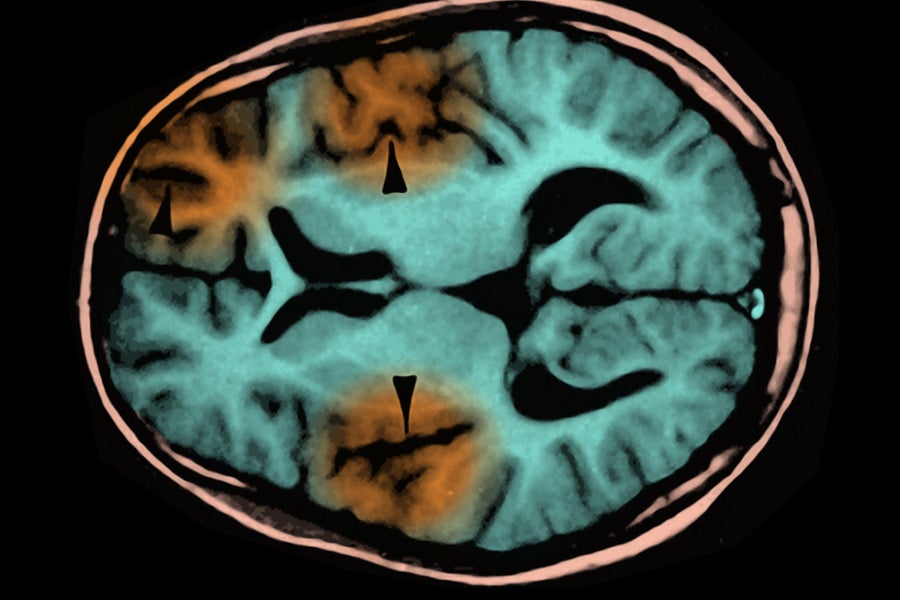
The child who died suffered from subacute sclerosing panencephalitis (SSPE), a progressive brain disorder that usually develops two to 10 years after a measles infection. The measles virus appears to mutate into a form that avoids detection by the immune system, allowing it to hide in the brain and eventually destroy neurons.
“It’s just a virus that goes unchecked and destroys brain tissue, and we have no therapy for it,” said Walter Orenstein, an epidemiologist and professor emeritus at Emory University, to Scientific American earlier this year.
People with SSPE experience a gradual, worsening loss of neurological function and usually die within one to three years after diagnosis, according to the Los Angeles County Health Department. The disorder affects only about one in every 10,000 people who contract measles. But the risk may be as high as about one in 600 for those who are infected as infants.
“There is no treatment for this. Children who suffer from this will always die,” said Paul Offit, director of the Vaccine Education Center and an attending physician in the Division of Infectious Diseases at Children’s Hospital of Philadelphia, in a previous interview with Scientific American. Offit, who had measles himself in the 1950s, has seen five or 10 cases of SSPE in his career.
SSPE is one of several side effects of measles that go beyond the coughing, runny nose, and characteristic rash of the original infection. Measles can also cause encephalitis, a faster-occurring brain inflammation, in one in every 1,000 people who are infected because the virus causes the immune system to attack a protein produced by certain brain cells. This inflammation kills about one in five people who develop it.
Measles also causes “immune amnesia”: the virus seems to attack the immune system’s B cells, which remember previous pathogens the body has been exposed to, resulting in reduced immunity. There is some evidence this effect can last for a couple of years, making those who get measles more susceptible to other infectious diseases.
These side effects are of particular concern because the measles virus is highly contagious, an order of magnitude more than seasonal influenza. With measles, viral particles emitted by coughing or sneezing can linger in a room for hours after the infected person has left. One infected person infects 15 more people on average.
.
An MRI scan showing subacute sclerosing panencephalitis, a complication of measles infection. Science Source
Film and Writing Festival for Comedy. Showcasing best of comedy short films at the FEEDBACK Film Festival. Plus, showcasing best of comedy novels, short stories, poems, screenplays (TV, short, feature) at the festival performed by professional actors.




 .
.



 Actor, director, and activist Robert Redford, known for roles in movies such as Butch Cassidy and the Sundance Kid and All the President’s Men, has died at the age of 89. His publicist, Cindi Berger, confirmed the death to CBC News on Tuesday, saying he passed away at his home in Sundance in the mountains of Utah, ‘the place he loved, surrounded by those he loved.’ (Adam Rountree/The Associated Press)

 James' World 2