August 17, 2025
Mohenjo
Business, Food For Thought, Human Interest, Political, Science, Technical
amazon, business, Business News, current-events, Future, Hotels, human-rights, medicine, mental-health, research, Science, Science News, technology, Technology News, travel, vacation

Click the link below the picture
.
Rabbits in northern Colorado have been spotted with bizarre, somewhat grisly horns on their face. But wildlife officials say the bunnies are likely ultimately going to be okay.
They’re also not a danger to others—at least, not to nonrabbits. The tentacle-faced bunnies are infected with Shope papillomavirus, a member of the same viral family that can cause warts in humans. Shope papillomavirus is known to affect only rabbits and hares, not humans or other animals, says Kara Van Hoose, a spokesperson for Colorado Parks & Wildlife (CPW). For most rabbits, it’s also a harmless infection.
Infected animals “are able to clear it from their system on their own,” Van Hoose says. Once the virus is gone, the growths, which are made of the same keratin found in hair and nails, eventually fall off. In a minority of cases, the infection can induce squamous cell cancer. The infection can also cause problems if the associated growths pop up near the eyes or mouth, where they might interfere with foraging and eating, Van Hoose says.
It’s not clear whether there are actually more rabbits than usual infected with Shope papillomavirus in northern Colorado this summer, Van Hoose says. CPW had not received any reports of horned-faced rabbits before a local news story published on August 8 drew attention to sightings in Fort Collins, Colo. Since then, multiple people have called the agency, Van Hoose says, but it’s hard to tell how many infected rabbits there really are.
“It’s also difficult to say, if we get 10 reports, if it’s 10 different rabbits or if it’s two rabbits that maybe we’re seeing five different times,” she says.
The growths themselves are not infectious. The virus spreads through bites from mosquitoes, ticks, and fleas, so it tends to peak in summer and fade away in the colder months.
The discoverer and namesake of the virus, virologist Richard Shope, first identified the pathogen in 1933 in the U.S. Midwest. Shope also was the first to identify the influenza A virus and was among the first to pinpoint that particular flu pathogen as the culprit of the deadly 1918 pandemic. His work on rabbit papillomavirus formed the basis of understanding human papillomavirus (HPV) strains, some of which can cause cancer. This line of research ultimately led to the development of the HPV vaccine, which dramatically reduces the risk of cervical and other cancers linked to HPV.
Though the horned rabbits aren’t a danger to humans or pets, Van Hoose advises people to keep their distance from the creatures, as they should with any wild animal, because rabbits can pass along other pathogens. “Once you realize these [growths] probably aren’t harmful to rabbits, you can kind of appreciate the science at work,” she says.
.

This eastern cottontail rabbit has growths protruding from its head because it is infected with a papilloma virus. Education Images/Universal Images Group via Getty Images
.
.
Click the link below for the complete article:
.
__________________________________________
August 17, 2025
Mohenjo
Business, Food For Thought, Human Interest, Political, Science, Technical
amazon, business, Business News, current-events, Future, Hotels, human-rights, medicine, mental-health, research, Science, Science News, technology, Technology News, travel, vacation

Click the link below the picture
.
I carry a lot of different phones around, and I rarely get questions about them because most people stopped talking about which phone they own around 2017. I could be using an unreleased iPhone 18 Pro Max Air Ultra to pay for my coffee and nobody would raise an eyebrow (present company excepted, of course). To the majority, a phone is a phone; no matter who makes it or what software it runs, they’re all roughly the same size and shape. Unless that phone happens to be a flip phone.
Flip phones attract attention from the kind of people who have seen every type of phone in existence, which makes sense: they’re very obviously different. During the rise of the smartphone, there was a time when manufacturers tried a lot of other form factors. Physical keyboards, swiveling screens, pop-up cameras — anything was fair game. But over the past decade, the industry converged around one design to rule them all: the form factor that we now know as the slab phone. And it remained more or less unchallenged until Samsung started folding screens in half.
Before the new flip phones, book-style foldables came first. And Samsung’s debut effort was kind of a fiasco. Within days of receiving review units, testers started experiencing problems with the inner screen. The Verge’s own Dieter Bohn was one of them; he noticed a small bulge in the inner screen along the crease, as if a very small particle was pressing up into the screen from inside the hinge.
.

Photo: Allison Johnson / The Verge
.
.
Click the link below for the complete article:
.
__________________________________________
August 17, 2025
Mohenjo
Business, Food For Thought, Human Interest, Political, Science, Technical
amazon, business, Business News, current-events, Future, Hotels, human-rights, medicine, mental-health, research, Science, Science News, technology, Technology News, travel, vacation

Click the link below the picture
.
Facing a lawsuit and pointed questions from a federal judge, the Trump administration agreed on Friday to pull back its attempt to take direct control over the District of Columbia police department by installing a Trump administration official to run the agency.
The legal fight, which prompted an emergency court hearing on Friday afternoon, was the most contentious episode since the Trump administration announced on Monday that it was placing the city’s police department under “federal control.” The retreat by Justice Department officials represented a significant, if narrow, victory for the city’s government as it contends with the federal intervention.
A host of other issues raised by the city about the federal intervention were not resolved on Friday, including the scope of demands that the administration can place on the local police. A hearing on those issues is scheduled for next week.
In court on Friday, U.S. District Judge Ana C. Reyes issued no formal ruling but asked pointed questions of the Justice Department lawyer, Yaakov Roth, and appeared to take a skeptical view of the president’s broad interpretation of his authority under the 1973 Home Rule Act, the federal law granting the citizens of D.C. the right to limited self government.
“The statute would have no meaning at all if the president can just say, ‘We’re taking over your police department,’” said Judge Reyes, who was nominated to the federal bench by President Biden.
The judge made clear that she was considering a ruling that would block the administration’s entire order as unlawful, but said she would prefer if the lawyers on both sides worked out some modifications to the order. After several hours, the Justice Department lawyers reissued the order, leaving the city in control of the police force.
City officials praised the outcome on Friday as an affirmation of the Washington’s autonomy.
Speaking to reporters, Brian Schwalb, the D.C. attorney general, said the law makes clear “that the authority to appoint a chief of police sits squarely with the mayor, and the right to control the local policing of our city sits with the mayor and the chief of police, notwithstanding the government, the president and the attorney general’s efforts to suggest that they had taken control of our police force.”
In a post on social media announcing the redrafted order, U.S. Attorney General Pam Bondi criticized Mr. Schwalb for, she said, opposing the administration’s “efforts to improve public safety.” But she said the administration remained committed to working closely with D.C. Mayor Muriel Bowser, “who is dedicated to ensuring the safety of residents, workers, and visitors” in the city.
Local officials were taken by surprise on Thursday evening when Ms. Bondi issued an order naming Terrance C. Cole, the head of the Drug Enforcement Administration, as an “emergency police commissioner.” The directive came after days of assurances by local officials, including the mayor and the police chief, that they would work as partners alongside federal law enforcement.
Within hours of the order by Ms. Bondi, Mr. Schwalb responded with an opinion arguing that the directive was unlawful and that the mayor should not abide by it. On Friday morning, his office filed a lawsuit against the Trump administration, challenging the “brazen usurpation” of the city’s authority.
Even with the administration’s modification of their efforts on Friday, many of the concerns about federal intervention raised by Mr. Schwalb and shared by the city’s leaders and residents remain.
Mr. Trump’s executive order asserting federal control was based on a section of the Home Rule Act that explicitly gives presidents temporary authority to “direct the mayor to provide him” such services of deemed “necessary and appropriate” to address “special conditions of an emergency nature.”
That order declared that there was a “crime emergency” in the city, and Mr. Trump said that he was “placing the D.C. Metropolitan Police under direct federal control.”
.
 Amtrak police officers and National Guard troops patrolling at Union Station in Washington on Thursday.Credit…Eric Lee for The New York Times
.
.
Click the link below for the complete article:
.
__________________________________________
August 16, 2025
Mohenjo
Business, Food For Thought, Human Interest, Political, Science, Technical
amazon, business, Business News, current-events, Future, Hotels, human-rights, medicine, mental-health, research, Science, Science News, technology, Technology News, travel, vacation
Click the link below the picture
.
Researchers have captured the very first real-time, three-dimensional images and videos of a human embryo implanting into collagen designed to mimic uterine tissue —a key stage in reproduction. The resulting footage, which shows how embryos push and pull to anchor themselves in the uterus in vivid detail, could lead to improvements for in vitro fertilization (IVF) techniques, the scientists say.
“This will allow us to develop treatments specifically targeting implantation, which is the biggest roadblock in human reproduction,” says Samuel Ojosnegros, a bioengineer at the Barcelona Institute of Science and Technology in Spain and a co-author of the new study, which was published in Science Advances.
Five days after an embryo is fertilized artificially, fertility doctors must implant it into the body so it can continue to grow. “What happens between the transfer and the first ultrasound weeks later is a black box,” says Ojosnegros, who is also co-founder of the biotech company Serabiotics. Implantation failure is one of the main causes of infertility —up to 60 percent of miscarriages occur during this process.
The first successful culture of human embryos beyond implantation was demonstrated in a petri dish in a lab in 2016, but Ojosnegros and his team wanted to see what this process would look like in 3D tissue that was more similar to that of the uterus.
To do this, the team designed a special ex vivo system made of gel and collagen—a protein found in the uterine lining—and used embryos donated by people who had completed an assisted reproduction process. The system works, Ojosnegros says, because the network of collagen fibers signals to the embryo at a molecular level that this is a natural matrix.
By using advanced 3D microscopes, the researchers recorded the action over time. Tracking tiny movements in the gel’s fibers allowed them to map exactly where and how strongly the embryos were pulling. The researchers did the same with mouse embryos to compare movement patterns.
The footage showed that human embryos generate a network of tiny pulling forces that ripple through the womb. They burrow into the surrounding tissue from one side, creating multiple small traction points that tug the lining in all directions. Mouse embryos, on the other hand, spread out more across the surface and pull mainly along two or three strong lines.
When the researchers applied external tension to the matrix, tugging it with tiny forceps, they noticed the embryos reoriented toward those areas. The scientists suggest micro contractions might be guiding the embryo to implant in the optimal direction in the uterus. “We believe these micro contractions are what the embryo uses to guide itself toward the blood vessels and the nutrients it needs,” Ojosnegros explains, adding that more studies are needed to confirm this hypothesis.
In both mouse and human experiments, the strength and pattern of these forces were linked to the embryo’s health, meaning embryos that pulled less were less likely to successfully invade the tissue. Observing implantation in real-time in a 3D model is a “quantum leap” compared with the two-dimensional observations that already exist, says developmental biologist Claudia Spits of the Free University of Brussels, who was not involved in the research. Keeping an embryo alive under these conditions is extremely difficult, she says. “What you see in a 10-second video is years of setting these [conditions] up so that the embryo can survive,” Spits adds.
.

Confocal microscopy image of a nine-day-old human embryo. Specific proteins and cellular structures have been coloured in the image: OCT4 (green), which is related to embryonic stem cells; GATA6 (magenta), which is associated with early tissue formation; DAPI (blue), which marks the DNA in the nuclei; and phalloidin (red), which reveals the actin cytoskeleton. The scale bar corresponds to 100 µm. Institute for Bioengineering of Catalonia (IBEC)
.
.
Click the link below for the complete article:
.
__________________________________________
August 16, 2025
Mohenjo
Business, Food For Thought, Human Interest, Political, Science, Technical
amazon, business, Business News, current-events, Future, Hotels, human-rights, medicine, mental-health, research, Science, Science News, technology, Technology News, travel, vacation

Click the link below the picture
.
Sadie Salazar,
Therapist and COO of Sage Therapy, considers herself to be a Type-A, recovering perfectionist who can be prone to anxiety. To have the best day possible, she uses her mornings to ground herself.
“What I found that really works well for me is making sure that I’m getting up early so that it actually feels like I have time to myself,” Salazar tells CNBC Make It.
“If I don’t wake up on time, it will throw everything off, and then it just compresses the morning so that I feel rushed and chaotic. I think that’s the biggest ritual. No matter what, I’m getting up when the alarm goes off.”
Salazar likes to use the additional time she builds into her mornings for activities that are unrelated to work or household chores. “Maybe it’s reading a chapter of a book or listening to a little bit of a podcast, or taking some extra time to walk my dog,” she says.
As a mom with a new baby, Salazar finds that waking up at 7 a.m. affords her time to prioritize self-care.
But to avoid putting too much pressure on herself, she doesn’t try to stick to a routine that makes each morning look the same.
No matter what, I’m getting up when the alarm goes off.
“A big thing is giving permission for other routines and rituals to ebb and flow. I would love to be the kind of person that does a workout every morning or listens to a podcast or a book or something, but I personally find it hard sometimes to stick with routine,” Salazar says.
“No one wants to start their day feeling like you’ve already failed at something.”
Her only commitment is getting up early, and then Salazar decides how she would like to spend her creative hour, in the moment.
“It’s less structured. It gives me the opportunity to really generate creativity and just have a part of my day that feels rejuvenating, instead of that routine I rush through to get on with, like all of the other tasks of the day,” she says.
She also aims to get dressed for work to help her stay focused, even though she works from home.
“There’s so much temptation to wear our comfy clothes and just kind of lounge about, and I found very quickly that I was just not feeling as
motivated or creative,” Salazar says.
“I try to resist the temptation to stay in pajama bottoms, and really get myself ready for the day [to] feel like I’m actually going to work. [And] actually getting out of the house is really helpful, especially for those days where maybe I’m working remotely back to back.”
.

Sadie Salazar is a therapist and COO of Sage Therapy. Courtesy of Sadie Salazar.
.
.
Click the link below for the complete article:
.
__________________________________________
August 16, 2025
Mohenjo
Business, Food For Thought, Human Interest, Political, Science, Technical
amazon, business, Business News, current-events, Future, Hotels, human-rights, medicine, mental-health, research, Science, Science News, technology, Technology News, travel, vacation

Click the link below the picture
.
President Trump on Saturday split from Ukraine and key European allies after his summit with President Vladimir V. Putin of Russia, backing Mr. Putin’s plan for a sweeping peace agreement based on Ukraine ceding unoccupied territory to Russia, instead of the urgent cease-fire Mr. Trump had said he wanted before the meeting.
Skipping cease-fire discussions would give Russia an advantage in the talks, which are expected to continue on Monday when President Volodymyr Zelensky of Ukraine visits Mr. Trump at the White House. It breaks from a strategy Mr. Trump and European allies, as well as Mr. Zelensky, had agreed to before the U.S.-Russia summit in Alaska.
Mr. Trump told European leaders that he believed a rapid peace deal could be negotiated if Mr. Zelensky agreed to give up the rest of the Donbas region to Russia, even those areas not occupied by Russian troops, according to two senior European officials briefed on the call.
In return, Mr. Putin offered a cease-fire in the rest of Ukraine at current battle lines and a written promise not to attack Ukraine or any European country again, the senior officials said. He has broken similar promises before.
Mr. Trump had threatened stark economic penalties if Mr. Putin left the meeting without a deal to end the war, but he has suspended those threats in the wake of the summit.
The American president’s moves got a chilly reception in Europe, where leaders have time and again seen Mr. Trump reverse positions on Ukraine after speaking with Mr. Putin.
Mr. Trump wrote on Truth Social early on Saturday that he had spoken by phone to Mr. Zelensky and European leaders after his meeting with Mr. Putin. He claimed “it was determined by all” that it was better to go directly to negotiating a peace agreement without first implementing a cease-fire.
European leaders, publicly and privately, made clear that was not the case. They issued a statement that did not echo Mr. Trump’s claim that peace talks were preferable to a cease-fire. Britain, France, Germany, and others threatened to increase economic penalties on Russia “as long as the killing in Ukraine continues.”
Mr. Zelensky, who was left out of the Alaska summit, said in a statement that he and Mr. Trump would on Monday “discuss all of the details regarding ending the killing and the war.”
Here’s what else to know:
-
Zelensky’s challenge: Ukraine was left scrambling to piece together what Mr. Trump and Mr. Putin had discussed and striving to avoid being sidelined. Mr. Zelensky is heading to Washington on Monday. An official briefed on his call with Mr. Trump and Mr. Zelensky said Kyiv does not understand why the American president suddenly dropped the demand that a cease-fire precede negotiations. Read more ›
-
European response: European leaders moved to support Ukraine and voice caution of Russia. They neither endorsed Mr. Trump’s changed stance on how to achieve peace nor openly contradicted it. A virtual meeting between the leaders of France, Britain, and Germany is due on Sunday.
-
Russia’s advantage: Mr. Trump’s swing into alignment with Russia’s vision of ending the war came as Moscow’s forces have the upper hand on the battlefield. Discarding the prospect of a cease-fire allows Russia to press that advantage further.
.
 Doug Mills/ The New York Times
.
.
Click the link below for the complete article:
.
__________________________________________
August 15, 2025
Mohenjo
Business, Food For Thought, Human Interest, Political, Science, Technical
amazon, business, Business News, current-events, Future, Hotels, human-rights, medicine, mental-health, research, Science, Science News, technology, Technology News, travel, vacation
Click the link below the picture
.
After a brain stem stroke left him almost entirely paralyzed in the 1990s, French journalist Jean-Dominique Bauby wrote a book about his experiences—letter by letter, blinking his left eye in response to a helper who repeatedly recited the alphabet. Today, people with similar conditions often have far more communication options. Some devices, for example, track eye movements or other small muscle twitches to let users select words from a screen.
And on the cutting edge of this field, neuroscientists have more recently developed brain implants that can turn neural signals directly into whole words. These brain-computer interfaces (BCIs) largely require users to physically attempt to speak, however, and that can be a slow and tiring process. But now a new development in neural prosthetics changes that, allowing users to communicate by simply thinking what they want to say.
The new system relies on much of the same technology as the more common “attempted speech” devices. Both use sensors implanted in a part of the brain called the motor cortex, which sends motion commands to the vocal tract. The brain activation detected by these sensors is then fed into a machine-learning model to interpret which brain signals correspond to which sounds for an individual user. It then uses those data to predict which word the user is attempting to say.
But the motor cortex doesn’t only light up when we attempt to speak; it’s also involved, to a lesser extent, in imagined speech. The researchers took advantage of this to develop their “inner speech” decoding device and published the results on Thursday in Cell. The team studied three people with amyotrophic lateral sclerosis (ALS) and one with a brain stem stroke, all of whom had previously had the sensors implanted. Using this new “inner speech” system, the participants needed only to think a sentence they wanted to say, and it would appear on a screen in real time. While previous inner speech decoders were limited to only a handful of words, the new device allowed participants to draw from a dictionary of 125,000 words.“As researchers, our goal is to find a system that is comfortable [for the user] and ideally reaches a naturalistic ability,” says lead author Erin Kunz, a postdoctoral researcher who is developing neural prostheses at Stanford University.
Previous research found that “physically attempting to speak was tiring and that there were inherent speed limitations with it, too,” she says. Attempted speech devices, such as the one used in the study, require users to inhale as if they are actually saying the words. But because of impaired breathing, many users need multiple breaths to complete a single word with that method. Attempting to speak can also produce distracting noises and facial expressions that users find undesirable. With the new technology, the study’s participants could communicate at a comfortable conversational rate of about 120 to 150 words per minute, with no more effort than it took to think of what they wanted to say.
Like most BCIs that translate brain activation into speech, the new technology only works if people are able to convert the general idea of what they want to say into a plan for how to say it. Alexander Huth, who researches BCIs at the University of California, Berkeley, and wasn’t involved in the new study, explains that in typical speech, “you start with an idea of what you want to say. That idea gets translated into a plan for how to move your [vocal] articulators. That plan gets sent to the actual muscles, and then they carry it out.” But in many cases, people with impaired speech aren’t able to complete that first step. “This technology only works in cases where the ‘idea to plan’ part is functional but the ‘plan to movement’ part is broken,”—a collection of conditions called dysarthria, Huth says.
According to Kunz, the four research participants are eager about the new technology. “Largely, [there was] a lot of excitement about potentially being able to communicate fast again,” she says—adding that one participant was particularly thrilled by his newfound potential to interrupt a conversation—something he couldn’t do with the slower pace of an attempted speech device.
To ensure private thoughts remained private, the researchers implemented a code phrase: “chitty chitty bang bang.” When internally spoken by participants, this would prompt the BCI to start or stop transcribing.
Brain-reading implants inevitably raise concerns about mental privacy. For now, Huth isn’t concerned about the technology being misused or developed recklessly, speaking to the integrity of the research groups involved in neural prosthetics research. “I think they’re doing great work; they’re led by doctors; they’re very patient-focused. A lot of what they do is really trying to solve problems for the patients,” he says, “even when those problems aren’t necessarily things that we might think of,” such as being able to interrupt a conversation or “making a voice that sounds more like them.”
For Kunz, this research is particularly close to home. “My father actually had ALS and lost the ability to speak,” she says, adding that this is why she got into her field of research. “I kind of became his own personal speech translator toward the end of his life, since I was kind of the only one that could understand him. That’s why I personally know the importance and the impact this sort of research can have.”
The contribution and willingness of the research participants are crucial in studies like this, Kunz notes. “The participants that we have are truly incredible individuals who volunteered to be in the study, not necessarily to get a benefit to themselves but to help develop this technology for people with paralysis down the line. And I think that they deserve all the credit in the world for that.”
.

Andrzej Wojcicki/Science Photo Library/Getty Images
.
.
Click the link below for the complete article:
.
__________________________________________
August 15, 2025
Mohenjo
Business, Food For Thought, Human Interest, Political, Science, Technical
amazon, business, Business News, current-events, Future, Hotels, human-rights, medicine, mental-health, research, Science, Science News, technology, Technology News, travel, vacation
From

Click the link below the picture
.
One of the reasons Serena Williams decided to take some time away from tennis was to focus on motherhood and expanding her family. The tennis icon is staying true to her word and has just kickstarted a world tour with her eldest daughter, Olympia, 7, and youngest, Adira, 1.
Williams, 43, announced the beginning of her mother-daughter travels with her Instagram followers and shared some snaps from their adventures.
“A year ago, I told @olympiaohanian that we would start an epic girls trip that would include the 7 wonders of the world, and there are a lot of them!” the caption began. “Natural wonders. Man made wonders. Ancient wonders. So we are going to do them all. We started with #NiagaraFalls … where to next?”
The Seven Wonders of the World include the Great Wall of China, Petra, Christ the Redeemer, Machu Picchu, Chichén Itzá, Colosseum, and Taj Mahal. Niagara Falls is considered one of the Seven Wonders of North America.
In the footage shared, the mom and former athlete posed with her girls in front of the stunning Niagara Falls. Olympia, whom many of us remember being a baby in diapers, is almost at her mom’s shoulder. The trio even went aboard Niagara City Cruises, where they sighted a rainbow in front of the waterfalls.
In a follow-up post a couple of days later, Serena posted more images from their getaway with the caption, “What can I say, still chasing waterfalls… 🤷🏾♀️.” Williams made the brave choice to depart from one of her greatest loves, tennis, in 2022 after much contemplation.
“Believe me, I never wanted to have to choose between tennis and a family. I don’t think it’s fair,” she wrote in an essay for Vogue at the time. “If I were a guy, I wouldn’t be writing this because I’d be out there playing and winning while my wife was doing the physical labor of expanding our family.”
Although it was a tough decision, the tennis pro is happy in this chapter of her life where she focuses on entrepreneurship, wellness, and motherhood. Williams’ longtime husband, Alexis Ohanian, sang his wife’s praises, emphasizing how great of a mother she is during an appearance on the Today show in July.
.

Serena Williams/Instagram
.
.
Click the link below for the complete article:
.
__________________________________________
August 15, 2025
Mohenjo
Business, Food For Thought, Human Interest, Political, Science, Technical
amazon, business, Business News, current-events, Future, Hotels, human-rights, medicine, mental-health, research, Science, Science News, technology, Technology News, travel, vacation

Click the link below the picture
.
President Trump has spent the week setting the bar extremely low for his high-stakes U.S.-Russian summit on Friday in Alaska. Hardly anyone expects him to make much progress in halting the fighting between Russia and Ukraine, given how far apart their views of the conflict are.
But those two warring countries do seem to agree on at least one thing. Merely meeting with Mr. Trump is a big win for President Vladimir V. Putin, bringing the Russian leader out of a diplomatic deep freeze and giving him a chance to cajole the American president face-to-face.
“Putin’s visit to the U.S.A. means the total collapse of the whole concept of isolating Russia. Total collapse,” Kremlin-controlled television crowed after news of the hastily arranged summit broke last weekend.
For Russia, “this is a breakthrough even if they don’t agree on much,” said Sergei Mikheyev, a pro-war Russian political scientist who is a mainstay of state television.
President Volodymyr Zelensky of Ukraine, iced out of the Alaska talks about his own country’s future, has come to the same conclusion, telling reporters on Tuesday: “Putin will win in this. Because he is seeking, excuse me, photos. He needs a photo from the meeting with President Trump.”
But it is more than a photo op. In addition to thawing Russia’s pariah status in the West, the summit has sowed discord within NATO — a perennial Russian goal — and postponed Mr. Trump’s threat of tough new sanctions. Little more than two weeks ago, he vowed that if Mr. Putin did not commit to a cease-fire by last Friday, he would punish Moscow and countries like China and India that help Russia’s war effort by buying its oil and gas.
The deadline passed with no pause in the war — the fighting has, in fact, intensified as Russia pushes forward with a summer offensive — and no new economic penalties on Russia.
“Instead of getting hit with sanctions, Putin got a summit,” said Ryhor Nizhnikau, a Russia expert and senior researcher at the Finnish Institute of International Affairs. “This is a tremendous victory for Putin, no matter what the result of the summit.”
Before Alaska, only two Western leaders — the prime ministers of tiny Slovakia and Hungary — had met with Mr. Putin since he ordered the full-scale invasion of Ukraine in February 2022 and was placed under an international arrest warrant for war crimes in March 2023.
Many in Europe have been flabbergasted by Mr. Trump’s decision to hold a summit on Ukraine that excluded Mr. Zelensky, and the continent’s leaders have pressed the president not to strike a deal behind Ukraine’s back.
Mr. Trump tried to allay those fears in a video call with European leaders, including Mr. Zelensky, on Wednesday. The Europeans said they had hammered out a strategy with President Trump for his meeting with Mr. Putin, including an insistence that any peace plan must start with a cease-fire and not be negotiated without Ukraine at the table.
A peace deal on Ukraine is not Mr. Putin’s real goal for the summit, said Tatiana Stanovaya, senior fellow at the Carnegie Russia Eurasia Center. “His objective is to secure Trump’s support in pushing through the Russian proposals.”
.
 European leaders were stunned by Mr. Trump’s decision to hold a meeting with Mr. Putin on Ukraine that excluded Ukraine’s president, Volodymyr Zelensky.Credit…Haiyun Jiang/The New York Times
.
.
Click the link below for the complete article:
.
__________________________________________
August 14, 2025
Mohenjo
Business, Food For Thought, Human Interest, Political, Science, Technical
amazon, business, Business News, current-events, Future, Hotels, human-rights, medicine, mental-health, research, Science, Science News, technology, Technology News, travel, vacation
Click the link below the picture
.
In the spring of 2022, the U.S. space community selected its top priority for the nation’s next decade of science and exploration: a mission to Uranus, the gassy, bluish planet only seen up close during a brief spacecraft flyby in 1986. More than 2.6 billion kilometers from Earth at its nearest approach, Uranus still beckons with what it could reveal about the solar system’s early history—and the overwhelming numbers of Uranus-sized worlds that astronomers have spied around other stars. Now, President Donald Trump’s proposed cuts to NASA could push those discoveries further away than ever—not by directly canceling the mission but by abandoning the fuel needed to pull it off.
The technology in question, known as radioisotope power systems (RPS), is an often overlooked element of NASA’s budget that involves turning nuclear fuel into usable electricity. More like a battery than a full-scale reactor, RPS devices attach directly to spacecraft to power them into the deepest, darkest reaches of the solar system, where sunlight is too sparse to use. It’s a critical technology that has enabled two dozen NASA missions, from the iconic Voyagers 1 and 2 now traversing interstellar space to the Perseverance and Curiosity rovers presently operating on Mars.
But RPS is expensive, costing NASA about $175 million in 2024 alone. That’s largely because of the costs of sourcing and refining plutonium 238, the chemically toxic, vanishingly scarce, and difficult to work with radioactive material at the heart of all U.S. RPS. The Fiscal Year 2026 President’s Budget Request (PBR) released this spring suggests shutting down the program by 2029. That’s just long enough to use RPS tech on NASA’s upcoming Dragonfly
mission, a nuclear-powered dual-quadcopter drone to explore Saturn’s frigid moon Titan. After that, without RPS, no further U.S. missions to the outer solar system would be possible for the foreseeable future.
“It was an oversight,” says Amanda Hendrix, director of the Planetary Science Institute, who has led science efforts on RPS-enabled NASA missions such as Cassini at Saturn and Galileo at Jupiter. “It’s really like the left hand wasn’t talking to the right hand when the PBR was put together.”
Throughout its 400-odd pages, the PBR repeatedly acknowledges the importance of planning for the nation’s next generation of planetary science missions and even proposes funding NASA’s planetary science division better than any other part of the space agency’s science operations, which it seeks to cut by half. But “to achieve cost savings,” it states, 2028 should be the last year of funding for RPS, and “given budget constraints and the reduced pipeline of new planetary science missions,” the proposed budget provides no funding after 2026 for work by the Department of Energy (DOE) that supports RPS.
Indeed, NASA’s missions to the outer solar system are infrequent because of their long durations and the laborious engineering required for a spacecraft to withstand cold, inhospitable conditions so far from home. But what these missions lack in frequency, they make up for in discovery: some of the most tantalizing and potentially habitable environments beyond Earth are thought to exist there, in vast oceans of icy moons once thought to be wastelands. One such environment lurks on Saturn’s Enceladus, which was ranked as the nation’s second-highest priority after Uranus in the U.S.’s 2022 Planetary Science and Astrobiology Decadal Survey.“The outer solar system is kind of the last frontier,” says Alex Hayes, a planetary scientist at Cornell University, who chaired the Decadal Survey panel that selected Enceladus. “You think you know how something works until you send a spacecraft there to explore it, and then you realize that you had no idea how it worked.”Unlike solar power systems—relatively “off-the-shelf” tech that can be used on a per-mission basis—RPS requires a continuous production pipeline that’s vulnerable to disruption. NASA’s program operates through the DOE, with the space agency purchasing DOE services to source, purify, and encapsulate the plutonium 238 fuel, as well as to assemble and test the resulting RPS devices. The most common kind of RPS, a radioisotope thermoelectric generator, converts the thermal energy released from plutonium 238’s natural decay to as much as 110 watts of electrical power. Any excess heat helps keep the spacecraft and its instruments warm enough to function.
Establishing the RPS pipeline took around three decades, and the program’s roots lie in the bygone Cold War era of heavy U.S. investment in nuclear technology and infrastructure. Preparing the radioactive fuel alone takes the work of multiple DOE facilities scattered across the country: Oak Ridge National Laboratory produces the plutonium oxide, then Los Alamos National Laboratory forms it into usable pellets, which are finally stockpiled at Idaho National Laboratory. Funding cuts would throw this pipeline into disarray and cause an exodus of experienced workers, Hendrix says. Restoring that expertise and capability, she adds, would require billions of dollars and a few decades more.
.
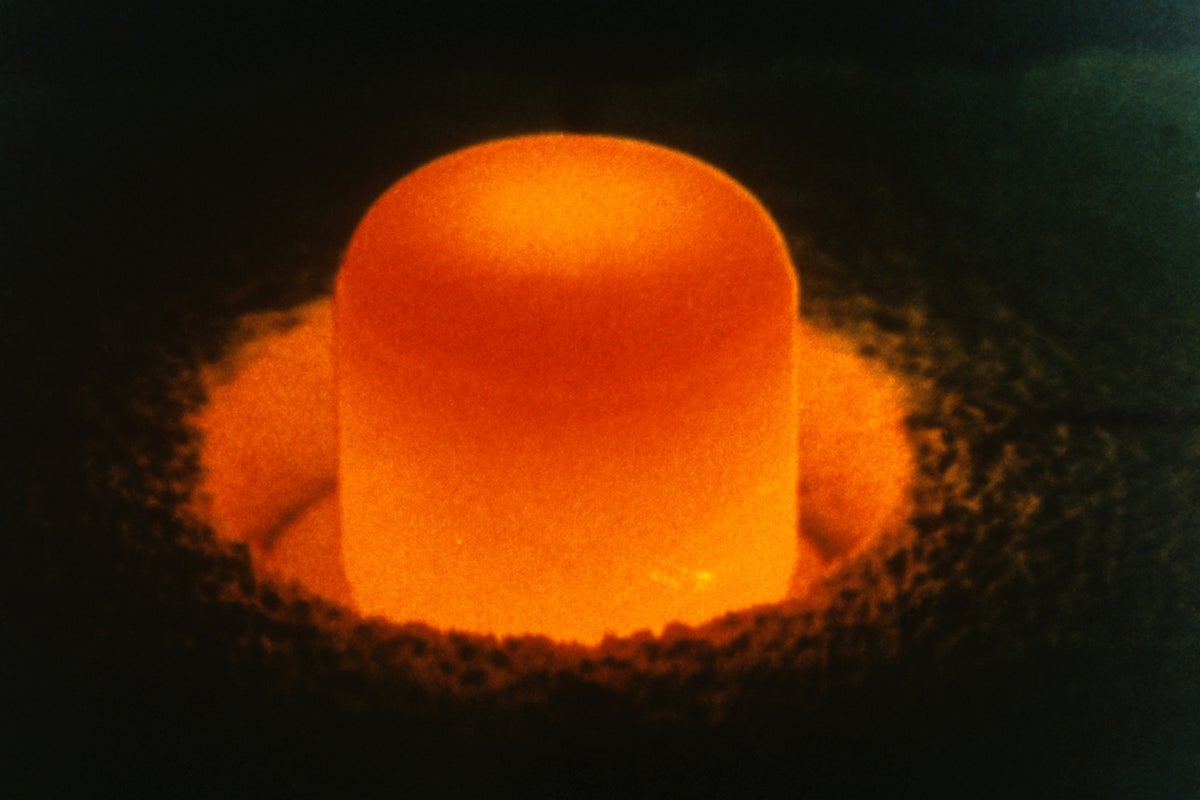
A pellet of plutonium 238, illuminated by the glow of its own radioactivity. NASA and other space agencies use this material in radioisotope power sources for interplanetary missions to the solar system’s darkest, most distant destinations. Photo Researchers/Science Source
.
.
Click the link below for the complete article:
.
__________________________________________
Older Entries
Newer Entries
 James' World 2