October 23, 2025
Mohenjo
Business, Food For Thought, Human Interest, Political, Science, Technical
amazon, business, Business News, current-events, Future, Hotels, human-rights, medicine, mental-health, research, Science, Science News, technology, Technology News, travel, vacation

Click the link below the picture
.
The Treasury Department announced new sanctions targeting Russia’s oil sector Wednesday, the day after President Donald Trump confirmed that a planned meeting with Russian President Vladimir Putin to discuss Russia’s war with Ukraine was off.
“Now is the time to stop the killing and for an immediate ceasefire,” Treasury Secretary Scott Bessent said in a statement. “Given President Putin’s refusal to end this senseless war, Treasury is sanctioning Russia’s two largest oil companies that fund the Kremlin’s war machine. Treasury is prepared to take further action if necessary to support President Trump’s effort to end yet another war. We encourage our allies to join us in and adhere to these sanctions.”
The two companies being sanctioned are Rosneft and Lukoil, along with some of their subsidiaries, the statement said.
Despite the war and the battered Russian economy, Rosneft and Lukoil are worth more than $50 billion each and are two of the biggest companies listed on the Moscow Stock Exchange.
Trump told reporters Wednesday that it was the appropriate time to use sanctions to try to end the war.
“I just felt it was time. Waited a long time,” Trump said.
He added, “These are tremendous sanctions. These are very big; these are against their two big oil companies. And we hope that they won’t be on for long. We hope that the war will be settled.”
Trump also said he hoped both Putin and Ukrainian President Volodymyr Zelenskyy would be “reasonable” and put aside their hatred for each other to resolve the conflict.
Ukraine’s ambassador to the United States, Olga Stefanishyna, signaled her strong support for the new sanctions Wednesday. “The decision is fully aligned with Ukraine’s consistent position: peace is possible only through strength and pressure on the aggressor using all available international tools,” she posted on X.
Last week, it appeared that relations between Washington and Moscow were warming after Trump held a call with Putin on Thursday and after Trump did not approve Zelenskyy’s request for long-range Tomahawk missiles in a meeting Friday.
Trump’s latest peace push hit a roadblock during a call between Secretary of State Marco Rubio and Russian Foreign Minister Sergey Lavrov, according to senior figures on both sides.
Lavrov became “exercised” during the call, a Trump administration official told NBC News. He reiterated Russia’s refusal to agree to an immediate ceasefire before talks begin, a key demand of Kyiv and Europe that the United States has backed.
“We canceled the meeting with President Putin. It just, it didn’t feel right to meet. It didn’t feel like we were going to get to the place we have to get. So I canceled it, but we’ll do it in the future,” Trump said Wednesday.
He added, “Every time I speak with Vladimir, I have good conversations, and then they don’t go anywhere. They just don’t go anywhere.”
Trump has been under pressure from Zelenskyy, European nations, and members of Congress from both parties for months to intensify U.S. sanctions on Russia
.
 .
.
.
Click the link below for the complete article:
.
__________________________________________
October 23, 2025
Mohenjo
Business, Food For Thought, Human Interest, Political, Science, Technical
amazon, business, Business News, current-events, Future, Hotels, human-rights, medicine, mental-health, research, Science, Science News, technology, Technology News, travel, vacation

Click the link below the picture
.
Lawyers for President Donald Trump are asking a federal judge in Florida to deny a request by the Wall Street Journal and its parent companies, Dow Jones and News Corp, to dismiss a $10 billion defamation lawsuit over the paper’s reporting on the bawdy letter allegedly penned by Trump that appeared in a birthday book for disgraced financier and sex offender Jeffrey Epstein.
In a court filing late Monday, Trump’s lawyers argued that the July article and surrounding coverage were a “deliberate smear campaign designed to damage President Trump’s reputation” and subject the president to “public hatred and ridicule.” They also requested oral arguments over the Journal’s recent motion to dismiss.
WSJ moves to dismiss Trump’s $10B lawsuit over alleged letter in Epstein birthday book
Epstein associate Ghislaine Maxwell, who is currently serving a 20-year prison sentence for aiding and participating in Epstein’s trafficking of underage girls, told Justice Department officials in August that Epstein had asked her to coordinate contributions to his 2003 50th birthday book from friends and associates, but said she could not recall if Trump, then a private citizen, was among those who responded.
Last month the House Oversight Committee released records from Epstein’s estate that included a copy of a birthday book with the alleged letter from Trump that the newspaper had described.
Trump, who filed suit against the Journal in July, has continued to argue the letter is fake and that the signature on the letter is not his.
Acknowledging the release of the letter by the House Oversight panel, Trump’s lawyers alleged that the Wall Street Journal was still “deliberate and malicious” because the reporting suggested that the letter was not only authored by Trump but also on-brand for the president.
“Defendants cannot hide behind a few words buried within the text — words that refer to the letter ‘bearing Trump’s name’ — while simultaneously ignoring their deliberate portrayal of the letter as being authored and sent by President Trump to Epstein in 2003,” the filing said.
The Wall Street Journal has stood by its reporting.
“Because Plaintiff has publicly admitted that he was Epstein’s friend in the early 2000s, his reputation cannot be harmed by the suggestion that he was friends with Epstein in 2003. Indeed, he was listed in the Birthday Book as a ‘friend’ of Epstein. The fact that his relationship with Epstein may now be a political liability — over 20 years after the Birthday Book was presented to Epstein — does not change this conclusion,” the Journal contended in its request for dismissal.
While the Journal’s reporting included a denial from President Trump, his lawyers argued in Mondays filing that the publication still acted with a “reckless disregard for the truth” because the request for comment was rushed and the reporting allegedly cast doubt on the president’s claim.
“Although Defendants included Plaintiff’s denial, they did so in a way that made it seem as if Plaintiff’s denial was false. This kind of reckless disregard for the truth by Defendants provides a sufficient basis for an inference of actual malice,” the filing said.
.
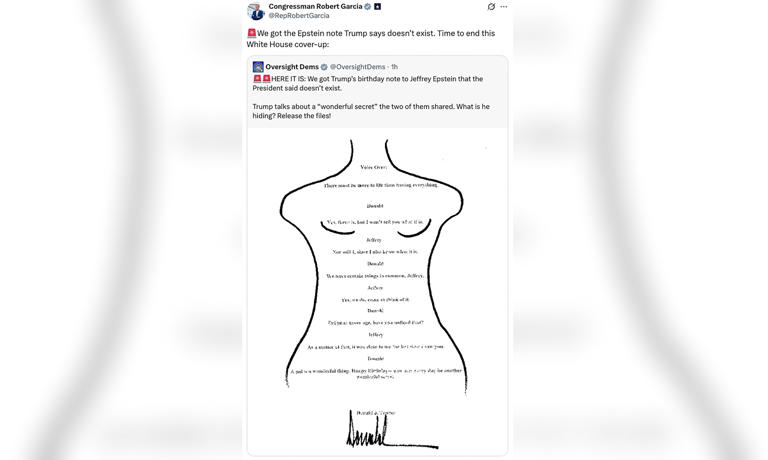 @RepRobertGarcia/X – PHOTO: Democratic Rep. Robert Garcia posted a photo on X that Democrats say is the page attributed to Trump in Jeffrey Epstein’s “birthday book.” The White House is denying that the image shared is the president’s signature.
.
.
Click the link below for the complete article:
.
__________________________________________
October 22, 2025
Mohenjo
Business, Food For Thought, Human Interest, Political, Science, Technical
amazon, business, Business News, current-events, Future, Hotels, human-rights, medicine, mental-health, research, Science, Science News, technology, Technology News, travel, vacation

Click the link below the picture
.
Scientists have converted the blood type of a donor kidney and transplanted the organ into a person. The procedure — the first of its kind — could improve access to donor organs, specialists say, because the blood type of the donor would no longer matter.
Currently, organs from deceased donors can be transplanted into people only if they have a compatible blood type. This is because the recipient’s immune system can produce antibodies to attack and destroy the donated organ if the donor and recipient have different antigens, which come in two types: A and B. Organs that are blood type O do not have A or B antigens, so anyone can receive them.
Researchers from Canada and China used an enzyme to remove type-A antigens from a donor kidney. The enzyme converts type-A blood into type-O, says study author Stephen Withers, a chemist at the University of British Columbia in Vancouver, Canada. The type-O kidney was then transplanted into a 68-year-old brain-dead man in Chongqing, China. The organ remained healthy for two days before showing signs of rejection. It produced urine for six days. The results are published in Nature Biomedical Engineering today.
The enzyme was first identified in 2019 by some members of the same team. In 2022, they showed that a type-A lung could be converted into a type-O one, although the organ wasn’t transplanted into a person.
The results are groundbreaking, says Natasha Rogers, a transplant clinician at Westmead Hospital in Sydney, Australia. They could improve access to donor organs and reduce transplant wait lists. If the blood type of the organ was no longer a barrier for transplantation, physicians could focus on things such as matching other antigens unrelated to blood type, which are important in terms of how long a transplant will last, she adds
What’s next?
Living donors can give their organs to people with different blood types, but the recipient first has to undergo multiple treatments to lower their antibody levels, Rogers says. However, for deceased donors, there is not enough time for the recipient to undergo the treatments before the donor organ becomes unusable, she adds. The treatment also affects the recipient’s immune system, increasing the risk of infection.
Treating the donor organ instead of the recipient is a breakthrough, says Rogers. The study shows that a person could initially receive the same kind of immunosuppression given for transplants between people with matching blood types to reduce the risk of rejection. But more trials in brain-dead and trials in living people will be needed before the enzyme can be used routinely, she adds, including adjusting treatment for the organ or recipient to help the organ function for longer.
.
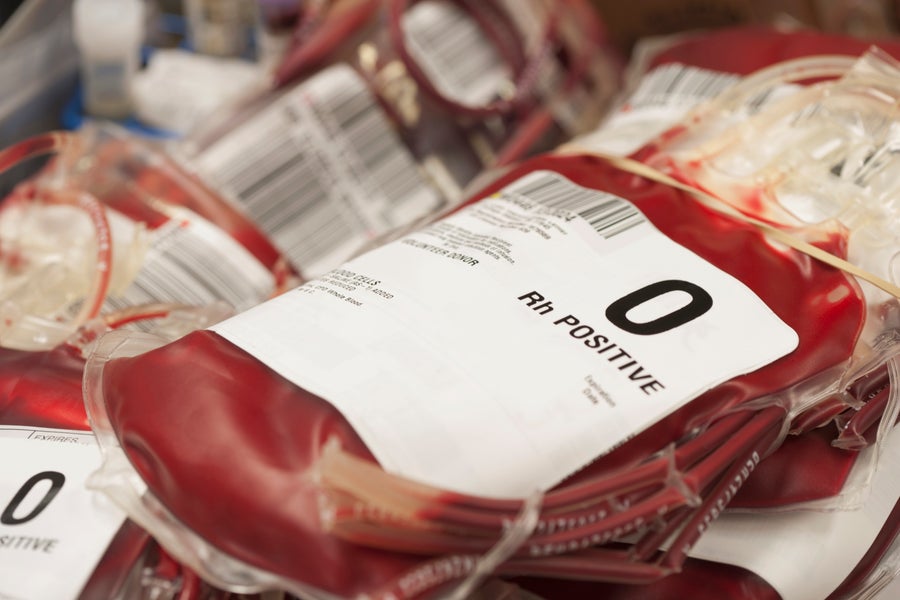
Pouches of donated blood in a hospital. ER Productions Limited/Getty Images
.
.
Click the link below for the complete article:
.
__________________________________________
October 22, 2025
Mohenjo
Business, Food For Thought, Human Interest, Political, Science, Technical
amazon, business, Business News, current-events, Future, Hotels, human-rights, medicine, mental-health, research, Science, Science News, technology, Technology News, travel, vacation

Click the link below the picture
.
The massive Amazon Web Services outage that took down sites from Reddit to Ring to Roblox has been fixed, the company said. The AWS outage rendered huge portions of the internet unavailable for most of the work day for many people on Monday. As the day rolled along, the breakdown affected more than 2,000 companies and services, including Snapchat, Fortnite, Venmo, the PlayStation Network, Amazon itself and critical services such as online banking.
As of 3:53 p.m. PT, Amazon said that the massive issue was resolved. The company said the outage began at 11:49 p.m. on Sunday, with the company seeing increased error rates for services on the US East Coast. Amazon says its workers identified the source of the error at 12:26 a.m., blaming DNS resolution issues for the regional DynamoDB service endpoints. After that issue was resolved, Amazon faced additional problems, and had to throttle, meaning temporarily limit the power and performance, for certain operations.
“Over time, we reduced throttling of operations and worked in parallel to resolve network connectivity issues until the services fully recovered,” the latest update said. “By 3:01 p.m., all AWS services returned to normal operations.”
Why were so many sites affected?
AWS, a cloud services provider owned by Amazon, props up huge portions of the internet. So when it went down, it took many of the services we know and love with it. As with the Fastly and Crowdstrike outages over the past few years, the AWS outage shows just how much of the internet relies on the same infrastructure — and how quickly our access to the sites and services we rely on can be revoked when something goes wrong.
The reliance on a small number of big companies to underpin the web is akin to putting all of our eggs in a tiny handful of baskets. When it works, it’s great, but only one small thing needs to go wrong for the internet to fall to its knees in a matter of minutes.
Outage reports spiked as the West Coast woke up
AWS first registered an issue on its service status page just after midnight PT on Monday, saying it was “investigating increased error rates and latencies for multiple AWS services in the US-East-1 Region.” Around 2 a.m. PT, it said it had identified a potential root cause of the issue. Within half an hour, it had started applying mitigations that were resulting in significant signs of recovery.
“The underlying DNS issue has been fully mitigated, and most AWS Service operations are succeeding normally now,” AWS said at 3.35 a.m. PT.
The issues seemed to have been largely resolved as the US East Coast was coming online, but outage reports spiked again dramatically after 8 a.m. PT as work began on the West Coast.
As of 8:43 a.m. PT, the AWS status page showed the severity as “degraded.” In a post at that time, AWS noted: “We are throttling requests for new EC2 instance launches to aid recovery and actively working on mitigations.” (EC2 is AWS shorthand for Amazon Elastic Compute Cloud, a service that it says “provides secure, resizable compute capacity in the cloud.”)
Amazon didn’t respond to a request for further comment beyond pointing us back to the AWS health dashboard.
Around the time that AWS says it first began noticing error rates, the outage-tracking site Downdetector saw reports begin to spike across many online services, including banks, airlines and phone carriers. As AWS resolved the issue, some of these reports saw a drop-off, whereas others have yet to return to normal. (Downdetector is owned by the same parent company as CNET, Ziff Davis.)
Around 4 a.m. PT, Reddit was still down, while services including Ring, Verizon and YouTube were still seeing a significant number of reported issues. Reddit finally came back online around 4.30 a.m. PT, according to its status page, which was then verified by CNET.
n total, Downdetector saw over 9.8 million reports, with 2.7 million coming from the US, over 1.1 million from the UK and the rest largely spread across Australia, Japan, the Netherlands, Germany and France. Over 2,000 companies in total have been affected, Downdetector added, without around 280 still experiencing issues around 10 a.m. PT.
“This kind of outage, where a foundational internet service brings down a large swath of online services, only happens a handful of times in a year,” Daniel Ramirez, Downdetector by Ookla’s director of product, told CNET. “They probably are becoming slightly more frequent as companies are encouraged to completely rely on cloud services and their data architectures are designed to make the most out of a particular cloud platform.”
What caused the AWS outage?
AWS didn’t immediately share full details about what caused the internet to fall off a cliff this morning. Then at 8:43 a.m. PT, it offered this brief description: “The root cause is an underlying internal subsystem responsible for monitoring the health of our network load balancers.”
Earlier in the day, it had attributed the outage to a “DNS issue.” DNS stands for the domain name system and refers to the service that translates human-readable internet addresses (for example, CNET.com) into machine-readable IP addresses that connect browsers with websites.
.

An Amazon Web Services outage affected more than 2,000 companies at the start of the work week. Jeffrey Hazelwood/CNET
.
.
Click the link below for the complete article:
.
__________________________________________
October 22, 2025
Mohenjo
Business, Food For Thought, Human Interest, Political, Science, Technical
amazon, business, Business News, current-events, Future, Hotels, human-rights, medicine, mental-health, research, Science, Science News, technology, Technology News, travel, vacation

Click the link below the picture
.
European and Arab nations, Canada, and the U.S. appear willing to contribute to the estimated $70 billion needed to rebuild Gaza, a U.N. official said on Tuesday, adding that the two-year war there had produced rubble equal to 13 times the pyramids of Giza.
.
Jaco Cilliers, an official at the United Nations Development Program, said Israel’s war against Hamas had generated at least 55 million tons of rubble and that it could take decades for Gaza to fully recover.
.
“We’ve heard very positive news from a number of our partners, including European partners… Canada,” regarding their willingness to help, he told a press conference, adding that there were also discussions with the United States.
Since a ceasefire deal came into effect in Gaza, large numbers of Palestinians have returned to the ruins of their homes in the coastal territory.
.
Huge swathes of Gaza have been reduced to a wasteland by Israeli bombardment over two years that killed some 68,000 people, according to Gaza health authorities.
A large part of the destruction is in Gaza City, scene of some of the fiercest fighting. About 83% of all building structures there have been damaged, according to the United Nations Satellite Center (UNOSAT).
.
UNDP said it had already cleared some 81,000 tons of rubble from the Gaza Strip and was continuing to do so.
Israel launched its offensive after Hamas-led militants attacked the country on October 7, 2023, killing 1,200 people and taking 251 hostages, according to Israeli tallies.
.
Hamas freed the last living Israeli hostages from Gaza on Monday under the ceasefire deal, and Israel sent home busloads of Palestinian detainees, as U.S. President Donald Trump declared the end of the two-year-long war.
.
 [1/2] Heavy machinery drives through a street, amid a ceasefire between Israel and Hamas, in Gaza City, October 14, 2025. REUTERS/Ebrahim Hajjaj Purchase Licensing Rights
.
.
Click the link below for the complete article:
.
__________________________________________
October 21, 2025
Mohenjo
Business, Food For Thought, Human Interest, Political, Science, Technical
amazon, business, Business News, current-events, Future, Hotels, human-rights, medicine, mental-health, research, Science, Science News, technology, Technology News, travel, vacation
Click the link below the picture
.
Babies start processing language before they are born, a new study suggests. A research team in Montreal has found that newborns who had heard short stories in foreign languages while in the womb process those languages similarly to their native tongue.
The study, published in August in Nature Communications Biology, is the first to use brain imaging to show what neuroscientists and psychologists had long suspected. Previous research had shown that fetuses and newborns can recognize familiar voices and rhythms, and even that they prefer their native language soon after birth. But these findings come mostly from behavioral cues—sucking patterns, head turns, or heart rate changes—rather than direct evidence from the brain.
“We cannot say babies ‘learn’ a language prenatally,” says Anne Gallagher, a neuropsychologist at the University of Montreal and senior author of the study. What we can say, she adds, is that neonates develop familiarity with one or more languages during gestation, which shapes their brain networks at birth.
The research team recruited 60 people for the experiment, all of them about 35 weeks into their pregnancy. Of those, 39 exposed their fetuses to 10 minutes of prerecorded stories in French (their native language) and another 10 minutes of the same stories in either Hebrew or German at least once every other day until birth. These languages were chosen because their acoustic and phonological properties are very distinctfrom French and from each other, explains co-lead author Andréanne René, a Ph.D. candidate in clinical neuropsychology at the University of Montreal. The other 21 participants were part of the control group; their fetuses were exposed to French in their natural environments, with no special input.
Between the first 10 hours and three days after birth, the team observed how the newborns’ brains reacted to German, Hebrew and French by using functional near-infrared spectroscopy (fNIRS), a noninvasive imaging technique that measures changes in blood oxygenation in the brain.
All babies in the cohort had increased activity in the left temporal lobe, the brain’s language processing center, when they heard spoken French. But only those exposed to Hebrew or German before birth showed similar brain activation when listening to those languages. Newborns who had not heard the Hebrew or German stories before birth showed activation in brain regions for processing sounds in general and less activation in language-processing regions.
The study supports the idea that the newborn brain is not a “blank slate,” says Ana Carolina Coan, a pediatric neurology expert and member of the Brazilian Academy of Neurology. Instead, the gestational environment starts shaping fetuses’ brain processing even before birth.
It isn’t clear how much in utero exposure to a given tongue is needed for newborns’ brains to process it as language. Some previous research into the effects of the auditory environment on fetuses used hours-long exposure; other studies used a duration of as little as 15 minutes. Gallagher was concerned that the new study’s exposure time wouldn’t be enough to note any response, but asking for more than that might have been burdensome to the participants. This made the study’s clear results a welcome surprise, she says.
“The study doesn’t suggest mothers should expose their unborn babies to foreign languages to be smarter or multilingual later,” says Coan, who did not take part in the research. But studying how language exposure in utero affects a child’s speech development will be important for understanding speech disorders, which affect around 5 to 10 percent of children in the U.S. “For clinicians, this adds evidence that language development begins much earlier than birth, which matters for how we detect and treat delays,” she says.
.
 Vicki Smith/Getty Images
.
.
Click the link below for the complete article:
.
__________________________________________
October 21, 2025
Mohenjo
Business, Food For Thought, Human Interest, Political, Science, Technical
amazon, business, Business News, current-events, Future, Hotels, human-rights, medicine, mental-health, research, Science, Science News, technology, Technology News, travel, vacation

Click the link below the picture
.
Capital gains taxes are levied on profits from the sale of assets like stocks, mutual funds, and real estate. The rate at which these gains are taxed depends on your taxable income and how long you’ve held the asset. But keep in mind that capital gains tax rates are generally lower than the tax rates for ordinary income, like wages.
Let’s examine the 2025 rates for long-term capital gains (assets held for more than a year) and highlight the changes from last year’s rates. We will also review the new IRS threshold brackets for 2026.
Additionally, we will discuss short-term rates (ordinary income tax rates) and rates for specific capital gains tax situations, including those applicable to collectibles and the Net Investment Income Tax.
Long-term capital gains tax rates
Long-term capital gains tax rates apply to assets held for more than a year. These rates are structured to encourage long-term investment.
The rates are 0%, 15%, or 20%, depending on your income level; essentially, the higher your income, the higher your rate. The income thresholds for long-term capital gains are adjusted annually for inflation.
If you compare the capital gains tax rates from 2024 and 2025 below, you can see the impact of inflation adjustments.
The 2025 capital gains tax thresholds increased by about 2.8% across various filing statuses from the prior year.
For instance, with single filers, the 0% rate now applies to incomes up to $48,350 in 2025, up from last year’s threshold of $47,025.
The 20% rate threshold for single filers rose substantially from $518,900 in 2024 to $583,400 for 2025.
For married couples filing jointly:
- The 0% rate threshold increased by 2.82%, from $94,050 last year to $96,700 for 2025.
- The 20% rate threshold rose from $588,750 to $600,050.
Head of household filers also experienced changes:
- The 0% rate threshold increased by about 2.78%, from $63,000 last year to $64,750 for 2025.
- The 20% rate threshold jumped from $551,350 to $566,700
These inflation adjustments are designed to prevent “bracket creep,” where taxpayers might be pushed into higher tax brackets due to inflation rather than actual increases in real income.
.
 (Image credit: Getty Images)
.
.
Click the link below for the complete article:
.
__________________________________________
October 21, 2025
Mohenjo
Business, Food For Thought, Human Interest, Political, Science, Technical
amazon, business, Business News, current-events, Future, Hotels, human-rights, medicine, mental-health, research, Science, Science News, technology, Technology News, travel, vacation

Hmmmm… Gen Z, and Gen Alpha in the USA have been bamboozled!
Click the link below the picture
.
The economic effect of past government shutdowns has been straightforward. The economy loses some activity for a few weeks, then gains it back after the government reopens. The net cost is basically zero.
This time, the math may not be so benign.
As Washington’s stalemate continues into its fourth week with no end in sight, it’s looking like this could become one of America’s longest funding lapses. During the previous record-holder, a 34-day closure in 2018, Congress passed enough appropriations bills to keep more of the government funded. This time, none have been passed.
And the White House is attempting to lay off thousands of people and threatening to withhold back pay for furloughed workers, despite a 2019 law requiring that they be paid. “That would obviously make it a larger macroeconomic impact,” said Michael Zdinak, a director on the United States economics team at S&P Global Market Intelligence.
Then there are the services those workers aren’t providing, including national park tours and new drug reviews, that support commerce. For many businesses, the timing couldn’t be worse, with the holiday season approaching and economic uncertainty already high.
“If you’re worried about the potential for those indirect impacts, those only increase the longer the shutdown goes on,” Mr. Zdinak said.
Economists estimate that the shutdown will trim between 0.1 and 0.2 percentage points off annual growth in economic output for each week it drags on. That amounts to between $7.6 billion and $15.2 billion a week based on hours that government employees aren’t working, according to Oxford Economics. The 2018 shutdown trimmed slightly less than 0.1 percentage points off annual growth per week, according to the Bureau of Economic Analysis.
That estimation does not capture the ways federal services support economic activity in other sectors, where the effect could be narrow but deep. Consider visa processing. Much of it is performed by contractors, who were told to stop work on Oct. 1. Unlike government employees, they will not be paid back when the shutdown ends.
Brandon Muniz owns a Maryland information technology provider, HeiTech Services, which relies on federal contracts. He has already lost business this year because of government cost-cutting, and over the past couple of weeks, he has had to cut hours for staff members who can’t evaluate applications for green cards and employment-based visas until the government reopens. Mr. Muniz has had to lay off 15 people this year and furlough another 25 because of the shutdown. He worries about getting them back if they find other jobs and keeping the business afloat in the meantime.
“All of our indirect costs for our headquarters team, the facilities, the vehicles that they have, we still have to pay for,” Mr. Muniz said. “Those are things we factor in when we write up a proposal for a contract, but it’s very difficult to factor in something like a shutdown.”
The individuals and businesses that HeiTech serves — like farmers, operators of seasonal attractions and seafood processors — are dealing with delayed visa applications.
Small companies that depend on one or two foreign workers with specific skills are in limbo, said Mark Neuberger, a lawyer with Foley & Lardner in Miami who helps clients with labor issues. “Even a short shutdown gums up the works for months, and they have to clean up the mess from when they were gone,” Mr. Neuberger said.
The federal government also guarantees a significant share of credit markets through agencies whose work has been significantly curtailed, including the Small Business Administration and the Department of Agriculture.
The pause in federal loan processing poses the largest obstacle for low-income borrowers who would qualify for a mortgage backed by the Agriculture Department’s program for rural areas. But even people with approvals for private mortgages in disaster-prone areas are getting tripped up because they have no access to the National Flood Insurance Program.
For farms and small businesses, October is a critical month for borrowing money. Some are paying their taxes, having gotten a six-month extension from the spring. Others are trying to stock up on inventory, or purchase equipment for the upcoming planting season.
Federal agencies generally offer more affordable terms than private lenders, and if they’re not available, borrowers may resort to pricier options.
.

The U.S. Capitol is seen from an empty meeting room in the Hart Senate Office Building during the federal government shutdown. Credit…Jonathan Ernst/Reuters
.
.
Click the link below for the complete article:
.
__________________________________________
October 20, 2025
Mohenjo
Business, Food For Thought, Human Interest, Political, Science, Technical
amazon, business, Business News, current-events, Future, Hotels, human-rights, medicine, mental-health, research, Science, Science News, technology, Technology News, travel, vacation
Click the link below the picture
.
The 2025 Nobel Prize in Chemistry has been awarded for a versatile technology that can be used for an astonishing variety of purposes, from environmental remediation to drug delivery and energy storage.
Metal-organic frameworks, or MOFs, are molecular sponges that are already in clinical trials for use in cancer radiation treatment and are being sold as a way to contain carbon dioxide taken from cement and to fuel hydrogen production. They are also being explored as methods of pulling water out of air in arid places, cleaning up wastewater, and removing perfluoroalkyl and polyfluoroalkyl substances (PFAS) from the environment, and for providing targeted drug delivery. The researchers behind MOFs—Susumu Kitagawa, Richard Robson, and Omar M. Yaghi—will share the Nobel Prize and divide the award of 11 million Swedish kronor, or about $1 million.
During a press briefing, Yaghi—a chemist at the University of California, Berkeley, who has been widely credited for expanding the use of MOFs—referenced other ways the frameworks could be used, including the sequestration of nerve gas. MOFs “opened new avenues of applications that other materials could not do,” he said.
MOFs are part chemistry, part materials science. They are made by linking metal ions with organic, or carbon-containing, molecules. The linked molecules form crystals, repeating and stacking to create a cage with a hole—or a pore in a sponge. The cages can be one-dimensional or multidimensional, and they can be formed from a host of metals and organic linkers to make structures with larger or smaller pores. The holes are generally uniform in size.
Richard Robson of the University of Melbourne dreamed up the first MOFs. He was inspired by the tetrahedral, or pyramidlike, shape that carbon atoms take to form diamonds. He mixed a form of copper with a nitrile, an organic compound with nitrogen bonded to carbon, and watched as it formed that repeating structure with small spaces in it. But early MOFs were not very stable.
The pores are key to the power of MOFs, says Ling Zang, a material scientist at the University of Utah, who is using these frameworks to sequester PFAS from water. The porous of nature of MOFs means relatively small amounts can adsorb huge quantities of its intended target. They can be small, less than a nanometer, he says, but also several nanometers in size. The Nobel Committee for Chemistry noted the surprisingly large capacity of MOFs, with one member comparing it to the character Hermione Granger’s beaded bag, which could hold much more than its size would suggest, in the Harry Potter series.
The size of the pore is important for removing PFAS because some chemicals in this group have only two carbons in their chains, and others have eight or 10. Zang is building a MOF that fluoresces when it’s full, telling the user when it should be changed out like an indicator light on a home water filter.
Kitagawa, a researcher at Kyoto University, furthered MOF developments with the scientists in his laboratory, creating structures that were flexible and finding that gases could flow in and out of MOFs. Yaghi and his collaborators helped make MOFs more stable, tinkering with many combinations of metal ions and organic linkers.
Wenbin Lin of the University of Chicago is the scientist whose team created RiMO-301, a MOF with medical applications that is now in clinical trials as a way to make radiation treatment for some cancers more effective. RiMO-301 is injected into tumors before low-dose radiation therapy. Lin says that in interim results of his team’s phase 1 trial, 42 percent of people who otherwise would not have responded to radiation therapy responded to RiMO-301.
Like many in the field, Theresa Reineke knew the time was coming for MOFs to earn this high honor in science. She was one of Yaghi’s first graduate students and works on organic drug delivery systems at the University of Minnesota. There was a lot of doubt in the early days of MOFs, she says. Yaghi and other scientists had to prove that this new material could do the job better, more efficiently, and more cost-effectively than what was already out there.
In many ways, they have done so, says Pernilla Wittung-Stafshede of Rice University, a protein chemist, a member of the Royal Swedish Academy of Sciences, and one of the members of the Nobel Committee for Chemistry.
“Sometimes it depends on the competition that particular year,” she says. But with MOFs, “it’s really that all these applications were building up.” The technology, and often Yaghi, have been on Nobel prediction lists for years. “It was ready,” Wittung-Stafshede says. “It became the right time.”
.

vanbeets/Getty Images (medal)
.
.
Click the link below for the complete article:
.
__________________________________________
October 20, 2025
Mohenjo
Business, Food For Thought, Human Interest, Political, Science, Technical
amazon, business, Business News, current-events, Future, Hotels, human-rights, medicine, mental-health, research, Science, Science News, technology, Technology News, travel, vacation

Click the link below the picture
.
French President Emmanuel Macron said that “everything is being done” to catch the suspects.
“The theft committed at the Louvre is an attack on a heritage we cherish because it is part of our history,” Macron said on X, “ We will recover the works, and the perpetrators will be brought to justice.”
A detailed list of the stolen items released by the culture ministry revealed a single earring from the sapphire parure of Queen Marie-Amélie and Queen Hortense, an emerald necklace and pair of emerald earrings from the parure of Empress Marie-Louise, the “reliquary brooch,” and the tiara and large corsage bow brooch of Empress Eugénie were stolen in the heist.
An attempt to set fire to the truck used to carry out the raid was foiled by a Louvre security officer, forcing the burglar to flee, according to the culture ministry’s statement.
An investigation for “aggravated theft by an organized gang and criminal conspiracy to commit a felony,” has been opened by Paris police under the authority of Paris public prosecutor’s office.
The robbery took only seven minutes, with the suspects fleeing on motorcycles, Nuñez told France Inter.
“Clearly, a team had been scouting the location. It was obviously a very experienced team that acted very, very quickly,” the interior minister said.
“I am confident that we will very quickly find the perpetrators and, above all, recover the stolen goods,” he added.
Video from the scene showed French police examining an abandoned furniture elevator positioned next to a corner of the Louvre, with its ladder leading up to a broken window off a balcony.
According to Le Parisien’s reporting, the police have found “two angle grinders, a blowtorch, gasoline, gloves, a walkie-talkie, a blanket, and a crown” at the scene of the robbery. A yellow vest used by the perpetrators to disguise themselves as workmen was found a bit further away, lost during their escape, the newspaper said.
A tour guide told CNN how he had heard what sounded like “stomping” on the window as he led tourists through the Apollo Room, before hearing shouts from security guards to evacuate.
“I was just trying to figure out what’s happening when I saw the museum staff going to that noise. Then they did a turn around, like real quick, and they started running and saying ‘get out, get out, get out, get out, evacuate!’” Ryan el Mandari said.
He tried to keep his group of visitors calm as they left the building, he said, adding that they heard the sounds but “had no clue that it was a robbery.”
The French interior ministry said the incident took place at 9:30 a.m. local time and that members of the public had been evacuated without incident.
Minister of Culture Rachida Dati said the robbery had taken place as the museum opened. “No injuries were reported. I am on site alongside museum staff and the police. Investigations are ongoing,” Dati said in a post on X.
Christopher Marinello, the founder of Art Recovery International, said that if the thieves are just looking to get cash out as quickly as possible, they might melt down the precious metals or recut the stones with no regard for the piece’s integrity.
“We need to break up these gangs and find another approach, or we’re going to lose things that we are never going to see again,” Marinello told CNN.
The museum, which houses world-famous artworks including Leonardo da Vinci’s Mona Lisa, said it would remain closed on Sunday due to “exceptional reasons.” The interior ministry later said the closure was a security measure to preserve evidence for the investigation. The mayor of Paris Center, Ariel Weil, told reporters that the thieves had “planned this meticulously, obviously” and that he could not recall the Louvre being the target of a robbery in more than a century. “I’m thinking, of course, of the Mona Lisa sting in 1911, but I can’t think of any more recent robbery,” he said.
.
 .
.
.
Click the link below for the complete article:
.
__________________________________________
Older Entries
Newer Entries
 James' World 2