November 19, 2025
Mohenjo
Business, Food For Thought, Human Interest, Political, Science, Technical
amazon, business, Business News, current-events, Future, Hotels, human-rights, medicine, mental-health, research, Science, Science News, technology, Technology News, travel, vacation

Click the link below the picture
.
Finding the oldest Maya site ever documented was only the beginning of archaeologist Takeshi Inomata’s discoveries. After locating the Aguada Fénix site buried in the jungle of southern Mexico in 2017, Inomata and his team began digging downward and uncovered a massive cross-shaped pit.
Inside the pit were pigments of blue azurite to the north, green malachite to the east and yellow ochre to the south, as well as marine shells interspersed with axe-shaped clay offerings to the west, says Inomata, a researcher at the University of Arizona. Later, the team realized that the cross-shaped pit was aligned with giant canals that extended toward the four cardinal directions.
The cross and the canals, Inomata says, form a cosmogram—a monumental map of the universe etched into the landscape. Cosmograms were used by Mesoamerican civilizations to represent their understanding and cultural relationship with the cosmos. Inomata says that his and his colleagues’ findings, published on Wednesday in Science Advances, challenge long-held assumptions about the social order of the ancient Maya and the reasons behind their architectural achievements.
For decades, archaeologists theorized that the monumental architecture built by the Maya civilization, such as pyramids and other ceremonial centers, arose after ancient Maya hierarchy began to emerge around 350 B.C.E. and was the product of powerful rulers who commanded labor and controlled resources. (This social scale consisted of four distinct classes, with slaves and commoners in the two lowest tiers and priests and nobility at the top.) Earlier Maya communities, by contrast, were assumed to live in small villages with modest ceremonial structures.
Aguada Fénix covers a nearly nine-by-7.5-kilometer area, making it one of the largest ancient constructions in all of Mesoamerica. After its discovery in 2017, the team found that the site dated from between 1000 and 800 B.C.E., long before Maya hierarchies had developed. “The question was ‘Why was it built?’” Inomata says.
To find answers, he and his team combined lidar (light detection and ranging) technology with excavations conducted between 2020 and 2024. From above, they found a pattern of raised causeways, carved corridors and canals that formed nested crosses, all oriented along north-south and east-west axes. At the center of this pattern lay a rectangular plateau and a plaza consisting of structures arranged in what is called an E Group, a ceremonial layout found across Mesoamerica and associated with astronomical observations. Beneath it, the team found the cross with the colored pigments. Radiocarbon dating placed the year of the ritual deposit as around 900 B.C.E.
The researchers also documented a network of canals and a dam that extended westward from the main plateau; these features were likely designed to channel water from a nearby lake. Though the hydraulic system appears unfinished, its monumental scale suggests an extraordinary level of coordination for its construction, Inomata says.
Because the canals served no practical purpose, the archaeologists thought they might have been built for ritual use. The team also found no palaces, royal tombs or elite residences at the site. Along with the evidence found inside the pit, this suggests that Aguada Fénix may have been a gathering place where dispersed communities came together seasonally for rituals, ceremonies and feasts. Instead of orders from a ruling class, “religion was very important and motivated people to do this huge work,” Inomata says.
Within the archaeological community, there is broad debate about what defines a cosmogram, says archaeologist Oswaldo Chinchilla of Yale University, who was not involved with the research. Some archaeologists, including Chinchilla, believe “the term has been somewhat overused,” he says, because it has often been applied to precolonization sites with limited evidence. The case of Aguada Fénix is different, however, given that “the evidence is strong.”
The use of pigments and the alignment of ceremonial centers with the sunrise and sunset are elements that are strongly tied to Maya religion and cosmology, something that endures today among Maya communities that still live in Mexico and Central America, Chinchilla says.
“Based on what we know of Mesoamerican science and religion, the cruciform pit would have anchored everything to the cosmos,” says archaeologist David Stuart of the University of Texas at Austin, who also was not involved with the study. “It helped to make it a sacred space for the community that built it.”
Like Inomata and Chinchilla, Stuart proposes that the underground offerings placed around the pit “work as a metaphorical planting, activating the space, which amounted to a cosmic stage,” perhaps for communal gatherings and performances.
For Inomata, the new evidence is a reminder that social hierarchies are not always necessary when a goal serves the common good, such as by allowing for collective ritual. “This is a remarkable achievement of the [Maya] people who still live there,” he says.
.
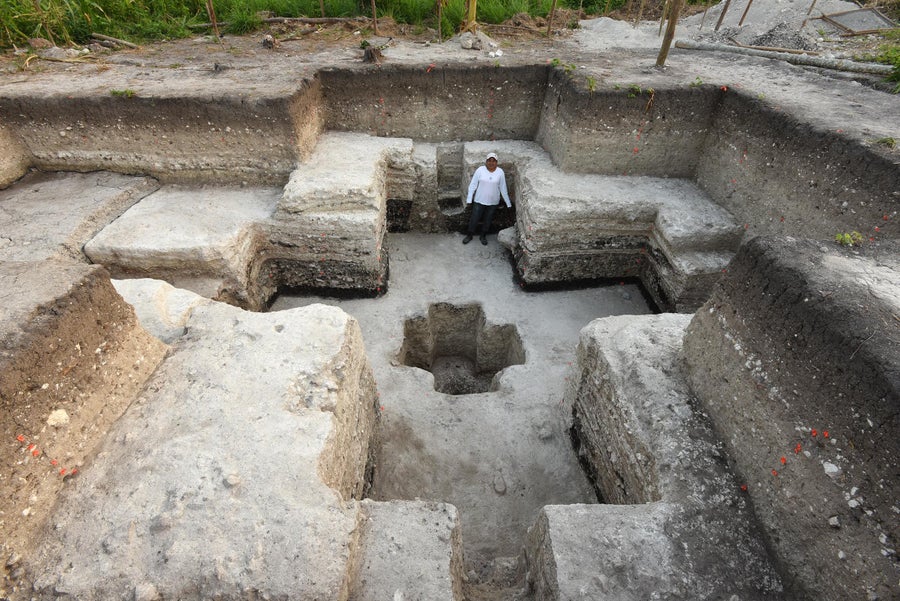
A cross-shaped pit found at the Aguada Fénix site in Mexico after excavation. Takeshi Inomata
.
.
Click the link below for the complete article:
.
__________________________________________
November 19, 2025
Mohenjo
Business, Food For Thought, Human Interest, Political, Science, Technical
amazon, business, Business News, current-events, Future, Hotels, human-rights, medicine, mental-health, research, Science, Science News, technology, Technology News, travel, vacation

Click the link below the picture
.
A narrow procedural crowbar pried open the House of Representatives this week. The tool was a discharge petition—historically, very rarely successful—that helped force a 427–1 vote on the “Epstein Files Transparency Act,” and the Senate agreed to speed it to President Donald Trump, who so far has said he’d sign it.
But the “new” Epstein transparency process has an escape hatch built on Biden-era logic. The bill Trump has backed outlaws redactions for political embarrassment—but echoes the very clause Joe Biden’s Justice Department relied on to keep Epstein records sealed. If disclosure would “jeopardize an active Federal investigation,” Justice can temporarily, narrowly hold material back. On November 14, Trump said he’d ask DOJ to probe Epstein’s ties to various high-profile figures, and Attorney General Pam Bondi said she’d assigned a U.S. attorney to lead a federal investigation. That gives DOJ an “ongoing investigation” rationale.
Whatever Trump’s critics say, that isn’t a loophole invented this week; it’s the same rationale the Biden-era DOJ cited in 2022 under FOIA Exemption 7(A) to protect an “ongoing criminal investigation of Jeffrey Epstein and others.”
In other words, Congress promised sunlight on a 30-day clock while inadvertently or otherwise reaffirming the old, court-tested carve-outs for victim privacy and live cases—the very exemptions that kept much of this material dark under Biden.
Common Knowledge
Democrats cast the vote as a victory for transparency. “We will pass the House’s bill without changes, without delay and we will finally get this done,” said Senate Democratic leader Chuck Schumer.
Ro Khanna, the California Democrat who co-led the discharge petition with libertarian-leaning Republican Thomas Massie, pitched the release as a moral necessity: “A nation that cannot hold accountable rich and powerful men who have abused young girls is a nation that has lost its moral and spiritual bearings.”
On the right, Speaker Mike Johnson has cautiously framed himself as pro-transparency. “It’s not a reversal,” he said, but warned that forcing disclosures in 30 days is “incredibly dangerous” given classification and victim-privacy concerns.
National Review’s editors called the latest Democratic-released emails “embarrassing” for Trump but said they contain “no smoking gun,” urging “maximal transparency” overseen by judges rather than a “willy-nilly, politicized push.”
Trump has simply insisted: “We have nothing to hide.”
Republican Representative Clay Higgins—the lone “no”—warned the bill “reveals and injures thousands of innocent people … witnesses, people who provided alibis, family members.”
Uncommon Knowledge
What Congress just advanced is a transparency mandate with the same brakes. The act compels the attorney general to publish, within 30 days, “all unclassified records, documents, communications, and investigative materials” related to Epstein and Ghislaine Maxwell—flight logs, immunity deals, internal DOJ communications, and records on Epstein’s detention and death. It also orders DOJ, after publication, to provide Congress a non-redacted list of every government official, public figure, or foreign dignitary named in the materials. And it bars withholding for “embarrassment, reputational harm, or political sensitivity.”
However, it explicitly permits narrowly tailored, temporary redactions where disclosure “would jeopardize an active Federal investigation or ongoing Federal prosecution.” It likewise shields child-exploitation imagery, certain victim identifiers, depictions of abuse, and properly classified national-security information. For each redaction, DOJ must file a written justification in the Federal Register and “declassify to the maximum extent possible,” or at least publish an unclassified summary. This framework unmistakably mirrors what Biden’s DOJ already told a court: that it was withholding Epstein-related materials under FOIA’s Exemption 7(A) to avoid harming an “ongoing criminal investigation of Jeffrey Epstein and others,” including potential co-conspirators. The politics have reversed; the doctrine is the same.
Survivors and their allies pressed Congress not to add new caveats; obliged with a clean, fast Senate pathway. Yet the decisive arena now shifts to DOJ, where line attorneys will comb each page, draft Federal Register justifications, and decide how expansively to read “jeopardize an active investigation.” And because the act requires DOJ to transmit the names list to Congress (not necessarily to post it online), many revelations may first surface via hearings, subpoenas, or selective leaks rather than a single, neatly indexed website drop.
Whether this is deliberate strategy or circumstance is not known. But did Democrats “play the same game” under Biden that Trump’s Justice Department can now play? In a narrow, legal sense: yes. The Biden DOJ told a court it was withholding Epstein records because related investigations and potential prosecutions remained active; the new statute explicitly allows similar withholdings. Bureaucracy, then as now, is where the battle ahead may be fought.
.
 President Donald Trump aboard Air Force One on November 14, 2025. | Roberto Schmidt/Getty Images
.
.
Click the link below for the complete article:
.
__________________________________________
November 19, 2025
Mohenjo
Business, Food For Thought, Human Interest, Political, Science, Technical
amazon, business, Business News, current-events, Future, Hotels, human-rights, medicine, mental-health, research, Science, Science News, technology, Technology News, travel, vacation

Click the link below the picture
.
My early Thanksgivings were a cross-cultural hodgepodge: boxed stuffing and canned cranberries sat on the table alongside pav bhaji and lemon rice. My Indian immigrant parents didn’t want us to miss out on American celebrations, but they also couldn’t wrap their heads around eating so much beige food devoid of spice.
By the time I was 16 years old, though, I had fallen in love with cooking thanks to a daily after-school dose of the Food Network, so I eagerly volunteered to cook a “traditional” feast for my family and my best friend’s family. They lived a street away, and though they weren’t related to us by blood, we called each other’s mothers “auntie,” and we always celebrated special occasions together.
When my friend and I took over the menu, we added every decadent dish our adolescent brains could dream of, from marshmallow sweet potatoes to triple-dairy mashed potatoes. After spending 12 hours in our mothers’ aprons, we lined up our masterpieces on her family’s kitchen counter, giddily drinking in the oohs and aahs of our siblings and parents.
When I went vegan in my late 20s, I assumed these indulgent feasts would be a thing of the past. But as I looked back on my favorite dishes — green beans with caramelized shallots, warm roasted vegetable salad, butternut squash gratin — I realized the most delicious things on the table were always vegetables.
When vegetables are treated with care, they don’t need to be in a supporting role. They are the feast. Over the last decade, I’ve learned a few more tricks to make vegetables dazzle, all without using dairy or meat.
The recipes below bring the abundance of Thanksgiving to the wide world of vegetables and offer tricks that apply to any produce you want to prepare for the big day. The only thing you need to add to this mix of warming richness and bright freshness are the people you love the most.
Vegan Herb Bread Pudding With Caramelized Leeks
Golden at the edges, custardy soft in the middle, this savory bread pudding pairs herbs with maple-caramelized leeks for an irresistible alternative to stuffing. Plus, it can be assembled ahead of time for a stress-free showstopper.
Takeaway Technique: Cooking vegetables down until they’re meltingly sweet is always a winning method.
Maple-Roasted Squash and Chickpeas
With Mint-Pistachio Pesto
Sweet-salty roasted squash and crispy chickpeas atop a bed of tangy, Middle Eastern-inspired mint pesto create a holiday-worthy platter full of texture and color. It’s elegant yet surprisingly easy to make.
Takeaway Technique: Crisp toppings make any dish more satisfying. Roasting chickpeas and toasting nuts are simple ways to add crunch.
Citrus-Braised Fennel With White Beans
This stovetop braise transforms fibrous fennel into meltingly tender silkiness. Layering it with zippy orange, creamy beans, briny olives, and earthy walnuts makes for a surprisingly hearty dish. With only seven ingredients, it delivers restaurant-quality complexity without taking up precious oven space.
Takeaway Technique: Small touches like citrus zest, fresh herbs, and olives can make vegetables shine without much effort.
.

When vegetables dishes taste this good, they are the feast. Credit…Ryan Liebe for The New York Times. Food Stylist: Barrett Washburne. Prop Stylist: Megan Hedgpeth.
.
.
Click the link below for the complete article:
.
__________________________________________
November 18, 2025
Mohenjo
Business, Food For Thought, Human Interest, Political, Science, Technical
amazon, business, Business News, current-events, Future, Hotels, human-rights, medicine, mental-health, research, Science, Science News, technology, Technology News, travel, vacation
Click the link below the picture
.
Some people taking popular new diabetes and weight-loss drugs, including Ozempic, Wegovy, Zepbound, and Mounjaro, have reported reduced cravings for substances besides food. The medications seem to dampen the effects of drugs ranging from nicotine to alcohol, but scientists haven’t been able to fully figure out why.
A recent preliminary study in Scientific Reports offers clues to how the new class of drugs may make people drink less alcohol—and feel less drunk when they do. The study authors suggest that understanding the drugs’ mechanism in the entire body—not just the brain—could open up avenues for treating alcohol use disorder.
“There’s a lot of action in the brain, but what we were trying to argue in our paper is that there also is probably action in the gut,” says study co-author Alex DiFeliceantonio, an appetitive neuroscientist at Virginia Tech. “We need to look at both to really fully understand how these drugs are working to reduce the intake of substances with abuse liability.”
The drugs promote the release of insulin and ma
ke people feel full by mimicking the natural gut hormone glucagon-like peptide 1 (GLP-1). Scientists largely agree that the primary way GLP-1 drugs cause weight loss is through their effects on feelings of satiety in the brain—causing people to feel full faster and ultimately eat smaller meals. Past evidence suggests the brain’s pleasure and satiety pathways overlap, which has spurred researchers to propose that the GLP-1 drugs may be also quieting reward signals key in certain addictive behaviors, such as drinking alcohol.
But the drugs also cause a physiological reaction in the gut: they slow down the movement of food and liquids from the stomach into the small intestine, a process known as gastric emptying.
People taking these drugs “can’t eat quite as much, because the food is staying in their stomach longer,” DiFeliceantonio says. “The interesting thing about alcohol is it is not well absorbed in the stomach. It needs to empty into the intestine to be absorbed and for you to feel the effects.”
If the GLP-1 drugs delay gastric emptying, alcohol may take longer to reach the brain. “We know that slowing down a drug makes it less rewarding,” DiFeliceantonio says—and reducing reward may help treat addiction. “The substance matters, yes, but the speed at which it gets to your brain also matters,” she says.
DiFeliceantonio and her colleagues set out to test this hypothesis. In a makeshift bar in their lab, they gave vodka mixed in orange or cranberry juice to 10 people who were taking one of the GLP-1 medications for weight loss and a similar number of people in a control group. None of the participants had alcohol use disorder. In the span of an hour, all participants drank three vodka doses, calculated based on their body size, to increase their breath alcohol content (BrAC) to 0.08 percent. This is equivalent to a blood alcohol content (BAC) of 0.1 percent, past the legal limit for driving in the U.S.
The researchers surveyed the participants about how drunk they felt and took several breath alcohol measurements over four hours, or until the participants’ BrAC levels dropped below 0.02 percent.
“What we found was that, especially in the first 20 to 30 minutes after drinking the alcohol, there was a lower breath alcohol content in the group taking a GLP-1 receptor agonist, and they reported that they felt less drunk,” DiFeliceantonio says. All the participants reached similar BrAC levels after about an hour, but slowing the alcohol’s effect on the brain made people feel less intoxicated, she says.
Neither changes in blood glucose nor nausea (a common side effect of GLP-1 medications) explained how intoxicated people felt, the researchers found.
The study has several limitations. The sample size was small, and different participants were taking different weight-loss medications, which act on different gut hormone receptors or are prescribed at varying dosages. Ideally, in drug studies, researchers would keep the medication and dose consistent, but this study is a good start, says Carolina Haass-Koffler, an addiction researcher and associate professor of psychiatry at Brown University, who was not involved in the study.
“Alcohol use disorder is a complex, systemic disease and involves not only brain dysfunction but also a metabolic component,” Haass-Koffler says. “I really like the integration of the whole-body concept in this study.”
She notes, however, that introducing GLP-1 medications to a new population requires careful evaluation of the risks and benefits. “Safety data are out there for people with diabetes and now people taking the medication for obesity,” but the clinical presentation could be completely different in people with alcohol use disorder, Haass-Koffler says. DiFeliceantonio wouldn’t recommend GLP-1 drugs as future frontline treatments for someone with alcohol use disorder who is underweight.
Randomized controlled trials of these drugs have shown some promise in treating alcoholism. A 2022 clinical trial found that the early-generation GLP-1 medication exenatide lowered alcohol cravings in people with alcohol use disorder, and another trial published in February found that people with obesity and alcohol use disorder drank less when treated with semaglutide, the generic name for Wegovy and Ozempic.
“It seems like a really small thing, to just slow down [alcohol reaching the brain] a little,” DiFeliceantonio says. “From this study, we can’t definitively say this is the reason that people taking GLP-1 medications drink less, but it’s adding to this body of evidence of what the mechanism is.”
.
 Maria Korneeva/Getty Images
.
.
Click the link below for the complete article:
.
__________________________________________
November 18, 2025
Mohenjo
Business, Food For Thought, Human Interest, Political, Science, Technical
amazon, business, Business News, current-events, Future, Hotels, human-rights, medicine, mental-health, research, Science, Science News, technology, Technology News, travel, vacation
From

Click the link below the picture
.
The ultimate holiday spread isn’t complete without a giant bowl of stuffing — “or dressing, as we call it in the South,” says Christian Gill, chef and social media and culinary content manager at Spiceology. “If you’re not stuffing the bird, it’s dressing.”
Regardless of what you call it, an exceptional version of this Thanksgiving side starts with your base, so we asked chefs to share their favorite breads for optimal flavor and toasty-tender texture. From tangy sourdough to buttery brioche, here’s what to grab at the store — or make yourself, if you’re an overachiever.
Best overall: sourdough
This slightly acidic, supremely versatile loaf is a favorite among chefs for its complex flavor and robust structure. “For me, sourdough is the best bread for stuffing — the sturdy, chewy crumb soaks up broth without getting soggy, while its tangy flavor adds a depth you don’t get from plain white bread,” says Justin Ferrera, executive sous chef at Fleeting in Savannah, Georgia.
Gabrielle Quiñónez Denton, a 2014 F&W Best New Chef and chef and co-owner of Ox Restaurant in Portland, Oregon, echoes that sentiment. “I love the tangy flavor that it brings to what is traditionally a rich dish, and that bit of chew keeps it from disintegrating into mush when stock is added,” echoes.
To make a stuffing that’s even more “layered and exciting,” try blending sourdough with another bread, suggests Rosie Mitchell, culinary director at Calamigos Guest Ranch in Malibu, California. “Sometimes I’ll mix in a little brioche or challah with the sourdough for extra richness, or even rye if I want a deeper, earthier flavor,” she explains.
There’s a lot of room to experiment with the mix-ins, too: “While sourdough lends itself to most flavor combinations, my preferred stuffing additions are fresh sage fried in butter, melty leeks, crumbled breakfast sausage, and plenty of celery,” says Denton. Freshly grated lemon zest or chopped dried fruit like apricots “can brighten things up too if you want balance,” adds Mitchell.
Tip: Cube or tear your loaf
“Consistent sizing ensures even cooking and predictable absorption across the pan,” explains Gill, who favors uniform cubes. Mitchell prefers tearing her loaf by hand to create greater textural interest: “Those uneven edges toast up differently, so you get some soft, custardy bites and some golden, crispy ones,” she says.
Best for a rich stuffing: brioche
Fluffy brioche enriched with butter and egg isn’t just for sweets like French toast or bread pudding — it also produces a deliciously decadent stuffing. “[Brioche] adds a rich, slightly sweet depth that other breads just can’t match,” says Sam Hazen, executive chef at Palladino’s Steak & Seafood in New York City. “The flavor is luxurious, and it brings a soft, tender texture that really elevates the stuffing into something special.” Potato buns, which are “soft, slightly sweet, and toast up nicely while maintaining great structure,” can work as well, he notes.
Hazen advises using a fresh (rather than stale) loaf, sliced and toasted to deepen its flavor and firm up its texture. Hazen also skips the traditional casserole dish in favor of a more memorable presentation: “One of my favorite tricks is to bake the stuffing in a loaf pan so I can slice it into thick, hearty pieces that pair beautifully with whatever protein I’m serving,” he says.
.
:max_bytes(150000):strip_icc()/Best-Bread-for-stuffing-FT-DGTL1125-Hero-6f65b3634e34439abce8f49c3a621bb3.jpg) Credit: Food & Wine / Getty Images
Credit: Food & Wine / Getty Images
.
.
Click the link below for the complete article:
.
__________________________________________
November 18, 2025
Mohenjo
Business, Food For Thought, Human Interest, Political, Science, Technical
amazon, business, Business News, current-events, Future, Hotels, human-rights, medicine, mental-health, research, Science, Science News, technology, Technology News, travel, vacation

Click the link below the picture
.
Here’s the latest.
The House on Tuesday approved a bill directing the Justice Department to release all files related to its investigation into the convicted sex offender Jeffrey Epstein, in a near-unanimous vote that was a stunning turn for an effort that Republicans had worked for months to kill.
Hours later, Senator Chuck Schumer, Democrat of New York and the minority leader, won unanimous agreement for the Senate to pass the measure as soon as it arrived in the chamber, which would clear it for President Trump’s signature. Mr. Trump, who toiled for months to derail the bill but reversed himself once it was clear it would pass overwhelmingly, has said he would sign it.
A federal judge has dealt another blow to President Trump’s efforts to shutter Voice of America, a federally funded news group that had provided reporting to 360 million people every week in 49 languages until March. Judge Paul L. Friedman of U.S. District Court for the District of Columbia blocked the president’s August executive order that cancelled collective bargaining agreements with the union that represented Voice of America employees, according to the judge’s written ruling filed on Tuesday. Trump’s efforts to close the entire news group have been stalled after pushback from courts and Congress.
Republican Clay Higgins was the sole vote against releasing the Epstein files.
Representative Clay Higgins, the Louisiana Republican who was the sole “no” vote in Congress on Wednesday against a bill to compel the Justice Department to release the Epstein files, has long stood out as a hard-right conspiracy theorist even in a Republican conference that trends that way.
In the past, Mr. Higgins, an ardent supporter of President Trump, has claimed that “ghost buses” took agents provocateurs to the Capitol on Jan. 6, 2021, to instigate the riot. He has made fantastical claims, promoting a theory that 200 F.B.I. informants were “embedded in the crowd” and “inside the Capitol dressed as Trump supporters.”
The Senate has adjourned for the evening, meaning that despite having agreed to quickly send the bill to compel the release of the Epstein files to the president’s desk, that will not happen until the Senate is back in session on Wednesday.
President Trump is prepared to sign the Epstein files bill as soon as it arrives at his desk, a White House official said.
For Trump, Epstein is the story that won’t go away.
It’s the one story line President Trump hasn’t been able to evade.
During his first term and now in his second, Mr. Trump has managed to deflect and defeat news cycles he views as negative to him, often by quickly diverting the media and public’s attention to a new topic.
t was pretty remarkable for the Republican majority in the Senate to agree to the Democratic leader’s maneuver to automatically pass the Epstein bill. Typically, the Senate’s majority would not want to see the action dictated by the minority. That the move worked underscores how much Republicans want to be rid of the issue, and quickly. The approach also avoids a recorded vote.
Schumer’s effort has succeeded. The bill will automatically pass once it is delivered to the Senate and advance to the president’s desk.
Senator Chuck Schumer, Democrat of New York and minority leader, is about to push for unanimous consent to immediately pass the Epstein bill as soon as it comes over from the House. “Epstein victim groups have made clear that they support this bill as written, without amendments,” he said. “We should listen to them and pass this bill quickly.”
The move dares any Republican to object and go on the record moving to block a bill that just passed by a near-unanimous vote in the House.
.
 All but one member of the House voted to pass a bill on Tuesday that demanded the Justice Department to release the Epstein files. Hours later, Senator Chuck Schumer, the minority leader, won unanimous agreement for the Senate to pass the measure as soon as it arrived. President Trump, who was once friends with Epstein, initially opposed the vote, but caved to pressure and said he would support the measure.CreditCredit…Tierney L. Cross/The New York Times
.
.
Click the link below for the complete article:
.
__________________________________________
November 17, 2025
Mohenjo
Business, Food For Thought, Human Interest, Political, Science, Technical
amazon, business, Business News, current-events, Future, Hotels, human-rights, medicine, mental-health, research, Science, Science News, technology, Technology News, travel, vacation
Click the link below the picture
.
For astronomers, the sky isn’t exactly falling—yet the sky-high ambitions of tech companies seeking profits in Earth orbit and beyond are becoming too disruptive to ignore. SpaceX’s Starlink Internet service, built with thousands of telescope-photobombing satellites, is the poster child for this problematic trend, but it’s not alone. The latest start-up with brash out-of-this-world plans is Reflect Orbital, which has built a business case for beaming sunlight from orbit to power solar farms after dark. The company, based in Hawthorne, Calif., next to SpaceX’s former headquarters, recently sought a license from the Federal Communications Commission to launch its first satellite in 2026 and plans to put thousands more in orbit.
Maybe that could work. But experts have technological, environmental, and safety concerns. Marketed as “sunlight on demand,” Reflect Orbital’s high-frontier initiative is just one among many; other companies in the proliferating space industry want to launch space advertisements, human remains, and made-to-order artificial meteor showers. Such wide-ranging—and, to some, objectionable—projects are part of an ongoing shift from government-sponsored science or defense-focused missions to a new, commerce-dominated space era.
The satellite that Reflect Orbital aims to loft in 2026 is a test spacecraft dubbed EARENDIL-1—a Lord of the Rings–inspired name that, like many other tech companies and products that reference the works of J.R.R. Tolkien, would probably make the anti-industrial author roll in his grave.
Once the satellite reaches its approximately 600-kilometer-high orbit, it will deploy a giant 18-by-18-meter mirror to redirect sunlight down to targets on Earth. (The mirror’s area is twice the size of a volleyball court.) In addition to describing the solar-power-boosting benefit of the technology, the company’s website advertises other applications, too, such as “unforgettable” sunlit evenings at “entertainment venues, corporate events, and urban public spaces.” Reflect Orbital is financed by investors, including Sequoia Capital and the billionaire Baiju Bhatt, and is supported by a $1.25-million Small Business Innovation Research contract from the U.S. Air Force as well.
Reflect Orbital’s project comes with many engineering challenges, however. “It’s simple but not easy,” says Darren McKnight, a systems engineer and senior technical fellow at LeoLabs, a spacecraft- and debris-tracking company based in Menlo Park, Calif. “People look at each individual technology and say, ‘See, it’s possible,’ but don’t put it all together.”
Overheating and station-keeping could be big problems for the sprawling, sunbathed satellite, as could the precise control required to pinpoint a reflected beam onto targets far below. The beam would also shed some of its energy in the atmosphere, with the potential for clouds and inclement weather to dramatically degrade its intensity. Overcoming these overlapping challenges would be a tall order, and the transmission losses alone could be astronomical across such vast distances, McKnight says. Reflect Orbital isn’t the first organization to attempt giant mirrors in space for the purpose of beaming sunlight onto Earth: Russian space agency scientists pursued and even launched a prototype spacecraft in the 1990s before ultimately abandoning the effort.
Reacting to the company’s announcements, a group of astronomers produced a fact sheet on October 6. It stated, “There are already solutions right here on Earth to many of the problems ‘sunlight as a service’ purports to solve. This approach is simply a reckless and inefficient use of Earth orbit, a precious and finite resource.” In a statement to Scientific American, Reflect Orbital’s chief strategy officer Ally Stone said the company “is committed to protecting dark skies,” and that its first missions would involve “tightly controlled light spots steered well away from observatories and sensitive areas.”
If the company’s plans come to fruition, following its tests next year, it will begin launching more mirror-toting satellites, ultimately building a mega constellation of 4,000 by 2030. Each would be capable of casting a 5 km-wide beam about four times brighter than the full moon down to Earth. But atmospheric scattering would ensure that some light escapes each beam, says John Barentine, a Tucson, Ariz.–based astronomer and executive officer of Dark Sky Consulting, which advises companies and city officials on outdoor lighting use. “We’ve calculated that, even relatively far from the beam, the [satellites] would still have an apparent brightness that would make them among the brightest objects in the night sky,” he says.
Large numbers of satellites in low-Earth orbit are crucial to Reflect Orbital’s plans because a daisy-chain approach is required to consistently illuminate a target on the ground. A single satellite there could only beam sunlight to a surface target for some four minutes before flying out of range, whereupon another satellite would take over with its own beam. This process could continue for an hour or two during twilight and dawn. In addition to the potential effects on ground-based astronomical observatories, which already struggle to study the universe through existing levels of light pollution, Barentine fears the beaming could also have dire consequences for nocturnal wildlife—as well as the celestial views of everyday stargazers.
Besides Reflect Orbital’s planned fleet of satellites, he cites other companies’ bright spacecraft—not only SpaceX’s Starlink mega constellation, which now includes more than 8,000 among its ranks, but also Amazon’s growing Project Kuiper satellite fleet. Other problematic projects are AST SpaceMobile’s BlueBird satellites and its BlueWalker 3 prototype, which Barentine and his colleagues have shown to be exceptionally bright.
.
 ebrublue10/Getty Images
.
.
Click the link below for the complete article:
.
__________________________________________
November 17, 2025
Mohenjo
Business, Food For Thought, Human Interest, Political, Science, Technical
amazon, business, Business News, current-events, Future, Hotels, human-rights, medicine, mental-health, research, Science, Science News, technology, Technology News, travel, vacation

Click the link below the picture
.
Customs and Border Patrol agents made an arrest on the grounds of a church in front of children in Charlotte as federal officers surged into the Democratic-led city for the Trump administration’s latest anti-immigration operation.
Immigration agents descended on North Carolina’s largest city over the weekend against fierce objections from local leaders, leading to the arrests of at least 81 people within one day, according to Gregory Bovino, a top border patrol official for Donald Trump’s mass deportation agenda.
In one reported sting, agents turned up at a church in the east of the city Saturday as 15 to 20 churchgoers were doing yard work on the property and children were playing games, according to the Charlotte Observer.
The masked agents’ presence caused some of the churchgoers to run into the nearby woods, but officers detained one member of the group, according to the church’s pastor, who did not wish to be identified.
“They took one of the members of the church, they don’t ask nothing, they just took him,” the pastor told the newspaper. “One of these guys with immigration, he [said] he was going to arrest one of the other guys in the church. He pushed him.”
The pastor claimed the agents did not show any identification before they detained the suspect, whose wife and child were reportedly inside the church at the time.
Members of the church were aware the anti-immigration operation was starting this weekend, but believed they would be safe on church grounds, said 15-year-old Miguel Vazquez.
“We thought church was safe and nothing gonna happen,” Vazquez told the Observer. “But it did happen.”
The arrest appears to be one of the first instances where the Trump administration has deliberately entered church grounds to carry out anti-immigration enforcement.
The Independent has requested comment from the Department of Homeland Security.
Homeland Security Secretary Kristi Noem has been accused of violating First Amendment protections and infringing on religious freedoms after the Trump administration rescinded previous Immigration and Customs Enforcement policy that prohibited enforcement actions in sensitive locations such as places of worship, as well as schools and hospitals.
Faith leaders have hit back with lawsuits in recent months to stop immigration enforcement arrests in their places of worship.
Hundreds of demonstrators protested against Homeland Security’s so-called “Operation Charlotte’s Web” in marches across the city over the weekend.
Charlotte’s New Covenant AME Church, which was not believed to be targeted by CBP, is condemning the administration’s tactics.
“This is not a partisan issue —this is a humanitarian issue,” the church posted in a statement on social media.
“To witness individuals, including U.S. citizens, being snatched off the street and violently forced into vans is more than a travesty of justice; it is a violation of human dignity and a crime against humanity,” the statement added.
Elsewhere in the city, footage began circulating of Border Patrol agents questioning two workers hanging Christmas lights in a homeowner’s front yard.
The homeowner, Rheba Hamilton, filmed the agents speaking to the workers in Spanish, asking them which country they were from.
One agent told the workers, “If you are a citizen, there should be no problems,” and asked, “Do you know which country you are from, sir? Are you an American citizen?”
They did not respond, and the agents did not make any arrests.
The Trump administration’s mass deportation operations have seen a boost in ICE and border patrol agents in major Democratic-led cities with large immigrant populations in recent months, including Chicago, Los Angeles, and Portland.
.
 Resident captures Border Patrol agents questioning garden workers in her garden
.
.
Click the link below for the complete article:
.
__________________________________________
November 17, 2025
Mohenjo
Business, Food For Thought, Human Interest, Political, Science, Technical
amazon, business, Business News, current-events, Future, Hotels, human-rights, medicine, mental-health, research, Science, Science News, technology, Technology News, travel, vacation

Click the link below the picture
.
President Trump on Sunday urged House Republicans to back a measure that would compel the Justice Department to release the Epstein files, a sudden reversal after his campaign to tamp down G.O.P. dissent and halt the vote.
Mr. Trump said on social media that House Republicans should vote to release files related to the sex offender “because we have nothing to hide,” a dramatic shift in his stance as he faced the possibility that dozens of G.O.P. lawmakers could support the measure in a floor vote expected this week.
“It’s time to move on from this Democrat Hoax perpetrated by Radical Left Lunatics in order to deflect from the Great Success of the Republican Party, including our recent Victory on the Democrat ‘Shutdown,’” he wrote.
The president’s turnabout followed his intensive pressure campaign over the Epstein files that often appeared to overshadow efforts on other matters, including the recent government shutdown. In a last-ditch effort in recent days, Mr. Trump reached out personally to try to sway Republican lawmakers backing the measure, summoning one to a meeting in the White House Situation Room with his attorney general and F.B.I. director to discuss the demand to release the files.
It was unclear how quickly Mr. Trump’s tightly controlled Justice Department might release files on Mr. Epstein, or whether the president’s seeming backing of the idea might speed such a release, regardless of the vote. When he ordered the department to look into Democrats associated with Mr. Epstein last week, his own ties to the disgraced financier were receiving renewed scrutiny because of a release of a trove of emails in which Mr. Epstein claimed Mr. Trump knew of his activities.
The Republican base remains split over the files, and the tension has led to a falling-out between Mr. Trump and one of his closest political allies, Representative Marjorie Taylor Greene of Georgia.
On Sunday, minutes after Mr. Trump publicly reversed course on the Epstein files, he said on social media that Ms. Greene “is working overtime to try and portray herself as a victim when, in actuality, she is the cause of all of her own problems.” Mr. Trump has escalated his attacks on Ms. Greene in the past week, calling her a “traitor,” something that she says has led to death threats.
Ms. Greene is far from the only Republican lawmaker pushing to release the files.
Hours before Mr. Trump’s announcement on Sunday evening, Representative Thomas Massie of Kentucky, who has helped lead congressional efforts, suggested in an ABC News interview that “100 or more” House Republicans could vote in favor of releasing the Epstein files this week despite opposition from the president. Speaker Mike Johnson also predicted significant G.O.P. support, acknowledging on Sunday that there would be “lots of votes” for the bill.
Mr. Johnson said last week he would move up the timeline for a vote on the bill to this week, and told “Fox News Sunday” that the House just needed to “get this done and move it on.”
“There’s nothing to hide,” he added.
Mr. Massie has long called on other Republicans to support the measure. “The record of this vote will last longer than Donald Trump’s presidency,” he said Sunday on ABC’s “This Week.”
On Wednesday, lawmakers released more than 20,000 emails belonging to Mr. Epstein in which the sex offender claimed that the president once “spent hours at my house” with a young woman who later accused Mr. Epstein of sexually abusing and trafficking her when she was a teenager.
.

President Trump speaking to reporters before boarding Air Force One at Palm Beach International Airport on Sunday.Credit…Pete Marovich for The New York Times
.
.
Click the link below for the complete article:
.
__________________________________________
November 16, 2025
Mohenjo
Business, Food For Thought, Human Interest, Political, Technical
amazon, business, Business News, current-events, Future, Hotels, human-rights, medicine, mental-health, research, Science, Science News, technology, Technology News, travel, vacation
Click the link below the picture
.
Rachel Feltman: For Scientific American’s Science Quickly, I’m Rachel Feltman.
Headaches are incredibly common, but they’ve gotten surprisingly little attention from scientists.
Here to walk us through what we know—and don’t know—about headache science is Tom Zeller, Jr. He’s a former New York Times reporter and editor and the current editor in chief of Undark. He’s also the author of a new book called The Headache.
Thanks so much for coming on to chat with us today.
Tom Zeller, Jr.: Oh, it’s great to be here. Thanks for having me.
Feltman: So I would love to start with a little bit about what inspired you to write a book about headaches.
Zeller: Sure, well, you probably could guess that I have headaches myself. And not just the ordinary sort of headaches that we all get, but I have something called cluster headache, which is one of the three primary headache disorders—I mean, there are other primary headache disorders, but these are the three main ones: tension-type headache being the most common, migraine being probably the most familiar and most debilitating—and predominantly among women. Cluster headache is far more rare and more common among men, and that’s what I have.
So, you know, it’s an issue that I’ve sort of grappled with for most of my adult life. It’s not something that I ever wrote about as a journalist, or thought that I ever would. But when I started thinking about a book, I realized that I’d kind of been researching this topic for most of my life for other reasons, and so it seemed like a natural fit.
Feltman: And what is the research landscape like when it comes to these, you know, three major headache types?
Zeller: Yeah, it’s surprisingly bleak. I mean, in the book, I focus mostly on migraine because if there is any research being done, it tends to be on that. And to some extent, I think it’s fair to assume that what we learn about migraine will shed light on other headache disorders, too, because there’s sure to be some underlying biology that they all share.
But in general, the surprising thing to me that I discovered was how little we actually know about what’s actually going on inside, like what bits of anatomy are being pulled into the choreography of a migraine attack, what bits of anatomy are more important than others.
And we know some. I mean, the research suggests—there are a lot of good imaging studies that show certain parts of the brain lighting up. There are more recent studies that indicate that certain neurochemicals are in abundant supply in the blood when someone is undergoing an attack. And we also know that the blood vessels may or may not play a role in all of this. But that’s the extent of our knowledge of what’s happening in migraine headache.
Feltman: Yeah, and how is it that we know so little when headaches are so ubiquitous?
Zeller: I think there’s a lot going on. I think one of the most obvious things is that migraine mostly affects women, and I don’t think I’m saying anything that you don’t already know: that women’s health in general has gotten short shrift over the decades. And so to the extent that women were more often presenting in clinicians’ [offices] with migraine over the course of the 20th century, it was not taken very seriously …
Feltman: Mm.
Zeller: And I think that that, in a lot of ways, it bled into decision-making at institutions like the [National Institutes of Health], which is the biggest funder of basic science in the U.S. So I think that’s part of it.
I also think that there’s something sort of cultural about the word “headache.” I mean, we use this word as a metaphor for a mere annoyance: You know, “Doing your taxes is a headache.” “Sitting in traffic is a headache.” And it’s unfortunate that we often have the same word to describe real neurobiological disorders. So that’s at play, too.
And I think a third leg of it is the fact that we all get this thing called headache. If you don’t have enough water, or you’ve skipped lunch, you have a little too much to drink the night before, you get a bit of a headache. So we all sort of think that we know what a headache is, and yet there is this sort of subset of people who have headaches, in a disorder sense …
Feltman: Yeah.
.
 Uncle3105/Getty Images
.
.
Click the link below for the complete article (sound on to listen):
.
__________________________________________
Older Entries
Newer Entries
 James' World 2