Rapid eye movement, or REM sleep, is the final phase of the four stage cycle that occurs during sleep. Unlike non-REM sleep, the fourth phase is characterized by an increase in brain activity and autonomic nervous system functions, which are closer to what is seen during the awakened state. Similar to non-REM sleep stages, this stage of sleep is primarily controlled by the brainstem and hypothalamus, with added contributions from the hippocampus and amygdala. Additionally, REM sleep is associated with an increase in occurrence of vivid dreams. While non-REM sleep has been associated with rest and recovery, the purpose and benefits of REM sleep are still unknown. However, many theories hypothesize that REM sleep is useful for learning and memory formation.
Key Takeaways: What Is REM Sleep?
REM sleep is an active stage of sleep characterized by increased brain wave activity, return to awake state autonomic functions, and dreams with associated paralysis.
The brainstem, particularly the pons and midbrain, and the hypothalamus are key areas of the brain that control REM sleep with hormone secreting “REM-on” and “REM-off” cells.
The most vivid, elaborate, and emotional dreams occur during REM sleep.
The benefits of REM sleep are uncertain, but may be related to learning and storage of memory.
REM Definition
REM sleep is often described as a “paradoxical” sleep state due to its increased activity after non-REM sleep. The three prior stages of sleep, known as non-REM or N1, N2, and N3, occur initially during the sleep cycle to progressively slow bodily functions and brain activity. However, after the occurrence of N3 sleep (the deepest stage of sleep), the brain signals for the onset of a more aroused state. As the name implies, the eyes move rapidly sideways during REM sleep. Autonomic functions such as heart rate, respiratory rate, and blood pressure begin to increase closer to their values while awake. However, because this period is often associated with dreams, major limb muscle activities are temporarily paralyzed. Twitching can still be observed in smaller muscle groups.
This is a digital illustration of areas of activity during REM sleep in the human brain, highlighted in red and green.Dorling Kinderley / Getty Images
REM sleep is the longest period of the sleep cycle and lasts for 70 to 120 minutes. As the duration of sleep progresses, the sleep cycle favors increased time spent in REM sleep. The proportion time spent in this phase is determined by a person’s age. All stages of sleep are present in newborns; however, babies have a much higher percentage of non-REM slow wave sleep. The ratio of REM sleep gradually increases with age until it reaches 20-25% of the sleep cycle in adults.
REM and Your Brain
REM Sleep. Numbering the traces from top to bottom, 1 & 2 are electroencephalograms (EEG) of brain activity; 3 is an electrooculogram (EOG) of movement in the right eye; 4 an EOG of the left eye; 5 is an electrocardiogram (ECG) trace of heart activity. 6 & 7 are electromyograms (EMG) of activity in the laryngeal (6) and neck (7) muscles.James Holmes / Science Photo Library / Getty Images Plus
During REM sleep, brain wave activity measured on an electroencephalogram (EEG) also increases, as compared to the slower wave activity seen during non-REM sleep. N1 sleep shows slowing of the normal alpha wave pattern noted during the awake state. N2 sleep introduces K waves, or long, high voltage waves lasting up to 1 second, and sleep spindles, or periods of low voltage and high frequency spikes. N3 sleep is characterized by delta waves, or high voltage, slow, and irregular activity. However, EEGs obtained during REM sleep show sleep patterns with low voltage and fast waves, some alpha waves, and muscle twitch spikes associated with transmitted rapid eye movement. These readings are also more variable than those observed during non-REM sleep, with random spiking patterns at times fluctuating more than activity seen while awake.
An electroencephalogram (EEG) uses electrodes to read small electromagnetic waves from the human brain.Graphic_BKK1979 / iStock / Getty Images Plus
The major portions of the brain activated during REM sleep are the brainstem and the hypothalamus. The pons and midbrain, in particular, and the hypothalamus contain specialized cells known as “REM-on” and “REM-off” cells. To induce the transition to REM sleep, REM-on cells secrete hormones such as GABA, acetylcholine, and glutamate to instruct the onset of rapid eye movements, muscle activity suppression, and autonomic changes. REM-off cells, as their name implies, induce the offset of REM sleep by secretion of stimulatory hormones such as norepinephrine, epinephrine, and histamine.
.
REM sleep is an active stage of sleep characterized by increased brain wave activity. Jamie Grill / Getty Images
Transportation Secretary Sean Duffy threatened to freeze $73 million from New York on Friday for allegedly issuing commercial driver’s licenses for immigrants “illegally,” which could result in the “total decertification” of the state’s CDL program.
Why it matters: The warning comes amid the Trump administration’s broader goal of pushing undocumented immigrants out of the American workforce and a broader push to remove non-proficient English speakers off the road.
What they’re saying: “When more than half of the licenses reviewed were issued illegally, it isn’t just a mistake—it is a dereliction of duty by state leadership,” Duffy said in a Friday news release.
“Gov. Hochul must immediately revoke these illegally issued licenses. If they refuse to follow the law, we will withhold federal highway funding.”
“This administration will never stop fighting to keep you and your family safe on our roads,” he added.
Context: A non-domiciled CDL is a U.S. license for a non-citizen, and is routinely issued to foreign drivers who can meet all of the DOT licensing requirements.
The other side: “Secretary Duffy is lying about New York State once again in a desperate attempt to distract from the failing, chaotic administration he represents,” a NY DMV spokesperson told Axios in an emailed statement.
“Here is the truth: Commercial Drivers Licenses are regulated by the Federal Government, and New York State DMV has, and will continue to, comply with federal rules.”
“Every CDL we issue is subject to verification of an applicant’s lawful status through federally-issued documents reviewed in accordance with federal regulations.”
“This is just another stunt from Secretary Duffy, and it does nothing to keep our roads safer. We will review USDOT’s letter and respond accordingly.”
Catch up quick: The Trump administration has sought to crackdown on the amount of non-citizen drivers on the road and attempted to prohibit states from issuing non-domiciled CDLs earlier this year.
A D.C. Court of Appeals judge blocked that move in November, but some states, such as Virginia and Georgia, have paused new applications as the legal challenge unfolds.
State of play: Roughly 18% of all truck drivers are immigrants, and the often-grueling industry is already short of tens of thousands of drivers.
Nonetheless, several high-profile fatal crashes involving immigrants over the years have spurred the wave of new restrictions.
By the numbers: Duffy said 53% of New York’s non-domiciled CDLs reviewed by DOT were issued “unlawfully or illegally.”
The review only sampled 200 licenses, but 107 of them violated federal law, according to DOT.
Zoom in: Duffy said NY’s DMV system automatically issues an 8-year license to drivers, regardless of if their work authorization or legal status expires before then.
He also said that the state frequently skips verifying if applicants have a visa or are in the country legally.
Zoom out: The administration also announced it was revoking roughly 9,500 licenses for failing to meet the president’s reinstated English-language proficiency requirements earlier this week.
That move essentially reversed an Obama-era order that softened the ELP requirements back in 2016.
What we’re watching: DOT will trigger the funding freeze if NY doesn’t fix the problems the department identified within 30 days.
.
Transportation Secretary Sean Duffy speaks during a news conference on May 20 in Austin, Texas. Photo: Brandon Bell/Getty Images
You know how it goes: You’re trying to get some shut-eye in your bunk after a long shift of scraping samples of prebiotic material from red rocks in Utopia Planitia, and before you know it, your alarm bell rings. And then you see it woke you up a full 477 microseconds early!
Life on Mars is tough. Figuring out the exact time isn’t much easier.
Even on the larger end of the timescale, Martian chronometry is not exactly simple; the planet takes about 687 Earth days to go around the sun, making calendrical coordination with Earth pretty hairy. It also spins on its axis—completing one Mars day—in 24 hours, 39 minutes, and 35 seconds (to distinguish this period from an Earth day, we call it a “sol,” referencing the Latin word for the sun). Keeping track of your schedule on Mars would be different than doing so on Earth. But still, at its core, it would just be a matter of conversion.
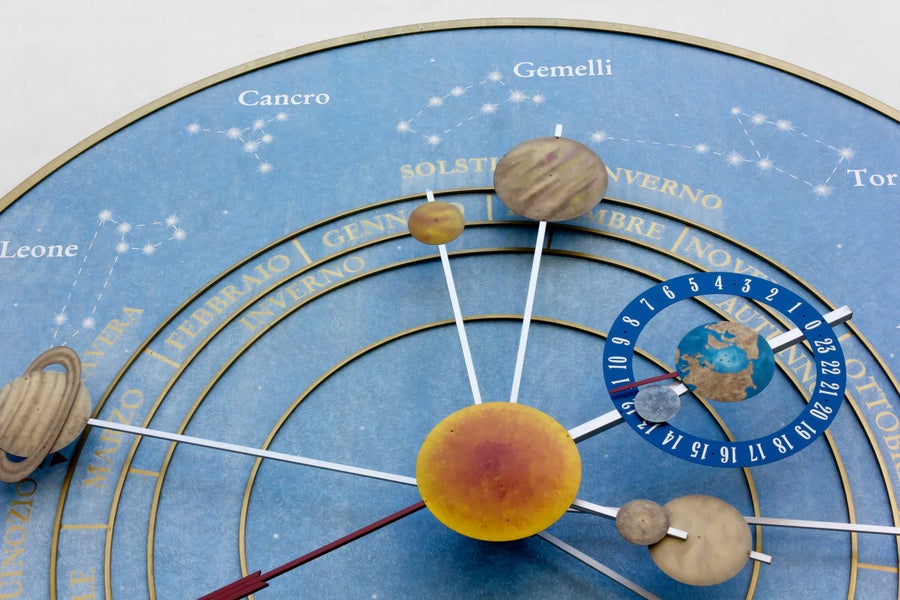
Building an accurate Martian clock, on the other hand, can be very tricky, depending on how accurate you want it to be. When you start to slice time into smaller and smaller bits, the problem concerns not only engineering but also fundamental physics. That’s because the flow of time on milli- and microsecond scales is affected by relativity, gravity and orbital mechanics, which can vary radically from world to world.
The good news is that a pair of physicists did all the associated mathematical heavy lifting for Mars and published their results on December 1 in the Astronomical Journal. With their help, we can fine-tune our Martian timepieces.
It was Albert Einstein who really first got this ball rolling. Among many other things that emerged from his special theory of relativity, he postulated that time does not necessarily flow the same for two independent objects. The most commonly used example of this is how a clock runs more slowly when it is moving relative to an observer. The effect is pretty small until that motion nears the speed of light, whereupon it can get very large.
But there’s another twist to relativity: besides relative motion, gravity affects time’s flow as well! The stronger the gravity, the slower a clock will tick relative to some observer far away, where the gravitational effects are weaker. Both of these phenomena can affect us on Earth: GPS satellites, for example, orbit far above Earth, where gravity is weaker, so their clocks run faster than those on the surface. But the satellites’ rapid orbital motion also slows their clocks. Combined, these effects cause their clocks to tick about 38 microseconds faster than ones on the ground. This profoundly affects their accuracy in mapping, throwing them off by about 10 kilometers per day. Think about how angry you’d be if your smartphone’s map app was off by a kilometer or so after only a half hour of use. Happily, GPS takes all this into account, so the positional accuracy it calculates is pretty high. But this situation just shows how important relativity can be
What does this have to do with the Red Planet? Well, for one thing, while Mars is a rocky world like our own, it’s much smaller, about a tenth the mass of Earth. Its surface gravity is some three times less than what we feel at home. So on Mars, I’d only weigh about 65 pounds (29 kilograms)! I bet my knees and back would feel a lot better about that.
But this also means a clock on Mars feels less gravity than one on Earth, so it will run faster. And unfortunately, plugging this into Einstein’s equations to calculate that advancement is no easy task.
First, you have to define what the average surface of Mars is. After all, if you’re on a mountain, you’re farther up from the average elevation than you’d be if you were in a valley, where you’d feel a different amount of gravitational force.
But you can’t just average between the highest peaks and lowest valleys to arrive at some clear median. Oh, no. Just as a world can have varying surface elevation, it can also have a varying subsurface composition, with some regions being denser (and thus having greater local gravity) than others. Still, factoring this in alongside things like a global rotation rate and the influence of any massive orbiting moons, it’s possible (though difficult) to determine the average surface for any given world.
We did this properly for Earth in the late 20th century—and thanks to our extensive robotic orbital reconnaissance, we’ve done it more recently for Mars, too. Once calculated, Mars’s average surface can be used to gauge gravity’s influence on clocks anywhere on the planet.
Jamie Dimon is the CEO of JPMorgan Chase, the largest U.S. bank.
In a recent interview, Dimon advised workers to develop skills like critical thinking, communication, and writing to unlock “plenty of jobs.”
Other CEOs, like Amazon’s Andy Jassy, agree with Dimon that curious minds get ahead.
JPMorgan Chase CEO Jamie Dimon says that it’s certain that AI “will eliminate jobs.” However, he also notes that mastering a few skills can help workers protect themselves.
Dimon, who leads the largest bank in the U.S. with $3.9 trillion in assets, told Fox News’ Sunday Morning Futures recently that AI taking over tasks “doesn’t mean that people won’t have other jobs.”
“My advice to people would be critical thinking,” Dimon said in the interview, which aired earlier this week. “Learn EQ [emotional quotient or emotional intelligence], learn how to be good in a meeting, how to communicate, how to write. You’ll have plenty of jobs.”
Critical thinking involves the ability to analyze information and question assumptions, while a high EQ allows workers to handle conflict and collaboration well. Communication and writing skills mean explaining ideas clearly.
Dimon says these skills matter in every field, not just banking. He previously highlighted the importance of soft skills in CEOs, stating last year that good leaders get out from behind their desks to meet and communicate with clients and competitors. They are curious, ask a “million questions” and learn from every interaction, he said.
Other CEOs agree with Dimon that curious minds get ahead. Amazon CEO Andy Jassy said in a video published by Amazon last year that the difference between people with successful careers and those who stay “stagnant” is a hunger for learning. “You have to be ravenous and hungry to find ways to learn,” Jassy said.
Research has shown that using AI can lead to a drop in critical thinking skills. A study published earlier this year from MIT suggests that the use of chatbots like ChatGPT could weaken the neural connections that help users process information and think critically.
Brandon Daniels, the CEO of Exiger, an AI-powered supply chain risk management company, told Entrepreneur last month that if AI is used correctly, it actually demands deeper critical analysis, not less.
Daniels agreed with Dimon that workers need to develop critical thinking skills to get ahead in the age of AI and argued that to get the most out of AI, users need to fact-check it. Daniels said that the best results arrive when people combine their own judgment with AI, rather than letting the technology do all the work.
“We need more significant critical reasoning skills,” Daniels said. “The AI, in order to be effective, has to understand the nuances of your question, and you have to understand the limitations of the response.”
.
Jamie Dimon, CEO of JPMorgan Chase. Photographer: Eva Marie Uzcategui/Bloomberg via Getty Images
Taylor Swift’s Eras Tour concluded a year ago in Vancouver, but the pop superstar isn’t done with her record-breaking live show just yet. On Friday, she dropped the concert film “The Eras Tour: The Final Show” on Disney+ along with the first two episodes of a behind-the-scenes six-part documentary series, “The End of an Era.”
While cameras captured preparation for the tour long before its first date in March 2023, the crew was supposed to join Swift on the road in Vienna in August 2024. But her three shows in that city were canceled after two men were arrested and accused of plotting a terrorist attack there, with her concerts as a target. The first episode focuses on how Swift struggled to get past that moment, and the second has a lighter feel, capturing how the production continued to evolve on the road (particularly with one amusingly overwhelmed special guest: Florence Welch).
Here are five key takeaways.
Goals for the Eras Tour were always lofty.
“The End of an Era” shows that many people in Swift’s circle — including her mother, Andrea — were skeptical about her idea to make the tour an extravaganza lasting over three hours. But Swift’s intention was always to “over-serve” her fans. Maximalism — and giving attendees an escape from the everyday — was the point.
“We got a list of about 40 songs,” the bassist Amos Heller says. “This is insanity. What are we going to cut? And I think we added three songs.”
The series shows that Swift had specific ideas for the band — there are lots of shots of her enthusiastically air drumming and vocalizing musical parts — and worked out the surprise numbers that varied from night to night with each artist. In one scene, she and Ed Sheeran rehearse their duet on “Everything Has Changed,” intently watching each other’s fingers as they play acoustic guitars.
The Eras Tour was touched by tragedy.
The first episode digs into how Swift handled two frightening events that happened in quick succession. In late July 2024, three children died after a knife attack in Southport, England, at a Swift-themed dance class. The next month, Swift’s Vienna dates were called off after the thwarted terrorist attack. As Swift planned to return to the stage in London, cameras caught her battling what she called a “physical reaction” to her nerves. “It sort of feels like we’ve done like 128 shows so far but this is the first one where I feel like, I don’t know, like I’m skating on thin ice,” she says.
In interviews, Swift likens her job to a pilot flying a plane, where she has to remain calm so nobody else has a sense of alarm. Though she breaks down following a private meeting with survivors of the Southport attack and families affected by it, the show must go on: “It’s my job to be able to handle all these feelings and then perk up immediately to perform.”
Swift loves secrets.
Yes, viewers do see Swift getting into what appears to be a cleaning cart in order to make her way to the stage.
She also details how her team worked surreptitiously to incorporate songs from “The Tortured Poets Department” into the set after its release in April 2024. They constructed a “top secret” facility to rehearse that portion, but couldn’t play the music on speakers as they learned the choreography because it hadn’t been released yet.
Swift’s penchant for secrecy is also invoked when she plans to bring Welch out at Wembley Stadium for a rendition of “Florida!!” Welch, who has headlined arenas for years with Florence + the Machine, is still taken aback by the scale of Eras. (She likens arriving onstage with Swift to landing on Mars.)
Swift has changed her football allegiances.
Swift is engaged to the Kansas City Chiefs’ Travis Kelce, but fans will definitely notice that in footage of early Eras rehearsals, she’s wearing a Philadelphia Eagles sweatshirt. (It’s a display of loyalty to her home state’s team before she switched allegiances.) Kelce doesn’t physically show up in the first two episodes, but his voice is heard in phone calls to Swift, marveling at her onstage skills. She tells him, “Some people get a vitamin drip. I got this conversation.”
Choreography has long been a challenge for Swift.
The second episode focuses heavily on the tour’s dancers as Swift integrates “The Tortured Poets Department” into her set. Viewers get a chance to meet Kameron Saunders, who praises Swift for giving a dancer with his body type a featured role, and Amanda Balen, who was retired and working as an associate to the choreographer Mandy Moore when Swift asked her to appear onstage.
Swift admits that choreography hasn’t always been her strongest suit. “It’s taken me a really long time to be even fine at choreography,” she says. Moore has been able to teach her the moves from a “lyrical perspective.” “I don’t do eight counts,” Swift explains, “I learn based on what syllable of the lyric I’m attaching the movement to, and I can’t really learn any other way.”
.
Taylor Swift onstage at the opening night of the Eras Tour in March 2023.Credit…Cassidy Araiza for The New York Times
IGNACE, Ontario, C.E. 51,500—Feloo, a hunter, chews a strip of roasted caribou flank, washing it down with water from a nearby lake. Her boots press into thin soil that, each summer, thaws into a sodden marsh above frozen ground. Caribou herds drift across the tundra, nibbling lichen and calving on the open flats. Hooves sink into moss beds; antlers scrape dwarf shrubs. Overhead, migratory birds wheel and squawk before winging south. Two lakes remain liquid year-round, held open by hidden taliks—oases of water in a frozen land. Beneath it all lies the Canadian Shield: a billion-year-old granite craton, a basement of rock, scarred by ice, that has endured glaciation after glaciation. In 10 or 15 millennia, Feloo’s world will vanish beneath three kilometers of advancing ice.
Feloo is unaware that 500 meters below her feet rests an ancestral deposit of copper, steel, clay, and radioactive debris. Long ago, this land was called Canada. Here, a group known as the Nuclear Waste Management Organization (NWMO) built a deep geological repository to contain spent nuclear fuel—the byproducts of reactors that once powered Ontario, Quebec, and New Brunswick. The vault was engineered to isolate long-lived radionuclides such as uranium 235, which has a half-life that exceeds 700 million years—sealing them away from war, disaster, neglect, sabotage, and curiosity for as long as human foresight could reach.
NWMO issued reports with titles such as Postclosure Safety Assessment of a Used Fuel Repository in Crystalline Rock. These studies modeled future boreal forests and tundra ecosystems, simulating the waxing and waning of vast glacial ice sheets across successive ice ages. They envisioned the lifeways of self-sufficient hunters, fishers, and farmers who might one day inhabit the region—and even the remote possibility of a far-future drill crew inadvertently breaching the buried canisters.
Feloo was born into a world that has remembered none of this. Records of the repository were lost in the global drone wars of C.E. 2323. All that endured were the stories of Mishipeshu, the horned water panther said to dwell beneath the lakes—and to punish those who dig too deep. Some of Feloo’s companions dismiss the legend; others whisper that the earth below still burns with poison. Yet every step she takes is haunted by choices made tens of millennia before—when Canada undertook the Promethean task of safeguarding a future it could scarcely imagine.
In 2024, NWMO announced that Canada’s deep geological repository for spent nuclear fuel would be built in the granite formations of northwestern Ontario, near the Township of Ignace and the Wabigoon Lake Ojibway Nation. The decision capped off a 14-year siting effort that solicited volunteer host communities and guaranteed them the right to withdraw at any stage of the process. NWMO is now preparing for a comprehensive regulatory review, which will include a licensing process conducted by the Canadian Nuclear Safety Commission. This means the development of impact assessments that will be specific to the Ignace site. NWMO has also pledged an Indigenous-led regulatory process alongside federal oversight, with the Wabigoon Lake Ojibway Nation conducting its own assessments to ensure the project reflects Anishinaabe principles of ecological stewardship. If approvals proceed, construction could begin in the 2030s, and the repository could go into operation in the 2040s.
A deep-time repository, like a deep-space probe, must endure without maintenance or intervention, independently carrying human intent into the far future.
A deep geological repository can be seen as a reverse ark: a vessel designed not to carry valuables forward in time but to seal dangerous legacies away from historical memory. Or it can be understood as a reverse mine: an effort returning hazardous remnants to the Earth rather than extracting resources from it. Either way, it is more than just a feat of engineering. Repository projects weave together scientific reasoning, intergenerational ethics, and community preferences in decisions that are meant to endure longer than empires. As messages to future versions of ourselves, they compel their designers to ask: What symbols, stories, or institutions might bridge epochs? And what does it mean that we are trying to protect future humans who may exist only in our imaginations? I am a cultural anthropologist. From 2012 to 2014, I spent 32 months living in Finland, conducting fieldwork among the safety assessment teams for Onkalo—an underground complex that is likely to become the world’s first operational deep geological repository for spent nuclear fuel. The teams’ work involved modeling far-future glaciations, earthquakes, floods, erosion, permafrost, and even hypothetical human and animal populations tens of millennia ahead. That research became the basis for Deep Time Reckoning, a book exploring how nuclear-waste experts’ long-range planning practices can be retooled as blueprints for safeguarding future worlds in other domains, from climate adaptation to biodiversity preservation.
During the Biden administration, I joined the U.S. Department of Energy’s Office of Spent Fuel and High-Level Waste Disposition, where I helped advance participatory siting processes modeled on approaches that had proven successful in Finland and Canada. I served as federal manager of the DOE’s Consent-Based Siting Consortia—a nationwide coalition of 12 project teams from universities, nonprofits, and the private sector that were tasked with fostering community engagement with nuclear waste management. Through it all, I came to see repository programs as civilizational experiments in long-term responsibility: collective efforts to extend the time horizons of governance and care so that shared futures may be protected far beyond the scale of any single lifetime or institution.
Democratic Representative Al Green said Friday, after failing to secure enough votes to impeach President Donald Trump, that he would do it again.
In a speech on the House floor, the Texas congressman said he was “a proud, liberated Democrat” despite others in his party voting against him on his resolution to impeach the president.
“I believe in this flag. I believe in liberty and justice for all. I don’t support beneficial bigotry. I don’t support people who desecrate what the flag really means as it relates to the Constitution,” Green said, in part.
Why It Matters
Green has tried multiple times to impeach Trump, and the backfiring of previous attempts appeared to have made Democrats much more cautious about supporting another attempt, particularly with Republicans controlling the House and the Senate.
What To Know
Green, wearing a tie with alternating red-and-white stripes and white stars on a blue background, said he believed in the Pledge of Allegiance and that the tie was a symbol of it.
“There are many people who have said to me that the tie is old, that it appears to be soiled and stained, but it’s my favorite tie, it’s a tie that I will never surrender,” Green said. “It’s a tie that means something to me because it stands for something, it stands for the Pledge of Allegiance.”
Green spoke for around 35 minutes on Friday, saying he was grateful to the lawmakers who showed support for his efforts on Thursday, and drawing on previous examples of scholars and lawmakers who have spoken about the powers of impeachment.
Twenty-three Democrats opposed his motion, while an additional 47 voted “present.” The majority of House Democrats, 140 lawmakers, voted against tabling the resolutions. Additionally, 214 House Republicans voted to table the effort, while six did not vote.
The Texas Democrat said he was not deterred, referencing the “millions” of people who stand against the current administration’s policies, and that he saw no reason not to try to impeach Trump again.
“Those were not the last articles of impeachment that will be brought to the floor, those yesterday HRes939, they’re not the last to be brought to the floor for a vote to remove Donald John Trump from office,” Green said.
Trump was impeached twice previously by the House, first in December 2019 over allegations that he withheld congressionally approved aid to Ukraine in a bid to blackmail a political rival.
The president was then impeached again following the January 6, 2021, riot at the U.S. Capitol carried out by his supporters. That second effort was bipartisan, with 10 House Republicans voting in favor and five GOP senators voting to convict Trump.
While seemingly not willing to impeach the president, Democrats have filed articles of impeachment against Defense Secretary Pete Hegseth and Secretary of Health and Human Services Robert F. Kennedy Jr. this week.
What People Are Saying
House Democratic leaders in their statement said they’d vote “present”: “Donald Trump’s out-of-control behavior continues to put the health, safety, and economic well-being of the American people at risk. At the same time, House Republicans have zero interest in holding this corrupt administration accountable.”
Florida Republican Representative Mario Díaz-Balart told the Associated Press on Thursday: “It shows you they have no agenda. And so this is the kind of stuff that they’ve been doing, as opposed to actually trying to solve the American people’s issues. This is not a surprise, but it just shows you that the Democrats continue to do the same kind of thing they’ve been doing for years, which is playing games and not coming up with real solutions.”
The oil tanker seized by the United States off the coast of Venezuela this week was part of the Venezuelan government’s effort to support Cuba, according to documents and people inside the Venezuelan oil industry.
The tanker, which is called Skipper, left Venezuela on Dec. 4, carrying nearly two million barrels of the country’s heavy crude, according to internal data from Venezuela’s state oil company, known as PDVSA. The ship’s destination was listed as the Cuban port of Matanzas, the data shows.
Two days after its departure, Skipper offloaded a small fraction of its oil, an estimated 50,000 barrels, to another ship, called Neptune 6, which then headed north toward Cuba, according to the shipping data firm Kpler. After the transfer, Skipper headed east, toward Asia, with the vast majority of its oil on board, according to a U.S. official briefed on the matter.
President Nicolás Maduro of Venezuela and his predecessor, Hugo Chávez, have for decades sent oil to Cuba at highly subsidized prices, providing a crucial resource at low cost to the impoverished island.
In return, the Cuban government, over the years, has sent tens of thousands of medics, sports instructors and, increasingly, security professionals on assignments to Venezuela. That exchange has assumed special importance as Mr. Maduro has leaned on Cuban bodyguards and counterintelligence officers to protect himself against the U.S. military buildup in the Caribbean.
In recent years, however, only a fraction of Venezuelan oil set aside for Cuba has actually reached the island, according to PDVSA documents and tanker tracking data.
Most of the oil allocated for Cuba has instead been resold to China, with the money providing badly needed hard currency for the Cuban government, according to multiple people close to the Venezuelan government.
Some of that money is believed to have been used by Cuban officials to purchase basic goods, though the opacity of the country’s economy makes it difficult to estimate where that money ends up, or how it is spent, or how much goes to business intermediaries with ties to both governments.
On Friday, Cuban officials condemned the American seizure of the tanker, calling it in a statement an “act of piracy and maritime terrorism” that hurts Cuba and its people.
“This action is part of the U.S. escalation aimed at hampering Venezuela’s legitimate right to freely use and trade its natural resources with other nations, including the supplies of hydrocarbons to Cuba,” the statement said.
The White House did not immediately respond to a request for comment.
The main person managing the flow of oil between Cuba and Venezuela is a Panamanian businessman named Ramón Carretero, who in the past few years has become one of the largest traders of Venezuelan oil, according to PDVSA data and people close to Venezuela’s government.
The U.S. Treasury Department imposed sanctions on Mr. Carretero on Thursday for “facilitating shipments of petroleum products on behalf of the Venezuelan government.” Mr. Carretero, through a legal representative, declined to comment on the government’s decision. He did not respond to detailed questions for this article.
Mr. Carretero’s role as an economic intermediary between Cuba and Venezuela was first reported by Armando.info, a Venezuelan investigative news outlet.
Skipper, the seized tanker, was carrying oil jointly contracted by Cubametales, Cuba’s state-run oil trading firm, and an oil trading company tied to Mr. Carretero, PDVSA documents show. Overall, Mr. Carretero’s trading companies have accounted for a quarter of the oil allocated by PDVSA for export this year, the documents show.
Cubametales has won contracts to buy about 65,000 barrels a day of Venezuelan oil so far this year, a 29 percent increase from 2024, and a sevenfold increase from 2023, according to PDVSA documents. The U.S. Treasury imposed sanctions on Cubametales in 2019 for buying Venezuelan oil, a move that formed part of Mr. Trump’s previous standoff with Mr. Maduro during his first administration.
The oil from Venezuela that does reach Cuba generates electricity and provides fuel for airplanes and machinery. But it is not enough to prevent widespread power outages that have plagued the island amid a broader economic crisis.
Skipper’s planned voyage shows how, in practice, Cuba benefits from oil trade in Venezuela. Cubametales, the state-run firm, listed the ship’s destination as Cuba, suggesting that all of the company’s allocated 1.1 million barrels were heading to the island.
The tanker, however, ultimately headed to China after offloading only a small fraction of the oil to the Neptune 6 and sending it en route to Cuba, according to a person close to PDVSA.
Then, on Wednesday, as Skipper sailed east in international waters between the islands of Grenada and Trinidad, it fell into a U.S. ambush.
Armed American law enforcement agents wearing camouflaged combat gear rappelled from a helicopter onto the tanker’s deck on Wednesday, according to a video released by the U.S. government and a U.S. official with knowledge of the operation. The crew offered no resistance, and U.S. officials said there were no casualties.
U.S. officials said they would seek a warrant to seize the oil, valued at tens of millions of dollars, adding that the crew had agreed to sail the vessel under Coast Guard supervision to a U.S. port, likely Galveston, Texas.
.
An oil tanker called the Skipper in the southern Caribbean Sea. It was seized by the United States. Credit…Vantor, via Associated Press
After my grandmother died, we had to clean out her condominium. Wall to wall and floor to ceiling, her studio apartment in a Berkeley, Calif., high-rise was filled with books. Every surface was stacked with them except for a couple of chairs, the tiny kitchen counter, the bed, and narrow connecting paths like game trails in a forest. The shelves were three books deep and bowed in their middle.
But this wasn’t chaos. Besides being a communist, a labor activist, and a speaker of five languages that I knew of (Yiddish, English, German, some Russian, and some Spanish, in addition to her ability to read Latin), Grandma had been a lecturer in library science at the University of California, Berkeley. Every shelf and every pile was a subject, placed in proximity to related subjects and alphabetized by author.
When my wife and I started excavating, we found another organizational layer. Some of the books had whole magazines stuffed into them—the New Yorker, the London Review of Books,Smithsonian—folded open to an article that was relevant to their enveloping tome. Further into the stacks, a whole other classification system surfaced—articles neatly torn or clipped out, with notes stapled to them on which Grandma’s looping cursive noted their subject and bibliographic metadata.
This was more than a library. Sure, it contained books—objects that convey information—, but the condo itself was an object that conveyed information. It was what historian of memory Mary Carruthers calls an architectural mnemonic—a map of Grandma’s multivariate, interesting, and generally unshakable opinions. Its physical structure at every scale helped her to maintain not just her sources but her ideas and to send them forward in time to when she might need them. “The archive has always been a pledge,” according to a translation of philosopher Jacques Derrida’s book Archive Fever, “and like every pledge, a token of the future.”
Not every pledge gets fulfilled, of course. By the end of her life, my grandmother’s once-pointed mind had become less deft; she couldn’t really understand her own archive anymore. Information theory says that for a message to arrive, both sender and receiver have to agree on its form and timing. And now the receiver was gone. This happens all the time—at the scale of studio apartments and entire societies, on time spans of years or millennia. Even organizations dedicated to creating things and trying to remember them don’t always know how to ensure that those things make it through time. That’s understandable. Nobody really knows how to speak to the future in a way that it will hear.
When we try to unravel information from the past, we’re limited by what archives and nature have preserved. “The technical structure of the archiving archive determines the structure of the archivable content,” as Derrida put it. Take the oldest known piece of human art, a 73,000-year-old drawing of crosshatched red triangles on a chunk of rock. South African archaeologists found it in a cave called Blombos, about 185 miles east of Cape Town. Whether these triangles were a vision of mountains, an econometric chart of the seal harvest or an accident of boredom is lost to time. Maybe humans were constantly going around drawing ochre triangles on fragments of rock, and symbolic thinking was common. Maybe only Paleolithic geniuses did it. Whoever drew that fragment was thinking about something, but no one here in the future can know what.
Even when humans create written language and records, they often fail to send information up the line. Most of what historians know about ancient Greece and Rome is because of a lucky accident—scholars in the Abbasid Caliphate, which extended throughout much of the Middle East, got scrolls from Alexandrian libraries and translated them. But which scrolls never made it? Archaeologists know that a Babylonian copper merchant named Ea-nasir had supply chain problems nearly 4,000 years ago, but only because of the fluke survival of clay tablets saying that happened. The shape of the archive of the past limits the knowledge of the future.
Nobody really knows how to speak to the future in a way that it will hear.
The northeastern coast of Japan is dotted with future-message failures—hundreds of “tsunami stones” mark past catastrophes dating back 600 years. One in the village of Aneyoshi denotes the level of a flood in the 1800s and warns people not to build houses any lower along the hillside; others advise people to flee to Nokoriya, the “Valley of Survivors,” or Namiwake, “Waves’ Edge,” the extent of a tsunami in 1611. People mostly ignore them. The Tohoku earthquake and tsunami in 2011 hit that very same coast, swept away a bunch of stones, and killed more than 18,000 people.
Another example: In 1850, on the main canal leading from the Merrimack River to the industrial mill town of Lowell, Mass., James Francis built a dam. As the engineer in charge of Lowell’s water-powered textile mills, Francis was convinced that the Merrimack was liable to flood. So he built a 27-foot-wide, 25-foot-tall, 17-inch-thick palisade out of experimental pressure-treated pine. The cost of a project like this, “Great Gate” in 2025, would be about $413 million. The gate was so heavy that it had no mechanism to raise or lower it—it just hung over the Pawtucket Canal, suspended by a massive iron chain. Locals called it “Francis’s Folly.”
Two years later, a massive rainstorm flooded the Merrimack. At 3:30 in the morning on April 22, 1852, a worker used a chisel to cut the chain. The gate dropped; the town was saved; Boston newspapers hailed Francis as a hero.
In 1936, there was another storm and an even bigger flood. Lowell was doomed! But someone remembered that really big gate. Workers once again rushed to the gatehouse. No one had a key, so they broke in. Someone shined a light into the decaying shack, which was empty except for a spike stuck through the floor. On the wall hung a sledgehammer. Above it, a sign read, “Take the hammer. Hit the pin.” The men followed the instructions. The spike broke the chain; the gate fell; the town was saved. Francis’s message to the future had been received.
President Donald Trump has in recent months overseen military strikes against alleged “drug smuggling” boats off the coast of Venezuela, ordered a military buildup in its coastal waters, accused its president, Nicolás Maduro, of being part of a drug cartel, and, on Wednesday, seized one of the nation’s oil tankers.
What’s his problem with Venezuela? And why does he seem intent on dragging the U.S. into a war with the South American nation?
On any given day, Trump or his officials may blame Venezuela for sending too many migrants into the U.S., for sending migrants who are gang members, murderers, or other criminals, or for trading valuable resources with America’s enemies.
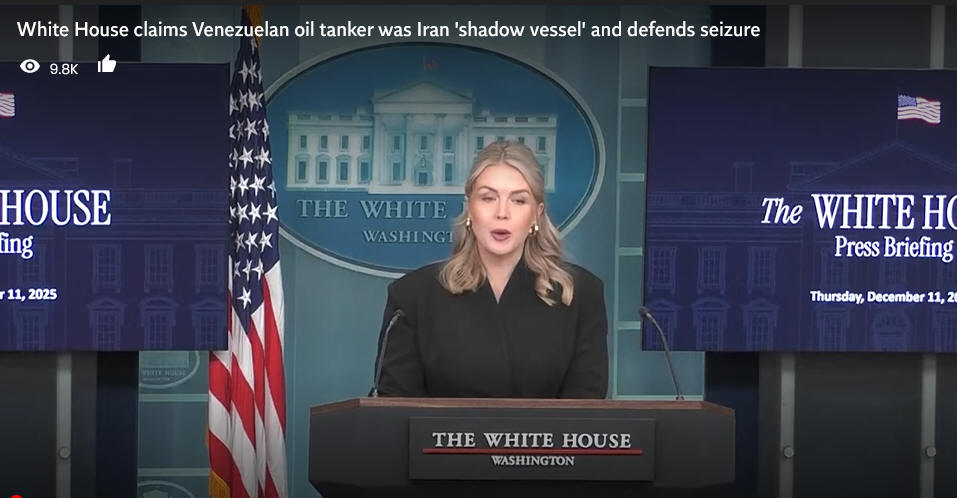
Trump’s Attorney General Pam Bondi claims the tanker that was just seized off the coast of Venezuela was carrying sanctioned oil intended for Iran. Venezuela has denied this and called Trump’s actions an “act of international piracy.”
Immigration
Trump has frequently accused Venezuela of pouring illegal migrants into the U.S. During his 2024 re-election campaign, Trump regularly told his supporters that Venezuela was “opening up the prisons” and encouraging hardened criminals to flood across America’s borders.
He even cited immigration on Thursday when Fox News’ Peter Doocy asked him about his intentions regarding Venezuela.
“Now that we’ve seized this tanker, is the campaign against Venezuela still just about drugs, or is it now also about oil?” Doocy asked.
“Well, it’s about a lot of things,” Trump replied. “But one of the things it’s about is the fact that they’ve allowed millions of people to come into our country from their prisons, from gangs, from drug dealers, and from mental institutions.”
He then claimed that 12,000 murderers entered the U.S. and insisted that “many of them are from Venezuela.”
As much as he’s spoken about his issues with Venezuelan migrants, immigration isn’t the issue that Trump has used to justify killing people in its recent strikes on what it calls “drug boats”.
Drugs
Trump has accused Venezuela of trafficking drugs into the U.S. and has used those accusations to justify lethal military operations on Venezuelan ships.
Earlier this fall, Trump approved military strikes on Venezuelan boats that his administration claims were used to traffic drugs. In an incident on September 2, Secretary of Defense Pete Hegseth gave an order to attack a boat carrying 11 people. According to a Washington Post report, Hegseth then ordered a second strike to kill the survivors.
None of the individuals killed in Trump’s boat strikes have been proven to be criminals in a court of law.
The president is not just accusing Venezuela of being the departure point for alleged drug traffickers, but accusing Maduro — the nation’s president — of being a top-level member of a drug cartel that ships drugs into the U.S.
Trump claims that Maduro is the head of the “Cartel de los Soles.” The cartel is a name given to military officers and other officials in the Venezuelan government who are corrupt and engage in drug trafficking. The term has been in use since at least the 1990s and doesn’t necessarily describe a structured organization in the way a typical drug cartel might be organized. Trump has not provided evidence that Maduro is involved in or leading drug traffickers in Venezuela.
On Thursday, the president bragged to Doocy that drug trafficking by sea was down, though his numbers seem suspiciously high.
“If you look at drug traffic, drug traffic by sea is down 92%,” the president claimed. “And nobody can figure out who the eight is, because I have no idea. Anybody getting involved in that right now is not doing well. And we’ll start that on land too. It’s gonna be starting on land pretty soon.”
While drugs may be how Trump is justifying military action, what he really wants may not be what is leaving Venezuela, but what is buried beneath it.
.
White House claims Venezuelan oil tanker was Iran ‘shadow vessel’ and defends seizure
Film and Writing Festival for Comedy. Showcasing best of comedy short films at the FEEDBACK Film Festival. Plus, showcasing best of comedy novels, short stories, poems, screenplays (TV, short, feature) at the festival performed by professional actors.

:max_bytes(150000):strip_icc()/REM_sleep_brain_activity-1a23fffa91b44145bdb9d9a6907b0c6e.jpg)
:max_bytes(150000):strip_icc()/REM_sleep-85feb7f9a84f4169ac977bec0fbc6dac.jpg)
:max_bytes(150000):strip_icc()/EEG-a63ebfc68f5e412db0882957eb52868d.jpg)
:max_bytes(150000):strip_icc()/woman_dreaming-5081da90c33547c891904ed54ca9849a.jpg) REM sleep is an active stage of sleep characterized by increased brain wave activity. Jamie Grill / Getty Images
REM sleep is an active stage of sleep characterized by increased brain wave activity. Jamie Grill / Getty Images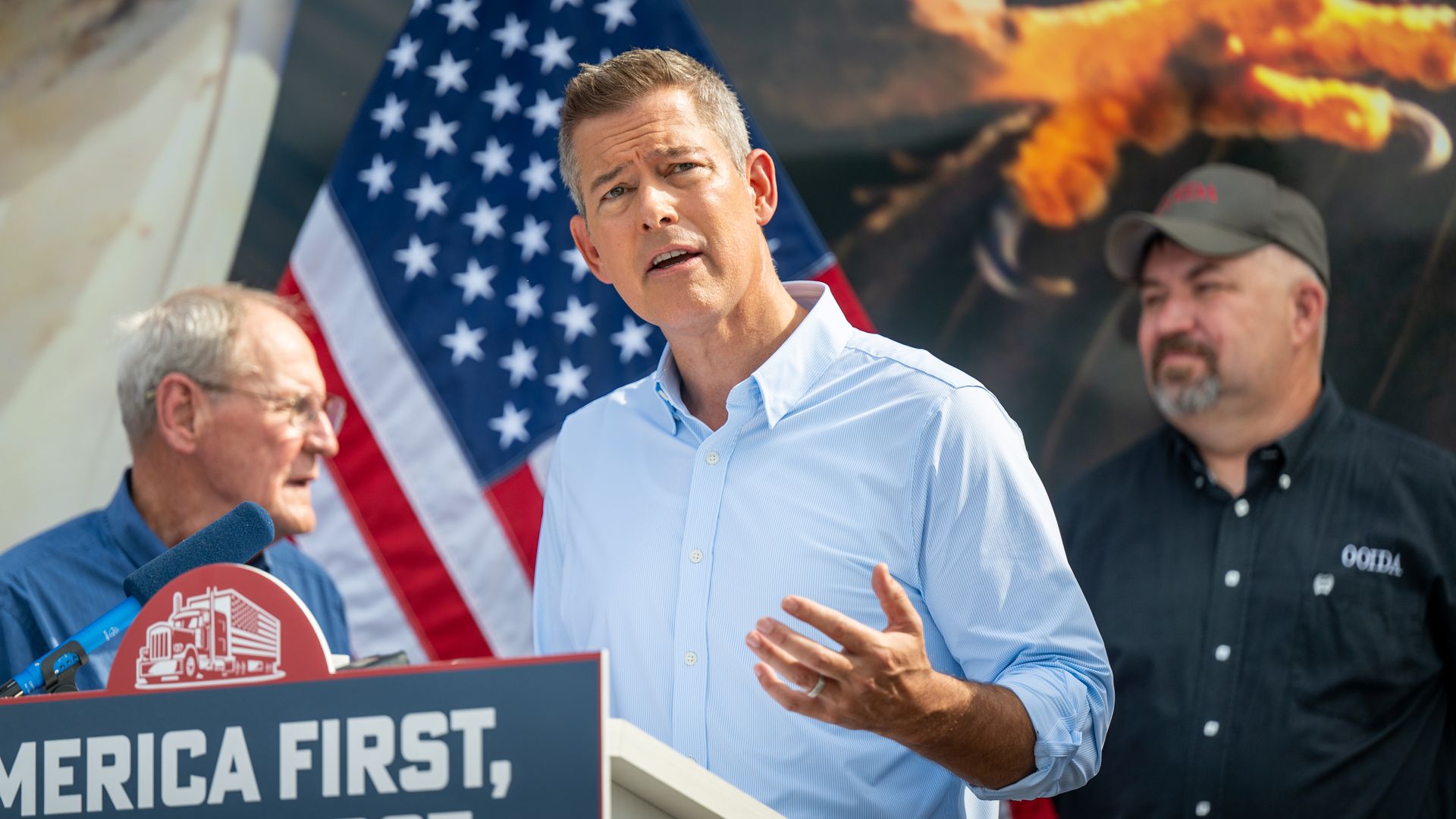 Transportation Secretary Sean Duffy speaks during a news conference on May 20 in Austin, Texas. Photo: Brandon Bell/Getty Images
 Emmeci74/Getty Images
 Jamie Dimon, CEO of JPMorgan Chase. Photographer: Eva Marie Uzcategui/Bloomberg via Getty Images

 Federico Tramonte



 Federico Tramonte
 White House claims Venezuelan oil tanker was Iran ‘shadow vessel’ and defends seizure
 James' World 2