June 22, 2023
Mohenjo
Business, Food For Thought, Human Interest, Political, Science, Technical
amazon, business, Business News, current-events, Future, Hotels, human-rights, medicine, mental-health, research, Science, Science News, technology, Technology News, travel, vacation

Click the link below the picture
.
Despite some companies’ attempts, we can’t fix today’s burnout culture with a wellness app. What it takes, instead, is a mindset and culture shift among managers and organizations everywhere.
The old management mindset
An outdated way of thinking about peak performance is “maximum effort = maximum results.” It doesn’t actually work that way in reality, but many managers still believe that it does. They might talk a good game about “practicing self-care,” but their core assumptions are often more akin to a bad 1980s motivational speaker. (Think: “No pain, no gain,” “No guts, no glory,” and “Give it 110%!”)
When managers expect 80+ hours a week from people while offering Friday yoga to combat stress, they unintentionally create a toxic contradiction. It’s a classic example of what we call in psychology a “double bind”: Employees can’t talk about the contradiction, and they can’t talk about not being able to talk about it.
As a result, many well-intended efforts to end the burnout epidemic don’t actually work. If you think individual overachievers are solely to blame for exhaustion, then you’ll only end up addressing the wrong problem. Consider McKinsey’s research on burnout, which showed that “in all 15 countries and across all dimensions assessed, toxic workplace behavior was the biggest predictor of burnout symptoms and intent to leave by a large margin.”
.
 Anchiy/Getty Images
.
.
Click the link below for the article:
https://hbr.org/2023/06/to-build-a-top-performing-team-ask-for-85-effort?utm_source=pocket_discover_career
.
__________________________________________
June 21, 2023
Mohenjo
Business, Food For Thought, Human Interest, Political, Science, Technical
amazon, business, Business News, current-events, Future, Hotels, human-rights, medicine, mental-health, research, Science, Science News, technology, Technology News, travel, vacation

Click the link below the picture
.
Inside one of the massive brick-lined warehouses at the Brooklyn Navy Yard, more than a dozen teams laid out a rather odd display of food samples. Whether it’s a juicy meatball made from fungi, a batch of greens grown inside an ecosystem pod or a wheel of mushy crust heated inside a gravity-defying device, this eclectic menu could one day feed astronauts traveling to the Moon and beyond.
On Friday, NASA announced the winners of the second phase of its Deep Space Food Challenge. The announcement took place during an event held at the NYCxDESIGN Festival in New York, which showcased the work of the participating teams. In partnership with the Canadian Space Agency, the competition first called for novel food production technologies in January 2021 and is now entering its third and final phase.
Eight teams have been handed a check for $150,000, and also their next challenge: scale these concepts for the final frontier. The winning U.S. teams are: Air Company, Interstellar Lab, Kernel Deltech, Nolux, and SATED. Three international teams also made the cut: Enigma of the Cosmos from Australia, Mycorena from Sweden, and Solar Foods from Finland. The winning teams will now compete for $1.5 million in total prizes for the third and final phase.
“The whole system is working very well, now we need to adapt for a space environment,” Barbara Belvisi, CEO of Interstellar Lab, one of the winning companies which manufactures controlled-environment biofarms, told Gizmodo at the event. “The whole design of the system is based on gravity, and now you’re going to get rid of gravity.”
.
 Photo: NASA/Methuselah Foundation
.
.
Click the link below for article:
.
__________________________________________
June 21, 2023
Mohenjo
Business, Food For Thought, Human Interest, Medical, Political, Science, Technical
amazon, business, Business News, current-events, Future, Hotels, human-rights, medicine, mental-health, research, Science, Science News, technology, Technology News, travel, vacation

Click the link below the picture
.
Lutyens’ Delhi is one of the most iconic neighborhoods of India’s capital. Home to the country’s parliament, numerous embassies, and a lush, 90-acre Mughal-era park, it’s an architectural paradise, connected by tree-lined streets and roundabouts with mini-gardens. Yet despite being one of the city’s most refined districts, this clean, green neighborhood is home to something sinister. It is a hot spot for a dangerous and overlooked air pollutant: ozone.
India is no stranger to pollution, with many of its cities reporting some of the worst air quality in the world. Every winter, New Delhi gets shrouded in smog for days. But discussions about air pollution and policies to mitigate it mostly focus on particulate matter: PM2.5 and PM10—small particles or droplets that are only a few microns in diameter. However, scientists are increasingly raising the alarm about surface ozone. It’s a secondary pollutant that isn’t released from any source, forming naturally when oxides of nitrogen and volatile organic compounds—such as benzene, which is found in gasoline, or methane—react under high heat and sunlight. This makes ozone a particularly ugly modern threat—a problem that arises where pollution and climate change coincide.
“Even an hour of exposure can give you very poor health outcomes,” says Avikal Somvanshi, a researcher at the Center for Science and Environment in New Delhi. While ozone is beneficial in the high atmosphere, where it absorbs ultraviolet radiation, down on Earth’s surface, concentrations of it can be deadly. Data on its impacts is patchy, but a 2022 study estimates that ozone killed more than 400,000 people worldwide in 2019, up 46 percent since 2000. And according to the State of Global Air Report 2020, it is in India where the number of ozone deaths has increased the most over the past decade.
Ozone wreaks havoc in the respiratory tract. The gas can “inflame and damage airways” and “aggravate lung diseases like asthma,” warns the US Environmental Protection Agency. It does this by affecting the cilia, the microscopic hair-like structures that line the airways to help protect them, explains Karthik Balajee, a clinician and community medicine specialist based in Karaikal, India. After exposure “we are more prone to respiratory infections,” he says, adding that inhaling ozone also affects lung capacity. Studies show that long-term exposure is associated with an increased risk of chronic obstructive pulmonary disease, a lung disease that makes it hard to breathe and increases the risk of dying from other cardiovascular or respiratory conditions. Even short-term exposure can land you in the emergency room. “One or two days following a peak in ozone, there have been increases in hospital admissions due to respiratory problems,” says Balajee.
.
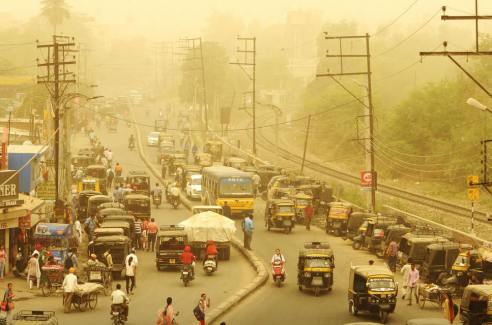 Photograph: Bharat Bhushan/Hindustan Times/Getty Images
.
.
Click the link below for the article:
.
__________________________________________
June 20, 2023
Mohenjo
Business, Food For Thought, Human Interest, Political, Science, Technical
amazon, business, Business News, current-events, Future, Hotels, human-rights, medicine, mental-health, research, Science, Science News, technology, Technology News, travel, vacation

Click the link below the picture
.
A friend in Brooklyn DMed me on Sunday: “Skies here in Brooklyn have been milky and the air a pale haze for days from Canadian smoke plumes.”
“I hope it doesn’t go to orange,’ I wrote back. “That’s when things really start feeling weird—otherworldly.”
“So far no orange,” he wrote. “I’ve only seen photos of that.”
Yesterday, he wrote again: “Orange skies today.”
Welcome to our weird new world. Out west, orange skies have become a feature of fire season from L.A. to Anchorage. Over the past few years, most west coast cities have earned the title: worst urban air quality in the world, beating out the usual suspects in Asia. Now it’s New York’s turn, and Boston’s, and New Haven’s. We feel your pain, and we dread that smell. This particulate-laden smoke is truly unhealthy; it gets in your eyes and nose, but what is most damaging is what it does to your head: your home, the world you thought you knew, is no longer quite the same. You feel a new precarity, and a creeping fear: what if it doesn’t go away?
There is a theme running through the weather-related disasters now traumatizing communities around the globe in all seasons, and it is the theme of dissonance. It’s not just our infrastructure that’s built for a different time, it’s our mindset. Whether it’s the depth of the snow, the volume of the rainfall, or the speed of the flames, when it comes to extreme weather, our heads are still in the 20th century.
There is actually a name for this phenomenon: the Lucretius Problem. Lucretius (Titus Lucretius Carus) was a Roman poet and philosopher who identified this cognitive disconnect more than 2000 years ago. Nassim Taleb, author of The Black Swan: The Impact of the Highly Improbable, paraphrases Lucretius this way: “The fool believes the tallest mountain in the world will be equal to the tallest he has observed.” In essence, the Lucretius Problem is rooted in the difficulty humans have imagining and assimilating things outside their own personal experience.
.

A wildfire burns on Highway 63 south of Fort McMurray, Alberta, Canada, on Saturday, May 7, 2016. Wildfires raging through Alberta have spread to the main oil sands facilities north of Fort McMurray, knocking out an estimated 1 million barrels of production from Canada’s energy hub. Darryl Dyck-Bloomberg
.
.
Click the link below for the article:
.
__________________________________________
June 20, 2023
Mohenjo
Business, Food For Thought, Human Interest, Political, Science, Technical
amazon, business, Business News, current-events, Future, Hotels, human-rights, medicine, mental-health, research, Science, Science News, technology, Technology News, travel, vacation

Click the link below the picture
.
All of the organisms we can see around us—the plants, animals, and fungi—are eukaryotes composed of complex cells. Their cells have many internal structures enclosed in membranes, which keep things like energy production separated from genetic material, and so on. Even the single-celled organisms on this branch of the tree of life often have membrane-covered structures that they move and rearrange for feeding.
Some of that membrane flexibility comes courtesy of steroids. In multicellular eukaryotes, steroids perform various functions; among other things, they’re used as signaling molecules, like estrogen and testosterone. But all eukaryotes insert various steroids into their membranes, increasing their fluidity and altering their curvature. So the evolution of an elaborate steroid metabolism may have been critical to enabling complex life.
Now, researchers have traced the origin of eukaryotic steroids almost a billion years further back in time. The results suggest that many branches of the eukaryotic family tree once made early versions of steroids. But our branch evolved the ability to produce more elaborate ones—which may have helped us outcompete our relatives.
A confused timeline
To some extent, the new work involves testing an idea proposed decades ago by the biochemist Konrad Bloch. Bloch won a Nobel Prize for figuring out the biochemical pathways that allow cells to produce steroids from simpler precursors. In 1994, Bloch suggested that the chemical intermediates on the pathways he identified were, at some point in our evolutionary paths, the end products. Cells would make these less complex steroids, which played critical roles in their survival; over time, however, our branch evolved enzymes that further modified them in ways that were advantageous.
.
 All steroids past and present share the complex ringed structure, but differ in terms of the atoms attached to those rings.
.
.
Click the link below for the article:
.
__________________________________________
June 19, 2023
Mohenjo
Business, Food For Thought, Human Interest, Political, Science, Technical
amazon, business, Business News, current-events, Future, Hotels, human-rights, medicine, mental-health, research, Science, Science News, technology, Technology News, travel, vacation

Click the link below the picture
.
Tom Hanks speaks About the Tulsa Massacre! Sound on!
.
 Tulsa
Tulsa
.
.
Click the link below for the article:
.
__________________________________________
June 19, 2023
Mohenjo
Business, Food For Thought, Human Interest, Political, Science, Technical
amazon, business, Business News, current-events, Future, Hotels, human-rights, medicine, mental-health, research, Science, Science News, technology, Technology News, travel, vacation
 .
.
__________________________________________
June 19, 2023
Mohenjo
Business, Food For Thought, Human Interest, Political, Science, Technical
amazon, business, Business News, current-events, Future, Hotels, human-rights, medicine, mental-health, research, Science, Science News, technology, Technology News, travel, vacation

Click the link below the picture
.
1. What is REM sleep behavior disorder?
Every night, you go through four to five sleep cycles. Each cycle, lasting about 90 to 110 minutes, has four stages. That fourth stage is REM sleep.
REM sleep only comprises 20% to 25% of total sleep, but its proportion increases throughout the night. During REM sleep, your brain rhythms are similar to when you are awake, your muscles lose tone so you are unable to move, and your eyes, while closed, move quickly. This stage is often accompanied by muscle twitches and fluctuations in your respiratory rate and blood pressure.
But someone with REM sleep behavior disorder will act out their dreams. For reasons that are poorly understood, the dream content is usually violent – patients report being chased, or defending themselves, and as they sleep they shout, moan, scream, kick, punch, and thrash about.
Injuries often result from these incidents; patients may fall from bed or accidentally harm a partner. Some 60% of patients and 20% of bed partners of people with this disorder sustain an injury during sleep.
Appropriate testing, including a sleep study, are needed to determine if a patient has REM sleep behavior disorder, as opposed to another disorder, such as obstructive sleep apnea. This is a disorder in which breathing is interrupted during sleep.
REM sleep behavior disorder can occur at any age, but symptoms usually start with people in their 40s and 50s. For those younger than 40, antidepressants are the most common cause of REM sleep behavior disorder; in these younger patients, it affects biological males and females about equally, but past age 50, it’s more common in biological males.
.
 Past age 50, men are much more likely to have REM sleep behavior disorder than women. Jose Luis Pelaez/Stone via Getty Images
.
.
Click the link below for the article:
.
__________________________________________
June 19, 2023
Mohenjo
Business, Food For Thought, Human Interest, Political, Science, Technical
amazon, business, Business News, current-events, Future, Hotels, human-rights, medicine, mental-health, research, Science, Science News, technology, Technology News, travel, vacation

Click the link below the picture
.
In the gym, on medical and wellness websites, and on social media, the phrase “boost your metabolism” gets thrown around a lot. Supplement marketers promise pills to make it happen, health mavens pinky swear their diet routine will rev the rate, and probably most of us, starting around our 30s, think that aging has reduced the efficiency of our metabolic engine.
And almost none of that is true.
There isn’t a method to boost metabolism “in a way that’s durable or real,” says Herman Pontzer, an evolutionary anthropologist at the Global Health Institute at Duke University. He says most things people promise will boost metabolism fall into two categories. “There are things that are dangerous and illegal and things that are BS, and you should probably avoid both of them,” Pontzer says.
Basal, or resting, metabolic rate refers to work performed by cells when we are doing nothing. It’s the baseline hum of being alive as cells keep blood circulating and lungs functioning. Formally, it’s the calories per minute used for these housekeeping duties. That adds up to about 50 to 70 percent of the total you burn through each day, depending on age, says Samuel Urlacher, an anthropologist, and human evolutionary biologist at Baylor University in Waco, Tex.
Most popular interest in basal metabolism centers around ways to kick it up a notch and increase our energy use while doing absolutely nothing, with the prospect of losing weight in the process.
.
 Credit: Luis Alvarez/Getty Images
.
.
Click the link below for the article:
.
__________________________________________
June 18, 2023
Mohenjo
Business, Human Interest, Political, Science, Technical
amazon, business, Business News, current-events, Future, Hotels, human-rights, medicine, mental-health, research, Science, Science News, technology, Technology News, travel, vacation
 Happy Father’s Day
.
__________________________________________
Older Entries
Newer Entries
 James' World 2