August 14, 2023
Mohenjo
Business, Food For Thought, Human Interest, Political, Science, Technical
amazon, business, Business News, current-events, Future, Hotels, human-rights, medicine, mental-health, research, Science, Science News, technology, Technology News, travel, vacation

Click the link below the picture
.
Twitter is better than it has ever been.
Elon Musk, who bought the platform for $44 billion in 2022 after months of well-publicized drama and legal issues, is a confirmed bozo. The overgrown Tommy Pickles is best known for inventing an electric car that people made their personalities, trying to go to space, having a child named X Æ A-12 with musician Grimes, and of course, founding PayPal.
Since his big purchase, he has made several interesting (and highly public) business decisions. It has been reported that he has slashed staff by about 80%, closed several offices, stopped paying bills, and of course, he gave former President Donald Trump his account back. Even if you are not a Twitter power user like me, you can imagine these extreme measures have caused some issues with the platform. But TBH, shockingly, nothing catastrophic.
Every morning, I open the app and find interesting things to read, jokes to laugh at, and takes to make me angry. The introduction of the “For You” feed—an algorithmically-powered stream of popular tweets, tailored to each user’s online bubble—polarized my timeline but has consistently exposed me to some of the most hilarious stuff I have seen on the app in years. If you use Twitter as God intended—for the jokes—you are handsomely rewarded. Not every tweet is a home run, but it is very easy to ignore the garbage and keep scrolling. The overly sanctimonious users whose feeds keep surfacing the triggering content that they can’t resist interacting with are the only ones suffering.
As Elon’s reign has continued, there have been some hiccups: losing my blue check was a short-lived ego bruise, the “rate limit exceeded” debacle (in which non-paying users were only allowed to see 600 tweets per day) affected me for about 24 hours, and previews not loading in iMessage negatively impacted my group chat performance. These were short-lived, minor annoyances. Bonehead moves that were quickly corrected or forgotten.
.

.
.
Click the link below for the article:
.
__________________________________________
August 13, 2023
Mohenjo
Business, Food For Thought, Human Interest, Political, Science, Technical
amazon, business, Business News, current-events, Future, Hotels, human-rights, medicine, mental-health, research, Science, Science News, technology, Technology News, travel, vacation

Click the link below the picture
.
Carrie Frost is well-equipped for hydration. A registered nurse and a mother of two from Colorado, she estimates that her family has accumulated “upward of 25 to 30” reusable flasks at home for keeping cold drinks: flasks large and small, of various designs and colors, with a straw and without. But last month, as she sat in 90-degree heat at her son’s travel baseball tournament, she drank from a plastic water bottle that she had purchased for $3 at a local grocery store.
“Convenience,” she said, laughing, as she tried to piece together why, once again, she was not using one of her many beverage containers. “I guess we’re just a lazy society.”
Americans are drinking a lot of water, but they are on the fence about how best to do it. More than $2 billion in reusable water bottles were sold in the United States in 2022, up from around $1.5 billion in 2020, according to Greg Williamson, the president of CamelBak, which is a maker of reusable bottles.
And sales of single-serving water bottles have been rising steadily, too, reaching 11.3 billion gallons in 2022, according to the most recent data from the Beverage Marketing Association, which tracks beverage sales.
In other words, consumers are spending billions of dollars a year on reusable bottles to stay hydrated and then buying bottled water anyway, even as faucet water remains free.
“Faucet?” said Jason Taylor from Georgia, whose son was playing the same Birmingham baseball tournament. “Faucet? I haven’t drunk from the faucet since I was 18.” He had heard stories about tainted water, like in Flint, Mich., and did not trust the faucet water at the hotel, he said, so he filled his reusable flask with ice from the hotel and poured bottled water over it. The hotel ice he trusted; the faucet water there, not so much.
.

.
.
Click the link below for the article:
.
__________________________________________
August 13, 2023
Mohenjo
Business, Food For Thought, Human Interest, Political, Science, Technical
amazon, business, Business News, current-events, Future, Hotels, human-rights, medicine, mental-health, research, Science, Science News, technology, Technology News, travel, vacation

Click the link below the picture
.
Calibrating your monitor means making sure it displays colors correctly—that content other people have created looks accurate on your screen, and vice versa. If you’re working on documents or images for a wider audience, or simply just want things to look good, you want that kind of accuracy.
Color calibration is also important for making sure anything on your screen looks its best, from games to movies. It ensures that light areas aren’t too blown out, that details aren’t lost in dark areas, and that color tones look natural. The process can improve your viewing experience even if you’re not a creative professional.
You should also bear in mind that laptop screens are configured and calibrated at the factory, and no adjustments are necessary (or indeed possible, apart from brightness). These calibration steps only apply if you’ve got a separate monitor hooked up to your Windows or Mac computer.
Before you dig in, you’ll need a working knowledge of your monitor’s settings and controls, so checking the documentation that came with it or running a quick web search might help here. You can also just play around with the on-screen controls until you know what’s what. You’ll be adjusting settings such as brightness, contrast, and color temperature.
.
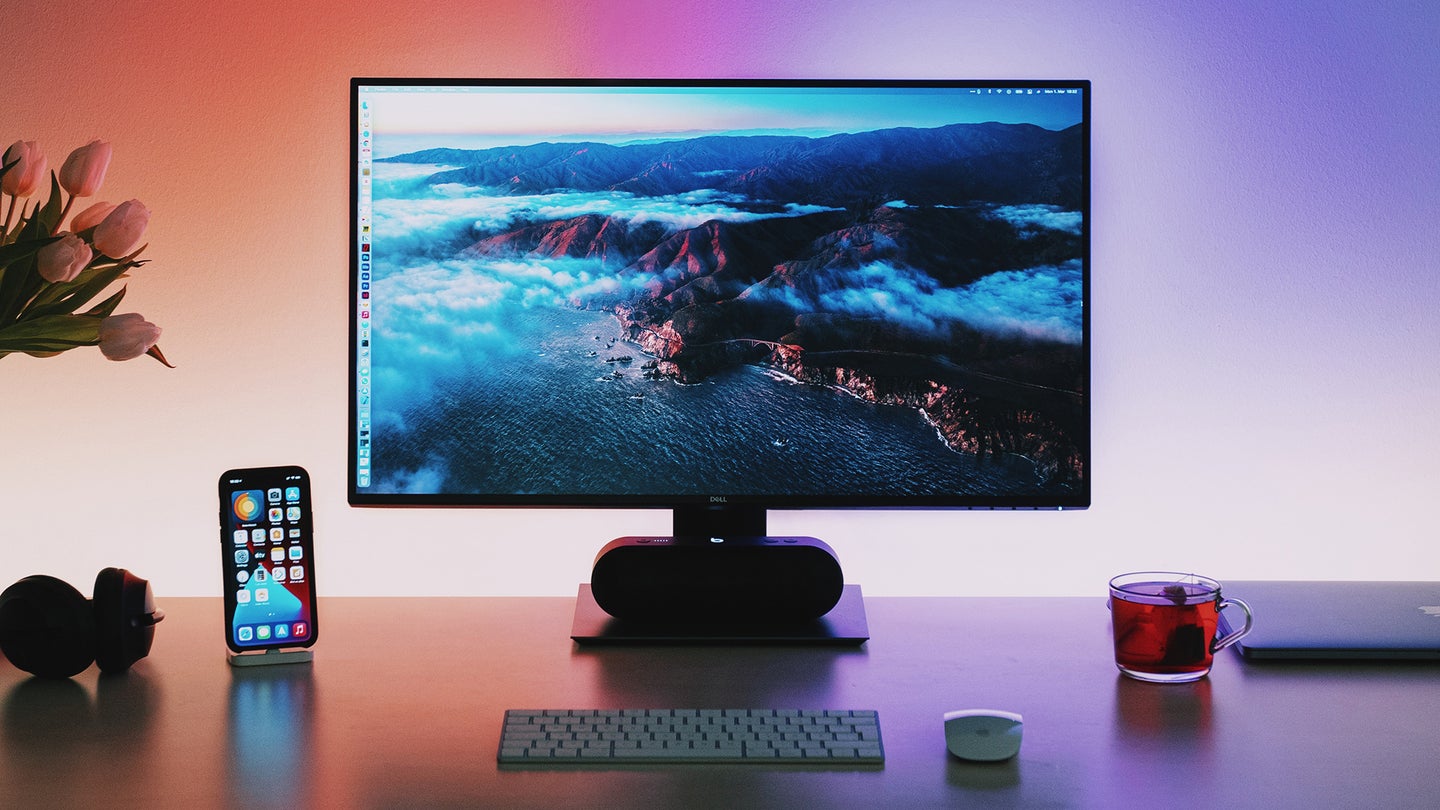 You’ll want to ensure your monitor’s colors are calibrated correctly to see everything in wondrous detail. Linus Mimietz / Unsplash
.
.
Click the link below for the article:
.
__________________________________________
August 12, 2023
Mohenjo
Business, Food For Thought, Human Interest, Political, Science, Technical
amazon, business, Business News, current-events, Future, Hotels, human-rights, medicine, mental-health, research, Science, Science News, technology, Technology News, travel, vacation

Click the link below the picture
.
We’ve all heard that an apple a day keeps the doctor away, but how true is that?
Apples are not high in vitamin A, nor are they beneficial for vision like carrots. They are not a great source of vitamin C and therefore don’t fight off colds as oranges do.
However, apples contain various bioactive substances – natural chemicals that occur in small amounts in foods and that have biological effects in the body. These chemicals are not classified as nutrients like vitamins. Because apples contain many health-promoting bioactive substances, the fruit is considered a “functional” food.
For years, I have taught university classes on nutrients such as vitamins, minerals, carbs, proteins, and fats. But recently I developed a course specifically on functional foods. The class explores the various bioactive substances in food and how some may even function like a medicine.
Functional foods defined
Functional foods are not the same as superfoods. “Superfood” is a buzzword marketers use to promote foods like kale, spinach, and blueberries. Labeling them as “super” appeals to the public and increases sales. But superfood is generally meant to imply a food that has superior nutritional value and that is high in nutrients that are beneficial for health. For example, salmon and tuna are considered superfoods because the omega-3 fats they contain have been linked to heart health.
Superfood advertisements claim that eating the food will improve some aspect of health. The problem is that most of those claims are not based on scientific research like the criteria for functional foods are.
In addition to the nutrients that our bodies need for growth and development, functional foods contain a variety of bioactive substances, each with a unique function in the body. The bioactive substances can be found naturally in foods or added during processing.
.
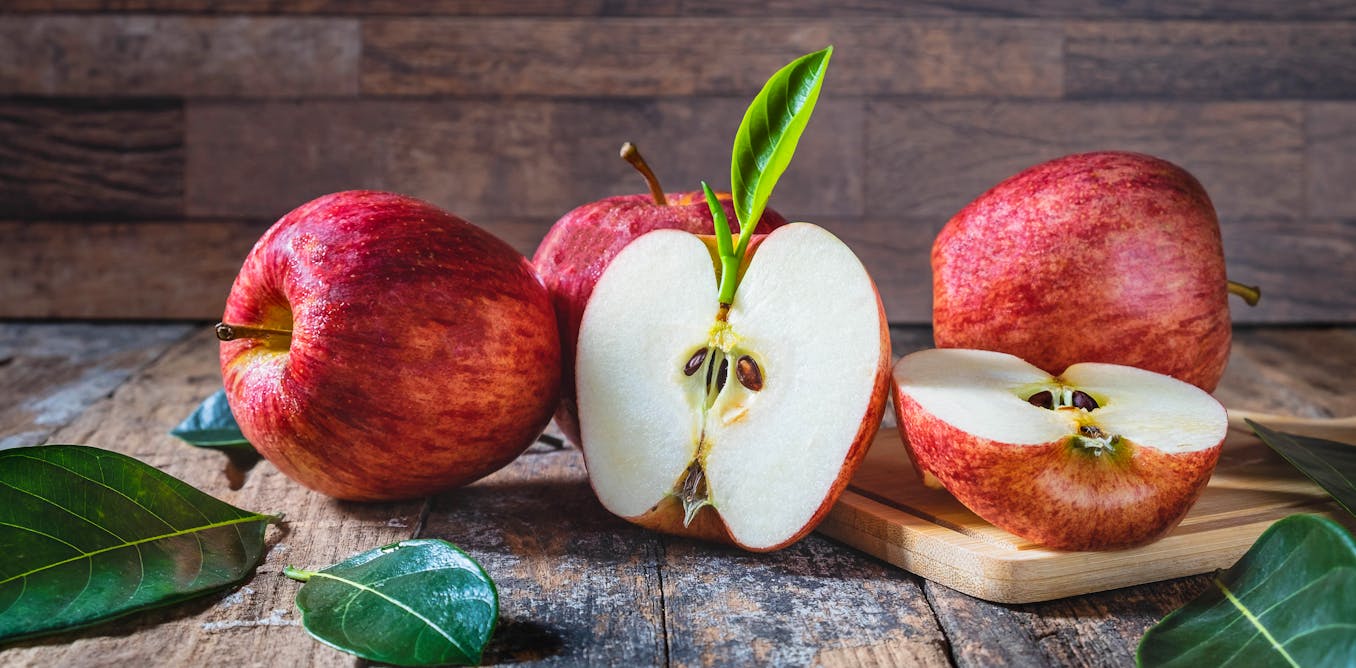 While apples aren’t considered a superfood, they are considered a functional food. Caterina Oltean/500px Prime via Getty Images
.
.
Click the link below for the article:
.
__________________________________________
August 12, 2023
Mohenjo
Business, Food For Thought, Human Interest, Political, Science, Technical
amazon, business, Business News, current-events, Future, Hotels, human-rights, medicine, mental-health, research, Science, Science News, technology, Technology News, travel, vacation

Click the link below the picture
.
The term toxic positivity has gained popularity in recent years, referring to moments when people responded to others’ struggles with surface-deep assurances and clichéd phrases such as, “Everything happens for a reason,” or, “Have you tried yoga?”
But there is a similar, if lesser-known, concept that is more inner-directed: emotional perfectionism.
While we usually think of a perfectionist as someone who holds themselves to a high standard for how they look, behave, or work, emotional perfectionists hold themselves to a similar standard regarding how they feel. Rather than encouraging others to look on the bright side (toxic positivity), they expect themselves to be unfailingly upbeat.
“It’s really when you have an emotion about emotion, and you’re suppressing what you have labeled the bad emotion,” said Annie Hickox, a psychologist who also holds a Ph.D. in clinical neuroscience. “Emotional perfectionism often follows a script of: ‘We shouldn’t do this,’ ‘I shouldn’t be mad about that,’ ‘I shouldn’t be angry,’ ” added Hickox, who coined the term in 2016.
Hickox believes emotional perfectionism could be an unrecognized source of anxiety, based on experience with her patients. “They’ll say, ‘Oh no, I’m not a perfectionist.’ But you can find thoughts where they’re holding themselves up to a very high standard,” she said.
Toxic positivity and emotional perfectionism have the same underlying root cause: a discomfort with other people’s negative emotions. Vrinda Kalia, a psychology professor at Miami University who studies perfectionism and emotional expression, said that expecting life — yours or others’ — to be “awesome all the time” is extremely debilitating because it ignores reality. “This is not what life is like.”
.
 People who experience emotional perfectionism are reluctant to admit to negative emotions. (iStock)
.
.
Click the link below for the article:
.
__________________________________________
August 11, 2023
Mohenjo
Business, Food For Thought, Human Interest, Political, Science, Technical
amazon, business, Business News, current-events, Future, Hotels, human-rights, medicine, mental-health, research, Science, Science News, technology, Technology News, travel, vacation

Blame others for exactly what you are doing!
Click the link below the picture
.
One of Donald Trump’s greatest political talents–if you can call it that–is the ability to kick up such a whirlwind of chaos that it becomes easy to lose sight of simple moral baselines. Actions and stories that would functionally end other presidencies are forgotten within days as the bright bouncy orange ball moves to the next outrage and shatters the next norm. Opponents are left wondering whether to five the next five-alarm fire or try to focus on rebuilding the crumbling foundations of governance from the last fire.
That is in part what has happened over Trump’s personal financial behavior. For years, Americans of decency have eagerly awaited the disclosure of Donald Trump’s personal and organizational tax records, knowing that they were likely to reveal massive corruption, potentially leading to a crisis of government, impeachment, resignation, or any other consequence of note. But Trump’s chaos tornado, particularly in the context of a historic pandemic, has essentially nullified the consequences of what should be earth-shattering revelations.
When the New York Times released the main story on Trump’s tax-dodging and enormous personal debts, it basically had no impact on public polling and lasted about one to two days in the national news cycle. This is in part because Trump has so debased expectations for his own behavior and public service that everyone knows he’s a crook–even his own supporters–but either they don’t care or they were already opposing him, anyway. But it’s also because who has time to worry about whether the president is a tax cheat when he is actively spreading a deadly virus at the highest levels of government, sabotaging the Postal Service, and refusing to accept the results of a free and fair election? This in spite of the fact that we absolutely must care about these things. After all, the president is $421 million in debt. Whoever owns his debt, including potential foreign adversaries, could essentially be running national policy! Even if we believe we cannot afford to pay attention to it given the rest of the hurricane winds, we still must manage to maintain our focus.
.
 Gage Skidmore/Flickr
.
.
Click the link below for the article:
.
__________________________________________
August 11, 2023
Mohenjo
Business, Food For Thought, Human Interest, Political, Science, Technical
amazon, business, Business News, current-events, Future, Hotels, human-rights, medicine, mental-health, research, Science, Science News, technology, Technology News, travel, vacation

Click the link below the picture
.
Rain or shine, Mohammad Shukkur Ali, a rickshaw puller in his 50s, shows up for work on the streets of the Bangladesh capital Dhaka. The work is already punishing as it requires massive physical effort. But this year, the heat has made things even worse. Temperatures in the city hit 40.6C (105.8F) in April – a record high.
But Mr. Ali, who lives with his wife and two children in a rented room, says he has no choice but to endure the discomfort.
“I need to work because we are poor,” he said.
Mr Ali works eight-hour shifts every day in Gulshan, an affluent district in Dhaka which houses fancy apartments, sprawling corporate offices and several foreign embassies. To be even allowed into the area, he has to wear a jacket over his shirt – a uniform of sorts – which makes the heat even more uncomfortable.
The grueling heat in the country has been made worse by fuel shortages- a consequence of the Ukraine war – which has led to frequent power cuts.
Millions of people across the world, including in North America and Europe, have experienced blistering heat this year.
A large number of cities have reported record temperatures, with scientists saying that July is “virtually certain” to be the world’s warmest month on record.
.
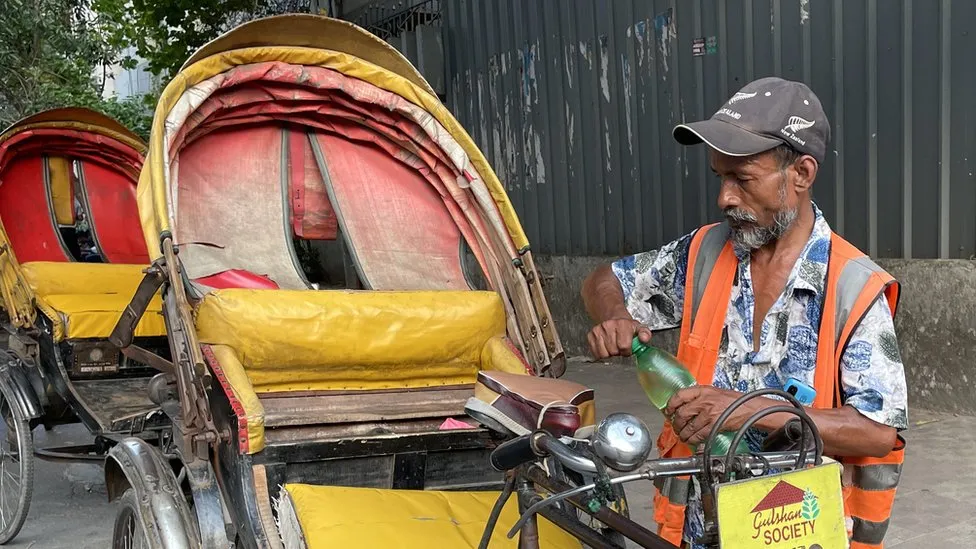 Mohammad Shukkur Ali, 50, a Bangladeshi rickshaw puller, says the heat this year has been extreme
.
.
Click the link below for the article:
.
__________________________________________
August 10, 2023
Mohenjo
Business, Food For Thought, Human Interest, Political, Science, Technical
amazon, business, Business News, current-events, Future, Hotels, human-rights, medicine, mental-health, research, Science, Science News, technology, Technology News, travel, vacation

Click the link below the picture
.
Just four years ago, the movement to ban police departments from using face recognition in the US was riding high. By the end of 2020, around 18 cities had enacted laws forbidding the police from adopting the technology. US lawmakers proposed a pause on the federal government’s use of the tech.
In the years since, that effort has slowed to a halt. Five municipal bans on police and government use passed in 2021, but none in 2022 or in 2023 so far, according to a database from the digital rights group Fight for the Future. Some local bans have even been partially repealed, and today, few seriously believe that a federal ban on police use of face recognition could pass in the foreseeable future. In the meantime, without legal limits on its use, the technology has only grown more ingrained in people’s day-to-day lives.
However, in Massachusetts, there is hope for those who want to restrict police access to face recognition. The state’s lawmakers are currently thrashing out a bipartisan state bill that seeks to limit police use of the technology. Although it’s not a full ban, it would mean that only state police could use it, not all law enforcement agencies.
The bill, which could come to a vote imminently, may represent an unsatisfying compromise, both to police who want more freedom to use the technology and to activists who want it completely banned. But it represents a vital test of the prevailing mood around police use of these controversial tools.
.
 Sarah Rogers/MITTR | Getty
.
.
Click the link below for the article:
.
__________________________________________
August 10, 2023
Mohenjo
Business, Food For Thought, Human Interest, Political, Science, Technical
amazon, business, Business News, current-events, Future, Hotels, human-rights, medicine, mental-health, research, Science, Science News, technology, Technology News, travel, vacation

Click the link below the picture
.
We share the planet with some 7.7 million species of animals. And every day, they confound us. Take the orcas (i.e., killer whales), for example, that have taken to ramming human vessels. Despite the tens of thousands of academic papers that have been written about them, the best any researcher can do to explain why they have been bludgeoning ships is shrug, and make some guesses.
Animals tease us by sharing the world with us, but by also withholding many of their secrets. “We don’t know what it’s like to conceive of the world as a killer whale or as a cat, or a nonhuman primate, or any individual that doesn’t have language really,” Jennifer Vonk, a cognitive scientist who studies animals at Oakland University, tells Vox’s, Byrd Pinkerton.
On Unexplainable — Vox’s podcast that explores scientific mysteries, unanswered questions, and all the things we learn by diving into the unknown — we routinely return to stories about animals. The people who study them have enviable jobs: involving playing with puppies, or diving deep into the dark parts of the sea, or thinking through what the roar of a long-dead dinosaur might have sounded like.
And their works in turn provoke deep, fascinating questions. Questions about the interior lives of animals, but also about how humans are changing the world, about how wildlife is responding to those changes, and about how many forms of life depend on one another.
We might not be able to understand why animals do what they do. But we can at least understand how important these creatures are.
.
:format(webp)/cdn.vox-cdn.com/uploads/chorus_image/image/72506310/GettyImages_1609615.0.jpg) David McNew/Getty Images
David McNew/Getty Images
.
.
Click the link below for the article:
.
__________________________________________
August 9, 2023
Mohenjo
Business, Food For Thought, Human Interest, Political, Science, Technical
amazon, business, Business News, current-events, Future, Hotels, human-rights, medicine, mental-health, research, Science, Science News, technology, Technology News, travel, vacation

Click the link below the picture
.
Shortly after his sixty-seventh birthday, Ernesto Chavez retired from his job at a Los Angeles food warehouse. Sara, his wife of forty-five years, told me that he meticulously took his medications for high blood pressure and cholesterol, hoping to enjoy his time with his grandchildren. But one morning in January 2021, Ernesto burned with fever, his chest heaving as though he were once again lifting heavy boxes. At the hospital, he tested positive for COVID-19. His oxygen levels plummeted, and he was quickly intubated. Ten days later, his lungs were failing, his face was bloated from liters of intravenous fluid, and his hands and feet had begun to cool. As his chances of survival waned, I arranged to speak with his family about a subject inseparable from death itself: cardiopulmonary resuscitation, or CPR.
For decades, physicians have debated whether CPR should be offered to people who suffer from the final blows of incurable illness, be it heart failure, advanced cancer, or dementia. Although CPR has become synonymous with medical heroism, nearly eighty-five percent of those who receive it in a hospital die, their last moments marked by pain and chaos. The pandemic only deepened the risks: every chest compression spewed contagious particles into the air, and intubation, which often follows compressions, exposed doctors to virus-laden saliva. Hospitals in Michigan and Georgia reported that no COVID patient survived the procedure. An old question acquired new urgency: Why was CPR a default treatment, even for people as sick as Ernesto?
As a palliative-care physician, I help people with serious, often terminal, illness consider a path forward. During the pandemic, this involved weekly Zoom meetings with each family whose loved one was in the I.C.U. with COVID. We discussed how the virus could damage the lungs irreversibly, how we gauged a patient’s condition, and what we would do if, despite being on life support, that patient died.
On a gray afternoon, I logged on to Zoom to speak with Ernesto’s family. I would be joined by Sara, her daughter Nancy, and Neal, an internal-medicine resident covering the I.C.U. Before the meeting, I asked Neal whether he’d been taught how to have these conversations. “Nope,” he said. I asked him what he might say to Ernesto’s family. “Unfortunately, he still needs the ventilator for his lungs, and he’s not showing signs of improvement. We want you to know that he is very sick,” he said, his expression solemn. “Because he is so sick, his heart could stop. If that happened, would you want us to do CPR to revive him?” He used his hands to simulate chest compressions on a phantom body.
.
 Photograph by Ashlee Rezin Garcia / Chicago Sun-Times / AP
.
.
Click the link below for the article:
.
__________________________________________
Older Entries
Newer Entries
 James' World 2