September 21, 2023
Mohenjo
Business, Food For Thought, Human Interest, Political, Science, Technical
amazon, business, Business News, current-events, Future, Hotels, human-rights, medicine, mental-health, research, Science, Science News, technology, Technology News, travel, vacation

Click the link below the picture
.
The long evolutionary journey that created modern humans began with a single step—or more accurately—with the ability to walk on two legs. One of our earliest-known ancestors, Sahelanthropus, began the slow transition from ape-like movement some six million years ago, but Homo sapiens wouldn’t show up for more than five million years. During that long interim, a menagerie of different human species lived, evolved, and died out, intermingling and sometimes interbreeding along the way. As time went on, their bodies changed, as did their brains and their ability to think, as seen in their tools and technologies.
To understand how Homo sapiens eventually evolved from these older lineages of hominins, the group including modern humans and our closest extinct relatives and ancestors, scientists are unearthing ancient bones and stone tools, digging into our genes, and recreating the changing environments that helped shape our ancestors’ world and guide their evolution.
These lines of evidence increasingly indicate that H. sapiens originated in Africa, although not necessarily in a single time and place. Instead, it seems diverse groups of human ancestors lived in habitable regions around Africa, evolving physically and culturally in relative isolation, until climate-driven changes to African landscapes spurred them to intermittently mix and swap everything from genes to tool techniques. Eventually, this process gave rise to the unique genetic makeup of modern humans.
“East Africa was a setting in foment—one conducive to migrations across Africa during the period when Homo sapiens arose,” says Rick Potts, director of the Smithsonian’s Human Origins Program. “It seems to have been an ideal setting for the mixing of genes from migrating populations widely spread across the continent. The implication is that the human genome arose in Africa. Everyone is African, and yet not from any one part of Africa.”
New discoveries are always adding key waypoints to the chart of our human journey. This timeline of Homo sapiens features some of the best evidence documenting how we evolved.
.
 Homo sapien skulls on display at the Hubei Provincial Museum, China. (Public domain/Wikimedia Commons)
.
.
Click the link below for the article:
.
__________________________________________
September 20, 2023
Mohenjo
Business, Food For Thought, Human Interest, Political, Science, Technical
amazon, business, Business News, current-events, Future, Hotels, human-rights, medicine, mental-health, research, Science, Science News, technology, Technology News, travel, vacation

Click the link below the picture
.
In the constellation Aquarius, invisible to the naked eye, lies a star that might change history. Home to seven mysterious planets—each around the size of our own Earth—the TRAPPIST-1 system is regarded by some as the crown jewel of astronomy’s efforts to find life in the Milky Way. With not one, but three worlds orbiting in the so-called habitable zone, where water can flow and life can thrive, TRAPPIST-1 is one of humanity’s best and brightest opportunities to chase the discovery of a lifetime.
More than science is at stake: what we find—or don’t—on these worlds will shape science forever.
What sets TRAPPIST-1 apart is its striking commonality. At the heart of this system is a small, dim star called a red dwarf. Ranging between 8 percent and 57 percent of the mass of our own sun, red dwarfs quietly make up a remarkable 73 percent of all stars in the galaxy, and are suspected to harbor at least three planets per star. Naturally, this has piqued the curiosity of those who study life in the cosmos—astrobiologists. Could alien life thrive around these small red suns?
The possibility tantalizes the philosopher, but even more so the astronomer: planets around red dwarfs are easier to find than around any other type of star. In fact, the TRAPPIST-1 system was discovered in 2016 with a telescope only two feet across. Because the star is small even by red dwarf standards, its Earth-sized planets stand out easily; when they cross, or transit, the star, they block roughly half a percent of its total light output. For comparison, the Earth only blocks 0.01 percent of our much larger sun’s light when it passes in front of it. In terms of detectability, red dwarfs seem to be the clear winner, and out of 445 red dwarf systems (I asked Jessie Christensen, the scientist who maintains the NASA Exoplanet Archive, what the latest count was), TRAPPIST-1 is one of the brightest that transits, making it a favorite target for astrobiology.
But red dwarfs have a dark side. They are not simply smaller, redder versions of our own well-behaved sun; they are turbulent, active sources of extreme radiation. While Earth experiences violent solar outbursts called coronal mass ejections (CMEs) roughly once every 25 years, a planet that orbits TRAPPIST-1 experiences them weekly. And the bigger the host star, the more powerful the CME. If a planet does not have a strong magnetic field to protect it, a CME can strip away its atmosphere until it is a barren, uninhabitable rock.
In addition, red dwarfs are born hot, and cool over time. This means that a planet may have its water inventory boiled away before it gets the chance to settle into the habitable zone, or that a planet may begin its life habitable before freezing over. Finally, red dwarf planets live very close to their star, and when two things in space orbit close together, one will eventually come to face the other—the way the same side of the moon is always facing the Earth. In the case of TRAPPIST-1’s planets, this means that one hemisphere may experience eternal daytime, and the other, eternal night: perhaps unideal conditions for life to evolve.
.
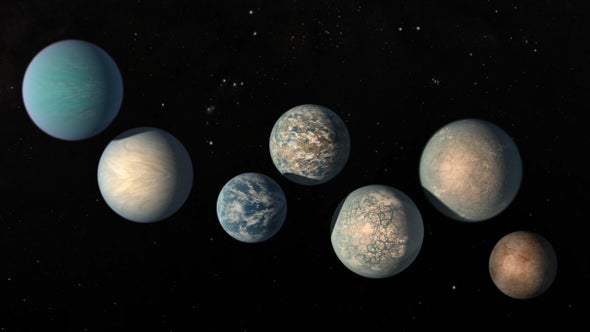 This illustration shows the seven Earth-size planets of TRAPPIST-1, an exoplanet system about 40 light-years away, based on data current as of February 2018. The image shows the planets’ relative sizes, but does not represent their orbits to scale. Credit: NASA/JPL-Caltech/R. Hurt, T. Pyle (IPAC)
.
.
Click the link below for the article:
.
__________________________________________
September 20, 2023
Mohenjo
Business, Food For Thought, Human Interest, Political, Science, Technical
amazon, business, Business News, current-events, Future, Hotels, human-rights, medicine, mental-health, research, Science, Science News, technology, Technology News, travel, vacation

Click the link below the picture
.
In a neat little neighborhood in Venice, Calif., there’s a block of squat, similar homes, filled with mortals spending their finite days on the planet eating pizza with friends, blowing out candles on birthday cakes, and binging late-night television. Halfway down the street, there’s a cavernous black modern box. This is where Bryan Johnson is working on what he calls “the most significant revolution in the history of Homo sapiens.”
Johnson, 46, is a centimillionaire tech entrepreneur who has spent most of the last three years in pursuit of a singular goal: don’t die. During that time, he’s spent more than $4 million developing a life-extension system called Blueprint, in which he outsources every decision involving his body to a team of doctors, who use data to develop a strict health regimen to reduce what Johnson calls his “biological age.” That system includes downing 111 pills every day, wearing a baseball cap that shoots red light into his scalp, collecting his own stool samples, and sleeping with a tiny jet pack attached to his penis to monitor his nighttime erections. Johnson thinks of any act that accelerates aging—like eating a cookie, or getting less than eight hours of sleep—as an “act of violence.”
Johnson is not the only ultra-rich middle-aged man trying to vanquish the ravages of time. Jeff Bezos and Peter Thiel were both early investors in Unity Biotechnology, a company devoted to developing therapeutics to slow or reverse diseases associated with aging. Elite athletes employ therapies to keep their bodies young, from hyperbaric and cryotherapy chambers to “recovery sleepwear.” But Johnson’s quest is not just about staying rested or maintaining muscle tone. It’s about turning his whole body over to an anti-aging algorithm. He believes death is optional. He plans never to do it.
Outsourcing the management of his body means defeating what Johnson calls his “rascal mind”—the part of us that wants to eat ice cream after dinner, or have sex at 1 a.m., or drink beer with friends. The goal is to get his 46-year-old organs to look and act like 18-year-old organs. Johnson says the data compiled by his doctors suggests that Blueprint has so far given him the bones of a 30-year-old, and the heart of a 37-year-old. The experiment has “proven a competent system is better at managing me than a human can,” Johnson says, a breakthrough that he says is “reframing what it means to be human.” He describes his intense diet and exercise regime as falling somewhere between the Italian Renaissance and the invention of calculus in the pantheon of human achievement. Michelangelo had the Sistine Chapel; Johnson has his special green juice.
.

Bryan Johnson, tech entrepreneur and Founder of Blueprint, poses for a portrait at his home. Johnson follows a strict diet and lifestyle routine in an attempt to reduce his biological age. Philip Cheung for TIME
.
.
Click the link below for the article:
.
__________________________________________
September 19, 2023
Mohenjo
Business, Food For Thought, Human Interest, Science, Technical
amazon, business, Business News, current-events, Future, Hotels, human-rights, medicine, mental-health, research, Science, Science News, technology, Technology News, travel, vacation

Click the link below the picture
.
On Labor Day, you could drive from Minnesota’s border with Canada all the way to where Louisiana hits the Gulf of Mexico and not encounter a high under 90 degrees. The heat hasn’t broken: Today, nearly a third of Americans are sweltering under heat alerts.
Such weather is a fitting end to a devastating season, the kind you run out of superlatives for. This summer, climate extremes suddenly seemed to be everywhere, all at once. It was the world’s hottest June since humans started keeping track. July was even worse. Phoenix—which averaged 102 degrees in July—got so hot that people received third-degree burns from touching doorknobs. In Iowa, livestock dropped dead in their pens. The disasters weren’t limited to heat: Canadian wildfires blanketed large swaths of the United States in smoke, flash floods thundered through Vermont, and wildfires reduced parts of Maui to rubble.
Pumpkin spice is already back on the Starbucks menu, but fall isn’t poised to provide a respite. El Niño, the warm phase of a naturally recurring cycle that can wreak havoc on global weather patterns, has officially returned—and it’s predicted to be a strong one. The southern U.S. will likely be wetter, while forecasts are for a warm winter in the North. These cycles always have some variability, but experts say that the climate crisis has now raised temperatures to the extent that they may also amplify El Niño. This summer has shown starkly how climate change can supercharge the weather. This fall, El Niño could further magnify the problem.
Although El Niño technically started in June, it likely didn’t contribute much to this summer’s extremes. That was the climate crisis. Across the U.S., hundreds of temperature records fell. Kansas City’s heat index approached that of Death Valley. Chicago had to reduce its trains’ speeds because high temperatures stressed the tracks. “Historically, El Niño events during the summer have very little impact over the United States,” Michelle L’Heureux, a climate scientist at the National Oceanic and Atmospheric Administration, told me. “Climate change, however, is having an impact.” Scientists once hesitated to say how global warming might worsen weather. Now they can accurately measure just how much climate contributes to events such as heat waves. An international team of researchers found that climate change made July’s heat waves in the U.S., Europe, and China hotter by as much as 2 degrees Celsius, or 3.6 degrees Fahrenheit, as a result of climate change.
.

.
.
Click the link below for the article:
.
__________________________________________
September 19, 2023
Mohenjo
Business, Food For Thought, Human Interest, Political, Science, Technical
amazon, business, Business News, current-events, Future, Hotels, human-rights, medicine, mental-health, research, Science, Science News, technology, Technology News, travel, vacation

Click the link below the picture
.
I was told the monkeys would be here, although nothing about this spot seemed particularly suitable for wildlife. On a stifling morning in late July, I stood in a large parking lot near Fort Lauderdale-Hollywood International Airport, about 40 miles north of Miami. Cars drove in and out. Planes passed low overhead. It reeked of gasoline.
The only visible natural habitat was a sliver of forest, just a few hundred feet wide, wedged between the paved lot, a field of oil tanks, and a highway. I couldn’t find monkeys in the lot, so I tried my luck in the forest.
It turned out to be more of a swamp. With each step, thick mud crept past my ankles, making it difficult to move. A thorny underbrush etched puffy red lines into my bare legs.
Half an hour in, when I was about to turn back in pursuit of air conditioning and a fresh pair of socks, I heard a rustling overhead. I froze in place and looked up. There, through the branches, I saw the unmistakable face of a monkey.
To see exotic animals in Florida, one could visit Disney’s Animal Kingdom, Busch Gardens, or Zoo Miami. Or they could just step outside.
The Sunshine State is utterly brimming with nonnative species. More than 500 of them have been reported here, which is more than in any other state, and many of them are considered “invasive,” meaning they harm humans or ecosystems. For most of their evolutionary history, these species have never set foot in Florida — they’ve never been near a Publix, or Magic Kingdom, for that matter.
In the last few decades, Florida has become an unmanaged zoo, an uncontrolled experiment. And each year, the decision of what to do with it gets harder.
.
:format(webp)/cdn.vox-cdn.com/uploads/chorus_image/image/72659918/lede_Benji.0.jpg) A veiled chameleon in a patch of trees near a canal east of Fort Myers.Benji Jones
A veiled chameleon in a patch of trees near a canal east of Fort Myers.Benji Jones
.
.
Click the link below for the article:
.
__________________________________________
September 18, 2023
Mohenjo
Business, Food For Thought, Human Interest, Political, Science, Technical
amazon, business, Business News, current-events, Future, Hotels, human-rights, medicine, mental-health, research, Science, Science News, technology, Technology News, travel, vacation

Click the link below the picture
.
Singapore’s prime minister has described climate change as “life and death.” He has reason to worry: Stifling temperatures and humidity already last all year, and the city-state has warmed at twice the global average over the past six decades.
Heat like this isn’t just uncomfortable. It can cause chronic illness and death, including heat exhaustion, kidney damage, and even heart attacks. With two-thirds of the global population expected to live in urban areas by 2050, urban heat is an enormous global health challenge.
Rapid urbanization has made Singapore hotter. A big part of the problem is how almost every global city is built.
Preventing climate change is out of Singapore’s control: The city-state emits less than 0.1% of global carbon emissions. But there is a surefire way to limit city temperatures, researchers say: Revive the natural processes that cooled the land before urbanization.
Most cities do not have Singapore’s wealth and centralized political system, which allow it to move quickly to build new infrastructure. But while some of Singapore’s strategies to reduce excess heat are expensive, many of them are straightforward, and cheaper than planning for, say, floods or hurricanes.
As temperature records were shattered around the world this summer, Singapore’s blueprint for slowing the urban impacts of extreme heat is gaining urgency.
.
 Singapore is rethinking its sweltering urban areas to dampen the effects of climate change. Can it be a model?
.
.
Click the link below for the article:
.
__________________________________________
September 18, 2023
Mohenjo
Business, Food For Thought, Human Interest, Political, Science, Technical
amazon, business, Business News, current-events, Future, Hotels, human-rights, medicine, mental-health, research, Science, Science News, technology, Technology News, travel, vacation

Click the link below the picture
.
In the film “2001: A Space Odyssey,” an astronaut travels through a seeming tunnel of light. (In the novelization, he radios to mission control: “The thing’s hollow—it goes on forever—and—oh my God!—it’s full of stars!”) Earlier this summer, Artechouse, an organization producing immersive, technology-based art, started offering a science-backed version of a similar trip at its New York venue. The show, titled “Beyond the Light,” is a looping twenty-six-minute journey through space and other realms inspired by images from the James Webb Space Telescope (J.W.S.T.). Artechouse began talks with NASA about a show in 2018, and started pulling this one together earlier this year, after the first images captured by J.W.S.T. were released to the public last July.
There’s a long tradition of art about the stars. More than sixteen thousand years ago, cave explorers in what’s now Lascaux, France, painted animals that are believed to represent the constellations. A few hundred miles away and many centuries later—near Saint-Rémy-de-Provence, in 1889—Vincent van Gogh made “The Starry Night,” a swirling blur of color looming over a village. “I’m sure people have been painting the heavens for as long as they’ve been looking at them,” Maggie Masetti, the NASA social-media lead for the J.W.S.T. mission, told me. “Beyond the Light” is high-tech—video is projected on three walls and the floor of a vast room, while a powerful sound system thrums—but it’s also connected to traditional astro-art in the way it’s largely abstract and impressionistic (sometimes even Cubist). Although the show makes use of images taken by the Webb telescope, it is mostly imaginative. Splashes of color, bubbles, tubes, machinery, and glowing rocks covered with runes flow across the room in response to what the telescope has found.
When the show premièred, in June—its D.C. première is this Friday—a number of researchers involved with the J.W.S.T. were in attendance, among them Stefanie Milam, a NASA astrochemist; Macarena García Marín, an astrophysicist at the European Space Agency; and Mike Menzel, NASA’s mission-systems engineer for the Webb. They stood talking with Sandro Kereselidze, one of Artechouse’s founders. “It’s absolutely fantastic and beautiful,” Milam said. “We already tried to do our own art,” she went on—scientists producing images with the Webb had used “different components of the instruments, different wavelengths, or different filters, to really tell the story about a given image, because we want you to see the baby stars being formed in a giant cloud, or to see the Great Red Spot on Jupiter in multiple colors, or other storms in planetary atmospheres.” But now artists were telling other kinds of stories using the images. “What we do is sort of amateur art,” Milam said.
“We designed the telescope to wow the scientists,” Menzel agreed. Now, he said, “We’re here in an art show, watching some images that we helped produce becoming things that are almost iconic.”
Kereselidze saw similarities between the artists he worked with at Artechouse and the scientists. “We speak the same language,” he said. “We have the passion for expressing what we discovered.” There were some small science exhibits on a mezzanine, but the venue wasn’t trying to be a science museum. Instead, Kereselidze said, “The goal is to open up curious minds. If everything is, like, ‘A, B, C, D,’ it becomes like PowerPoint, right?”
.

.
.
Click the link below for the article:
.
__________________________________________
September 17, 2023
Mohenjo
Business, Food For Thought, Human Interest, Political, Science, Technical
amazon, business, Business News, current-events, Future, Hotels, human-rights, medicine, mental-health, research, Science, Science News, technology, Technology News, travel, vacation

Click the link below the picture
.
We’ve all heard of the five tastes our tongues can detect—sweet, sour, bitter, savory-umami, and salty. But the real number is actually six, because we have two separate salt-taste systems. One of them detects the attractive, relatively low levels of salt that make potato chips taste delicious. The other one registers high levels of salt—enough to make overly salted food offensive and deter overconsumption.
Exactly how our taste buds sense the two kinds of saltiness is a mystery that’s taken some 40 years of scientific inquiry to unravel, and researchers haven’t solved all the details yet. In fact, the more they look at salt sensation, the weirder it gets.
Many other details of taste have been worked out over the past 25 years. For sweet, bitter, and umami, it’s known that molecular receptors on certain taste bud cells recognize the food molecules and, when activated, kick off a series of events that ultimately sends signals to the brain.
Sour is slightly different: It is detected by taste bud cells that respond to acidity, researchers recently learned.
In the case of salt, scientists understand many details about the low-salt receptor, but a complete description of the high-salt receptor has lagged, as has an understanding of which
taste bud cells host each detector.
“There are a lot of gaps still in our knowledge—especially salt taste. I would call it one of the biggest gaps,” says Maik Behrens, a taste researcher at the Leibniz Institute for Food Systems Biology in Freising, Germany. “There are always missing pieces in the puzzle.”
A fine balance
Our dual perception of saltiness helps us to walk a tightrope between the two faces of sodium, an element that’s crucial for the function of muscles and nerves but dangerous in high quantities. To tightly control salt levels, the body manages the amount of sodium it lets out in urine, and controls how much comes in through the mouth.
.
 Too much sodium is bad, but so is too little—no wonder the body has two sensing mechanisms.
.
.
Click the link below for the article:
.
__________________________________________
September 17, 2023
Mohenjo
Business, Food For Thought, Human Interest, Political, Science, Technical
amazon, business, Business News, current-events, Future, Hotels, human-rights, medicine, mental-health, research, Science, Science News, technology, Technology News, travel, vacation

Click the link below the picture
.
Mucus is not widely considered a topic for polite conversation. It’s something to be discreetly blown into a tissue, folded up, and thrown away.
But the simple truth is that without mucus, you wouldn’t be alive.
“Mucus is essential for the protection of your body,” says Jeffrey Spiegel, an ear, nose, and throat surgeon at Boston University. “It’s a protective barrier, and it allows you to breathe comfortably. If you had no mucus, you’d be quite sorry you didn’t.”
Given how important mucus is — and how often colds and allergies cause mucus-related symptoms — it’s worth learning a bit more about it.
1) You produce about 1.5 quarts of mucus a day — and swallow the vast majority
Most of us think of mucus as something that leaks from our nose, but the truth is that it also gets secreted in your trachea and other tubes that carry air through your lungs, where it’s technically called phlegm. Wherever it’s produced, mucus is a mix of water and proteins, and most of it gets pushed to the back of your throat by microscopic hairs called cilia.
.
 Nastasic/Getty Images
.
.
Click the link below for the article:
.
__________________________________________
September 16, 2023
Mohenjo
Business, Food For Thought, Human Interest, Political, Science, Technical
amazon, business, Business News, current-events, Future, Hotels, human-rights, medicine, mental-health, research, Science, Science News, technology, Technology News, travel, vacation

Click the link below the picture
.
To fully appreciate the modern-day marvel that is the National Weather Service, it’s useful to start with numbers. There’s 6.3 billion. (The number of observations the agency collects and analyzes every day.) There’s 1.5 million. (The number of forecasts it issues each year.) There’s 184 and 100,000. (The number of weather balloons NWS releases every day, including on weekends and holidays, and the number of feet said balloons can rise into the atmosphere.) And there’s 90 percent. (The average accuracy of a five-day forecast.)
There’s also zero. That’s the approximate number of minutes a typical American like you or me spends wondering about the weather information we access every single day via print newspapers or public radio stations or the hour-by-hour forecasts delivered courtesy of the phones we carry. The ubiquitousness of those updates, the fact that we don’t consider them at all, is a testament to just how much modern meteorology has spoiled us and—probably more than anything else—a tribute to the National Weather Service’s success.
This blasé attitude would have astounded the colonists who arrived in the New World from Europe during the seventeenth century and found North American weather to be, in a word, hellish. They sent letters home describing the climate in apocalyptic terms. When it rained, wrote one colonist in New Sweden, on the Delaware River, “the whole sky seems to be on fire, and nothing can be seen but smoke and flames.” “Intemperate” was how a missionary from Rhode Island described it. “Excessive heat and cold, sudden violent changes of weather, terrible and mischievous thunder and lightning, and unwholesome air” created an environment that was “destructive to human bodies.”
The harshness of the weather—with its extreme seasons and severe storms—wasn’t just an unpleasant surprise. It was also confusing. Among the various, sketchy assumptions that the Europeans had brought with them to their new home was the idea that a location’s climate was directly correlated to its latitude. By the colonists’ logic, the seasons in Newfoundland should resemble those in Paris, and crops grown in Spain should thrive in Virginia. Instead, the olive trees imported from the Mediterranean died in the frozen ground during the mid-Atlantic winters, and the beer went sour in the summer heat. American settlers could have consulted with the resident experts—the Native Americans, who had lived in the eastern part of the continent for thousands of years and knew more about the local climate than anyone else. But they generally didn’t. (“Descriptions of local indigenous knowledge in early colonial narratives,” the historian Sam White noted in his book A Cold Welcome, “are mostly conspicuous by their absence.”)
.
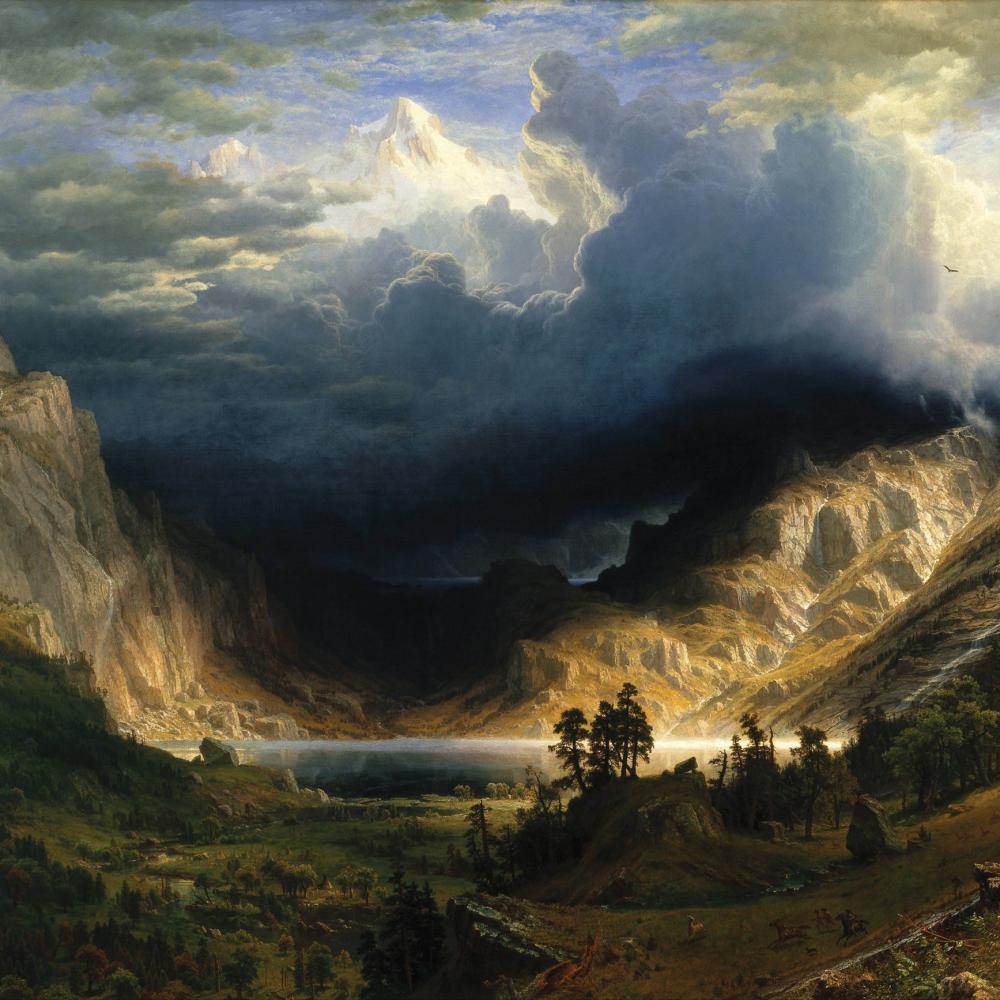
The exact mechanism by which storms formed was once a subject of fierce debate among American scientists. ―Albert Bierstadt, A Storm in the Rocky Mountains, Mt. Rosalie. detail (1866), Wikimedia
.
.
Click the link below for the article:
.
__________________________________________
Older Entries
Newer Entries
 James' World 2