October 6, 2023
Mohenjo
Business, Food For Thought, Human Interest, Political, Science, Technical
amazon, business, Business News, current-events, Future, Hotels, human-rights, medicine, mental-health, research, Science, Science News, technology, Technology News, travel, vacation

Click the link below the picture
.
It didn’t take long for Mario Zechner to prove the government wrong. In May, the independent software developer was listening to a radio interview with Austria’s labor minister, Martin Kocher, who said the government would build a new database that will help people find the cheapest milk, eggs, and other supermarket products to help fight soaring food prices. However, the planned system would take months to build and cover only a handful of food types. Zechner decided to take action.
Two hours after hearing the interview, Zechner had built the first prototype of a comparison system, pulling the cost of 22,000 items from the websites of Austria’s biggest two supermarket chains. “I decided to just sit down in the afternoon and see how hard it really can be,” Zechner says. The result was Heisse Preise (which translates as “Hot Prices”), with Zechner open-sourcing the project on GitHub. “From then on, it kind of escalated,” he says.
Months later, Heisse Preise has grown enormously, demonstrating the power of citizen-developed tools and what can be achieved when data is opened up to everyone. The comparison site now lists prices from 10 Austrian supermarket chains, plus four in neighboring Germany and Slovenia. Heisse Preise includes more than 177,000 items. Thanks to data provided by an anonymous contributor and local press, item pricing history goes back to 2017. Zechner’s creation of the tool came as Europe’s food retailers and governments have clashed over rising prices and the cost of living.
Perhaps most significantly, Zechner’s tool has shone a light on the opaque world of price changes by supermarkets, allowing price increases and decreases to be tracked. The transparency, Zechner and others say, shows there can be little difference in prices at some major supermarkets, and within days of an item changing price, competitors can mirror the change.
Data gathered by Heisse Preise and other newly-emerged DIY comparison sites has fed into the investigations of Bundeswettbewerbsbehörde, the Austrian Federal Competition Authority, which has been probing the food industry since October 2022. The authority, which is due to present its full findings later this month, has already suggested the government should introduce new laws to make shops publish their price data. The authority also says it “can be assumed” that supermarkets themselves crawl the websites of competitors and use that information to set their own prices.
“This data is enormously useful for anyone interested in serious competition policies,” says Leonhard Dobusch, the academic director at the Momentum Institute, an Austrian progressive think tank. “It really allows a peek into pricing strategies [and] price coordination tactics.”
.
 Photograph: Tanja Ivanua/ Getty Images
.
.
Click the link below for the article:
.
__________________________________________
October 5, 2023
Mohenjo
Business, Food For Thought, Human Interest, Political, Science, Technical
amazon, business, Business News, current-events, Future, Hotels, human-rights, medicine, mental-health, research, Science, Science News, technology, Technology News, travel, vacation

Click the link below the picture
.
Every year, the roughly 200 Renaissance fairs and festivals held across the United States and abroad attract several million visitors. United by their raucous entertainment, elaborate costumes, and setting in the distant past, these outdoor events boast a surprising backstory.
The country’s first Renaissance Pleasure Faire, staged in Los Angeles in May 1963, was inextricably linked to the Red Scare, a Cold War-era mass hysteria prompted by the specter of communism. It was the brainchild of Phyllis Patterson, a history, English, speech, and drama teacher who’d balked at having to sign a political loyalty oath to work in California public schools. Though Phyllis later told the press she’d left teaching in 1960 to become a stay-at-home mom, her son Kevin Patterson says this was only “part of the story.” In truth, he adds, “she felt strongly about the harms and unconstitutionality of the HUAC”—the House Un-American Activities Committee—and McCarthyism overall, “and was therefore uncomfortable taking a loyalty oath.”
Many of the volunteers involved in the first fair were residents of Laurel Canyon, a haven for left-leaning creatives in the Hollywood hills. Some had been blacklisted or “graylisted” as communists, leaving them unable to find work in the film industry. The fair presented an opportunity for these individuals to use their skills and participate in a project that celebrated free thinking.
After leaving her teaching position, Phyllis started working at the Wonderland Youth Center in Laurel Canyon, where she ran a theater program for children. She held classes in her backyard, pursuing “a vision of how she could open youngsters’ eyes to their own dramatic and artistic potential by using the great themes of the past,” wrote Kevin in the foreword to a 2013 book about the fair.
Through her work at the youth center, Phyllis met actors Robert and Doris Karnes, who served on its Board of Directors. The couple had also suffered the consequences of Joseph McCarthy-era suspicion and repression. In 1959, HUAC called Doris to testify about “an alleged communist infiltration of the youth center,” writes historian Rachel Lee Rubin in Well Met: Renaissance Faires and the American Counterculture. Two years later, the committee issued a report identifying Doris and 19 others as communists or communist sympathizers. The accusations sparked debate among locals: Some wanted to pull their children from drama classes, while others rejected the blackballing and a proposed amendment barring suspected communists from the center.
.
/https://tf-cmsv2-smithsonianmag-media.s3.amazonaws.com/filer_public/18/5e/185ed3c8-94be-49bf-a61d-5afcf5ce29a7/dancers.jpg) Performers at the 1963 Renaissance Pleasure Faire. Ron Patterson, a co-founder of the event, appears in orange at the far right. Marv Lyons / © Red Barn Productions (RBP) 2023
Performers at the 1963 Renaissance Pleasure Faire. Ron Patterson, a co-founder of the event, appears in orange at the far right. Marv Lyons / © Red Barn Productions (RBP) 2023
.
.
Click the link below for the article:
.
__________________________________________
October 5, 2023
Mohenjo
Business, Food For Thought, Human Interest, Political, Science
amazon, business, Business News, current-events, Future, Hotels, human-rights, medicine, mental-health, research, Science, Science News, technology, Technology News, travel, vacation

Wake up America!
Click the link below the picture
.
The bloodthirsty murders of pregnant celebrity actress Sharon Tate — along with four of her friends — by members of the Charles Manson “family” tipped off a decade of national fascination with cults during the 1970s. This fascination would reach its horrific zenith in 1978 with the forced suicide of over nine-hundred followers of Jim Jones, leader of the “People’s Temple,” in the small South American nation of Guyana.
The Role of Identification with the Aggressor in Brainwashing
Key to unlocking the enigma of cult leaders like Manson and Jones, is the concept of “Identification with the Aggressor,” first described by Hungarian analyst, Sandor Ferenczi, an acolyte, and member of the inner circle of psychology patron saints, Sigmund Freud and Carl Jung. Identification with the aggressor refers to a survival strategy Ferenczi identified in children undergoing traumatic abuse. In response to these incidents, Ferenczi believed a child might split off from reality and cease all thoughts and perceptions, becoming completely passive. Under this spell, children submit to all of their parents’ “desires, or even anticipating them, and eventually realizing that he can find some satisfaction in this.” Many followers of Ferenczi’s work went on to apply the concept of identification with the aggressor to circumstances experienced by adults who are exposed to traumatic abuse.
These theorists have observed that adults can revert to a childlike state of defenselessness and passivity in situations where they are made powerless by a complete loss of control over their personal safety. To adapt to ongoing traumatic abuse, it’s been hypothesized that victims fuse their identity with that of a charismatic, seemingly all-powerful leader. With an individual’s volitions and sense of self effectively erased, the motivations of a parasitic group or the needs of a cult leader are embraced by the victim as their own. Victims often feel gratitude for “favors” they are granted by those in power — small things like being allowed to live.
.
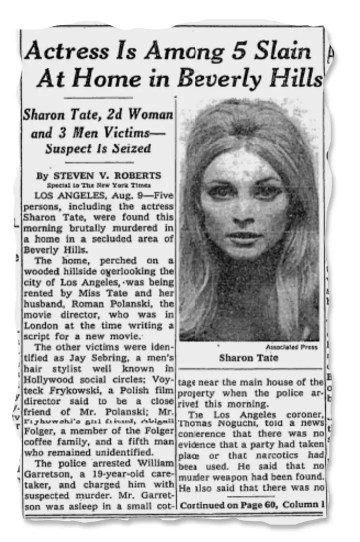 Sharon Tate
.
.
Click the link below for the article:
.
__________________________________________
October 4, 2023
Mohenjo
Business, Food For Thought, Human Interest, Political, Science, Technical
amazon, business, Business News, current-events, Future, Hotels, human-rights, medicine, mental-health, research, Science, Science News, technology, Technology News, travel, vacation

Click the link below the picture
.
The day almost two years ago when Harvard Business School informed Francesca Gino, a prominent professor, that she was being investigated for data fraud also happened to be her husband’s 50th birthday. An administrator instructed her to turn in any Harvard-issued computer equipment that she had by 5 p.m. She canceled the birthday celebration she had planned and walked the machines to campus, where a University Police officer oversaw the transfer.
“We ended up both going,” Dr. Gino recalled. “I couldn’t go on my own because I felt like, I don’t know, the earth was opening up under my feet for reasons that I couldn’t understand.”
The school told Dr. Gino it had received allegations that she manipulated data in four papers on topics in behavioral science, which straddles fields like psychology, marketing, and economics.
Dr. Gino published the four papers under scrutiny from 2012 to 2020, and fellow academics had cited one of them more than 500 times. The paper found that asking people to attest to their truthfulness at the top of a tax or insurance form, rather than at the bottom, made their responses more accurate because it supposedly activated their ethical instincts before they provided information.
Though she did not know it at the time, Harvard had been alerted to the evidence of fraud a few months earlier by three other behavioral scientists who publish a blog called Data Colada, which focuses on the validity of social science research. The bloggers said it appeared that Dr. Gino had tampered with data to make her studies appear more impressive than they were. In some cases, they said, someone had moved numbers around in a spreadsheet so that they better aligned with her hypothesis. In another paper, data points appeared to have been altered to exaggerate the finding.
.

Credit…Illustration by Anthony Gerace; Image via TEDx Talks/YouTube
.
.
Click the link below for the article:
.
__________________________________________
October 4, 2023
Mohenjo
Business, Food For Thought, Human Interest, Political, Science, Technical
amazon, business, Business News, current-events, Future, Hotels, human-rights, medicine, mental-health, research, Science, Science News, technology, Technology News, travel, vacation

Click the link below the picture
.
A voice says: “Close your left hand. Don’t ask yourself whether you’re asleep. Think about trees.”
I’m lying in bed. A sleep mask covers my eyes. A tangle of wires covers my left hand. At the tip of my ring finger, a sensor measures my heart rate. A flexible length of plastic embedded with circuits stretches from my palm to the top of my middle finger. This will record the hypnic jerks and spastic opening-hand motions that signal my entry into hypnagogia, the first stage of sleep, where thoughts slip free of conscious control.
There’s a laptop on the bedside table; the screen shows fluctuating green and red lines. Adam Haar Horowitz, who is running the experiment, speaks to me over Zoom, monitoring my somatic information. The device I wear is called a Dormio. It was developed by Adam and a team of professors and researchers at the MIT Media Lab to facilitate “dream incubation,” the shaping of dreams according to words or images chosen by the dreamer. I’m wearing a prototype. Adam envisions a time when the components of the Dormio will be widely available; anyone will be able to download its blueprint and, with a few cheap premade circuits, construct her own dream incubator.
The way it works is simple. The device connects to a website where you can record a voice message to yourself—“think about trees”—that will play as you begin to fall asleep. Dormio detects when you enter hypnagogia, waits a short period, then awakens you and prompts you to describe what you’re experiencing, and sends the recording to your hard drive. You can also alter the parameters of awakening, which enables you to enter deeper or shallower levels of sleep. This first time, Adam is manning the controls himself; his is the voice reminding me to think about trees.
I settle into bed. The Dormio feels light on my hand, and I soon forget about it. My eyes are closed under the mask.
“Hold the image of a tree in your mind.”
I’m not going to be able to do this, I think. A spark of nervous energy runs through my legs.
“Relax. Don’t ask yourself whether you’re asleep. Think about trees.”
.
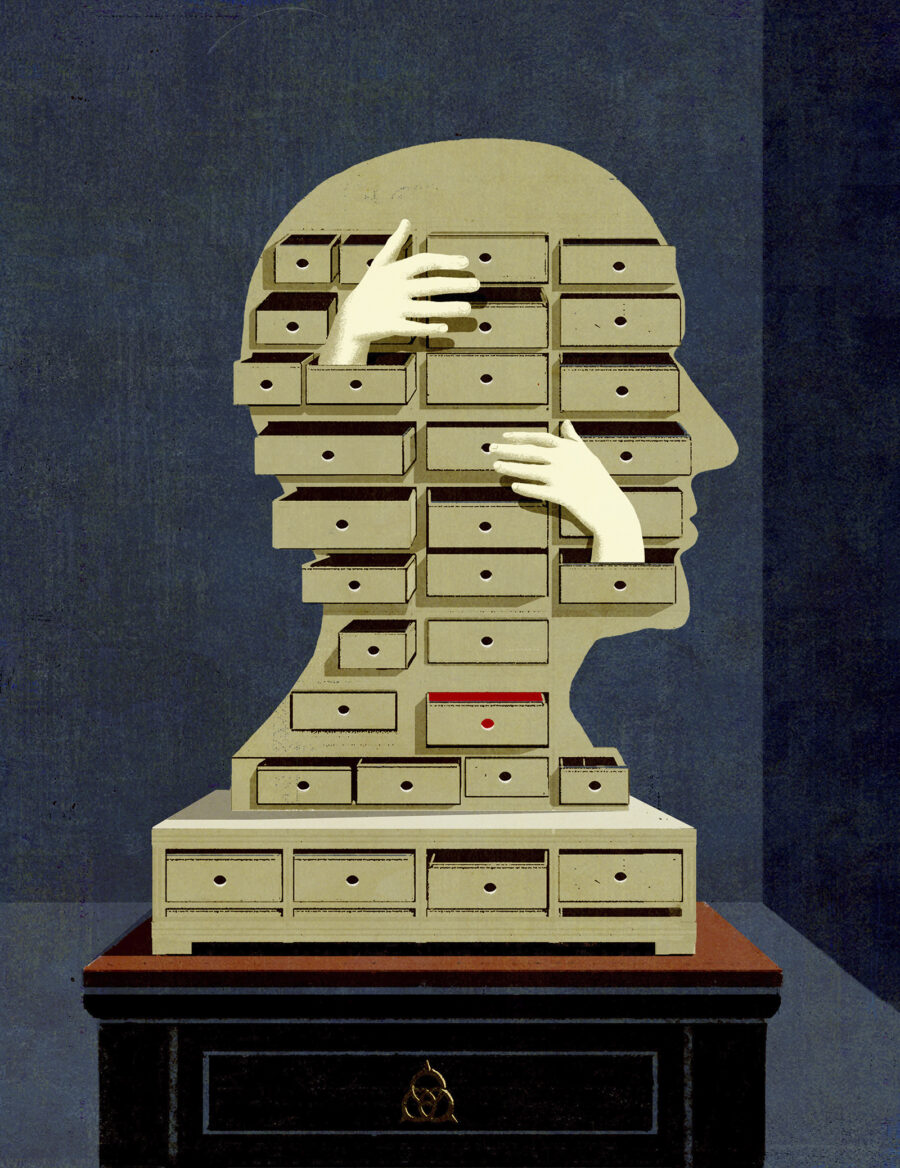 Illustrations by Beppe Giacobbe
.
.
Click the link below for the article:
.
__________________________________________
October 3, 2023
Mohenjo
Business, Food For Thought, Human Interest, Political, Science, Technical
amazon, business, Business News, current-events, Future, Hotels, human-rights, medicine, mental-health, research, Science, Science News, technology, Technology News, travel, vacation

Click the link below the picture
.
The half-bearded behavioral economist Dan Ariely tends to preface discussions of his work—which has inquired into the mechanisms of pain, manipulation and lies—with a reminder that he comes by both his eccentric facial hair and his academic interests honestly. He tells a version of the story in the introduction to his breezy first book, “Predictably Irrational,” a patchwork of marketing advice and cerebral self-help. One afternoon in Israel, Ariely—an “18-year-old military trainee,” according to the Times—was nearly incinerated. “An explosion of a large magnesium flare, the kind used to illuminate battlefields at night, left 70 percent of my body covered with third-degree burns,” he writes. He spent three years in the hospital, a period that estranged him from the routine practices of everyday life. The nurses, for example, stripped his bandages all at once, as per the cliché. Ariely suspected that he might prefer a gradual removal, even if the result was a greater sum of agony. In an early psychological experiment he later conducted, he submitted this instinct to empirical review. He subsequently found that certain manipulations of an unpleasant experience might make it seem milder in hindsight. In onstage patter, he referred to a famous study in which researchers gave colonoscopy patients either a painful half-hour procedure or a painful half-hour procedure that concluded with a few additional minutes of lesser misery. The patients preferred the latter, and this provided a reliable punch line for Ariely, who liked to say that the secret was to “leave the probe in.” This was not, strictly speaking, optimal—why should we prefer the scenario with bonus pain? But all around Ariely people seemed trapped by a narrow understanding of human behavior. “If the nurses, with all their experience, misunderstood what constituted reality for the patients they cared so much about, perhaps other people similarly misunderstand the consequences of their behaviors,” he writes. “Predictably Irrational,” which was published in 2008, was an instant airport-book classic, and augured an extraordinarily successful career for Ariely as an enigmatic swami of the but-actually circuit.
Ariely was born in New York City in 1967 and grew up north of Tel Aviv; his father ran an import-export business. He studied psychology at Tel Aviv University, then returned to the United States for doctoral degrees in cognitive psychology at the University of North Carolina and in business administration at Duke. He liked to say that Daniel Kahneman, the Nobel Prize-winning Israeli American psychologist, had pointed him in this direction. In the previous twenty years, Kahneman and his partner, Amos Tversky, had pioneered the field of “judgment and decision-making,” which revealed the rational-actor model of neoclassical economics to be a convenient fiction. (The colonoscopy study that Ariely loved, for example, was Kahneman’s.) Ariely, a wily character with a vivid origin story, presented himself as the natural heir to this new science of human folly. In 1998, with his pick of choice appointments, he accepted a position at M.I.T. Despite having little training in economics, he seemed poised to help renovate the profession. “In Dan’s early days, he was the most celebrated young intellectual academic,” a senior figure in the discipline told me. “I wouldn’t say he was known for being super careful, but he had a reputation as a serious scientist, and was considered the future of the field.”
.
 Dan Ariely and Francesca Gino became famous for their research into why we bend the truth. Now they’ve both been accused of fabricating data.
.
.
Click the link below for the article:
.
__________________________________________
October 3, 2023
Mohenjo
Business, Food For Thought, Human Interest, Political, Science, Technical
amazon, business, Business News, current-events, Future, Hotels, human-rights, medicine, mental-health, research, Science, Science News, technology, Technology News, travel, vacation

Click the link below the picture
.
Deirdre Barrett’s body was in bed, but her mind was in a library. The library was inside a very old house, with glowing oil lamps and shelves of beautiful leatherbound books. At first, it felt snug and secure and timeless, exactly the sort of place an academic like Barrett, who teaches in the psychiatry department at Harvard Medical School and edits the scientific journal Dreaming, might find inviting. But as the dream went on, she remembered later, “I became less able to focus on the library and more overwhelmed by the unseen horror outside.” Beyond the windows of the softly lit library, “a terrible plague was ravaging the world.”
When Barrett woke up, it was mid-March of 2020. She had been reading about the novel coronavirus in Wuhan since it began to make headlines, and she wondered, as she often did when she read about events in the news, how this one might be showing up in the dreams of the people who were experiencing it: residents on lockdown in China, overwhelmed doctors and nurses in Italy. The dreamlife of collective catastrophe was something she had studied repeatedly during her academic career — analyzing, for example, the dreams of Kuwaitis after the Iraqi invasion and those of British officers held prisoner by the Nazis during World War II, to see how the dreams compared with one another and with dreams from calmer times.
As a child, Barrett was fascinated by her own dreams, which were often vivid. They tended to stay with her well after she woke up, making nights feel like a time for slipping in and out of new worlds and adventures, often ones she’d read about but was now able to interact with and inhabit fully. When she grew up, she decided, she would become a writer of fiction; many of the early stories she wrote were set not just in worlds that she imagined, but also in and out of the various dream worlds of her characters. She was deeply curious about the dream lives of other people: When she started writing for her high school newspaper, she occasionally asked her sources if they’d had dreams related to whatever she was interviewing them about. Dreams were a window, albeit a very strange one, into the way that other people and their minds worked. In college, Barrett decided that fiction was not her future (though she did develop a practice of making visual art about what she saw and felt while sleeping). What she wanted was to be a scientist who studied what happened inside dreams.
.

Credit…Illustration by Amandine Urruty
.
.
Click the link below for the article:
.
__________________________________________
October 2, 2023
Mohenjo
Business, Food For Thought, Human Interest, Political, Science, Technical
amazon, business, Business News, current-events, Future, Hotels, human-rights, medicine, mental-health, research, Science, Science News, technology, Technology News, travel, vacation

Click the link below the picture
.
For decades, GQ was the place men learned to dress themselves. We’d teach you how to talk to your tailor, introduce you to your next game-raising boots, and—crucially—lay down a handful of hard and fast rules about style that you, the reader, were meant to follow religiously. Like: Never wear a tie wider than three inches. Plaid flannels are fine for a lumberyard or a hardware store, but not a formal office. Don’t go shirtless at a music festival. (That one is still true.) On occasion, we’d even explain how to properly break the rules with panache.
But a few years ago, GQ pumped the brakes on all the lawmaking. The thought was: We had entered menswear’s Wild Style era, where stylish guys began exploring new modes of self-expression at every turn—ditching their tuxes for flowy tunics and jumpsuits on the red carpet; dabbling in makeup and nail polish; investing in flashy It bags. Dictating exactly what one should and shouldn’t wear suddenly felt curmudgeonly and antiquated. Who were we to stand in the way of progress? It was a time for unbridled experimentation—for freaking it without restraint—and our precious style rules fell by the wayside.
In 2023, though, the moment finally feels right for us to lay down a few new sartorial edicts. The anything-goes abandon of the last couple years has given way to a return to elegance—and quite frankly, some of you have been allowed to dress yourselves unchecked for too long.
That’s why our team has come together to devise this new list of Dos and Don’ts for a new age of men’s style. Some of the advice is traditional, like which tie knots to avoid like the plague; some of it is extremely right now, like how best to parse TikTok menswear trends (hint: don’t). Unlike in the past, however, when GQ would’ve issued definitive rules as an institution, these new guidelines are a little more fluid and subjective, based more heavily on the personal style and lived experiences of our staffers (and a handful of our fashionable friends) than ever before. Follow them, ignore them, debate them, share them—it’s really up to you. These are GQ’s Dos and Don’ts for getting dressed right now.
Repeat your outfits over and over and over.
Trust us: No one but you is keeping track of how often you’ve worn those jeans with that shirt. Part of the beauty of holding onto clothes for the long haul is finding new things to enjoy about them—how good your ass looks in those jeans, say, or how sick a tie looks with that shirt—once you’ve worn them, so thoroughly you thought they had no secrets left to reveal. —Avidan Grossman
.
 Gabriel Alcaia
.
.
Click the link below for the article:
.
__________________________________________
October 2, 2023
Mohenjo
Business, Food For Thought, Human Interest, Political, Science, Technical
amazon, business, Business News, current-events, Future, Hotels, human-rights, medicine, mental-health, research, Science, Science News, technology, Technology News, travel, vacation

Click the link below the picture
.
Congress averted a shutdown on Saturday by mere hours, passing a measure that extends government funding for the next 45 days. The stopgap bill funds the government at the current $1.6 trillion annual rate until Nov. 17, the deadline by which it needs to pass another bill to avoid a government shutdown.
But while the Senate’s 88 to 9 vote salvaged the wages of millions of federal employees and social security payments for those in need, the act omits funding for what some deem critical—including Ukraine aid—while also increasing tensions between Republican House Speaker Kevin McCarthy and his more conservative colleagues.
McCarthy attempted to pass a separate resolution that would better appease his far-right colleagues on Friday, but that bill fell short by 21 votes, prompting the Speaker to seek an alternative route. “It’s alright if Republicans and Democrats join together to do what is right,” McCarthy said.
McCarthy has since faced criticism from the President for his failure to abide by funding agreements settled during the debt ceiling deal in May, and faces threats to his speakership.
“We should never have been in this position in the first place. Just a few months ago, Speaker McCarthy and I reached a budget agreement to avoid precisely this type of manufactured crisis,” said Biden in a statement. “For weeks, extreme House Republicans tried to walk away from that deal by demanding drastic cuts that would have been devastating for millions of Americans. They failed.”
.
 President Biden
.
.
Click the link below for the article:
.
__________________________________________
October 1, 2023
Mohenjo
Business, Food For Thought, Human Interest, Political, Science, Technical
amazon, business, Business News, current-events, Future, Hotels, human-rights, medicine, mental-health, research, Science, Science News, technology, Technology News, travel, vacation
Click the link below the picture
.
The Luddites have a bad reputation.
These days, the word is most commonly used as an insult—shorthand for somebody who doesn’t understand new technology, is skeptical of progress, and wants to remain stuck in the ways of the past.
That perception couldn’t be more wrong, according to Brian Merchant. In his new book, Blood in the Machine, Merchant argues that understanding the true history of the Luddites is vital for workers today grappling with the rise of artificial intelligence (AI) and automation in the workplace.
“At least in my lifetime, the Luddites have never been more relevant,” Merchant, 39, tells TIME. “We are confronting a series of cases where technology is being used by tech companies and executives in different industries as a means of trying to drive down wages and worsen conditions so that the entrepreneurial class can make more money.”
Who were the Luddites?
If you know anything about the Luddites, you probably know that they were English textile workers who, at the dawn of the industrial revolution, resisted the introduction of new machinery. They would sneak into factories in the dead of night and destroy the power-looms they believed were threatening their jobs.
.

Luddites destroying a piece of clothworking machinery Gamma-Rapho via Getty Images—API/GAMMA-RAPHO
.
.
Click the link below for the article:
.
__________________________________________
Older Entries
Newer Entries
 James' World 2