November 26, 2023
Mohenjo
Business, Food For Thought, Human Interest, Political, Science, Technical
amazon, business, Business News, current-events, Future, Hotels, human-rights, medicine, mental-health, research, Science, Science News, technology, Technology News, travel, vacation

Click the link below the picture
.
About a third of the food produced around the world goes to waste, and much of it ends up in landfills—where it becomes a source of methane, a greenhouse gas 25 times more potent than carbon dioxide. Eliminating waste is the ultimate solution, but food scraps will always remain. For that, there is a solution that nearly anyone can do: composting.
Composting turns rotting garbage into a valuable soil enhancer that helps plants thrive. Farmers call it “black gold.”
And now more cities are implementing curbside composting to help them meet their sustainability goals. New York is currently rolling out a mandatory composting program that will soon be effect in Brooklyn and throughout Manhattan by next year. Washington, D.C., and Chicago are piloting curbside composting programs, and Seattle and San Francisco have been successfully composting residents’ food scraps for years.
But you don’t have to wait for a city-wide program to begin composting in your backyard to taking food scraps to a community bin.
“Don’t be afraid of it. It’s relatively easy. It’s not without its missteps, but those are easily learned and corrected,” says Bob Rynk, lead author of The Composting Handbook and a professor emeritus at SUNY Cobleskill.
What happens in a compost pile?
Food turns into compost through the hard work of small microorganisms like bacteria, fungi, and protozoa.
“When you have a compost pile, you become a microbe farmer. You’re managing microbes,” says Rhonda Sherman, a composting expert at North Carolina State University. “And what do microbes need? They need the same things we do. Which is air, water, food, shelter.”
On a small scale, in your backyard or neighborhood, a compost pile should consist of three things: food scraps, water, and dry, woody material like yard trimmings or raked leaves.
Yard trimmings are frequently referred to as “browns” and are high in carbon. Food scraps are called “greens” and are high in nitrogen. A compost pile should typically have twice as many browns as it does greens.
.
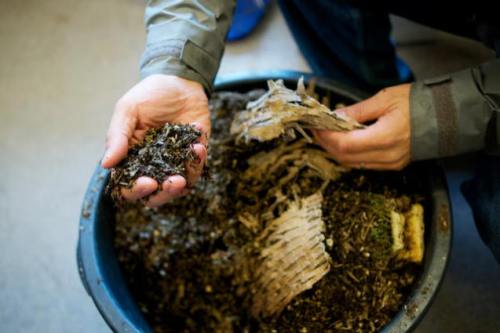
Compost is made from a mix of food scraps and yard waste such as raked leaves. When added to soil, it helps plants thrive. Photograph by Severin Wohlleben, laif/Redux
.
.
Click the link below for the article:
https://www.nationalgeographic.com/environment/article/how-to-compost?utm_source=pocket_collection_story
.
__________________________________________
November 25, 2023
Mohenjo
Business, Food For Thought, Human Interest, Political, Science, Technical
amazon, business, Business News, current-events, Future, Hotels, human-rights, medicine, mental-health, research, Science, Science News, technology, Technology News, travel, vacation

Check out bioGraphic for a long read of this problem.
Click the link below the picture
.
Every spring, as the daylight lengthens and the weather warms, rivers of birds flow north across the Midwest. They fly high and at night, navigating via the stars and their own internal compasses: kinglets and creepers, woodpeckers and warblers, sparrows and shrikes.
They come from as far as Central America, bound for Minnesotan wetlands, Canadian boreal forests, and Arctic tundra. They migrate over towns and prairies and cornfields; they soar over the black tongue of Lake Michigan in such dense aggregations that they register on radar. Upon crossing the water, many encounter Chicago, where they alight in whatever greenery they can find—office parks and rooftop shrubs and scraggly street trees and the sparse landscaping outside apartment-complex lobbies.
.
 Matt Dutile / GalleryStock
.
.
Click the link below for the article:
.
__________________________________________
November 25, 2023
Mohenjo
Business, Food For Thought, Human Interest, Political, Science, Technical
amazon, business, Business News, current-events, Future, Hotels, human-rights, medicine, mental-health, research, Science, Science News, technology, Technology News, travel, vacation

Click the link below the picture
.
Washing dishes is awful. It’s the kind of chore that never ends—pretty much every time you eat or drink, you make something dirty. Thankfully, a woman named Josephine Cochrane, who was really concerned about her fancy china getting chipped while being hand-washed, stepped up and invented the first dishwasher.
More than 100 years have passed since Cochrane revolutionized kitchen cleanup and got people hand-cranking their dishes clean. Now, other than the brainpower and Tetris skill you need to load the machine, you’ve only got to put some detergent in the soap compartment and press “start.”
Sure, Cochrane’s invention saves you time, but you still have to buy detergent. Make your own dishwasher tablets, though, and you’ll save some money. It’s easy, makes cleaning up a bit more exciting, and will leave your most likely not-so-fancy china shiny and smelling of fresh lemon… or whatever you want.
.
 Say goodbye to smelly dishwashers. Photo by alexraths via Deposit Photos
.
.
Click the link below for the article:
.
__________________________________________
November 24, 2023
Mohenjo
Business, Food For Thought, Human Interest, Political, Science, Technical
amazon, business, Business News, current-events, Future, Hotels, human-rights, medicine, mental-health, research, Science, Science News, technology, Technology News, travel, vacation

Click the link below the picture
.
After the twin towers of the World Trade Center collapsed on September 11, 2001, in a haze of horror and smoke, clinicians at the Icahn School of Medicine at Mount Sinai in Manhattan offered to check anyone who’d been in the area for exposure to toxins. Among those who came in for evaluation were 187 pregnant women. Many were in shock, and a colleague asked if I could help diagnose and monitor them. They were at risk of developing post-traumatic stress disorder, or PTSD—experiencing flashbacks, nightmares, emotional numbness, or other psychiatric symptoms for years afterward. And were the fetuses at risk?
My trauma research team quickly trained health professionals to evaluate and, if needed, treat the women. We monitored them through their pregnancies and beyond. When the babies were born, they were smaller than usual—the first sign that the trauma of the World Trade Center attack had reached the womb. Nine months later, we examined 38 women and their infants when they came in for a wellness visit. Psychological evaluations revealed that many of the mothers had developed PTSD. And those with PTSD had unusually low levels of the stress-related hormone cortisol, a feature that researchers were coming to associate with the disorder.
Surprisingly and disturbingly, the saliva of the nine-month-old babies of the women with PTSD also showed low cortisol. The effect was most prominent in babies whose mothers had been in their third trimester on that fateful day. Just a year earlier, a team I led had reported low cortisol levels in adult children of Holocaust survivors, but we’d assumed that it had something to do with being raised by parents who were suffering from the long-term emotional consequences of severe trauma. Now it looked like trauma could leave a trace in offspring even before they are born.
In the decades since, research by my group and others has confirmed that adverse experiences may influence the next generation through multiple pathways. The most apparent route runs through parental behavior, but influences during gestation and even changes in eggs and sperm may also play a role. And all these channels seem to involve epigenetics: alterations in the way that genes function. Epigenetics potentially explains why effects of trauma may endure long after the immediate threat is gone, and it is also implicated in the diverse pathways by which trauma is transmitted to future generations.
.
 Catherine Falls Commercial/Getty Images
.
.
Click the link below for the article:
.
__________________________________________
November 24, 2023
Mohenjo
Business, Food For Thought, Human Interest, Political, Science, Technical
amazon, business, Business News, current-events, Future, Hotels, human-rights, medicine, mental-health, research, Science, Science News, technology, Technology News, travel, vacation

Click the link below the picture
.
My apartment is essentially a graveyard for things that should have been thrown in the trash. Ombre paint chip strips have found a home on my gallery wall. Dead flowers (sorry, dried flowers) have taken the place of any living blooms, much to my roommate’s chagrin. And when it comes to the vessels I have adorning every available surface, they’re largely trash. Well, technically, they’re upcycled trash: I have a thing for hoarding empty candle jars.
The root of my obsession with repurposing every glass and ceramic jar stems—as most things in my life are wont to do—from a borderline insane fear I have of accidentally tossing something I’ll one day have a use for. This fear is the reason I still own low-rise jeans. Except, in this case, repurposing old candle jars has proved incredibly fruitful; not to mention, more sustainable and budget-friendly.
Candles tend to run fairly expensive, and it seems a shame to waste them after they’re burnt out. Especially when they come in such pretty containers. Whether repurposed for organizational or ornamental functions, there are so many uses for old candle jars. The main problem is figuring out how to get them clean.
This is the method I have found to be most effective:
- Remove any stickers.
- Pop your finished candles in the freezer for a minimum of 24 hours.
- Using a sharp knife, carefully jab at the wax to break it into pieces; once these fall out (usually taking the wick with them), your candle should be wax-free.
- Soak in a sink of warm, soapy water for an hour or so. Scrub with an old sponge or toothbrush to get rid of residue and soot. In more dire cases, you can also use Goo Gone.
- To really sanitize, run the now-empty jars through the dishwasher.
Convinced yet? Here are a few ways to reuse candle jars in every room of your home.
.
 Photo by Cody Guilfoyle.
.
.
Click the link below for the article:
.
__________________________________________
November 23, 2023
Mohenjo
Business, Food For Thought, Human Interest, Medical
amazon, business, Business News, current-events, Future, Hotels, human-rights, medicine, mental-health, research, Science, Science News, technology, Technology News, travel, vacation
Don’t overdo it!
.
 .
.
__________________________________________
November 23, 2023
Mohenjo
Business, Food For Thought, Human Interest, Political, Science, Technical
amazon, business, Business News, current-events, Future, Hotels, human-rights, medicine, mental-health, research, Science, Science News, technology, Technology News, travel, vacation

Click the link below the picture
.
Most things have a beginning and an end, including time itself. What was the spark that made it begin, and what will one day bring it to an end?
One of the pleasures of a show like Doctor Who that features near-unlimited time travel is that it can go anywhere and anywhen. That includes going to cosmic extremes.
On multiple occasions, the Doctor has gone billions of years into the future, to the end of the Universe. The Tenth Doctor went to the Universe’s dying days in the episode Utopia, and the Twelfth Doctor went there in Season Eight’s Listen and Season Nine’s Hell Bent.
The Doctor has also been into the most extremes of the distant past, for example to the creation of the Earth in The Runaway Bride.
And on one occasion he triggered a second Big Bang: the incredibly rapid expansion of matter and energy that cosmologists think marked the birth of the Universe.
In reality, the beginning and end of the Universe continue to challenge our understanding. In particular, there is still uncertainty about how time began and what it was like in the early Universe. As for the distant future and whether time will end, that’s even harder to say – and it depends partly on what we mean by “time”.
Cosmologists generally agree that the Universe began 13.8 billion years ago in the Big Bang. This is based on decades of observations showing that all the galaxies in the Universe are flying apart: in other words, the Universe is expanding. If you run the tape backwards, it looks like everything in the Universe was originally clumped together. The implication is that, at the very beginning, everything was compressed into an infinitely tiny dot or “singularity” – when then expanded astonishingly fast in the Big Bang.
It’s tempting to ask what happened before this, but most physicists will say this is meaningless. “Time only exists as the Universe exists,” says astrophysicist Emma Osborne at the University of York in the UK. “The moment the Universe came into existence is when time started.”
.
 Once upon a time, time began – so what will happen when it ends? (Credit: Edouard Taufenbach/Bastien Pourtout)
.
.
Click the link below for the article:
.
__________________________________________
November 23, 2023
Mohenjo
Business, Food For Thought, Human Interest, Political, Science, Technical
amazon, business, Business News, current-events, Future, Hotels, human-rights, medicine, mental-health, research, Science, Science News, technology, Technology News, travel, vacation
Click the link below the picture
.
I live in a one-bedroom “garden” apartment, which means that I get to have my own front door, porch, and small strip of flower bed. The only downside? The flower bed is under the porch roof, which means it’s constantly damp and shady, and also an ideal mosquito habitat.
So this year, after frantically trying to squash a few rogue mosquitoes that snuck indoors while I was carrying in groceries, I’ve decided to get myself some mosquito-repelling plants.
Yes, there are some plants that mosquitoes don’t like, due to their potent smell. The oils of some of these plants are used to formulate natural mosquito repellents, but there’s also some preliminary research to suggest that some live plants can also help keep at least some mosquitoes away.
I’m not expecting my mosquito-repelling plants to work miracles, but hopefully, they’ll discourage a few of those blood-suckers from coming too close. If you’re out doing a bit of weeding, or flipping burgers on the grill, try crushing the leaves of these plants and rubbing the oils on your skin to get the most protection.
Want to try growing your own mosquito-resistant garden? Here’s what you should plant.
Citronella Grass
The essential oil from citronella grass is used to make those insect-repellent candles you’ve probably come across at a summer barbecue. Make sure you’re buying the tall spiky grass Cymbopogon nardus, not “citronella plant” (Pelargonium citrosum), which is actually a type of geranium that smells similar to citronella but doesn’t contain the same mosquito-repelling oils. Citronella grass prefers partial sun and moist, loamy soil, so water every day if you’re growing it in a container. It is a perennial in tropical climates, but can be grown as an annual in colder places.
.
 Photo by Lana Kenney
.
.
Click the link below for the article:
.
__________________________________________
November 22, 2023
Mohenjo
Business, Food For Thought, Human Interest, Political, Science, Technical
amazon, business, Business News, current-events, Future, Hotels, human-rights, medicine, mental-health, research, Science, Science News, technology, Technology News, travel, vacation

Click the link below the picture
.
For the first time in over 60 years, a rare egg-laying mammal has been spotted by scientists. Attenborough’s long-beaked echidna (Zaglossus attenboroughi) was caught on camera during a major expedition in the Cyclops Mountains in Indonesia’s Papua Province.
A sacred animal
The long-beaked echidna is named for wildlife documentarian and conservationist Sir David Attenborough and has only been recorded by scientists once, in 1961. It is considered a monotreme, or an evolutionary distinct group of mammals who can lay eggs. The platypus is also a monotreme and there are only five remaining species of these strange types of mammal on Earth.
They live in burrows and mainly eat insects, earthworms, and termites. They are listed as Critically Endangered on the IUCN Red List of Threatened Species and are only known to live in the Cyclops Mountains.
“Attenborough’s long-beaked echidna has the spines of a hedgehog, the snout of an anteater, and the feet of a mole. Because of its hybrid appearance, it shares its name with a creature of Greek mythology that is half human, half serpent,” University of Oxford biologist James Kempton said in a statement. “The reason it appears so unlike other mammals is because it is a member of the monotremes–an egg-laying group that separated from the rest of the mammal tree-of-life about 200 million years ago.”
The echidna also has cultural significance for the people in the village of Yongsu Sapari. They have lived on the northern slopes of the Cyclops Mountains for eighteen generations. Rather than fighting during conflicts, the tradition is for one party to go up into the Cyclops to find echidna while the other party goes to the ocean to search for a marlin. Both of these creatures were difficult to find, and it would take decades to even whole generations to locate them. However, once they were found, the marlin and echidna would symbolize the end of the conflict.
.
 Attenborough’s long-beaked echidna, photographed by a camera trap. Expedition Cyclops
.
.
Click the link below for the article:
.
__________________________________________
November 22, 2023
Mohenjo
Business, Human Interest, Political, Science, Technical
amazon, business, Business News, current-events, Future, Hotels, human-rights, medicine, mental-health, research, Science, Science News, technology, Technology News, travel, vacation
Click the link below the picture
.
Keeping your finances organized doesn’t have to be as daunting as it can feel. To help make life a little easier, we’ve rounded up some of the best expert-advised tactics to help you better understand your spending and budget accordingly. Read on for simple ways you can feel in better control of your finances, even when it seems tough—plus, tips for improving everything from your home to your travel plans with a tighter budget in mind.
.
:extract_focal()/https%3A%2F%2Fs3.amazonaws.com%2Fpocket-collectionapi-prod-images%2F3855600f-0dde-4508-98be-65e244fa2295.jpeg)
.
.
Click the link below for the article:
.
__________________________________________
Older Entries
Newer Entries
 James' World 2