December 5, 2023
Mohenjo
Business, Food For Thought, Human Interest, Political, Science, Technical
amazon, business, Business News, current-events, Future, Hotels, human-rights, medicine, mental-health, research, Science, Science News, technology, Technology News, travel, vacation

Click the link below the picture
.
If we have stuff we neither want nor need, what should we do with it?
A lot of people save items for “someday,” but Joshua Fields Millburn and Ryan Nicodemus, aka The Minimalists, advise against that. The Minimalists have a 20/20 rule, which states that if you can get an item within 20 minutes for $20 or less, you don’t have to keep it for “just in case.” Also consider that people buy just about anything, even broken, nonfunctional tech they use to repair other things. You never know what you can get if you’re willing to part with something you may otherwise trash or stash away.
So now that you have stuff you want to unload, we have solutions.
When Cash Would’ve Been Better Than a Sweater
It’s sweet to receive a gift, but when it’s the wrong size, color, or just not your style, it makes sense to not wear it and keep the tags on. That way you can take advantage of the opportunity to sell it as a new item—NWT (New With Tags)—which brings you the most bang for your buck.
The only game in town for online reselling used to be eBay, and for years it was the best place to find and sell sold-out, discontinued, or vintage items in multiple categories—clothes, shoes, electronics, sports gear, cars, etc. Many people have made jobs for themselves side-hustling on eBay.
If it’s clothing you want to get rid of, there are sites dedicated to this, and they each offer something a little different.
.
 Photograph: Gerd Zahn/Getty images
.
.
Click the link below for the article:
.
__________________________________________
December 4, 2023
Mohenjo
Business, Food For Thought, Human Interest, Political, Science, Technical
amazon, business, Business News, current-events, Future, Hotels, human-rights, medicine, mental-health, research, Science, Science News, technology, Technology News, travel, vacation

Click the link below the picture
.
More than a century before Rosa Parks refused to give up her bus seat in Montgomery, Alabama, another Black woman insisted on her right to ride on a New York City streetcar — an act of defiance that eventually led to the desegregation of the city’s transit systems.
On Sunday, July 16, 1854, Elizabeth Jennings, a schoolteacher in her 20s, boarded a horse-drawn Third Avenue trolley to go to the First Colored American Congregational Church in Lower Manhattan, where she played the organ.
The streetcar’s conductor lied and said the car was full, telling Jennings she had to wait for a car reserved for Black passengers, according to a report by the New York Tribune in 1855. Then, African Americans were only allowed on trolleys with signs reading, “Colored People Allowed in This Train.”
When Jennings refused to disembark, the conductor forcefully threw her off.
“I screamed murder with all my voice and my companion screamed out, ‘You will kill her. Don’t kill her,'” Jennings wrote in a statement.
Reports from the time recounted how Jennings picked herself back up and tried to board the train again until a policeman came and removed her from the car.
A legal fight for desegregation
Jennings came from a family who fought for racial equity: Her father, Thomas L. Jennings, was the first Black person to hold a patent, which he obtained in 1821 for a new method of dry cleaning clothing. He bought his family’s freedom with the patent’s proceeds.
The streetcar incident sparked fury among Black New Yorkers, who organized a movement to end racial discrimination on streetcars. With the help of her father, Jennings sued the Third Avenue Railroad Company. She was represented by Arthur, then a 24-year-old lawyer. The attorney would later become the 21st US president.
.
 Courtesy of Kansas State Historical Society via Museum of the City of New York
.
.
Click the link below for the article:
.
__________________________________________
December 4, 2023
Mohenjo
Business, Food For Thought, Human Interest, Political, Science, Technical
amazon, business, Business News, current-events, Future, Hotels, human-rights, medicine, mental-health, research, Science, Science News, technology, Technology News, travel, vacation
Some content on this page was disabled on April 15, 2025 as a result of a DMCA takedown notice from Guardian Media Group. You can learn more about the DMCA here:
https://wordpress.com/support/copyright-and-the-dmca/
December 3, 2023
Mohenjo
Business, Food For Thought, Human Interest, Political, Science, Technical
amazon, business, Business News, current-events, Future, Hotels, human-rights, medicine, mental-health, research, Science, Science News, technology, Technology News, travel, vacation

Click the link below the picture
.
For a time, in the late 1980s, it looked like the field of neural networks was dead. Its researchers, who were seeking answers about consciousness by creating interconnected webs of computing units, could not overcome the limitations of their tools. Hardware did not compute at fast enough speeds. Software was too simplistic. It wasn’t until the 2010s that technology had advanced far enough to allow theories “that seemed almost frozen in amber” to be explored further.
That scientists could leap far ahead into new theoretical territory yet make little experimental progress in computational neuroscience underlines the challenges and complexity in explaining the workings of mind and consciousness. In Putting Ourselves Back in the Equation, journalist and Scientific American contributor George Musser brings readers along on this quest, tracking the development of different ideas and suppositions that aim to elucidate how consciousness might have arisen and what processes inform—if not create—our perceptions of reality.
Investigating the mind and confronting the “hard problem” of consciousness necessarily require the collision of disciplines. The field’s most significant researchers seem to have stumbled into it from myriad backgrounds—semiconductors, psychiatry, and cosmology, among other fields—and it’s Musser who wanders into these scientists at conferences, in cafeterias and in train cars to get details on the latest findings. His book is structured as an overview in the form of an expansive series of questions. It begins with the mechanical and local—say, how a brain might anticipate information—and progresses toward ones that threaten any simplistic notion of reality, such as: What if we’re only a floating blob mind that briefly materializes in the death throes of a universe?
It’s no surprise that the study and building of neural networks have become central to learning about the mind. Unlike simple computers, these networks can involve many parallel systems of interwoven logic, much like our brain and its wiring. Simulated neurons in a network, for instance, allow for the dynamism of feedback, enabling the network to form associations and learn algorithmically. What we consider as consciousness could be an emergent property of these highly organized, interconnected systems.
.

Credit: Alex Eben Meyer
.
.
Click the link below for the article:
.
__________________________________________
December 3, 2023
Mohenjo
Business, Food For Thought, Human Interest, Political, Science, Technical
amazon, business, Business News, current-events, Future, Hotels, human-rights, medicine, mental-health, research, Science, Science News, technology, Technology News, travel, vacation
Click the link below the picture
.
Tens of millions of people in the U.S. have struggled with long COVID-19: a suite of symptoms that can persist long after an initial COVID-19 infection and impact one’s day-to-day life. Typically, these “long haulers” experience fatigue, difficulty concentrating, and joint pain. At its worst, however, the syndrome can leave them bedridden.
Now studies suggest the rates of long COVID may be dropping. Although the investigations were not designed to assess the reason for this trend, scientists suspect the downturn is a result of increased immunity to SARS-CoV-2 (the virus that causes COVID), milder variants of that pathogen, and improved treatments. It is a welcome reprieve, but the decline does not help the millions of people who are already suffering from long COVID. Moreover, experts warn that the risk is still not zero. And without a clear explanation for the downward trend, it is unclear whether it will continue.
“You have to be vigilant,” says Paul Elliott, an epidemiologist at Imperial College London’s School of Public Health. “You can’t just relax these days and be done.”
There is reason for hope, however. Elliott and his team recently reported that people infected during the pandemic’s Omicron wave were 88 percent less likely to develop long COVID, compared with those infected with the original strain that emerged in Wuhan, China. The research, published in October in Nature Communications, is the latest in a growing number of studies that point to a downswing in the debilitating condition. This summer, the U.S. Centers for Disease Control and Prevention noted that the proportion of people infected with SARS-CoV-2 who went on to develop long COVID-19 dropped from 18.9 percent in June 2022 to 11 percent in January 2023. And just a few months before that, European researchers found that the risk of long COVID among cancer patients fell from 19.1 percent in 2020 to 6.2 percent in early 2022. Other studies show similar findings.
.
 Credit: Andriy Onufriyenko/Getty Images
.
.
Click the link below for the article:
.
__________________________________________
December 2, 2023
Mohenjo
Business, Food For Thought, Human Interest, Political, Science, Technical
amazon, business, Business News, current-events, Future, Hotels, human-rights, medicine, mental-health, research, Science, Science News, technology, Technology News, travel, vacation

Click the link below the picture
.
Thinking of spring-cleaning? Whether you’re finally cleaning up the junk drawer or upgrading your tech, don’t condemn your old device to your in-home gadget graveyard — or worse, the garbage. We all hang onto outdated tech for our own reasons, but there are also multiple ways to repurpose old devices for your smart home, using them as security cameras and more.
Whatever the tech, when it’s finally time to say goodbye, there’s a right way to dispose of your old gadgets — and there are a lot of wrong ways. We’ll show you which is which.
What to do before you get rid of a device
When you’re finished with a gadget, make sure it’s also finished with you. Make sure to back up anything you want off the device — photos, videos, songs — and then perform a factory reset. Here are a few CNET articles to help clarify the finer points of wiping a device:
How to recycle smartphones
Smartphone Recycling lets you print a free FedEx shipping label or request a recycling kit. Ship your old smartphone, and you might even get paid, depending on the device’s condition and age. Smartphone Recycling accepts devices in bulk, so you have to ship a minimum of 10. Depending on how long you’ve been hoarding phones, you might meet this quota on your own. If not, check with friends and family and make it a group effort.
.

What do you do with your phone when it’s served its purpose? We’ll give you some options. Sarah Tew/CNET
.
.
Click the link below for the article:
.
__________________________________________
December 2, 2023
Mohenjo
Business, Food For Thought, Human Interest, Political, Science, Technical
amazon, business, Business News, current-events, Future, Hotels, human-rights, medicine, mental-health, research, Science, Science News, technology, Technology News, travel, vacation

Click the link below the picture
.
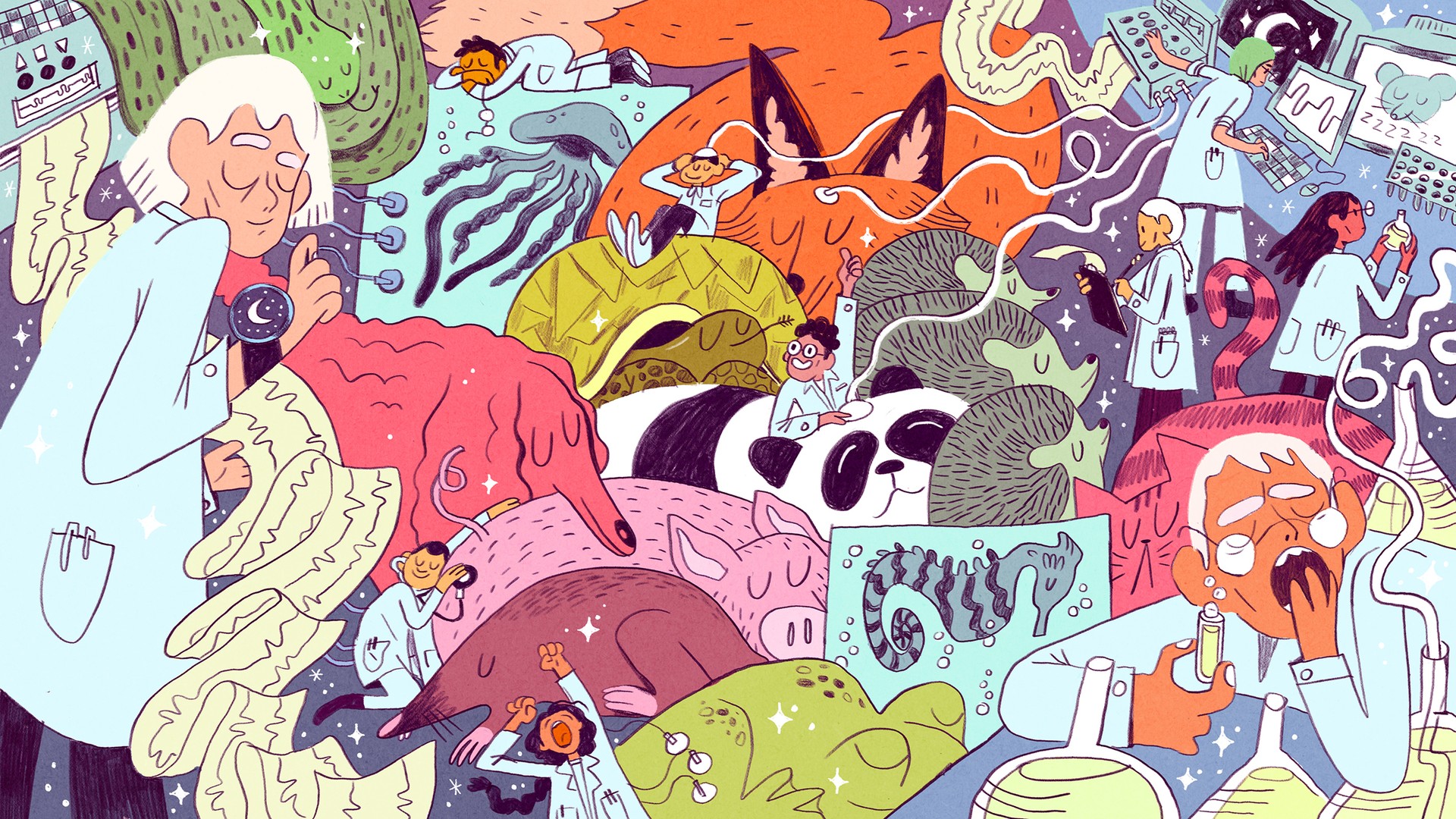
TSUKUBA, Japan—Outside the International Institute for Integrative Sleep Medicine, the heavy fragrance of sweet Osmanthus trees fills the air, and big golden spiders string their webs among the bushes. Two men in hard hats next to the main doors mutter quietly as they measure a space and apply adhesive to the slate-colored wall. The building is so new that they are still putting up the signs.
The institute is five years old, its building still younger, but already it has attracted some 120 researchers from fields as diverse as pulmonology and chemistry and countries ranging from Switzerland to China. An hour north of Tokyo at the University of Tsukuba, with funding from the Japanese government and other sources, the institute’s director, Masashi Yanagisawa, has created a place to study the basic biology of sleep, rather than, as is more common, the causes and treatment of sleep problems in people. Full of rooms of gleaming equipment, quiet chambers where mice slumber, and a series of airy work spaces united by a spiraling staircase, it’s a place where tremendous resources are focused on the question of why, exactly, living things sleep.
Ask researchers this question, and listen as, like clockwork, a sense of awe and frustration creeps into their voices. In a way, it’s startling how universal sleep is: In the midst of the hurried scramble for survival, across eons of bloodshed and death and flight, uncountable millions of living things have laid themselves down for a nice, long bout of unconsciousness. This hardly seems conducive to living to fight another day. “It’s crazy, but there you are,” says Tarja Porkka-Heiskanen of the University of Helsinki, a leading sleep biologist. That such a risky habit is so common and so persistent, suggests that whatever is happening is of the utmost importance. Whatever sleep gives to the sleeper is worth tempting death over and over again, for a lifetime.
The precise benefits of sleep are still mysterious, and for many biologists, the unknowns are transfixing. One rainy evening in Tsukuba, a group of institute scientists gathered at an izakaya bar manage to hold off only half an hour before sleep is once again the focus of their conversation. Even simple jellyfish have to rest longer after being forced to stay up, one researcher marvels, referring to a new paper where the little creatures were nudged repeatedly with jets of water to keep them from drifting off. And the work on pigeons—have you read the work on pigeons? another asks. There is something fascinating going on there, the researchers agree. On the table, dishes of vegetable and seafood tempura sit cooling, forgotten in the face of these enigmas.
.
 Natalie Andrewson
.
.
Click the link below for the article:
.
__________________________________________
December 1, 2023
Mohenjo
Business, Food For Thought, Human Interest, Political, Science, Technical
amazon, business, Business News, current-events, Future, Hotels, human-rights, medicine, mental-health, research, Science, Science News, technology, Technology News, travel, vacation

Click the link below the picture
.
During residency, I worked hospital shifts that could last 36 hours, without sleep, often without breaks of more than a few minutes. Even writing this now, it sounds to me like I’m bragging or laying claim to some fortitude of character. I can’t think of another type of self-injury that might be similarly lauded, except maybe binge drinking. Technically the shifts were 30 hours, the mandatory limit imposed by the Accreditation Council for Graduate Medical Education, but we stayed longer because people kept getting sick. Being a doctor is supposed to be about putting other people’s needs before your own. Our job was to power through.
The shifts usually felt shorter than they were, because they were so hectic. There was always a new patient in the emergency room who needed to be admitted, or a staff member on the eighth floor (which was full of late-stage terminally ill people) who needed me to fill out a death certificate. Sleep deprivation manifested as bouts of anger and despair mixed in with some euphoria, along with other sensations I’ve not had before or since. I remember once sitting with the family of a patient in critical condition, discussing an advance directive—the terms defining what the patient would want done were his heart to stop, which seemed likely to happen at any minute. Would he want to have chest compressions, electrical shocks, a breathing tube? In the middle of this, I had to look straight down at the chart in my lap, because I was laughing. This was the least funny scenario possible. I was experiencing a physical reaction unrelated to anything I knew to be happening in my mind. There is a type of seizure, called a gelastic seizure, during which the seizing person appears to be laughing—but I don’t think that was it. I think it was plain old delirium. It was mortifying, though no one seemed to notice.
No matter what happened to my body, I never felt like it was dangerous for me to keep working. I knew I was irritable and sometimes terse, and I didn’t smell the best, but I didn’t think anything I did was unsafe. Sleep experts often liken sleep-deprived people to drunk drivers: They don’t get behind the wheel thinking they’re probably going to kill someone. But as with drunkenness, one of the first things we lose in sleep deprivation is self-awareness.
It’s this way of thinking—that you can power through, that sleep is the easiest corner to cut—that makes sleep disturbance among the most common sources of health problems in many countries. Insufficient sleep causes many chronic and acute medical conditions that have an enormous impact on quality of life, not to mention the economy. While no one knows why we sleep, it is a universal biological imperative; no animal with a brain can survive without it. Dolphins are said to sleep with only half their brain at a time, keeping partially alert for predators. Many of us spend much of our lives in a similar state.
.
 Mauricio Alejo
.
.
Click the link below for the article:
.
__________________________________________
December 1, 2023
Mohenjo
Business, Food For Thought, Human Interest, Political, Science, Technical
amazon, business, Business News, current-events, Future, Hotels, human-rights, medicine, mental-health, research, Science, Science News, technology, Technology News, travel, vacation

Click the link below the picture
.
With each passing year, the climate crisis comes into ever sharper focus. And no matter how small they may seem in the face of the herculean challenges we as a society face, our individual choices do matter. In that spirit, one pillar to consider is your beauty routine. More specifically, what you buy, how often you buy it, and whether it ends up in a landfill at the end of your use. This is because the beauty industry is among the world’s largest polluters. According to Euromonitor International, 152.1 billion units of beauty and personal-care packaging were sold globally in 2018 alone, much of which will never be recycled.
“I am grateful that sustainability has become a major focus for consumer products recently,” says Mia Davis, vice president of sustainability and impact at Credo Beauty. “Sustainability in beauty means that the work we do now–the resources we extract, the stuff we make–will not compromise people’s ability to do the same in the future.”
While change can be daunting, rest assured that being an environmentally conscious consumer and being passionate about your beauty routine aren’t mutually exclusive. “As someone who has always loved beauty, I didn’t want to give that up as I started to transition to a more sustainable lifestyle,” explains sustainability expert and low-waste living content creator Jhánneu. “Many people think they have to give up their lifestyles to be sustainable, but it really comes down to just finding better alternatives.” As a former self-proclaimed Sephora junkie, Ashlee Piper, an eco-lifestyle expert and author of Give a Sh*t: Do Good. Live Better. Save the Planet, knows firsthand it can–and needs–to be done.
“While I love a good haul and discovering new, niche beauty companies [to support], when it comes to creating excess that’s detrimental for the planet and our wallets, beauty, and grooming items are right up there,” explains Piper, citing that as of 2018, the beauty and personal care industry has created almost 8 billion rigid plastic packaging units per year in the U.S. alone. “I began evangelizing about paring down and being more mindful about our beauty-product consumption because it’s the unsung area of personal sustainability.”
.
 Photographed by Mikael Jansson, Vogue, November 2019
.
.
Click the link below for the article:
.
__________________________________________
November 30, 2023
Mohenjo
Business, Food For Thought, Human Interest, Political, Science, Technical
amazon, business, Business News, current-events, Future, Hotels, human-rights, medicine, mental-health, research, Science, Science News, technology, Technology News, travel, vacation

Click the link below the picture
.
Which colors will predominate?
“Brown — the more ‘off,’ the better. It’s subtle and confrontational: Not a lot of colors have that versatility.” — Thebe Magugu, 30, fashion designer
“After a hugely colorful period, I think we’re going back to a place of minimalism in our clothes: black, a faded brown. Subtlety.” — Nathan Stewart-Jarrett, 37, actor
“Whiskey and cognac — a brown with a lot of caramel.” — Jenna Lyons, 55, designer
“There’s always a resistance to meatball brown, so I believe that is going to be the next color to sweep runways.” — John Waters, 77, film director
“Purple. It’s finally getting its due.” — Freddie Ross Jr., a.k.a. Big Freedia, 45, musician
“Deep violet.” — Sharon Van Etten, 42, singer-songwriter
“Colors that reflect opulence. Like bluish purple. It’ll be the year of treating yourself.” — Kwame Onwuachi, 34, chef
“Neutrals will step up their game and pack some actual punch. I won’t be surprised if a diarrhea tone becomes Pantone’s color of the year. On the flip side, bright colors are still seeking vengeance for the millennial tyranny of pastel; we’ll finally get treated to a color like Tyrian purple.” — Misha Kahn, 34, designer and sculptor
“Pops of red. Navy, too.” — Alex Eagle, 40, creative director
“More blue — the color of the oceans and the skies that arc over every human being on this planet.” — Carole Iida-Nakayama, 46, chef
“Aside from quiet black, I’ll still be promoting gentle grays to show respect and modest deference to others and the conditions they might be going through.” — Rick Owens, 62, fashion designer
“Chroma key green — an ‘invisible’ color that’s ever-changing.” — Alex Da Corte, 43, visual artist
“The color of butter. I’m not sure who it looks good on, but I love gazing on it.” — Eileen Myles, 73, poet
.
 Carmen Winant
.
.
Click the link below for the article:
.
__________________________________________
Older Entries
Newer Entries
 James' World 2