If you’re looking to improve your sleep quality, there are a few basic changes you can make to both your workday and your bedtime routines. But your sleep environment matters, too. In fact, many people’s bedrooms aren’t designed well to maximize their sleep quality–and often wind up harming it.
One way to improve your sleeping arrangement is simply to approach it from four of your five senses (everything minus taste). Here’s how, in order of importance.
1. Sight
Light directly impacts your ability to sleep, so if you only make one change to your bedroom setup, commit to addressing light-related issues above all else.
There’s a spectrum of frequencies within all the light we see (as well as the light we don’t see), called wavelengths, and it’s within the range of 450–480 nanometers, which we call “blue light,” that’s worth looking out for. When exposed to the eye, this blue range causes the eye’s “melinopsin” (a photopigment) cells to signal the brain to turn off the melatonin, the chemical that tells your body it’s time for bed. This isn’t good when you’re trying to fall asleep. Bedside table lamps, TVs, phones, tablets, and laptops all emanate those blue-light wavelengths.
So while darker is generally better, filtered light is also better. Here are some products and techniques for eliminating blue light:
Blackout shades. Yes, these do work, and they work well. If your bedroom faces east, you may be getting a lot of sunlight in the morning, which can cut into the last leg of your sleep cycle. If you try blackout shades, avoid just hanging a liner behind your ordinary drapes. You’re better off with a product that has two to three layers to really block out light (as a bonus, these tend to keep your room cool–which matters, too, as I’ll explain below).
Specially filtered light bulbs. These are now commercially available (online and at many hardware and lighting stores) and priced around $20 or so, designed with a built-in filter to reduce blue light.
What is the most uninformative statement that people are inclined to make? My nominee would be “I love to travel.” This tells you very little about a person, because nearly everyone likes to travel; and yet people say it, because, for some reason, they pride themselves both on having travelled and on the fact that they look forward to doing so.
The opposition team is small but articulate. G. K. Chesterton wrote that “travel narrows the mind.” Ralph Waldo Emerson called travel “a fool’s paradise.” Socrates and Immanuel Kant—arguably the two greatest philosophers of all time—voted with their feet, rarely leaving their respective home towns of Athens and Königsberg. But the greatest hater of travel, ever, was the Portuguese writer Fernando Pessoa, whose wonderful “Book of Disquiet” crackles with outrage:
If you are inclined to dismiss this as contrarian posturing, try shifting the object of your thought from your own travel to that of others. At home or abroad, one tends to avoid “touristy” activities. “Tourism” is what we call travelling when other people are doing it. And, although people like to talk about their travels, few of us like to listen to them. Such talk resembles academic writing and reports of dreams: forms of communication driven more by the needs of the producer than the consumer.
One common argument for travel is that it lifts us into an enlightened state, educating us about the world and connecting us to its denizens. Even Samuel Johnson, a skeptic—“What I gained by being in France was, learning to be better satisfied with my own country,” he once said—conceded that travel had a certain cachet. Advising his beloved Boswell, Johnson recommended a trip to China, for the sake of Boswell’s children: “There would be a luster reflected upon them. . . . They would be at all times regarded as the children of a man who had gone to view the wall of China.”
Travel gets branded as an achievement: see interesting places, have interesting experiences, become interesting people. Is that what it really is?
Travelling-induced jet lag isn’t the only thing that causes untimely fatigue. Ignoring your biological rhythms can lead to chronic exhaustion, too, something that feels so much like jet lag that Till Roenneberg and his team, at Ludwig-Maximilian University, in Munich, Germany, coined the term “social jet lag” in 2006. It occurs when there’s a mismatch between your biological clock and your social life. And not only does it make you tired, it may be to blame for many of today’s ailments. In 2012, Roenneberg and colleagues studied the sleep-wake patterns of more than 65,000 people. They found that 80 percent of those who had jobs also used an alarm clock. The problem with
that, chronobiologists say, is that our own bodies’ clocks are far better for telling us when to wake up.
Unlike the rigid global clock, whose time zones are an artifice of our connected world, our internal clocks vary from person to person, and even within individuals as they move from childhood into puberty, adolescence, and adulthood. The discrepancy between our internal, biological clocks and our external, social clocks peaks around age 20. But the ongoing tug-of-war between external and internal time can affect everyone from school-aged children—whose schedules are dictated by their school districts—to those of retirement age and beyond. People stay up late, or sometimes not; use alarms to wake up early, or snooze it to sleep in; and then spend weekend mornings trying to make up for the sleep they missed, or they don’t. The result? A massive sleep debt and an off-kilter internal clock.
Each of us has a circadian clock that uses a roughly 24-hour rhythm that coordinates with the Earth’s light-dark cycle. Light-sensitive cells in the eye’s retina send information to the brain’s master clock, which readjusts daily. The master clock regulates systemic cues like body temperature, eating patterns, and even fluctuating hormone levels, which are then used by distant, peripheral cellular clocks throughout the body to fine-tune their respective molecular pathways so as to be in synchrony with the master clock phase. The resulting, cyclical patterns can be seen in everything from our behavior to our blood-sugar levels. And when the coordination persistently goes awry, the phase difference between the master and peripheral clocks can manifest as chronic, degenerative diseases.
Initially, scientists thought these broken circadian clocks were most concerning in night-shift workers, flight attendants, and frequent flyers—people whose jobs resulted in large and regular disruptions to their sleep-wake timing. But research seems to be revealing that, to some degree, all of us are being affected.
The digital renderings of North Bayshore, a massive proposed development in Mountain View, California, are crowded with glistening buildings and cheerful, animated pedestrians. There’s a lot to show off, including 7,000 new homes, three distinct neighborhoods, and nearly 300,000 square feet of retail and community space. Notably, though, the gleaming images don’t bear any hints of the company behind the whole endeavor: Google.
Companies like Google and Facebook’s parent, Meta, conquered the digital realm a long time ago, setting the ground rules for how we search, interact, and shop online. Not content to stop there, however, these firms are now making huge bids to expand their reach. They want to be landlords, too.
Across the country, corporations are using their considerable sway and resources to build modern company towns — mini-cities that will feature all the trappings of traditional civic life, including housing, shops, and public spaces. These new projects won’t have corporate logos on every building, and many of the units will be available to the general public, not just employees. But in the grand scheme of real estate, they’re distinct: After years of running up against housing shortages in their backyards, companies like Google, Meta, and Disney — not exactly known for building new homes — are taking matters into their own hands. Their creations have boring names like Middlefield Park and Willow Village, but they might as well be called Zucktown or Google City, USA. And while the developments promise thousands of new homes, the plans are also a tacit acknowledgment of the bleak state of the American housing market and the roles these companies have played in driving up home prices near their sprawling HQs.
The companies behind these projects argue that they can help solve the country’s lack of affordable housing, but it’s fair to approach the plans with a healthy degree of skepticism. America’s single-employer “company towns” have a long, bloody history of exploitation and labor strife. While the current plans hardly represent a return to those dark days of the 19th and early-20th centuries, they probably won’t usher in a new era of futuristic techno-utopias, either. Judging by the plans that have been publicly unveiled so far, the Googles and Metas of the world aren’t aiming nearly that high. Instead, their visions of city living spaces look a lot like what we’re already used to seeing from modern real-estate developers: glassy office buildings, verdant parks, and walkable main streets with coffee shops, salad bars, and alluring apartment buildings. It’s nice, but not exactly groundbreaking stuff.
.
After years of running up against housing shortages, companies like Google, Meta, and Disney are taking matters into their own hands. Arantza Pena Popo/Business Insider
About a month after the Civil War began, a slaveholding ancestor of current U.S. Congressman French Hill seemed confident about the future. “Lincoln can’t starve me out unless he takes my land and negros,” plantation owner Creed Taylor wrote to a relative.
By the time the war ended in 1865, President Abraham Lincoln had freed the enslaved, including at least 70 who worked Taylor’s cotton fields here. But Taylor’s family found a path back to prosperity that didn’t look much different from the way he had first made his fortune.
Taylor still owned at least 1,500 acres of farmland. By the turn of the 20th century, his grandson oversaw a sprawling cotton operation that would eventually grow to more than 10 times the size of Taylor’s farm. And for years, the fields would be worked once again by Black people who didn’t have a choice.
Emancipation dealt many slaveholders a staggering economic blow, wiping out vast amounts of wealth across the South. In 1870, five years after the war ended and about 4 million Black people were freed from slavery, the states that once made up the Confederacy were enduring one of the largest wealth shocks in American history. The reported wealth of Southerners dropped by $4.3 billion, or about 65%, from a decade earlier, a Reuters analysis found. Put another way, war and emancipation appear to have erased about two-thirds of wealth in the South.
Those who lost the most, like Congressman Hill’s direct ancestor, were the largest enslavers. They also had the clearest path to rebuilding – often by replicating elements of the slavery economy and reinstituting feudal systems that embraced white supremacy.
The Black people who had been enslaved emerged with far less. Racial violence and voting laws locked them out of political power. Schooling was limited, leaving most unable to read and write. The federal government let former slaveholders keep their land, and the newly freed were afforded few paths to prosper – leaving them once again at the mercy of the white elite. tangie
.
The forebears of three members of Congress regained – and passed forward – wealth and power their families lost when slavery was abolished. Their success shows how the Southern elite exploited Black Americans in new ways.
This past Thanksgiving, I asked my mother how old she was in her head. She didn’t pause, didn’t look up, didn’t even ask me to repeat the question, which would have been natural, given that it was both syntactically awkward and a little odd. We were in my brother’s dining room, setting the table. My mother folded another napkin. “Forty-five,” she said.
She is 76.
Why do so many people have an immediate, intuitive grasp of this highly abstract concept—“subjective age,” it’s called—when randomly presented with it? It’s bizarre, if you think about it. Certainly, most of us don’t believe ourselves to be shorter or taller than we actually are. We don’t think of ourselves as having smaller ears or longer noses or curlier hair. Most of us also know where our bodies are in space, what physiologists call “proprioception.”
Yet, we seem to have an awfully rough go of locating ourselves in time. A friend, nearing 60, recently told me that whenever he looks in the mirror, he’s not so much unhappy with his appearance as startled by it—“as if there’s been some sort of error” were his exact words. (High-school reunions can have this same confusing effect. You look around at your lined and thickened
“I feel betrayed on such a deep level.” Tamar Shamir read the message on her phone in surprise. Another followed: “I just want to puke.” Shamir, a 53-year-old peace activist, was at her home not far from Haifa, in northern Israel, on Oct. 8, the day after Hamas’s deadly attack. Already half-mad from grief, Shamir grew agitated as more angry messages streamed in, and other recipients signaled their agreement by adding heart emojis. Shamir was checking in on a WhatsApp group of young adult Israelis, members of a program Shamir often worked with called Young Ambassadors for Peace. Many of them had attended a summer camp that Shamir co-directs for teenagers from Israel and the West Bank, some of whom have lost loved ones to the decades-long conflict. They had compared sunburns at the beach, belted out songs from “Frozen” on karaoke night, stayed up late laughing, weeping, and sharing stories of their respective losses. Now the Israeli WhatsApp group was awash with hostility toward their Palestinian friends.
Shamir chain-smoked and paced around her house, phone in hand, forcing herself to follow the conversation. “I really don’t know how I can continue being in contact with those people,” she read. On social media, a Palestinian in the program had reposted a widely shared image of a Palestinian flag, alongside the date, Oct. 7, and a message in Arabic that translated to: “Officially the greatest day in the life of all of our generation.” One of the Israeli young ambassadors informed Shamir that she had seen an Instagram story from another Palestinian in the group with a visual of a flaming tank and an Israeli soldier dead beside it, accompanied by a laughing emoji. She told Shamir she was appalled.
Shamir could not bear the sense of finality of the messages. “It destroyed my heart,” she says. “I didn’t know what to do with it.” These were not just any friendships that were imploding; they were particular, carefully cultivated bonds. They were small and private, but they had been exceedingly rare footholds of mutual understanding. The project she held dear now seemed to be on the brink of collapse.
.
Ahmed Abu Jafar Tamar Shamir
“The Israelis would talk about peace with urgency, not as a luxury, because now they see how the war is painful,” Mohamed Abu Jafar says. Credit…Ahmed Abu Jafar
“They are not seeing what you are seeing on Israeli TV, and you are not seeing what they are seeing,” Tamar Shamir told a group of Israeli young people about their Palestinian friends. Credit…Yoss Stybel
A few years ago, it seemed like the trajectory of body diversity and inclusivity could only continue going upward. Across several major industries—particularly fashion, beauty, entertainment, and music—we witnessed an incredible surge of representation for bodies of all sizes, skin tones, gender expressions, ages, and abilities. Plus-size models walked top designers’ runways! Disabled models starred in luxury campaigns! Trans models showed up on billboards—and not just in the month of June! Finally, it seemed the industries that long felt like the exclusionary gatekeepers of the “ideal body” now seemed to welcome all bodies, reflecting their diverse consumer bases.
Then, came the backlash—or, perhaps more accurately, a quiet retreat back into the beauty standards of the ‘90s and ‘00s. As low-rise jeans and Y2K fashion made their comebacks, so returned the ultra-thin ideal. As journalist Gianluca Russo noted in September 2022 for The Zoe Report, plus-size representation in New York Fashion Week has seen a razor-sharp decline. And, despite the Fenty effect leading to an industry-wide expectation of base makeup to have 40- and 50-shade ranges, Black models continue to experience discrimination on sets, with many still bringing their own foundations and concealers just in case the makeup artist’s case doesn’t carry the right colors for their skin tones. In 2023, another major shift arrived: The releases of Ozempic and similar treatments marked revolutionary developments and supported the long-held stance of many medical professionals and advocates that obesity is a matter of biology, not willpower—sparked frenzied responses, from debate and confusion to corporate pivoting.
None of these are easy or simple conversations. They all contribute to a larger dialogue that many activists, academics, writers, and regular folks have carried on, despite it seeing fewer headlines nowadays. We’ve brought together several stories by writers exploring the complexities of these issues, and shed light on their less-discussed elements. Now, the only question: How will you participate in the body-inclusivity conversation?
There is growing evidence that simple, everyday changes to our lives can alter our brains and change how they work. Melissa Hogenboom put herself into a scanner to find out.
“It’s surprisingly hard to think of nothing at all”, is one of my first thoughts as I’m lying in the maw of a machine that is scanning my brain. I was told to focus on a black cross while the functional Magnetic Resonance Imagine (fMRI) machine does its noisy work. It also feels impossible to keep my eyes open. The hum of the scanner is somewhat hypnotic, and I worry a little bit that drifting off will affect how my brain appears on the resulting images.
As a science journalist I’ve always been fascinated by the workings of the mind, which is how I found myself inside a scanner at Royal Holloway, University of London, to have my brain examined before embarking on a six-week brain-altering course.
My goal was to investigate whether there’s a way we can influence meaningful brain change ourselves. By altering aspects of my daily life, I hoped to find out if it is possible to strengthen crucial connections in our brain, and keep our mind healthier in the process. Along the way I learnt techniques we can all use – with some powerful results.
Our brain has an incredible ability to adapt, learn and grow because by its nature, it is plastic – that is, it changes. This is called neuroplasticity, which simply means the brain’s ability to adapt and evolve over time in structure and function. It was once thought to be limited to youth but we now know it’s a constant force in shaping who we are. Every time we learn a new skill, our brain adapts.
Neuroscientists and psychologists are now finding that we have the power to control that to some extent. And there’s good reason to want to boost our brain – an increasing number of studies suggest it can play a role in delaying or preventing degenerative brain diseases.
So, with the help of Thorsten Barnhofer, a professor of clinical psychology at the University of Surrey in the UK, that’s what I set out to do. He’s currently running a study on the effects of mindfulness in managing stress and difficult emotions, with a special focus on individuals with severe depression.
I was surprised that something as simple as mindfulness can play such a crucial role in keeping our minds healthy. Research has shown that mindfulness is a simple but powerful way to enhance several cognitive functions. It can improve attention, relieve pain and reduce stress. Research has found that after only a few months of mindfulness training, certain depression and anxiety symptoms can ease – though as with any complex mental health problem, this may of course vary depending on individual circumstances.
.
Simple mindfulness exercises can help keep our minds healthy, research shows (Credit: BBC)
A new portrait of Queen Victoria’s black goddaughter, Sarah Forbes Bonetta, is now on view at Osborne, the Hanover monarch’s beloved seaside home.
Per a statement, the painting—created by artist Hannah Uzor—is based on a photograph currently housed at the National Portrait Gallery in London. It’s one of a series of works commissioned by English Heritage to spotlight historical black figures whose stories have previously been overlooked.
“What I find interesting about Sarah is that she challenges our assumptions about the status of black women in Victorian Britain,” says Uzor, whose family and children share Bonetta’s Nigerian heritage, in the statement. “ … To see Sarah return to Osborne, her godmother’s home, is very satisfying and I hope my portrait will mean more people discover her story.”
Born into a prominent Yoruba family in 1843, Bonetta was just 5 years old when a rival king, Gezo of Dahomey (located in what is now Benin), defeated her tribe. As Caroline Bressey, a cultural and historical geographer at University College London, wrote in a 2005 journal article, Gezo killed the young girl’s parents and enslaved her, forcing her to fulfill “whatever role was required of her” at the Dahomey court.
Bonetta ended up in England as the result of a failed diplomatic mission. In 1850, British Captain Frederick Forbes tried—and failed—to convince Gezo to abandon his role in the slave trade. The king gifted Bonetta to the captain as an act of conciliation; Forbes, in turn, brought the orphaned child back to his home country, renaming her after himself and the ship on which they’d arrived.
“Where do you start? Her story is an extraordinary one,” Anna Eavis, curatorial director of English Heritage, tells the Guardian’s Mark Brown. “Through her life we can also see a number of interesting and quite uncomfortable things around colonial attitudes to her.” Tangie
Film and Writing Festival for Comedy. Showcasing best of comedy short films at the FEEDBACK Film Festival. Plus, showcasing best of comedy novels, short stories, poems, screenplays (TV, short, feature) at the festival performed by professional actors.

 Photo by nadia_bormotova/Getty Images.


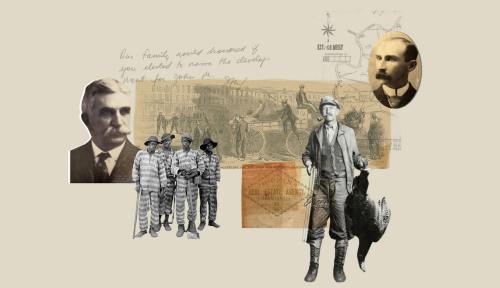 The forebears of three members of Congress regained – and passed forward – wealth and power their families lost when slavery was abolished. Their success shows how the Southern elite exploited Black Americans in new ways.




:extract_focal()/https%3A%2F%2Fs3.us-east-1.amazonaws.com%2Fpocket-collectionapi-prod-images%2F1f338ace-358c-4997-976f-e02dbe0242ab.jpeg) What body is perfect
What body is perfect


:focal(377x175:378x176)/https://tf-cmsv2-smithsonianmag-media.s3.amazonaws.com/filer/02/72/027235ff-0238-45ff-916e-6dd115c73049/sara.jpg) Sarah Forbes Bonetta, as seen in 1856 (left) and 1862 (right). Hannah Uzor’s new portrait is based on the 1862 photograph.
Sarah Forbes Bonetta, as seen in 1856 (left) and 1862 (right). Hannah Uzor’s new portrait is based on the 1862 photograph.  James' World 2