A few years back, I cut myself on a broken glass. I scampered about my apartment looking for a Band-Aid. As an anesthesiologist and cardiologist, I had airway equipment to insert a breathing tube, medication for a heart attack, resuscitation equipment that included an automated external defibrillator (AED). But no basic first aid. Needless to say, that was rectified quickly. It brought me to thinking, though, about what is medically essential for monitoring our health and wellness—not a breathing tube—in addition to addressing minor household injuries.
We always hear about the wisdom of having canned food, extra bottled water, a flashlight, and other sundries in the event of a calamity. Similarly, there are certain medical items that everyone should keep on hand, regardless of age. Despite social media, smartwatches, smartphones and clever apps, first aid kits should hold some relatively inexpensive, but valuable, devices:
Oximeter: This probe with the little red light—often compared to E.T. The Extra- Terrestrial’sglowing fingertip—is an extremely valuable product. (Yes, I am dating myself with that analogy.) It measures our oxygen saturation, which reflects how well our lungs, and indirectly our heart, are ensuring that our organs are getting enough oxygen. In operating rooms in the 1980s, they were bulky, heavy and very expensive (over $5,000), but with time, they have become extremely portable (the size of an ear pod case) and reasonably priced (as little as $25). They also provide heart rates, and some can determine whether your heart is beating at a regular pace. With respiratory illnesses from seasonal flu to RSV loose, this is very valuable. It will help your doctor decide on whether you need to visit the office or more seriously, proceed to the emergency room.
Blood pressure cuff: In decades past, the monitoring of high blood pressure required frequent visits to the primary care physician, and the measurement was only reflective of one specific moment on one day. Perhaps a hectic bus ride, a challenge finding a parking spot, or a waiting room delay—not to mention “white-coat hypertension”—caused added stress, resulting in an elevated number. A blood pressure cuff should be in every home. Though some simply slip onto the finger, I personally believe that the best choice is designed for the upper arm. The most accurate recordings are obtained after resting in bed for a few minutes, lying flat with your legs uncrossed. And probably not watching a suspenseful movie or with the need for a bathroom visit. It is wise to check it a few times, one minute apart from each other—just for accuracy. Lastly, it never hurts to keep a log of what the readings are so that you can share it with your doctor.
High blood pressure, or hypertension, is called the silent killer as it puts us all at risk of stroke or heart attack, and can even contribute to dementia. Checking it is an easy preventive measure and wise for all of us. When I was a medical student, first learning how to take a person’s blood pressure—in the days before automated machines—I convinced my mother to let me check hers. She always had low blood pressure, so when I found it was elevated, she reflexively said that I must be doing it wrong. My father, a physician, was called in to check, and that is how we diagnosed her hypertension.
Thermometer: Mercury in the glass thermometers have been replaced with newer devices to measure temperature. Their infrared technology can rapidly determine forehead temperature within a second with varied accuracy by product and measuring location, where the very middle of your forehead is best. A notable fever (temperature greater than 100.4 degrees Fahrenheit or 38 degrees Celsius) is important to track and perhaps seek medical attention over, depending upon other medical conditions, signs, and symptoms; including breathing problems, shivering and confusion, all signs of possible sepsis.
For those with children at home, early identification of a fever helps pediatricians. Rapid elevations in temperature, particularly in children of ages six months to five years old, can cause febrile seizures
Eyewash: We sometimes forget how easy it is to splash something into our eyes. Available over the counter, eyewash is worth having at your disposal. Just keep it in an easy-to-remember place. After all, the last thing you want with an irritated eye is a long search for the very product than can help you see better. Dangerous chemicals, splashes, and small foreign bodies are best to flush as soon as possible. Don’t touch the tip of the container to your eye, as it risks contamination. Discard it after such use. Finally, don’t confuse eye drops with eyewash; the former lubricate, whereas the latter cleanses eyes.
Recently, a book tour gave me the opportunity to travel around America. Budgets being what they are, I primarily chose cities where I had friends who would happily provide me with places to stay. These were homes, almost without exception, filled with children. I have no children of my own, and this felt like a serendipitous chance to catch up with many of the kids in my life.
In America, there is a persistent, pernicious belief that the only way to be invested in a child’s life is to be a parent — and, for women, to give birth to that child. (Ella and Cole Emhoff, among others, would like a word.) In a country that offers so little support to parents, this often feels like a not-so-covert argument for taking women back to a time when they lacked control over their bodies and their finances.
Recently, the Pew Research Center reported that 64 percent of women under 50 who don’t have children say they “just don’t want to.” This has contributed to another round of hand-wringing about birthrates and childless cat ladies. What the seemingly inexhaustible discussion around this topic leaves out is that many people who say they don’t want to birth or parent children do have children in their lives — other people’s. We rarely account for that, nor do we give full weight to the fulfillment these relationships provide.
Which is not entirely surprising. So often we hear about the annoyance of other people’s children — babies crying on planes, kids fussing at restaurants. Rarely do we talk about the pleasure of these little people, or how transformative it is to have children in your life whom you’re not raising.
I’ve been reminded of the joys of these relationships this summer. Most of the kids in my life, I have known since birth. In more than a few cases, I was present at the discovery that there was a child to be expected. Or I was the person on call to wait with a child while her sibling made an entrance. Many are children I have cared for in various stages of their life: I’ve changed countless diapers and dispensed endless bottles; I’ve given baths; I’ve been the emergency pickup contact at school. Several of these kids have vomited on me. I’m in a number of wills as the person these children will come to if, God forbid, something happens to their parents. For some, all of the above apply.
Since June, I’ve spent time variously spooning avocado into a toddler’s mouth and answering questions about what it’s like to get your period. I’ve been taught new card games. I balanced myself in the surf as a 6-year-old clung to me screaming with joy, trusting me not to let go. I attended a children’s performance of “The Little Mermaid” starring one 9-year-old who, as a 9-week-old, I held in my arms while I did an interview for my first book. Summer concluded with my driving a bunch of teens and preteens to one of their many sporting events while I cajoled them to look up from their phones once in a while and talk to me.
It has been a delight. And the experiences I’ve described are, I believe, fairly common among people who take part in the lives of children without raising their own. Yet it is simply not an experience I see reflected back to me in culture.
Her mother, Shyamala Gopalan, was from Chennai, India; her father, Donald Harris, from Jamaica. The two met as graduate students at the University of California, Berkeley.
Her name, Kamala, means “lotus” in Sanskrit, and is another name for the Hindu goddess Lakshmi. She visited India multiple times as a girl and got to know her relatives there.
But because her parents divorced when she was 7, she also grew up in Oakland and Berkeley, attending predominantly Black churches. Her downstairs neighbor, Regina Shelton, often took Kamala and her sister, Maya, to Oakland’s 23rd Avenue Church of God in Oakland. Harris now considers herself a Black Baptist.
She is a member of the Third Baptist Church of San Francisco, led by the Rev. Amos Brown.
She is married to a Jewish man.
Harris met her husband, Los Angeles lawyer Douglas Emhoff, on a blind date in San Francisco. They married in 2014. At their wedding, the couple smashed a glass to honor Emhoff’s upbringing (a traditional Jewish wedding custom).
It was Harris’ first marriage and his second. An article in the Jewish press described her imitation of her Jewish mother-in-law, Barbara Emhoff, as “worthy of an Oscar.”
Harris’s stepchildren gave her the nickname of “Momala,” which not only rhymes with Kamala, but also with the Yiddish term of endearment for mother, “mamaleh.”
She was criticized for not proactively assisting in civil cases against Catholic clergy sex abuse during the years she served as a prosecutor.
After graduating from the University of California, Hastings College of the Law, Harris speciali
zed in prosecuting sex crimes and child exploitation as a young prosecutor. But two investigations by The Intercept and The Associated Press found that Harris was consistently silent on the Catholic Church’s abuse scandal — first as San Francisco district attorney and later as California’s attorney general.
Survivors of sex abuse at the hands of priests say she resisted informal requests to help them with their cases and refused to release church records on abusive priests that had been gathered by her predecessor, Terence Hallinan.
As attorney general, Harris filed a brief with the U.S. Supreme Court asking it to refuse Hobby Lobby’s request to deny women health care coverage for contraception because of the craft-store chain owner’s religious beliefs.
In her 2014 brief, supported by 15 states and the city of Washington, D.C., Harris wrote that if Hobby Lobby were allowed to withhold birth control coverage on religious grounds, it might lead other corporations to demand similar exemptions from the nation’s civil rights laws.
In the landmark decision, the Supreme Court ruled that family-owned corporations can’t be forced to pay for insurance coverage for contraception under the Affordable Care Act if it offends their religious beliefs.
Later, as U.S. Senator, Harris co-sponsored a congressional bill to weaken the Religious Freedom Restoration Act to ensure it is not used to permit discrimination in the name of religion.
The measure, called the Do No Harm Act, was first introduced in 2017 and again in 2019. RFRA originally passed in 1993 to prevent the government from “substantially burdening a person’s exercise of religion.” Do No Harm’s backers believed that RFRA “should not be interpreted to authorize an exemption from generally applicable law.”
.
Democratic presidential candidate Sen. Kamala Harris, D-California, speaks at the Poor People’s Moral Action Congress presidential forum in Washington on June 17, 2019. (AP Photo/Susan Walsh)
The Miami-Dade Police Department released body camera footage on Monday afternoon from the incident that left both Miami Dolphins players Tyreek Hill and Calais Campbell detained briefly ahead of their season opener on Sunday.
Hill was detained by police after being pulled over on an apparent traffic stop while he was on his way to their win over the Jacksonville Jaguars, and he was seen in handcuffs on the ground just a few blocks away from Hard Rock Stadium. Campbell said he stopped to try and deescalate the situation, and he was detained by police, too. Both players were released in time to play in the game as scheduled.
Miami-Dade Police Department Director Stephanie V. Daniels announced on Sunday that one of the officers involved in the incident was placed on administrative duties and that the incident was under investigation. Daniels released body camera footage on Monday night.
CBS Sports’ Jonathan Jones obtained the footage first and shared a thread of it on social media. The first video he shared showed an officer on a motorcycle pulling Hill over. It’s unclear how fast Hill was driving at the time, or if he had committed any infractions. Hill appeared to comply with the officer’s instructions in the first video.
A second video showed Hill interacting with officers while he was on the phone with his agent, Drew Rosenhaus. Three officers pulled Hill out of the car and put him in the ground after Hill briefly rolled his window up.
A third video showed Hill in handcuffs being sat on a curb, and he warned officers that he had recently had surgery on his knee. Campbell then showed up and was told by officers to step back. Campbell did so with his hands raised.
.
The Miami-Dade Police Department released body camera footage on Monday afternoon from the incident that left both Miami Dolphins players Tyreek Hill and Calais Campbell detained briefly ahead of their season opener on Sunday.
James Earl Jones, a stuttering farm child who became a voice of rolling thunder as one of America’s most versatile actors in a stage, film and television career that plumbed race relations, Shakespeare’s rhapsodic tragedies, and the faceless menace of Darth Vader, died on Monday at his home in Dutchess County, N.Y. He was 93.
The office of his agent, Barry McPherson, confirmed the death in a statement.
From destitute days working in a diner and living in a $19-a-month cold-water flat, Mr. Jones climbed to Broadway and Hollywood stardom with talent, drive, and remarkable vocal cords. He was abandoned as a child by his parents, raised by a racist grandmother, and mute for years in his stutterer’s shame, but he learned to speak again with a herculean will. All had much to do with his success.
So did plays by Howard Sackler and August Wilson that let a young actor explore racial hatred in the national experience; television soap operas that boldly cast a Black man as a doctor in the 1960s; and a decision by George Lucas, the creator of “Star Wars,” to put an anonymous, rumbling African American voice behind the grotesque mask of the galactic villain Vader.
The rest was accomplished by Mr. Jones himself: a prodigious body of work that encompassed scores of plays, nearly 90 television network dramas and episodic series, and some 120 movies. They included his voice work, much of it uncredited, in the original “Star Wars” trilogy, in the credited voice-over of Mufasa in “The Lion King,” Disney’s 1994 animated musical film, and in his reprise of the role in Jon Favreau’s computer-animated remake in 2019.
Mr. Jones was no matinee idol, like Cary Grant or Denzel Washington. But his bulky Everyman suited many characters, and his range of forcefulness and subtlety was often compared to Morgan Freeman’s. Nor was he a singer; yet his voice, though not nearly as powerful, was sometimes likened to that of the great Paul Robeson. Mr. Jones collected Tonys, Golden Globes, Emmys, Kennedy Center honors and an honorary Academy Award.
Under the artistic and competitive demands of daily stage work and heavy commitments to television and Hollywood — pressures that burn out many actors — Mr. Jones was a rock. He once appeared in 18 plays in 30 months. He often made a half-dozen films a year, in addition to his television work. And he did it for a half-century, giving thousands of performances that captivated audiences, moviegoers, and critics.
They were dazzled by his presence. A bear of a man — 6 feet 2 inches and 200 pounds — he dominated a stage with his barrel chest, large head and emotional fires, tromping across the boards and spitting his lines into the front rows. And audiences were mesmerized by the voice. It was Lear’s roaring crash into madness, Othello’s sweet balm for Desdemona, Oberon’s last rapture for Titania, the queen of the fairies on a midsummer night.
He liked to portray kings and generals, garbage men and bricklayers; perform Shakespeare in Central Park, and the works of August Wilson and Athol Fugard on Broadway. He could strut and court lecherously, erupt with rage or melt tenderly; play the blustering Big Daddy in Tennessee Williams’s “Cat on a Hot Tin Roof” (2008) or an aging Norman Thayer Jr. in Ernest Thompson’s confrontation with mortality, “On Golden Pond” (2005).
Some theatergoers, aware of Mr. Jones’s childhood affliction, discerned occasional subtle hesitations in his delivery of lines. The pauses were deliberate, he said, a technique of self-restraint learned by stutterers to control involuntary repetitions. Far from detracting from his lucidity, the pauses usually added force to an emotional moment.
Mr. Jones profited from a deep analysis of meaning in his lines. “Because of my muteness,” he said in “Voices and Silences,” a 1993 memoir written with Penelope Niven, “I approached language in a different way from most actors. I came at language standing on my head, turning words inside out in search of meaning, making a mess of it sometimes, but seeing truth from a very different viewpoint.”
.
James Earl Jones in 1980. He climbed to Broadway and Hollywood stardom with talent, drive and remarkable vocal cords. Credit…M. Reichenthal/Associated Press
Mr. Jones in 1979 as the author Alex Haley on “Roots: The Next Generation.”Credit…Warner Brothers Television, via Everett Collection
Here’s a math problem that everybody can solve: What is 1 − 1? 0. So far so good. If we then add a 1, the sum grows, but if we subtract yet another 1, we’re back at 0. Let’s say, we keep doing this forever:
1 – 1 + 1 – 1 + 1 – 1 + …
What is the resulting sum? The question seems simple, silly even, but it puzzled some of the greatest mathematicians of the 18th century. Paradoxes surround the problem because multiple seemingly sound arguments about the sum reach radically different conclusions. The first person to deeply investigate it thought it explained how God created the universe. Its resolution in modern terms illustrates that mathematics is a more human enterprise than sometimes appreciated.
Take a guess at what you think the infinite sum equals. I’ll give you multiple choices:
A. 0 B. 1 C. ½ D. It does not equal anything
The argument for 0 comes naturally if we include suggestive parentheses:
(1 – 1) + (1 – 1) + (1 – 1) + …
Recall that in mathematics, the order of operations dictates that we evaluate those inside parentheses before evaluating those outside. Each (1 − 1) cancels to 0, so the above works out to 0 + 0 + 0 +…, which clearly amounts to nothing.
Yet a slight shift of the brackets yields a different result. If we set aside the first 1, then the second and third terms also cancel, and the fourth and fifth cancel:
1 + (–1 + 1) + (–1 + 1) + (–1 + 1) + …
Again, all the parentheticals add up to 0, but we have this extra positive 1 at the beginning, which suggests that the whole expression sums to 1.
Italian monk and mathematician Luigi Guido Grandi first investigated the series (the sum of infinitely many numbers) in 1703. Grandi, whom this particular series is now named after, observed that by merely shifting around parentheses he could make the series sum to 0 or 1. According to math historian Giorgio Bagni, this arithmetic inconsistency held theological significance for Grandi, who believed it showed that creation out of nothing was “perfectly plausible.
The series summing to both 0 and 1 seems paradoxical, but surely option C (½) is no less troubling. How could a sum of infinitely many integers ever yield a fraction? Yet ultimately, Grandi and many prominent 18th-century mathematicians after him thought the answer was ½. Grandi argued for this with a parable: Imagine that two brothers inherit a single gem from their father, and each keeps it in their own museum on alternating years. If this tradition of passing the gem back and forth carried on with their descendants, then the two families would each have ½ ownership over the gem.
As proofs go, I wouldn’t recommend putting the gem story on your next math test. German mathematician Gottfried Wilhelm Leibniz agreed with Grandi’s conclusion, but he tried to support it with probabilistic reasoning. Leibniz argued that if you stop summing the series at a random point, then your sum up to that point will be either 0 or 1 with equal probability, so it makes sense to average them to ½. He thought the result was correct but acknowledged that his argument was more “metaphysical than mathematical.”
.
How do we resolve a centuries-old paradox? The answer tells us as much about mathematicians as about mathematics. Ralf Hiemisch/Getty Images
After the first year of being divorced, I knew my two kids needed their own phones. It was becoming increasingly difficult to connect with my elementary-aged kids while they were with the other parent.
Adjusting to sharing time with them week to week meant long gaps of time without talking to my kids. This was heartbreaking not only for me but also for my kids.
Whenever I asked my ex how the kids were doing and if I could talk to them, even for a few minutes, it started a huge argument. He gave me a time slot on certain days when I could call and talk to my children. I knew this situation wouldn’t improve, and I had to do something about it, so I got them both phones.
I would’ve waited longer had it not been because of the divorce
If we had stayed married, I might have waited a few more years to give my kids their first phones, but as a divorced parent, the phone was a must-get. I’ll never forget the relief I felt when my kids had their first phones.
My daughter got her first phone in first grade. My son was in fourth grade. Phones are not a one-size-fits-all situation, and I know the thought of phones and kids can be scary for a lot of parents, but for me, I only wished I had gotten my kid’s phones earlier.
Now, I can talk with my kids daily without a middleman. I could send them my love in a simple text with a sunflower or tulip emoji for my daughter or a soccer ball for my son. I could send pictures of a memory from the week before. I could share silly jokes to make them smile, and my caring words would be like a virtual hug.
We text all the time now
My daughter texts me about everything, and I’ll admit I love it. She texts me how she feels, when she has a tummy ache, and shares a video she saw on YouTube that is cute or funny.
She types longer messages than my son, who is now almost 12, and typically replies with a “Good” or just the letter “K.” He texts longer messages when he needs something, such as asking me to bring him 10 dollars or a new pair of socks when he is at a friend’s house. Or he’ll send a text about staying after school for an hour so he can hang out with his friends.
.
The author gave her kids phones so she could stay in touch with them while they were at their dad’s house. FG Trade Latin/Getty Images
At least one-quarter of people who have severe brain injuries and cannot respond physically to commands are actually conscious, according to the first international study of its kind.
Although these people could not, say, give a thumbs-up when prompted, they nevertheless repeatedly showed brain activity when asked to imagine themselves moving or exercising.
“This is one of the very big landmark studies” in the field of coma and other consciousness disorders, says Daniel Kondziella, a neurologist at Rigshospitalet, the teaching hospital for Copenhagen University.
The results mean that a substantial number of people with brain injuries who seem unresponsive can hear things going on around them and might even be able to use brain–computer interfaces (BCIs) to communicate, says study leader Nicholas Schiff, a neurologist at Weill Cornell Medicine in New York City. BCIs are devices implanted into a person’s head that capture brain activity, decode it, and translate it into commands that can, for instance, move a computer cursor. “We should be allocating resources to go out and find these people and help them,” Schiff says. The work was published on August 14 in The New England Journal of Medicine.
The study included 353 people with brain injuries caused by events such as physical trauma, heart attacks, or strokes. Of these, 241 could not react to any of a battery of standard bedside tests for responsiveness, including one that asks for a thumbs-up; the other 112 could.
Everyone enrolled in the study underwent one or both of two types of brain scan. The first was functional magnetic resonance imaging (fMRI), which measures mental activity indirectly by detecting the oxygenation of blood in the brain. The second was electroencephalography (EEG), which uses an electrode-covered cap on a person’s scalp to measure brain-wave activity directly. During each scan, people were told to imagine themselves playing tennis or opening and closing their hand. The commands were repeated continuously for 15 to 30 seconds, then there was a pause; the exercise was then repeated for six to eight command sessions.
Of the physically unresponsive people, about 25 percent showed brain activity across the entire exam for either EEG or fMRI. The medical name for being able to respond mentally but not physically is cognitive motor dissociation. The 112 people in the study who were classified as responsive did a bit better on the brain-activity tests, but not much: only about 38 percent showed consistent activity. This is probably because the tests set a high bar, Schiff says. “I’ve been in the MRI, and I’ve done this experiment, and it’s hard,” he adds.
This isn’t the first time a study has found cognitive motor dissociation in people with brain injuries who were physically unresponsive. For instance, in a 2019 paper, 15 percent of the 104 people undergoing testing displayed this behavior. The latest study, however, is larger and is the first multi-center investigation of its kind. Tests were run at six medical facilities in four countries: Belgium, France, the United Kingdom and the United States.
.
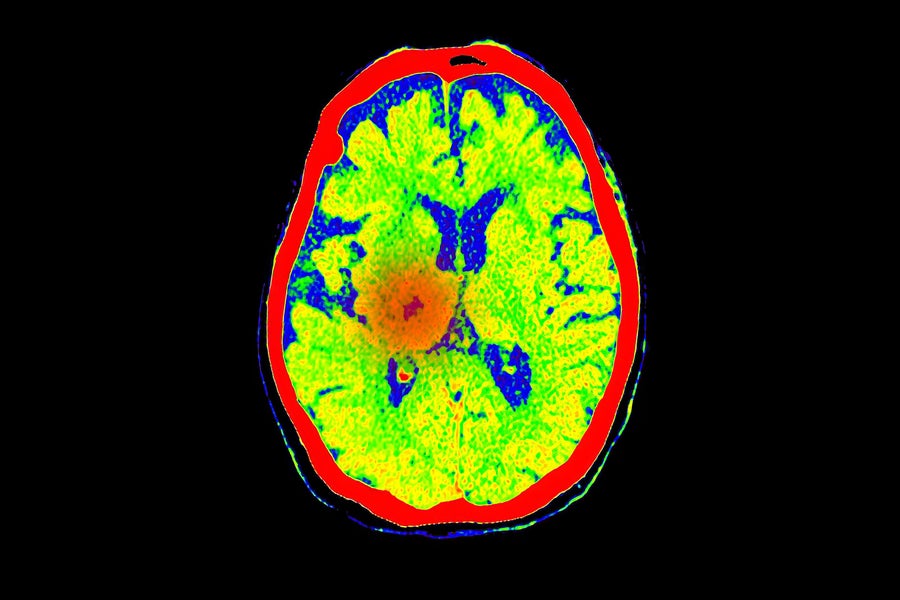
A brain scan shows blood flow at the location of a stroke, a common cause of coma. Mr. Suphachai Praserdumrongchai/Getty Images
It turns out that a long, happy marriage resembles a slow-moving rom-com, one that plays out over decades.
The first few years of a marriage are rife with conflicts, but the emotional weather eventually changes, according to a 2018 study by psychology researchers at UC Berkeley. In time, humor—friendly teasing, jokes, and silliness—becomes more prevalent, and bickering and criticisms decline.
These findings, which must be among the sweetest to enter the crowded field of relationships research, were reached after psychologists analyzed videotaped interactions of 87 couples who had been married 15 to 35 years, and followed them over 13 years.
The study’s conclusions contradict an existing theory that positive emotions fade over time in a long relationship, point out the co-lead authors, Robert Levenson, a UC Berkeley psychology professor, and Alice Verstaen, a postdoctoral fellow at the VA Puget Sound health center. However, they align nicely with other recent longitudinal studies that show a U-shaped pattern of happiness in lengthy marriages. The questions of how unions change, and what triggers different twists and turns, are not settled, they write.
Importantly, jokes and gentle humor were not the only heroic behaviors that showed up in greater abundance in the marriages they followed. All the positive ways we can behave toward someone became more evident as the years passed, but primarily humor, enthusiasm, and validation (actively listening to and understanding your partner). Criticisms dropped off, as did the truly toxic, divorce-courting habits like stonewalling. Men demonstrated less anger, and women less contempt.
One outcome of the study was more in keeping with grimmer perceptions of marriages: Older couples were not more affectionate with each other. They either exchanged about the same number of caring statements and compliments through the years, or, wives offered fewer of them. But there was a silver lining here, too: Those trajectories, the researchers write, “offer support for the idea of love evolving as adults age.” Psychological studies—and, I’m guessing, anecdotal evidence from the long-married couples you know—have proposed that couples start off with a sense of passionate love that morphs into “companionate love” in time. Humor, they say, is arguably an expression of the second kind of devotion.
It’s worth keeping in mind that the study had several limitations, including a relatively small sample size, and a limited representation of marriage. It did not include same-sex marriages, for instance, or couples going to marriage counseling. It also only dealt in averages.
And of course, companionable humor is no guarantee of a relationship’s longevity. Anecdotally, it’s easy to point to couples that survived decades without a hint of shared laughter or goofiness, or ones that ended despite a healthy quotient of humor and compassionate behavior.
However, the study’s strengths, compared to similar research, give it credence too: The couples’ interactions were coded by an observer, so the results didn’t rely on self-reported measures. Also, the team quantified behaviors, not subjective constructs like “satisfaction” or “happiness.”
.
Try jeering from the sidelines. Photo from Reuters/ Baz Ratner.
Thanks to the development of modern agriculture, the germ theory of disease and pasteurization, as well as the advent of freezers, electric ovens, and fridges, millions of people can now access safe, disease-free food in many parts of the world. But despite these advances, foodborne illnesses endure. The Centers for Disease Control and Prevention estimates that around 48 million Americans—one in seven—get sick from food each year.
Harmful, illness-causing pathogens lurk and fester in many different foods, from salad greens, fruit, and vegetables to meat, eggs, rice, and seafood. Improper food preparation and storage, lack of hand hygiene, general unsanitary conditions, and insufficient cooking or reheating can all lead to food contamination. A lot of foodborne illnesses are caused by such improper handling. “The vast majority will be sporadic cases,” says Martin Wiedmann, a food scientist at the Cornell University College of Agriculture and Life Sciences. “One person gets sick because one thing went wrong.”
It is possible for contamination to occur during growth of crops, animal agriculture, and production procedures, however. Strict food hygiene laws and monitoring agencies (including the CDC, the Food and Drug Administration, and the U.S. Department of Agriculture’s Food Safety and Inspection Service) ensure that the U.S. has one of the best food safety records in the world. But unexpected events or mistakes on farms or in factories can still lead to foodborne pathogen contamination. When outbreaks of foodborne illnesses do happen, experts can use DNA fingerprinting of bacteria to quickly identify the origin and recall any food that might be contaminated, helping to contain the spread.
Common symptoms of foodborne illness include upset stomach, nausea, vomiting, diarrhea, fatigue, and fever. In severe cases, people can be hospitalized and die. Pregnant women, elderly adults, immunocompromised individuals, and young children are more susceptible to foodborne illnesses. Around 30 percent of all foodborne illness deaths worldwide occur in children under five years old.
The CDC recognizes 31 pathogens as common sources of foodborne illness. Bacteria, viruses, chemicals and even parasites (such as tapeworms) can all be culprits. These are some of the major microbes you should especially watch out for.
E. coli
Escherichia coli bacteria normally live peacefully inside your intestines without harming you. If ingested, however, these bacteria can infect other areas of the body, causing diarrhea, vomiting, and stomach pain. Some severe strains (such as those that produce so-called Shiga toxin) can lead to life-threatening dehydration and serious kidney damage.
E. coli can be expelled from the intestines in feces, meaning that unsanitary bathroom conditions and poor hygiene habits can all cause contamination of food. If a person gets such bacteria on their hands from direct or indirect contact with fecal matter, and then they go to prepare food or handle kitchen utensils with unwashed hands, for example, the E.coli can easily spread and become foodborne. Unclean water and unpasteurized beverages (such as raw milk) can also spread E. coli. Farmed produce also carries an E. coli risk – particularly if wildlife or livestock feces come into contact with the bacterium.
“E. coli is often associated with cattle and other ruminants,” says Martin Bucknavage, food safety and quality specialist at the Pennsylvania State University’s Penn Extension, which focuses on agriculture. “It could be cows, sheep, even white-tailed deer—it’s in their intestinal tract.” Contamination can occur if an infected animal’s feces get into water supplies and crops. This route is thought to have caused a number of E. coli outbreaks in produce, such as one in spinach in 2006. But this type of pathogen exposure has decreased in recent years, partly because farmers have been better at controlling livestock waste, Bucknavage says. “The meat industry has done a lot of work to try to minimize it.”
.
Scanning electron micrograph of Listeria monocytogenes. BSIP/Getty Images
Film and Writing Festival for Comedy. Showcasing best of comedy short films at the FEEDBACK Film Festival. Plus, showcasing best of comedy novels, short stories, poems, screenplays (TV, short, feature) at the festival performed by professional actors.

 Westend61/Getty Images


 Democratic presidential candidate Sen. Kamala Harris, D-California, speaks at the Poor People’s Moral Action Congress presidential forum in Washington on June 17, 2019. (AP Photo/Susan Walsh)
 The Miami-Dade Police Department released body camera footage on Monday afternoon from the incident that left both Miami Dolphins players Tyreek Hill and Calais Campbell detained briefly ahead of their season opener on Sunday.







 James' World 2