October 21, 2024
Mohenjo
Business, Food For Thought, Human Interest, Political, Science, Technical
amazon, business, Business News, current-events, Future, Hotels, human-rights, medicine, mental-health, research, Science, Science News, technology, Technology News, travel, vacation

Click the link below the picture
.
This month, Google dropped a few hints about how its most important and lucrative product, Search, will be changing in the coming months. Earlier this year, the company rolled out AI Overviews — generated summary blurbs that are frequently passable and not infrequently completely erroneous — to many of its customers. “This week, we’re rolling out search results pages organized with AI in the U.S.,” the company said in a blog post. The test would be limited to “recipes and meal inspiration” for now, but searchers will “now see a full-page experience, with relevant results organized just for [them].” This, Google suggested, would be an exciting improvement. “You can easily explore content and perspectives from across the web including articles, videos, forums, and more — all in one place,” the company said. Not only that, but the company is testing a new design for AI Overviews that “adds prominent links to supporting webpages directly within the text.” Oh, and one more thing about the AI Overviews: Google has been “carefully testing ads” for “relevant queries.”
It doesn’t take much extrapolation to imagine AI Overviews, which are currently contained in a box above the standard and ever more cluttered search page, expanding from summaries to more comprehensive digests of information, with more citations, more things to tap and click, and space for sponsorship. Google’s most visible, high-stakes AI deployment is a set of tools that will automatically find and “organize” content from the web, present it in summary with prominent links, and have big chunky ads for products, not just links. Sound familiar? Google’s vision for the future of AI is … Google, again.
The prevailing narrative around Google’s current situation is that, despite its leadership in AI research, it was caught flat-footed by the arrival of apps like ChatGPT. It’s been hampered in its attempts to respond by institutional caution and clumsy moderation choices, but also by fear that revamping Search, a great product gradually undermined by an even greater business model, might threaten its underlying ad business. There simply isn’t as much room for ads, and not as much tapping or clicking, in a world where search engines start answering questions. There’s a lot of truth in this story, but it depends on an understanding of what Google has become and how people use it that’s slightly out of date.
Google is, substantially, still a platform for finding content on the web supported by ads from brands and websites. It’s also, by default, a major e-commerce platform, or at least a site through which we start to find things to buy. This has changed how the service looks and feels as well as the entire web around it. It should also change how we think about Google’s competition. Sure, it should be worried about OpenAI. But it might be more worried about … Amazon?
I don’t mean to understate the extent to which the arrival of ChatGPT and other AI services has rattled Google: It has. When Google and Microsoft showed off their first AI search demos in early 2023, they highlighted the ability to “chat” with your search engine, which would then produce, in conversational format or a clean, simple digest, links and summaries from the web. These were compelling previews of an entirely new interface. Arguably the most enticing things about them were that they were stripped down and simple, and they did what they were asked.
That’s not quite what they ended up shipping, of course. AI Overviews, in the beginning, leaned hard into summary, attempting to synthesize full answers while minimizing outside content. They also appeared as one more widget among many, another extra box with an unclear relationship to the rest of the results page, sometimes existing in conflict with other information presented just a few inches away. Google’s previews of its “AI-organized” results pages now look an awful lot like Google Search result pages, with a bunch of grids and modules and lists remixed but ultimately sort of piled together. Google, despite suggestions that it might change everything, is rapidly circling back around to where it started:
.
 Illustration: Intelligencer
.
.
Click the link below for article:
.
__________________________________________
October 21, 2024
Mohenjo
Business, Food For Thought, Human Interest, Political, Science, Technical
amazon, business, Business News, current-events, Future, Hotels, human-rights, medicine, mental-health, research, Science, Science News, technology, Technology News, travel, vacation

Click the link below the picture
.
Marie Curie, born more than 150 years ago, is still the only female scientist many people can name. The double Nobel Prize winner is most famous for her discovery of radioactivity, as well as the radioactive elements radium and polonium. She is less well known for encouraging a generation of women who worked in her lab and went on to work in research because of the path she paved. Though few women in science have reached Curie’s level of fame and name recognition, they continue to make gains in the field because of her life and example.
In the new book The Elements of Marie Curie: How the Glow of Radium Lit a Path for Women in Science (Atlantic Monthly Press, 2024), author (and Scientific American poetry editor) Dava Sobel chronicles Curie’s life and work, and sketches biographies of many of the women who worked with her. Sobel found that few people are familiar with the network of researchers she nurtured, as well as many other aspects of the famous chemist’s history. “Everybody knows her name, but hardly anybody knows anything about her,” Sobel says.
Scientific American spoke with Sobel about Marie Curie’s contributions to science, history, and gender equality.
[An edited transcript of the interview follows.]
How did you learn about the female scientists Curie worked with?
In 2020, I was asked to review a book called Women in Their Element, a collection of essays about female chemists. The only two names I recognized to begin with were Marie Curie and her daughter [Irène Joliot-Curie]. But then as I read, I was really struck by the number of women who had spent some time with her, either studying under her or working in her lab. By the fifth or sixth one, it really started to look like a network. And through the Curie Museum in Paris, I discovered there were really at least 45 women who passed through her laboratory. She was the first woman ever to teach at the Sorbonne. And then that made her a magnet for these other women. Also, she was already world-famous because she had won the Nobel Prize, and that spread her name everywhere. So I thought, well, this is something about Madame Curie that most people don’t know, and that’s how I got started.
How did Curie end up making the huge discoveries she made?
She had extraordinary drive to get herself out of Warsaw to Paris, to be able to get an advanced education, to believe in herself that much [in the face of strong resistance toward women in science at the time], and then to be willing and able to do the kind of laboratory work that she did. And then she married the right person. She and her husband Pierre Curie worked together when she started to do her doctoral research on this new discovery of [physicist Henri] Becquerel’s, uranic rays.
This was the radiation coming from uranium decay.
Right. This was a new thing, and nobody was paying attention to it because everybody was more interested in x-rays at the time [in 1896]. And [Curie] thought she’d go after the less exciting topic; there were 1,000 papers already written about x-rays, and nobody was doing anything with uranic rays. So that was the right time.
It’s amazing to me that she entered this field at this time and then had her first child just a year later, in 1897. I’d assumed before I read the book, that the children came well after she’d established herself as a scientist.
This is a very female story. She had two children; she had a miscarriage; she had trouble nursing. Some of the women who came to her lab stopped working when they got married and had children. It’s been more than 100 years, and that’s still true for many women in science. I really wanted to meet those issues directly in the book because I think it’s so important for young women to read about other female scientists and how they managed.
Did Curie actively set out to recruit more women into science?
I don’t think she was specifically looking to hire women, but what was different about her was that she had nothing against hiring them. So that was big, and then again, she was so prominent that she attracted them and inspired them. There are a couple of women in the story who were much younger and grew up hearing about her, which made them think, “Oh, I could be a scientist, too.” And the amazing thing to me is how she still has that effect. She’s been dead for almost 100 years, but she is still an inspiration—and not just to women who go into science but women in a variety of fields.
.

Polish-French physicist Marie Curie in a laboratory, circa 1905. H. Armstrong Roberts/ClassicStock/Getty Images
.
.
Click the link below for the article:
.
__________________________________________
October 20, 2024
Mohenjo
Business, Food For Thought, Human Interest, Political, Science, Technical
amazon, business, Business News, current-events, Future, Hotels, human-rights, medicine, mental-health, research, Science, Science News, technology, Technology News, travel, vacation
Click the link below the picture
.
Sociologist Elena Portacolone was taken aback. Many of the older adults in San Francisco she visited at home for a research project were confused when she came to the door. They’d forgotten the appointment or couldn’t remember speaking to her.
It seemed clear they had some type of cognitive impairment. Yet they were living alone.
Portacolone, an associate professor at the University of California-San Francisco, wondered how common this was. Had anyone examined this group? How were they managing?
When she reviewed the research literature more than a decade ago, there was little there. “I realized this is a largely invisible population,” she said.
Portacolone got to work and now leads the Living Alone With Cognitive Impairment Project at UCSF. The project estimates that at least 4.3 million people 55 or older who have cognitive impairment or dementia live alone in the United States.
About half have trouble with daily activities such as bathing, eating, cooking, shopping, taking medications, and managing money, according to their research. But only 1 in 3 received help with at least one such activity.
Compared with other older adults who live by themselves, people living alone with cognitive impairment are older, more likely to be women, and disproportionately Black or Latino, with lower levels of education, wealth, and homeownership. Yet only 21% qualify for publicly funded programs such as Medicaid that pay for aides to provide services in the home.
In a health care system that assumes older adults have family caregivers to help them, “we realized this population is destined to fall through the cracks,” Portacolone said.
Imagine what this means. As memory and thinking problems accelerate, these seniors can lose track of bills, have their electricity shut off, or be threatened with eviction. They might stop shopping (it’s too overwhelming) or cooking (it’s too hard to follow recipes). Or they might be unable to communicate clearly or navigate automated phone systems.
A variety of other problems can ensue, including social isolation, malnutrition, self-neglect, and susceptibility to scams. Without someone to watch over them, older adults on their own may experience worsening health without anyone noticing or struggle with dementia without ever being diagnosed.
Should vulnerable seniors live this way?
For years, Portacolone and her collaborators nationwide have followed nearly 100 older adults with cognitive impairment who live alone. She listed some concerns people told researchers they worried most about: “Who do I trust? When is the next time I’m going to forget? If I think I need more help, where do I find it? How do I hide my forgetfulness?”
Jane Lowers, an assistant professor at the Emory University School of Medicine, has been studying “kinless” adults in the early stages of dementia — those without a live-in partner or children nearby. Their top priority, she told me, is “remaining independent for as long as possible.”
Seeking to learn more about these seniors’ experiences, I contacted the National Council of Dementia Minds. The organization last year started a biweekly online group for people living alone with dementia. Its staffers arranged a Zoom conversation with five people, all with early-to-moderate dementia.
One was Kathleen Healy, 60, who has significant memory problems and lives alone in Fresno, California.
“One of the biggest challenges is that people don’t really see what’s going on with you,” she said. “Let’s say my house is a mess or I’m sick or I’m losing track of my bills. If I can get myself together, I can walk out the door and nobody knows what’s going on.”
.
 FG Trade/Getty Images
.
.
Click the link below for the article:
.
__________________________________________
October 20, 2024
Mohenjo
Business, Food For Thought, Human Interest, Political, Science, Technical
amazon, business, Business News, current-events, Future, Hotels, human-rights, medicine, mental-health, research, Science, Science News, technology, Technology News, travel, vacation

Click the link below the picture
.
In late August, Bloomberg reported rumors that electric automaker Tesla plans to reveal its forthcoming autonomous robotaxi — expected to be called the Cybercab — on Oct. 10 at the Warner Bros. studio lot in Burbank. This vehicle will reportedly be purpose-built to function solely as a self-driving cab. As such, it will not contain an accelerator, brake pedals, or a steering wheel, and will be hailed via a special Tesla app. A week or so ago, sources shared an image of a small, canary-yellow vehicle trolling the Warners lot, tailed by Tesla production vehicles, leading some to suggest it was a camouflaged robotaxi.
Overstatements, obfuscations, and broken promises regarding the unveiling and production of future Tesla products — a “semi” tractor-trailer, a new sporty roadster, an entry-level vehicle, this robotaxi — are so frequent as to be standard operating procedure. Since Tesla entirely eliminated its public relations department four years ago, The Hollywood Reporter can’t confirm that this event (already postponed once this year) will occur at all.
But, if it does move forward, the global launch of a new Tesla at Warners is certain to raise eyebrows in Hollywood and draw scrutiny toward the chummy relationship between the carmaker’s increasingly controversial CEO, Elon Musk, and Warners’ embattled chief executive, David Zaslav. (Warner Bros. declined to comment on the rumored robotaxi reveal.) As Musk has continued his trajectory into the MAGA-verse — pledging allegiance to right-wing conspiracies, amplifying racist and antisemitic messages, disparaging trans people, including his own daughter, and endorsing Donald Trump — his stock in Hollywood, and that of his brand, has plummeted.
“Elon is very outspoken, and his political views are not as popular in the entertainment industry,” says Debbie Levin, CEO of the Environmental Media Association (EMA), which promotes messages, actions, and products to create positive environmental change in Hollywood.
The brand’s current diminished status in Hollywood is particularly notable when compared to a decade ago, when Tesla products began penetrating the industry. “The Tesla became the ‘It’ car in terms of electrification,” Levin says. “If you could spend $100,000 on a car, that was sort of the way to go to show that you care about the environment.”
As the brand expanded, Southern California — long at the forefront of vehicular trends — became one of its largest markets. “When you’re in Hollywood, driving around the studios, that’s pretty much all you see,” says Ed Kim, president and chief analyst of Auto Pacific, a SoCal-based mobility research firm. “It’s Teslas everywhere.”
Shifts are now occurring in local consumer interest and purchase behavior. “Certainly, we have seen sales drop significantly at Tesla this year,” Kim says, citing a nearly 25 percent drop in sales in the Golden State this quarter alone. This is notable not just because the brand is losing market share as established luxury automakers like Audi, BMW, and Mercedes, and compelling upstarts like Polestar, Lucid, and Rivian, diversify their EV offerings, but because, in an expanding EV marketplace, Tesla is shrinking. “Despite all the headlines, EV sales are still growing. They’re just not growing at the same speed that they were before. But Tesla is actually losing sales,” Kim says. “In fact, Tesla is one of the few EV makers that has been losing volume, not just losing market share.”
This decline can be correlated with Musk’s recent rightward turn and related online antics. “Rejection of Tesla recently spiked and continues among Democrats. They want nothing to do with Tesla,” says Alexander Edwards, president of Strategic Vision, a Southern California-based consultancy that conducts hundreds of thousands of in-depth psychographic surveys with new car buyers annually. “And there are no hidden Republicans that are buying these. That just doesn’t exist.”
.
 “Tesla is one of the few EV makers that has been losing volume, not just losing market share,” says automative analyst Ed Kim. THR Illustration; images: David Livingston/Getty Images, Adobe Stock
.
.
Click the link below for the article:
.
__________________________________________
October 19, 2024
Mohenjo
Business, Food For Thought, Human Interest, Political, Science, Technical
amazon, business, Business News, current-events, Future, Hotels, human-rights, medicine, mental-health, research, Science, Science News, technology, Technology News, travel, vacation
Click the link below the picture
.
Megan Rumney, an executive with a financial-services firm in Severna Park, Md., an affluent Baltimore suburb, decided to buy her older son a smartphone. She made the purchase with the understanding that she would use it to track his location and social media use. Rumney was hesitant to do so for the fifth grader but admits she felt a lot of social pressure and eventually gave in. All of her friends were getting their children a smartphone, and Rumney didn’t want her son to feel left out; his friends almost exclusively communicate using their devices. Still, she was concerned about the risks of social media and cyberbullying.
At the time, Rumney thought this was a good compromise. It allowed her son, Harrison, now age 14, to ride his bike to school, sporting events, and friend’s houses, giving him some sense of autonomy. A few years later she got her younger son Weston, now age 11, an Apple Watch for much the same reason. At times, though, tracking has become a burden of sorts.
When her kids aren’t with her, she uses apps such as Life360 and her younger son’s Apple Watch to track their location. Rumney says that once you have the technology, it’s hard not to use it all the time. “It’s good to know where they are and be able to get in touch with them, but it’s also a double-edged sword,” she says.
Rumney says she likes knowing where her kids are but doesn’t like her family’s overreliance on devices. She adds that she’s just not sure that being able to track Harrison was worth him having a phone that he spends so much time on, and she doesn’t know how this type of monitoring will affect him emotionally down the line. “If I could do it all again, I’m not sure, I would,” Rumney says. In fact, she’s held off on getting her younger son his own smartphone.
About half of parents in the U.S. say they monitor their adolescents’ movements via location-tracking apps, according to a study published in June 2023 in the Journal of Family Psychology. An additional 14 percent of parents who participated in the study claimed to use a tracking app while their child reported that they weren’t being surveilled, indicating that the monitoring was done unbeknownst to the child.
Experts worry that tracking teens’ locations can turn into a slippery slope that can at times hinder a teen’s relationship with their parents and harm their developing sense of autonomy, as well as create a false sense of security.
With so many things for parents to worry about, from school shooters to fentanyl overdoses and child trafficking, it’s no surprise that they look to location monitoring apps such as Find My iPhone and Life360, which use GPS, as well as the location of nearby Wi-Fi networks and cellular towers, to track and keep their children safe, says Sophia Choukas-Bradley, an associate professor of psychology at the University of Pittsburgh, whose research focuses on the mental health and well-being of adolescents and emerging adults. “With that said, for adolescents, this is a stage of life when kids are seeking autonomy and independence from their parents,” she says, “and a time when privacy feels really important to kids for good developmental reasons.”
Choukas-Bradley adds that part of teenagers’ normal development has to do with the urge for privacy and the ability to maneuver their first romantic relationships or hold their own with peers while just hanging out. This stage of seeking independence during the teen years remains crucial to them for fostering a sense of personal responsibility, learning to make their own decisions, and establishing their own system of values. “There’s some tricky gray areas with regards to what tracking kids can tell parents and what that does to a kid’s sense of autonomy and privacy,” she says. Research published in the August 2019 issue of the International Journal of Adolescence and Youth found that some children understood their parents’ concerns for their safety, but at the same time, many felt that their parents often went too far by contacting them constantly in ways that felt meddlesome.
When parents’ scrutiny is overly intrusive, teens’ natural tendency is to rebel. “This can lead to feelings of resentment, which may strain the relationship,” says Judy Ho Gavazza, an associate professor of psychology at Pepperdine University.
A study published in November 2020 in the journal Computers in Human Behavior found that perceptions of privacy invasion are associated with rebellious responses. Teens devise ways to evade their parents by turning off their phone, letting their battery go dead, or refusing to respond to text messages. (Friction over tracking happens less with preteens, who need more supervision and expect less privacy.)
.
Find My app icon. Jakub Porzycki/NurPhoto via Getty Images.
.
.
Click the link below for the article:
.
__________________________________________
October 19, 2024
Mohenjo
Business, Food For Thought, Human Interest, Political, Science, Technical
amazon, business, Business News, current-events, Future, Hotels, human-rights, medicine, mental-health, research, Science, Science News, technology, Technology News, travel, vacation

Click the link below the picture
.
Has the U.S. economy, historically, been better under Republican presidents or Democratic presidents?
A Republican financial analyst decided to find out.
His name? Bart Starr, Jr. (Yes, the son of THAT Bart Starr.)
The answer may surprise you.
(Before Bart Starr, Jr. takes over this story, we have 18 days left until the election. This is go time. Your donations to @WisDems will help us get out the vote all across Wisconsin. Won’t you chip in now?)
Who is Bart Starr, Jr.?
The son of legendary Packers QB Bart Starr, Bart Jr. grew up in Green Bay, WI.
He’s an Alabama attorney, financial consultant, and a supporter of charities including Rawhide Youth Services, an organization co-founded by his parents in the 1960s to help at-risk youth.
A lifelong Republican, he voted for both Bushes, Dole, McCain, & Romney.
From here on, this piece is written by Bart Starr, Jr.
There exists in much of America a belief, one our Republican family accepted for decades, that GOP presidents are better for the U.S. in terms of stock market performance, economic and job growth, and fiscal discipline/deficits.
Recently we accepted a challenge from a centrist economist to determine whether our bias was correct.
It turns out we were wildly mistaken.
Someone known to most Americans said, many years ago, “The economy seems to do better under the Democrats than under the Republicans.”
Before we identify him, let’s see if he was correct by analyzing very long term data in order to avoid the distortion effects of one or two strange years.
Let’s look at the stock market performance from 1961-2024.
Assume we invested $10,000 in the stock market and allowed growth to compound only during Republican presidencies; our $10,000 would have done well, growing to approximately $105,000 during those 32 years.
If we did the exact same thing, but invested only during the 32 years of Democratic presidencies, we would have again done well…exceptionally well. Our $10,000 would have grown to approximately $570,000.
This equals a difference of close to 7% PER YEAR in favor of stock market performance during Democratic administrations.
In fairness, we should point out that one horrific year—2008—landed at the end of the George W. Bush administration.
Given the fact that a 37% drop in the S&P 500 Index resulted in a harsh impact on the Republican side of the ledger, let us run a hypothetical scenario, as follows: We will add 25% to the Republican data, AND deduct 25% from the Democratic data.
After making this adjustment to “share” the impact of 2008, growth under Republican presidents would have increased to $131,000; growth under Democrats would have increased to $427,000, still a significant difference: about 4% more PER YEAR in favor of the Democratic presidents.
Let’s move on from the stock market to economic and job growth.
In order to avoid upside bias from 1935-1944, as the economy recovered from the Great Depression and the buildup to WWll under FDR, we will begin our analysis in 1945.
The most important measure of economic performance is the real growth rate (nominal growth minus inflation).
Under the 40 years with GOP presidents, real GDP growth has averaged 2.4% per year.
Under the 40 years with Dem presidents, real GDP growth has averaged 3.5% per year.
A difference of 1.1% per year might not sound significant, but if you compound it over the course of a 40-year working career, it compounds to 50% more total growth.
Further, these data help explain something remarkable. EVERY transition from a Democratic to a Republican administration during the past 100 years has resulted in slower job growth, while EVERY transition from a GOP to a Democratic administration has led to faster job growth.
.
 Bart Starr, Jr.
.
.
Click the link below for the article:
.
__________________________________________
October 18, 2024
Mohenjo
Business, Food For Thought, Human Interest, Political, Science, Technical
amazon, business, Business News, current-events, Future, Hotels, human-rights, medicine, mental-health, research, Science, Science News, technology, Technology News, travel, vacation
Click the link below the picture
.
Since the COVID pandemic began, claims that the disease poses only minimal risk to children have spread widely, on the presumption that the lower rate of severe acute illness in kids tells the whole story. Notions that children are nearly immune to COVID and don’t need to be vaccinated have pervaded.
These ideas are wrong. People making such claims ignore the accumulating risk of long COVID, the constellation of long-term health effects caused by infection, in children who may get infected once or twice a year. The condition may already have affected nearly six million kids in the U.S. Children need us to wake up to this serious threat. If we do, we can help our kids with a few straightforward and effective measures.
The spread of the mistaken idea that children have nothing to worry about has had some help from scientists. In 2023 the American Medical Association’s pediatrics journal published a study–which has since been retracted—reporting the rate of long COVID symptoms in kids was “strikingly low” at only 0.4 percent. The results were widely publicized as feel-good news, and helped rationalize the status quo, where kids are repeatedly exposed to SARS-COV-2 in underventilated schools and parents believe they will suffer no serious harm.
In January 2024, however, two scientists published a letter with me explaining why that study was invalid. Some of the errors made it hard to understand how the study survived peer review. For example, the authors claimed to report on long COVID using the 2021 World Health Organization definition, but didn’t properly account for the possibility of new onset and fluctuating or relapsing symptoms, even though that definition and the subsequently released 2023 pediatric one emphasize those attributes. Any child with four symptom-free weeks—even nonconsecutive ones—following confirmed infection was categorized by the study authors as not having long COVID.
In August, the authors of the study retracted it. They did not admit to the errors we raised. But they did admit to new errors, and said these mistakes meant they understated the rate of affected children.
And that rate, according to other research, is quite high. The American Medical Association’s top journal, JAMA, in August, published a key new study and editorial about pediatric long COVID. The editorial cites several robust analyses and concludes that, while uncertainty remains, long COVID symptoms appear to occur after about 10 percent to 20 percent of pediatric infections.
If you’re keeping score, that’s as many as 5.8 million affected children in the U.S.—so far. And we know studies and surveys of adults have found that repeat infections heighten the risk of long-term consequences.
The JAMA study comparing infected and uninfected children found that trouble with memory or focusing is the most common long COVID symptom in kids aged six to 11. Back, neck, stomach, and head pain were the next most common symptoms. Other behavioral impacts included “fear about specific things” and refusal to go to school.
Adolescents aged 12 to 17 reported different leading symptoms. Change or loss in smell or taste was most common, followed by body pains, daytime tiredness, low energy, tiredness after walking, and cognitive deficits. The study noted that symptoms “affected almost every organ system.” In other words, these symptoms reflect real physiological trauma. For example, SARS-COV-2 can cause or mediate cardiovascular, neurological, and immunological harm, even increasing the relative risk of new onset pediatric diabetes when compared with other lesser infections.
.
 SergeyChayko/Getty Images
.
.
Click the link below for the article:
.
__________________________________________
October 18, 2024
Mohenjo
Business, Food For Thought, Human Interest, Political, Science, Technical
amazon, business, Business News, current-events, Future, Hotels, human-rights, medicine, mental-health, research, Science, Science News, technology, Technology News, travel, vacation
Some content on this page was disabled on April 15, 2025 as a result of a DMCA takedown notice from Guardian Media Group. You can learn more about the DMCA here:
https://wordpress.com/support/copyright-and-the-dmca/
October 17, 2024
Mohenjo
Business, Food For Thought, Human Interest, Political, Science, Technical
amazon, business, Business News, current-events, Future, Hotels, human-rights, medicine, mental-health, research, Science, Science News, technology, Technology News, travel, vacation
Click the link below the picture
.
Fifteen years ago, cosmologists were flying high. The simple but wildly successful “standard model of cosmology” could, with just a few ingredients, account for a lot of what we see in the universe. It seemed to explain the distribution of galaxies in space today, the accelerated expansion of the universe, and the fluctuations in the brightness of the relic glow from the big bang—called the cosmic microwave background (CMB)—based on a handful of numbers fed into the model. Sure, it contained some unexplained exotic features, such as dark matter and dark energy, but otherwise everything held together. Cosmologists were (relatively) happy.
Over the past decade, though, a pesky inconsistency has arisen, one that defies easy explanation and may portend significant breaks from the standard model. The problem lies with the question of how fast space is growing. When astronomers measure this expansion rate, known as the Hubble constant, by observing supernovae in the nearby universe, their result disagrees with the rate given by the standard model.
This “Hubble tension” was first noted more than 10 years ago, but it was not clear then whether the discrepancy was real or the result of measurement error. With time, however, the inconsistency has become more firmly entrenched, and it now represents a major thorn in the side of an otherwise capable model. The latest data, from the James Webb Space Telescope (JWST), have made the problem worse.
The two of us have been deeply involved in this saga. One (Riess) is an observer and co-discoverer of dark energy, one of the last pieces of the standard cosmological model. He has also spearheaded efforts to determine the Hubble constant by observing the local universe. The other (Kamionkowski) is a theorist who helped to figure out how to calculate the Hubble constant by measuring the CMB. More recently he helped to develop one of the most promising ideas to explain the discrepancy—a notion called early dark energy.
One possibility is that the Hubble tension is telling us the baby universe was expanding faster than we think. Early dark energy posits that this extra expansion might have resulted from an additional repulsive force that was pushing against space at the time and has since died out.
This suggestion is finally facing real-world tests, as experiments are just now becoming capable of measuring the kinds of signals early dark energy might have produced. So far the results are mixed. But as new data come in over the next few years, we should learn more about whether the expansion of the cosmos is diverging from our predictions and possibly why.
The idea that the universe is expanding at all came as a surprise in 1929, when Edwin Hubble used the Mount Wilson Observatory near Pasadena, Calif., to show that galaxies are all moving apart from one another. At the time, many scientists, including Albert Einstein, favored the idea of a static universe. But the separating galaxies showed that space is swelling ever larger.
.
 Chris Gash
.
.
Click the link below for the article:
.
__________________________________________
October 17, 2024
Mohenjo
Business, Food For Thought, Human Interest, Political, Science, Technical
amazon, business, Business News, current-events, Future, Hotels, human-rights, medicine, mental-health, research, Science, Science News, technology, Technology News, travel, vacation

Click the link below the picture
.
Social media companies will face punishments for failing to keep children safe on their platforms, communications watchdog Ofcom has warned.
Services like Facebook, Instagram, and Whatsapp could face fines from the regulator if they do not comply with the new Online Safety Act – which comes into force early next year – Ofcom chief executive Dame Melanie Dawes, told the BBC.
Dame Melanie said it was the responsibility of the firms – not parents or children – to make sure people were safe online.
Companies will have three months from when the guidance is finalized to carry out risk assessments and make relevant changes to safeguard users.
Dame Melanie’s comments came on the same day that Instagram added features to help stop sextortion.
Ofcom has been putting together codes of practice since the Online Safety Act became law.
The Act requires social media firms to protect children from content such as self-harm material, pornography and violent content.
However, the pace of change is not quick enough for some.
Ellen Roome’s 14-year-old son Jools Sweeney died in unclear circumstances after he was found unconscious in his room in April 2022. She believes he may have taken part in an online challenge that went wrong.
Mrs Roome is now part of the Bereaved Parents for Online Safety group.
She told the Today program: “I don’t think anything has changed. They [the technology companies] are all waiting to see what Ofcom are going to do to enforce it, and Ofcom don’t seem to be quick enough to enforce those new powers to stop social media harming children.
“From us as a group of parents, we are sitting there thinking ‘when are they going to start enforcing this?’ They don’t seem to be doing enough.
“Platforms are supposed to remove illegal content like promoting or facilitating suicide, self-harm, and child sexual abuse. But you can still easily find content online that children shouldn’t be seeing.”
Dame Melanie said that technology companies needed to be “honest and transparent” about what their “services are actually exposing their users to”.
“If we don’t think they’ve done that job well enough, we can take enforcement action, simply against that failure.”
Ofcom has already been in close contact with social networking services and Dame Melanie said when the new legal safeguards became enforceable the regulator would be “ready to go”.
She added: “We know that some of them are preparing but we are expecting very significant changes.”
.
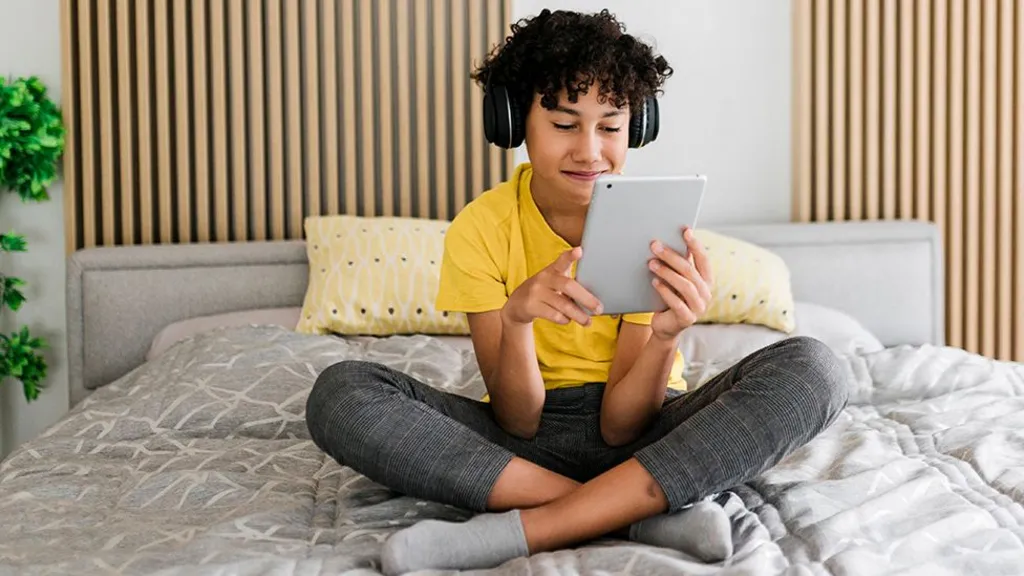 Getty Images The Online Safety Act, which aims to make the internet safer for children, became law just under a year ago in October 2023
.
.
Click the link below for the article:
.
__________________________________________
Older Entries
Newer Entries
 James' World 2