Louisa and Isaac, a lively, warm, and bright couple in their 40s, fell in love two decades ago. They were intellectually engaged with each other, adventurous, and, for years, shared “deep blue” affiliations. That changed during Donald Trump’s first term.
One of their earliest arguments about politics, they told me recently, erupted when Isaac announced he thought a wall on the southern border made sense. Louisa was shocked. She worked with undocumented immigrants; the spirit of protectiveness for the vulnerable was a deep part of her identity.
As Isaac became more engaged with a conservative worldview, their arguments grew more heated. Louisa described how their political divisions made them fearful of each other. “I didn’t recognize him,” she said. “I was afraid — maybe he wasn’t a compassionate person? Who is he? Is he even kind, loving? Does he care about people?”
I was introduced to Isaac and Louisa (that’s her middle name) by a director of my Showtime series, “Couples Therapy.” In my work as a psychoanalyst and couples therapist, I see a deep resignation in response to our political divide and a newfound fear of “the other side.” Due to our political differences, people in this country are deeply alienated from one another.
From a psychoanalytic perspective, I see how political disputes follow dynamics similar to disputes between couples, albeit amplified. People typically come to any event with differing views
of the world informed by their life and background. Couples negotiate these differences by creating their own political system and guiding ideologies.
Grasping the degree to which each of their “truths” emerges from a deeply subjective place is their most important challenge. This process is difficult — for a couple or for a country. A psychoanalytic approach offers a path.
As children, early in our psychological development, we all resort to a defense mechanism identified by the psychoanalyst Melanie Klein as “splitting.” To cope with negative or inexplicable experiences, we divide our perceptions of people into either all-good or all-bad.
This splitting allows us to avoid dealing with feelings of vulnerability, shame, hate, ambivalence or anxiety by externalizing (or dumping) unwanted emotions onto others. We then feel free to categorize these others as entirely negative, while seeing ourselves as good.
In political environments, this kind of splitting manifests in an “us versus them” mentality — where “our” side is virtuous and correct, and “their” side is wrong and flawed — which produces the kind of rigid, extreme, ideological warring we are caught up in now.
The technologies that mediate our access to reality only exacerbate this dynamic. The algorithms used by social media prioritize sensationalist and divisive content, creating “bubbles” that limit our exposure to diverse perspectives, rather than fostering a balanced discourse.It’s important for us to recognize just how gratifying this process can be, both for individuals and larger groups. Splitting produces a kind of ecstatic righteousness. There’s an intoxicating thrill in hate — in feeling that you’re in the bosom of a like-minded brotherhood, free from complexity and uncertainty. In this state, we’re prone to ignore information that contradicts our idealized version of ourselves, we become allergic to dissonance, and those with differing views are cast out or canceled.
In the weeks before and after the U.S. presidential election, many of us are asking about the role of empathy in American politics. Does it matter whether candidates express care for their constituents, and what does a person’s vote says about their ability or willingness to empathize with others?
Empathy is important to democracy—but it’s complicated to understand, as scientists and philosophers have long tried to study in practice. I am one of those scientists. As we use it in our day-to-day lives, we often mean sharing others’ emotions, such as feeling someone else’s sorrow or joy, but can also mean showing compassion or concern for their suffering or understanding and believing their hurt or joy.
In terms of the November election, how much did empathy matter? And in a challenging, exhausting, and polarized political environment, how do we remain empathetic? Do we even need to? Here, I argue that we need to remember our responsibility to choose and control the expanse of our empathy—and we can do so by reflecting on why we care and engage, whether that be to uphold our values, feel good, or better know the world. As research in my lab and in my field has shown, callousness is a decision—we are the authors of our empathy, and numbness isn’t a foregone conclusion.
I believe that showing empathy is a choice. We must be mindful of social pressures that might steer these choices in particular directions if we don’t take the effort to manage our empathy ourselves. Extending empathy across political divides can be important, but so too can sustaining motivations to empathize with the most marginalized, particularly if they are targeted by other political groups. Common ground may risk minimizing such harms.
To me, empathy is a strength, not weakness—a way to attend to the people we value most. If we let ourselves become callous to others’ needs, we risk losing sight of democracy and the importance of treating each other with dignity. Especially in the current climate, we should double down on desires to empathize, and remember that the willingness to empathize may be just as important as the ability to do so. The effort matters.
Exit polls tell us that having empathetic leaders may not be as important to many voters. Of four qualities ascribed to candidates in the 2024 U.S. presidential election, only 18 percent ranked empathy (“cares about people like me”) as most important. Though perhaps surprising, this is consistent with findings that people value leaders who care impartially, and who exhibit schadenfreude and relish pain in political opponents. Of that 18 percent that prioritized empathy, only one quarter supported Trump. Yet the pressing question may not be for whom empathy mattered most, as our research has shown that voters can overestimate partisan differences in concern.
What matters more is how we sustain willingness to empathize, as a value and social norm. How do we avoid numbness, as in the New Yorker cartoon about isolation as self-care?
Before politics enters the picture, we know that people find empathy to be exhausting and effortful. My team has found that people typically choose to avoid empathizing with strangers, finding it taxing. If empathy is like complex math, then people might take the easy road and avoid the problem set. But it matters who these feelings are about, as people choose empathy and compassion more for close others. When adding in political dynamics—such as what political opponents or peers think of our empathizing—it may make the calculus of empathy even more challenging.
Generally, it’s pretty hard for the average entrepreneur or professional to emulate the productivity habits of the likes of Tim Cook, Mark Cuban, and Bill Gates. Billionaire CEOs have a small army of assistants to manage their days and plan their schedules down to the minute, after all.
But there’s only productivity-booking trick of theirs absolutely anyone can steal and benefit from—time-saving artificial intelligence hacks.
Generative AI tools like ChatGPT have only been available for public use for two years, but according to a series of recent interviews, they’re already changing how some of the most successful CEOs in the world manage their days.
Former Shark and serial entrepreneur Mark Cuban, Apple boss Tim Cook, and Microsoft founder-turned-philanthropist Bill Gates all recently shared how they’re using AI tools. And handily for everyday workers, all the tools and techniques they mentioned are freely available for anyone to experiment with.
Tim Cook uses AI to summarize his emails
Take Tim Cook’s love of Apple Intelligence’s email summaries feature, for example. If you think your email overload is bad, spare a thought for the Apple CEO who gets upwards of 800 emails a day. Being a conscientious guy, he tried to read them all, he recently told the Wall Street Journal. That was a huge time suck until he started using Apple’s AI tool to summarize the deluge in his inbox every morning.
“If I can save time here and there, it adds up to something significant across a day, a week, a month,” Cook told the WSJ. “It’s changed my life. It really has.”
This could seem like just another CEO touting his company’s offerings (and there is no doubt some element of that going on here), but there are a host of AI email summary tools available for both Mac users and Microsoft fans. If you’re skeptical of Cook’s rave review of Apple’s products, try any of these tools to see if they can change your working life too.
Mark Cuban’s favorite AI hack
When it comes to Mark Cuban’s recommendation, there is no such conflict of interest. Cuban’s email problem is even worse than Cook’s. He receives thousands of often repetitive emails a day, he recently told CNBC. His solution? Using Gemini, Google’s generative AI assistant, to help him power through his replies in much less time.
“It’s reduced the need for me to write out routine replies,” he told CNBC. “I can spend 30 seconds evaluating its response and hit ‘send’ versus typing it all out myself.”
Cuban called outsourcing much of his email writing to AI the “ultimate time-savings hack.” Other CEOs can certainly experiment with AI tools to see if they could similarly streamline their inbox wrangling.
Bill Gates is a big fan of AI meeting notes
Not every iconic business leader is most excited about using AI to process emails. Bill Gates explained in a recent interview with The Verge that his favorite way to use new AI tools is for taking and searching through meeting notes.
Gates has long been known as extremely detail oriented and a dedicated note taker. But he used to be a big believer in the old fashioned pen and paper approach.
“You won’t catch me in a meeting without a legal pad and pen in hand—and I take tons of notes in the margins while I read. I’ve always believed that handwriting notes helps you process information better,” Gates once wrote on LinkedIn.
But AI has convinced him to update his note-taking approach, he told The Verge. Now he also has AI sit in on and transcribe meetings so he can reference those records later.
“I’d say the feature I use the most is the meeting summary, which is integrated into [Microsoft] Teams, which I use a lot,” he explained. “The ability to interact and not just get the summary, but ask questions about the meeting, is pretty fantastic.”
.
(L to R) Bill Gates, Mark Cuban, and Tim Cook. Illustration: Inc.; Photos: Getty Images
A shared meal, a kiss on the cheek: these social acts bring people together — and bring their microbiomes together, too. The more people interact, the more similar the make-up of their gut microorganisms is, even if individuals don’t live in the same household, a study shows.
The study also found that a person’s microbiome is shaped not only by their social contacts but also by the social contacts’ connections. The work is one of several studies that raise the possibility that health conditions can be shaped by the transmission of the microbiome between individuals, not just by diet and other environmental factors that affect gut flora.
In the quest to understand what shapes a person’s microbiome, social interactions are “definitely a piece of the puzzle that I think has been missing until recently”, says microbiologist Catherine Robinson at the University of Oregon in Eugene, who was not involved in the work.
The research was published in Nature on 20 November.
What’s mine is yours
The study has its roots in research published almost 20 years ago that investigated how obesity spreads in social networks. Certain viruses and bacteria found in the gut microbiome are known to change a person’s risk of obesity, and social scientist Nicholas Christakis wondered whether friends pass these microbes to each other in addition to influencing each other’s eating habits. “This was a kernel of an idea that I just couldn’t let go,” says Christakis, who is based at Yale University in New Haven, Connecticut.
Since then, several publications have suggested that social interactions shape the gut microbiome. Christakis and his colleagues travelled to the jungles of Honduras to add to this emerging literature. There, they mapped the social relationships and analysed microbiomes of people living in 18 isolated villages, where interactions are mainly face to face and people have minimal exposure to processed foods and antibiotics, which can alter the composition of the microbiome.
“This was an enormous undertaking,” Christakis says, because the team had to set up shop in a remote location, then get the samples back to the United States for processing.
Spouses and individuals living in the same house share up to 13.9% of the microbial strains in their guts, but even people who don’t share a roof but habitually spend free time together share 10%, the researchers found. By contrast, people who live in the same village but who don’t tend to spend time together share only 4%. There is also evidence of transmission chains — friends of friends share more strains than would be expected by chance.
The results add depth to scientists’ understanding of what shapes the microbiome, partly because the team looked at subspecies of the gut microbes, says microbiologist Mireia Valles-Colomer at Pompeu Fabra University in Barcelona, Spain, who was not involved in the work. Social contacts might share the same microbial species by chance, but they’re much less likely to share the same strains unless they’ve passed them to each other.
Rethinking transmissibility
Research like this “is changing completely the way we think”, because it suggests that risk factors for conditions with links to the microbiome, such as hypertension and depression, could spread from person to person through their microbiomes, says computational biologist Nicola Segata at the University of Trento in Italy. Segata was not involved in the current work, but he has worked with Valles-Colomer and members of Christakis’s team in the past on similar research.
.
Friends share more than just food when they dine together. ljubaphoto/Getty Images
An exciting and unique find from over 5,000 years ago was uncovered during the construction of a railroad.
Archaeologists have discovered evidence of a stone-paved cellar dating back to the Stone Age on the Danish island of Falster, according to a new paper in the journal Radiocarbon.
The presence of a cellar during this period would represent advanced technology, as no cellars have been discovered in this culture before.
“Stone paved sunken floors are so far not known from Neolithic Denmark so that the presented feature represents one-of-a-kind,” the researchers wrote.
The site where this potential cellar was discovered is Nygårdsvej 3. During excavations, archaeologists discovered two ancient houses—one of which was home to the cellar—belonging to the Funnel Beaker Culture.
The Funnel Beaker Culture was a prehistoric culture in Northern Europe that existed between approximately 4300 and 2800 BC, around present-day Denmark, Germany, Poland, Sweden, Norway, and the Netherlands. It is named after the distinctive pottery vessels found in archaeological sites with funnel-shaped necks.
This culture is one of the first Neolithic cultures in northern Europe to fully adopt agriculture. Evidence from other archaeological sites shows that they grew wheat, barley, and rye and domesticated cattle, pigs, and sheep. This shift to farming represented a significant change from the hunting and gathering lifestyle that preceded it.
In the houses discovered at the Nygårdsvej 3 site, the archaeologists found a large number of post holes, suggesting architectural planning during their construction, as well as loamy flooring made of sand and clay, which would have been an advanced flooring technique for the time.
One of the houses was found to have a stone-paved sunken feature dating to between 3080 and 2780 BC. Due to how carefully the stones appear to have been placed, the researchers suggest it is a cellar. The archaeologists also uncovered over 1,000 artifacts inside the cellar, including shards of pottery, flint tools, and two fossilized sea urchins.
While stone paving is not unusual for this culture, it is usually associated with graves or ritual sites. However, the researchers discount this feature being used for ritual purposes.
“The archaeological results from Nygårdsvej 3 show an important insight into the constructions and features of Neolithic Denmark. The fact that a subterranean construction has been present at the site underlines how each site can extend our knowledge about the Stone Age,” the researchers wrote in the paper.
I work in a small, close-knit, diverse team in a large health care organization. We have worked well together for years and have occasionally, and happily, socialized together outside of work. Recently there has been a marked cooling between two of my colleagues. They had a scuffle over an office-related issue (parking), which probably would not have been a big deal, but then one of them (P) trash talked the other (Q) in Spanish to another Spanish-speaking colleague. The issue is that this happened right in front of Q, who understands Spanish, which was not known by P. I want to tell P that Q understands Spanish. I worry more will be said in this way, leading to more hard feelings. Is it OK to lean in like this?
— Anonymous
This feels a little like an “A-story” in an NBC sitcom. (I’d call the episode “Mind Your P’s and Q’s.”) In fact, when I ran your question by my editor, his response was: “Love in-office fighting!” I love it as well … when I’m not the subject of it, of course. But I will dispense with the amusement because the reality is this isn’t a situation comedy but a situation — awkward! — and one I’m interested in tackling.
First things first: Parking. You may think it’s not a big deal, but it’s an issue for a fair number of us, and not just in the context of the workplace. (I live in Los Angeles.) Of course, it’s possible, even likely, that the bad vibes that resulted from the parking fracas are evidence of a deeper conflict between your two colleagues. But sometimes a parking space is just a parking space.
A few observations and opinions.
No. 1: That Q understands Spanish heightens the stakes in this scenario, but it’s also secondary. The bigger issue is that P decided it was OK to trash talk a colleague in front of that colleague in the first place.
No. 2: See above. (I can’t stress enough how inappropriate this was.)
Here’s where you come in. You’re wondering whether you should tell P that Q understood what P had to say. I have a few questions for you: Do you worry that more tension will arise if you do tell? Or do you worry that P will continue to trash talk Q because P is unaware that Q understands Spanish? Or is it a little of both? Listen, in a perfect world, P would be horrified and embarrassed to know that Q understood everything. But then again, P felt comfortable enough to trash talk Q in front of Q in the first place. So maybe all bets are off.
Get the best of The Times in your inbox
Thank you for signing up for The Morning. Manage your preferences.
Thank you for signing up for Opinion Today. Manage your preferences.
Thank you for signing up for From The Times. Manage your preferences.
I have another question: How close are you to these two? It sounds like you’re at a bit of a remove because you describe your socialization with P outside of work as being “occasional.” This complicates things, because it may appear (to P) that you’re picking sides in a matter that is actually outside your scope. That said, it couldn’t hurt to give P a quiet heads-up about Q’s literacy in Spanish. You could say something like, “I just wanted you to know that I think Q’s feelings were hurt the other day (week, month, year) when you complained about the parking situation. Q understands Spanish, you know.”
P can take it from there and decide whether to offer Q an apology or keep any complaints private, no matter the lingua franca. As for Q, I don’t think there’s anything you can, or need, to do or say. (In the sitcom version, the stakes are heightened after Q leaves a note that says “Hablo Español” on the windshield of P’s car. Unsigned.)
After all, it happened, and if it happens again, well, Q might be moved to act unprompted, whether in public or in private. I hope this answers your questions. (De nada.)
.
Photo illustration by Margeaux Walter for The New York Times
CLIMATEWIRE | Wildfire smoke can aggravate a variety of medical conditions, from asthma to heart disease.
Now, new research adds another worry to the mix. It can elevate the risk of dementia.
A study published Monday in the scientific journal JAMA Neurology, finds that long-term exposure to smoke concentrations is associated with a higher risk of dementia diagnosis over time. For every one microgram increase in wildfire pollution per cubic meter of air over the course of a three-year period, the odds of dementia diagnosis rise by about 18 percent, the study finds.
That’s compared with each person’s baseline risk of dementia diagnosis, which remains relatively low among the general population. Still, the increased risks are large enough to pose a public health concern.
The study focuses on a form of air pollution known as particulate matter — tiny, inhalable particles, with diameters of 2.5 micrometers or smaller. This kind of air pollution can originate from a variety of sources, including automobiles, industrial sources and fires.
Previous studies already have suggested that particulate matter can increase the risk of dementia, among other health problems. The new research zooms in specifically on particles produced by wildfire smoke, which can have different chemical and physical properties than particles produced by other sources.
The study examined medical records from more than 1 million people in Southern California from 2008 to 2019, all part of the Kaiser Permanente Southern California medical care consortium. It also analyzed air quality records from the same time period to estimate long-term pollution concentrations, including particles stemming directly from wildfire smoke.
The study found that wildfire smoke increases the risk of dementia significantly more than particulate matter from other sources. There are several reasons that could be the case, the researchers say.
Wildfire smoke particles tend to have higher concentrations of molecules known for toxic or inflammatory properties. And wildfire smoke tends to spike at certain times of the year, compared with other kinds of air pollution — intermittently exposing communities to extremely high pollution concentrations, which may have greater effects on their health.
The study also found that certain demographics are at higher risk than others, including people with lower incomes and people of color, including Black, Hispanic, and Asian communities.
Low-income communities often are at higher risk of exposure to air pollution, the researchers note. Lower quality housing in these communities may allow particulate matter to infiltrate homes more easily, and residents may have less access to air filtration systems.
Marginalized groups also may contend with more health challenges, in part because of systemic discrimination, compounding their risks of developing dementia later in life.
.
A firefighter is surrounded by heavy smoke as he battles the advancing Silverado Fire fueled by Santa Ana winds at the 241 toll road and Portola Parkway on October 26, 2020, in Irvine, California. Allen J. Schaben/Los Angeles Times via Getty Images
The 2023-24 school year saw more international students in the United States than ever before — setting a new record largely driven by graduate students and recent graduates in internship-type programs.
Over 1.1 million international students were in the U.S. during the last academic year, according to a survey of nearly 3,000 colleges and universities by the Institute of International Education (IIE) and sponsored by the U.S. State Department.
The new figures mark a full rebound from the start of the pandemic, when international enrollment dropped by 15%. But experts say those increases could once again be threatened under the incoming Trump administration, which upended the lives of many international students and workers in its first term.
Already, a few schools have recommended that their international students traveling overseas for winter break consider returning to the U.S. before President-elect Trump takes office on Jan. 20. That includes the University of Massachusetts Amherst, Wesleyan University and the Massachusetts Institute of Technology.
International students have made up around 5% of all college and university students in recent years. In the last school year, they injected about $44 billion into the U.S. economy, while also supporting about 378,000 jobs across the country, according to the group NAFSA: Association of International Educators.
Mirka Martel, who led the IIE survey, said while there is uncertainty, historically there has been bipartisan support to continue to welcome international students.
“We’ve seen numbers go up and down in the past, but overall, we’ve seen that there has been support, because of how much international students bring through economy and through culture to our states,” she said.
For the first time in 15 years, Indian students outnumber Chinese students
The new record in international students is largely fueled by graduate students and those in the Optional Practical Training (OPT) program, which allows foreign students to briefly work in the U.S. after completing their studies.
While the number of undergraduate students stayed about the same compared to the previous year, the graduate cohort and OPT program grew by about 8% and 22% respectively — reaching historic highs.
Meanwhile, India and China together accounted for over half of all international students in the U.S., according to the IIE. But for the first time since 2009, more students came from India than China, with over 331,000 students from India present during the 2023-24 school year.
The number of international Indian students has been rising since 2021, in particular due to an increase in the number of Indian graduate students coming to the U.S. Meanwhile, the number of international Chinese students has been waning since the pandemic. But China remains the top-sending country for undergraduates, with 87,000 students.
.
A group walks on the UC Berkeley campus on March 14, 2022, in Berkeley, Calif. California led the U.S. in international enrollment, with over 140,000 international students attending schools there in the 2023-24 academic year, according to the Institute of International Education. Justin Sullivan/Getty Images
For supporters of reproductive health care, a glaring contradiction stands at the center of the 2024 election. Most pro-abortion ballot initiatives passed, and the American people reelected the president who was responsible for overturning Roe v. Wade through his Supreme Court appointments.
How to reconcile this contradiction? In many ways, the results reflect the complicated dynamics of a post-Roe America.
In the two and a half years since the loss of our federal constitutional right to abortion with the Supreme Court’s Dobbs decision, the legal landscape has been upended, with 13 states currently banning abortion completely and many others banning abortion at different points throughout pregnancy that would have been unconstitutional under Roe. The consequences have been nothing short of disastrous, as the scientific evidence foretold. They include the documented tragic deaths of at least four women, the denial of care for women experiencing pregnancy complications, and the increased criminalization and surveillance of pregnant people. At the same time, the number of abortions has risen. That’s likely a result of monumental efforts by clinics, abortion funds, and practical support organizations to expand access to care and reduce stigma, as well as broader availability of telehealth for medication abortion and new supportive policies in protective states like shield laws that offer protection for abortion providers treating patients in other states via telemedicine and the removal of public insurance coverage restrictions that make abortion care more affordable.
No quick fix offers escape from this complicated legal and policy landscape. No one election can fully restore our rights or—as we needed even while Roe stood—bring us closer to true abortion access for all. There is only the steady, ongoing organizing work necessary, state by state, to deliver deep and lasting change. Ballot measures have become a key tool: between the June 2022 Dobbs decision and November 2023, voters in all seven states where measures on abortion were on the ballot came down decisively in favor of retaining or expanding abortion rights. While in November’s voting, the post-Dobbs winning streak of ballot measures on abortion was ultimately broken, seven new proabortion ballot measures passed while three failed. In sum then, voters in 13 states (Montana had measures in 2022 and 2024) have used direct democracy to declare their desire for legal abortion, in frank opposition to the Dobbs decision.
Amanda Montañez; Source: Guttmacher Institute (abortion ballot measures data)
Those results show voters are clearly comfortable splitting tickets, both in terms of candidates (for example, Wisconsin voters returned Trump to Washington alongside Senator Tammy Baldwin, an abortion rights champion) but also when it comes to abortion rights ballot measures. In Missouri, about 52 percent of voters supported establishing a constitutional right to abortion, making Missouri the first to clear the way for overturning a total ban. With their same votes, over 58 percent of voters supported Donald Trump. Similarly, 57.8 percent of voters approved Montana’s abortion rights ballot measure, while 58.4 percent of them supported Trump.
.
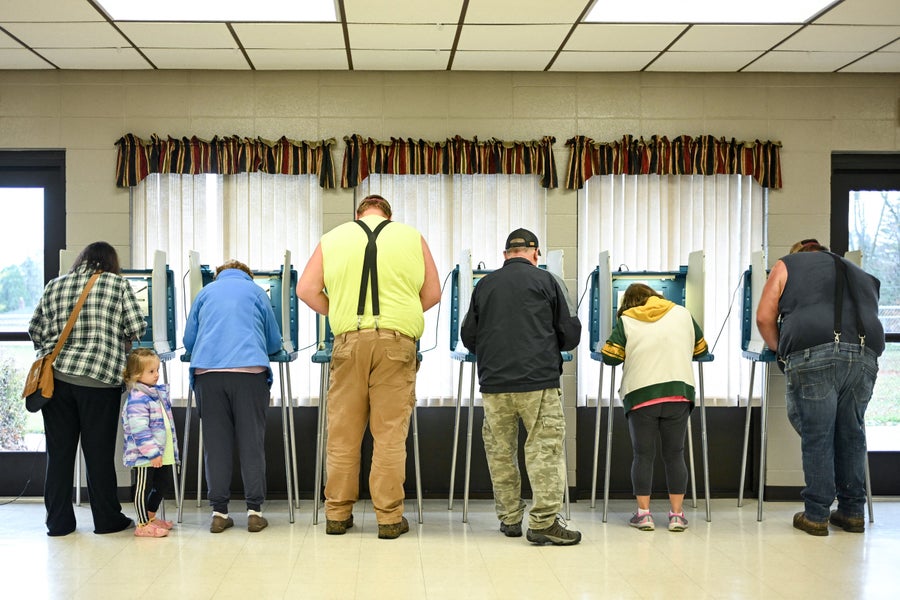
People vote at a polling station at Addison Town Hall in Allenton, Wisconsin, on Election Day, November 5, 2024. Alex Wroblewski/AFP via Getty Images
Film and Writing Festival for Comedy. Showcasing best of comedy short films at the FEEDBACK Film Festival. Plus, showcasing best of comedy novels, short stories, poems, screenplays (TV, short, feature) at the festival performed by professional actors.

 Cecilia Erlich

 Denis Novikov/Getty Images
 (L to R) Bill Gates, Mark Cuban, and Tim Cook. Illustration: Inc.; Photos: Getty Images






 James' World 2