February 25, 2025
Mohenjo
Business, Food For Thought, Human Interest, Political, Science, Technical
amazon, business, Business News, current-events, Future, Hotels, human-rights, medicine, mental-health, research, Science, Science News, technology, Technology News, travel, vacation

Click the link below the picture
.
A few years ago, my mother’s home was flooded and very badly damaged. During a cold New England weekend, a pipe burst in the attic. Water made its way through the entire house, soaking the carpets and the walls. Water found its way into the kitchen cabinets and seeped into pictures and paintings. As I frantically rummaged through my childhood bedroom to see what I could save, I was amazed at how many things I had once carefully wrapped away. Childhood charm bracelets, my prized Benetton t-shirt, a small wooden jewelry box, a seashell necklace, two porcelain dolls, and a box of other items.
While we didn’t have a lot of money growing up, I valued whatever we received. Every gift I received was cherished like a priceless item I could never find again. Every toy, chachki, and knick knack felt like that giant blue pendant necklace tossed into the ocean in the movie Titanic because I knew my parents wouldn’t have the money to buy me another one if it was lost or broken.
My children are growing up in a different world. “Mom, this broke,” my kids will say. “I need another one ordered on Amazon.”
As a dual career household, trying to manage traveling to a client, making sure there are string cheeses stocked in the fridge, finishing that work proposal, searching for a sports jersey for school, responding to emails from the boss, and helping with the science fair project that becomes your own—I often relent and just give up. My husband will try to give them a lecture on the value of
money (and the belongings money buys) as I race onto the next thing to do. I will quickly order whatever they have broken, lost, or need another of, as I race around looking for the right sized poster board for another school project.
As a child, I knew my parents often lived in survival mode. My dad was the primary breadwinner and worked as a mechanical engineer. My mother stayed home and was our chef, teacher, Uber driver, nurse, cleaning service, and more. She was also the bookkeeper, watching our finances carefully, cutting up dozens and dozens of coupons, paying only in cash for what we could afford, standing in line in cold weather with her best friend for hours to get the best deals on toys for Christmas.
My Indian immigrant parents had left everyone and everything they knew behind for a life in a strange new land. They had no support system in the U.S. If they couldn’t pay their bills, there was no one to help them. They hustled, sometimes living paycheck-to-paycheck, and sacrificed a lot for my younger brother and I. There were times when my dad almost lost his job, we moved a number of times (I went to four different high schools), and we knew when finances were tight. While my parents were transparent with us about finances, and sometimes I felt anxiety over it. But it also set expectations, taught us the value of things, and established in us a strong understanding of money.
.
 Jordan Lye—Getty Images
.
.
Click the link below for the complete article:
.
__________________________________________
February 24, 2025
Mohenjo
Business, Food For Thought, Human Interest, Political, Science, Technical
amazon, business, Business News, current-events, Future, Hotels, human-rights, medicine, mental-health, research, Science, Science News, technology, Technology News, travel, vacation

Click the link below the picture
.
CLIMATEWIRE | A number of safety documents containing the word “diversity” were removed from the Department of Labor website. But they weren’t the kind of racial and gender diversity programs that the Department of Government Efficiency has been targeting.
Instead, they dealt with the diverse size and shape of firefighters — a detail that helps them properly fit into safety equipment like ventilator masks. Another document that was taken down pointed to the diverse set of situations that first responders might be working in.
Their removal was prompted by President Donald Trump’s executive order to end federal diversity, equity, inclusion and accessibility initiatives, as well as White House missives to stop promoting “gender ideology.”
The Trump administration has been searching for those terms in programs, grants, and documents to trigger funding freezes and to shutter initiatives aimed at counteracting discrimination based on people’s race, gender and disabilities.
Larges swaths of government webpages have been taken offline in the past month as a result. That includes a 2015 guide from the Occupational Safety and Health Administration, an arm of the Labor Department, about restroom access for transgender workers. The removed document cited OSHA’s sanitation standard requiring employers to provide workers with toilet facilities.
Accessed via the Internet Archive, the 2015 guide notes that OSHA has long interpreted that standard to mean that “employers may not impose unreasonable restrictions on employee use of toilet facilities.” It also explains that “bathroom restrictions can result in employees avoiding using restrooms entirely while at work, which can lead to potentially serious physical injury or illness.”
Other documents that were removed include guidance for first responders when they treat and transport victims of chemical releases and guidance for small businesses about what personal protective equipment, such as respirators, they should use in diverse scenarios.
OSHA did not respond to requests for comment. But emails obtained by the website Popular Information show OSHA public affairs officials announcing to agency staff that the publications were removed from the website and will not be distributed from OSHA’s warehouse. The Feb. 7 email said, “if you have wallet cards that include language, or can be interpreted, on DEIA or gender ideology, please dispose of them as well.”
The purge has caught the attention of lawmakers. House Democrats on the Education and Workforce Committee wrote a letter to Vince Micone, acting secretary of Labor, to raise their concerns last week.
“If erasing these documents relates to President Trump’s executive orders on so-called ‘gender ideology’ and ‘diversity, equity and inclusion,’ DOL appears to be implementing the orders as though there is a list of banned words, without any regard for the context in which the words are used,” they wrote.
.
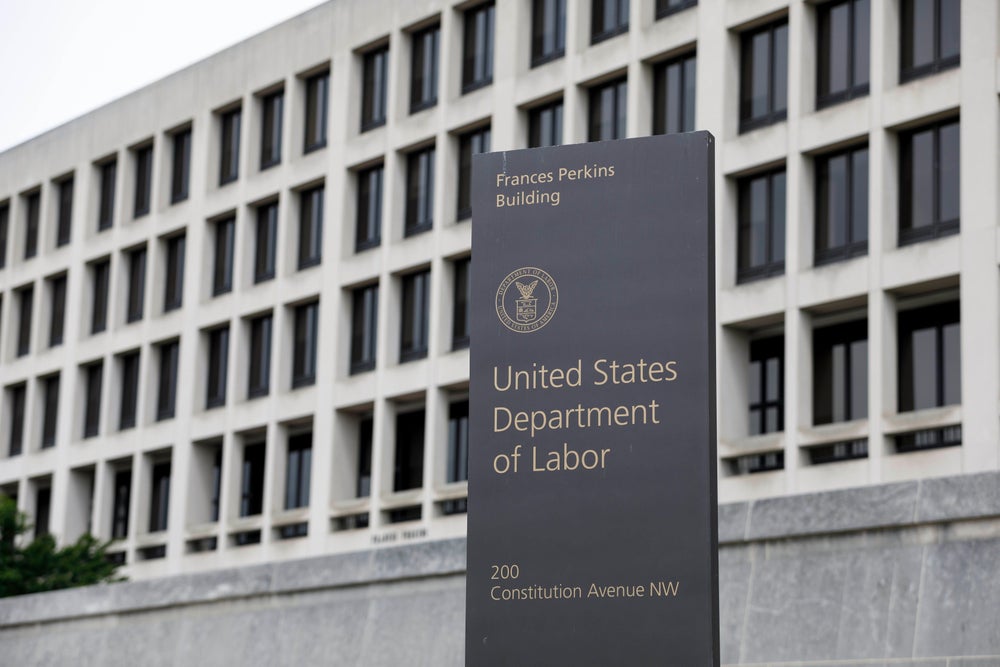
Occupational Safety and Health Administration (OSHA), an arm of the Labor Department, Washington D.C. Xinhua/Alamy Stock Photo
.
.
Click the link below for the complete article:
.
__________________________________________
February 24, 2025
Mohenjo
Business, Food For Thought, Human Interest, Political, Science, Technical
amazon, business, Business News, current-events, Future, Hotels, human-rights, medicine, mental-health, research, Science, Science News, technology, Technology News, travel, vacation

Click the link below the picture
.
After my daughter was born nearly four years ago, I decided that I wanted to breastfeed for one year. It was a challenging journey for so many reasons, but I can tell you with absolute certainty what made it possible: The fact that at the time, I worked a fully remote job. I never had to squeeze in a cramped room to pump milk at the office or commute to work with painfully clogged ducts.
These circumstances are among the reasons that some moms and other breastfeeding parents don’t return to their jobs after giving birth—or end up quitting breastfeeding before they are ready so that they don’t lose their jobs. As one mom recently explained, these working conditions are simply unfair and untenable for parents.
Breastfeeding Mom Finds Herself in Difficult Position at Work
In a rant posted to Reddit, the mom in question wrote that her 7.5-month-old baby has never taken a bottle. It was never a problem for her, as she worked from home. But after her previous manager left the company, she was told she would need to start coming into the office at least twice a week.
The new arrangement has already proved challenging for both mom and baby. She claims the first day she went back into the office, her baby didn’t eat for 10 hours. According to her replies in the comments, she’s tried a straw cup, introducing more solids, and “every sort of bottle and nipple flow out there” without much success.
The mom now feels like the sudden change in expectations at work is totally unjustified, given that she rarely has meetings and has proven to be an efficient and competent worker who can function without issue from her home. “I’m just so disgusted and fed up with how corporate America treats mothers.”
Multiple commenters agree that the company was “just trying to make you quit,” as one person put it. Others tried offering suggestions, which included leaving that company altogether.
“I’d start putting out some resumes and get ready to leave to a more flexible job. Or look at a daycare near work instead where you can maybe pop over to feed her there,” wrote another commenter.
Mom doesn’t want to leave her current job, even though her work schedule is so incompatible with her ability to parent, writing that “the thought of trying to get another job with the job market how it is right now sounds absolutely exhausting.” But with being the only full-time income in her family, she has no choice but to work, even though, as she put it, “being back to work with a 6-week-old is just criminal.”
Why Working Conditions Are Unfair for New Parents
She’s not the first mom to feel pulled impossibly between work and parenthood. The phenomenon that she, and so many other mothers face, is called the motherhood penalty, in which moms returning to work are less likely to get promoted, are paid less than non-parents, and are deemed less competent and committed to their jobs than their counterparts without kids. But as a lot of parents know, parenting is one of the most valuable job skills there is.
.
:max_bytes(150000):strip_icc()/breastfeeding-mom-reddit-GettyImages-672158891-48d020e57cb44c71b7d54e0b92cf3fcf.jpg) Parents/Getty Images
Parents/Getty Images
.
.
Click the link below for the complete article:
.
__________________________________________
February 23, 2025
Mohenjo
Business, Food For Thought, Human Interest, Political, Science, Technical
amazon, business, Business News, current-events, Future, Hotels, human-rights, medicine, mental-health, research, Science, Science News, technology, Technology News, travel, vacation

Click the link below the picture
.
President Donald Trump has long promised to cut excess in the federal government, saving money and dismantling bureaucracy.
Behind many of these moves is a new government group — the Department of Government Efficiency, or DOGE.
This new department was created when Trump renamed the previously existing United States Digital Service, appointing Elon Musk as a senior adviser to the president. Though Musk has often been seen as leading DOGE, new court filings claim he doesn’t work for the group.
This redefining of Musk’s role with Trump came after lawsuits challenging his authority. Several Democratic state attorneys general argue that his enormous power violates the Constitution’s “Appointments Clause,” which requires Congress to approve officers in the executive branch.
Here’s everything to know about DOGE, including where it came from, what it has done, and how its work is being tracked.
What is DOGE? What does DOGE mean in politics?
DOGE, which stands for Department of Government Efficiency, is mainly focused on finding ways to cut spending and regulations. The name refers to a cryptocurrency called dogecoin.
Musk was named the head of the organization by Trump shortly after he won the election. Trump made the department official with an executive action on his first day in office.
Recent court filings have called into question Musk’s role with DOGE, stating that Musk is a “senior advisor to the president” rather than leader of DOGE. The court filings also stated that the department is distinct and separate from the White House.
“In his role as Senior Advisor to the President, Mr. Musk has no greater authority than other senior White House advisors,” Joshua Fisher, director of the White House Office of Administration, wrote. “Like other senior White House advisors, Mr. Musk has no actual or formal authority to make government decisions himself. Mr. Musk can only advise the President and communicate the President’s directives.”
How much money has DOGE saved so far?
The DOGE website (doge.gov/savings) claims to track what it has done and how it has saved money.
As of Feb. 19, the site indicates that it has saved $55 billion through a “combination of fraud detection/deletion, contract/lease cancellations, contract/lease renegotiations, asset sales, grant cancellations, workforce reductions, programmatic changes, and regulatory savings.”
What has DOGE done?
The DOGE website claims to post receipts of its budget-slashing efforts, but most items listed are contracts canceled at various federal departments and agencies.
More than 10,000 federal employees have been fired and more cuts are expected. A recent executive order directs heads of federal departments and agencies to make “large-scale reductions in force.”
In many cases, probationary employees and the government’s newest hires are losing their jobs.
DOGE’s actions have fostered confusion and some false steps. For example, the administration rescinded the firings of hundreds of employees at the National Nuclear Security Administration, which oversees the nation’s arsenal of nuclear weapons. The U.S. Department of Agriculture is scrambling to rehire “several” fired employees who play a key role in the agency’s response to bird flu, an agency spokesperson has acknowledged.
The cuts, which include employees with USAID, the Federal Aviation Administration, Internal Revenue Service, the National Park Service, and Department of Education, have prompted legal challenges and other pushback.
There also has been backlash over what data DOGE can access. Several agencies, including the Department of Education and Treasury Department, have attempted to block DOGE’s access to data due to its sensitive nature.
DOGE is also seeking access to IRS data that includes extensive information about taxpayers and allows IRS employees to research accounts, request returns, enter transactions and collection information, and generate “notices, collection documents, and other outputs,” according to the IRS.
.

President Zelensky says he would step down if Ukraine can join NATO
.
.
Click the link below for the complete article:
.
__________________________________________
February 23, 2025
Mohenjo
Business, Food For Thought, Human Interest, Political, Science, Technical
amazon, business, Business News, current-events, Future, Hotels, human-rights, medicine, mental-health, research, Science, Science News, technology, Technology News, travel, vacation

Click the link below the picture
.
For all the extraordinary upheaval Donald Trump promises for America — mass deportations, mass layoffs of federal employees, the revoking of birthright citizenship — we will start to learn, in the coming months, how effective he’ll really be. Executive orders can be rescinded by later administrations, or get snagged in the courts, as has already happened over the past month. Yes, Trump can inflict tangible pain by himself. But becoming a dictator is easier said than done, even with the DOGE boys sowing chaos at the Treasury and IRS.
In Congress, Trump will have his chance to go much bigger. It’s there where his greatest ambitions, if he rounds up the votes, can become laws — which, unlike executive actions, are very difficult to undo. Joe Biden did not unravel Trump’s corporate tax cuts or save affluent households in the Northeast from the tighter SALT (state and local taxes) cap. Trump, in turn, will strain to do significant damage to the industrial policy Biden set into motion under the Inflation Reduction Act. If social conservatives ever felt they wanted to try to outlaw same-sex marriage again, they’d need to jam new legislation through Congress. Other than stacking the courts, leaving a policy legacy at the federal level means passing enormous omnibus legislation when your party is in power and daring rival successors to reverse it all.
When Trump turns his attention to legislation, what comes out of his administration might be, by modern Republican standards, rather conventional. On the agenda will be vicious attacks on the social safety net, the likes of which were waged, with limited success, in Trump’s first term. This is Trump’s version of populism; while he does not, like past Republican standard-bearers, want to privatize Social Security or gut Medicare, he is happy to aim at slashing other programs that the working class and poor rely upon.
It’s the House that will decide the fate of Trump’s legislative ambitions. Republicans have their smallest majority there since 1931, and Speaker Mike Johnson may only be able to spare a single vote. The majority itself is fractious, a mix of hard-right fiscal conservatives who’ve sought to topple Johnson and a small but influential number of moderates who carried swing districts. For many Republicans, aggressively reducing spending is the watchword, and that will carry with it especially destructive goals: bleeding out Medicaid with up to $2 trillion in reductions; slashing student-loan aid; cutting $250 billion from food stamps. The idea, in essence, is to balance out tax cuts for the rich by punishing the poor. MAGA and Reaganomics aren’t so different here.
Several days ago, Johnson got the House Budget Committee to approve a resolution that will allow the House to vote on a bill to address Trump’s aspirations for the border, energy, and taxes. The Senate, unlike the House,
wants to advance two separate bills rather than one, and the government could be shut down in a month if Congress can’t agree. The Senate, with its 53-member Republican majority, has far more leeway to back social safety nets and tax cuts than the House, where relative moderates in swing districts, like Mike Lawler in the Hudson Valley, may balk at any reconciliation bill that does significant damage to Medicaid or SNAP. Lawler wants to run for governor against Kathy Hochul next year, and the House bill that conservatives long for could do significant damage to his political prospects. Lawler would like to join suburban Democrats in getting Trump to lift the SALT cap, which the president imposed in 2017. Trump has signaled he is open to a SALT compromise, if conservatives in rural states still do not want to bail out the higher-tax states in the Northeast. Some progressive Democrats are fine with the SALT cap, too.
Republican leaders are now privately considering a continuing resolution to fund the government at current levels through the end of the fiscal year, along with wildfire aid and other provisions, according to Politico. To do this, the GOP would probably have to get the Democrats to play ball. So far, none of the Democratic leaders are eager to bail out Republicans if they can’t pass reconciliation legislation along a party-line vote or hunt up support for a stopgap bill.
.
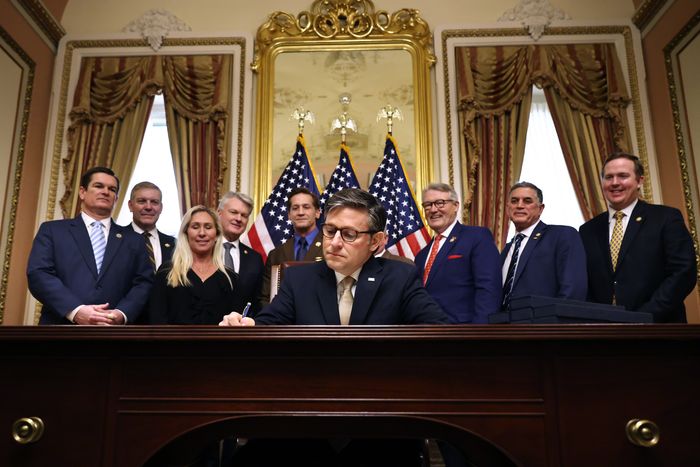 Photo: Chip Somodevilla/Getty Images
.
.
Click the link below for the complete article:
.
__________________________________________
February 23, 2025
Mohenjo
Business, Food For Thought, Human Interest, Political, Science, Technical
amazon, business, Business News, current-events, Future, Hotels, human-rights, medicine, mental-health, research, Science, Science News, technology, Technology News, travel, vacation
Click the link below the picture
.
Our teenagers are in trouble.
Headlines have been ringing loud alarms around adolescent mental health, and the data are sobering. In 2023, 40 percent of high school students surveyed by the Centers for Disease Control and Prevention said they persistently felt hopeless or sad in the past year. Nine percent had attempted suicide.
Some of it is because of COVID. Some of it is related to social media. Then there is bullying, the pressure to succeed academically, the pressure to fit in. Being a teenager in the U.S. is hard.
So it’s perhaps heartening to see President Donald Trump address mental health in a recent executive order (EO) targeting chronic health issues in children, one released as soon as Robert F. Kennedy, Jr., was confirmed as the director of the Department of Health and Human Services.
But nestled in this directive, which creates an RFK, Jr.–chaired commission to “Make America Healthy Again,” are words that speak to the doubt that he and Trump have tried to sow around established science. This includes suggestions that the research funded by the National Institutes of Health and other agencies isn’t “gold standard” and assertions that doctors are overprescribing medicines for conditions such as attention deficit hyperactivity disorder and
depression and that “medical treatments” might be part of the pediatric chronic disease problem. Perhaps most troubling is the language the administration uses to describe prescription medications for mood and behavior disorders—they are a “threat.”
That language stigmatizes families who choose prescription medication to treat their struggling children. It undermines the expertise of medical professionals. And it opens the door for unproven, improperly studied treatments to gain legitimacy.
The next era of snake oil dawns. Won’t anyone think of the children?
According to the CDC, in 2021 and 2022, more than half of U.S. teens talked to a health care provider about their mental health. About 14 percent of teens reported taking medication to manage their emotional state or for concentration and behavior. Yet 20 percent said they have unmet mental health needs.
The Affordable Care Act, and before it, the federal parity law, introduced a lot of Americans, including perhaps these teens’ parents, to parity in mental health coverage—in theory, insurance plans can’t deny mental health coverage, charge ridiculous rates for coverage that included mental health or put limits on the amount of mental health coverage a plan allows.
But even if you have insurance, depending on where you live, finding mental health care for children can be incredibly difficult. Many providers, whether therapists or psychiatrists, don’t take insurance, or don’t take certain plans. This includes Medicaid but also large commercial plans. Many primary care doctors, including pediatricians, have limits on what aspects of mental health care they are comfortable managing, including medication. In rural parts of the U.S., there are hundreds of counties that do not have a single child psychiatrist.
.
 Annadokaz/Getty Images
.
.
Click the link below for the complete article:
.
__________________________________________
February 23, 2025
Mohenjo
Business, Food For Thought, Human Interest, Political, Science, Technical
amazon, business, Business News, current-events, Future, Hotels, human-rights, medicine, mental-health, research, Science, Science News, technology, Technology News, travel, vacation

Click the link below the picture
.
If you are a parent, your greatest fear in life is likely something happening to one of your kids. According to one 2018 poll from OnePoll and the Lice Clinics of America (not my usual data source, but no one else seems to measure this), parents spend an average of 37 hours a week worrying about their children; the No. 1 back-to-school concern is about their safety. And this makes sense, if you believe that safety is a foundation that has to be established before dealing with other concerns.
You can see the effects of all this worrying in modern parenting behavior. According to a 2015 report from the Pew Research Center, on average, parents say children should be at least 10 years old to play unsupervised in their own front yard, 12 years old to stay home alone for an hour, and 14 to be unsupervised at a public park. It also shows up in what parents teach their kids about the world: Writing in The Journal of Positive Psychology in 2021, the psychologists Jeremy D. W. Clifton and Peter Meindl found that 53 percent of respondents preferred “dangerous world” beliefs for their children.
No doubt these beliefs come from the best of intentions. If you want children to be safe (and thus, happy), you should teach them that the world is dangerous—that way, they will be more vigilant and careful. But in fact, teaching them that the world is dangerous is bad for their health, happiness, and success.
The contention that the world is mostly safe or mostly dangerous is what some psychologists call a “primal world belief,” one about life’s basic essence. Specifically, it’s a negative primal in which the fundamental character of the world is assumed to be threatening. Primal beliefs are different from more specific beliefs—say, about sports or politics—insofar as they color our whole worldview. If I believe that the Red Sox are a great baseball team, it generally will not affect my unrelated attitudes and decisions. But according to Clifton and Meindl, if I believe that the world is dangerous, it will affect the way I see many other parts of my life, relationships, and work. I will be more suspicious of other people’s motives, for example, and less likely to do things that might put me or my loved ones in harm’s way, such as going out at night.
As much as we hope the dangerous-world belief will help our kids, the evidence indicates that it does exactly the opposite. In the same paper, Clifton and Meindl show that people holding negative primals are less healthy than their peers, more often sad, more likely to be depressed, and less satisfied with their lives. They also tend to dislike their jobs and perform worse than their more positive counterparts. One explanation for this is that people under bad circumstances (poverty, illness, etc.) have both bad outcomes and a lot to fear. However, as Clifton and Meindl argue, primals can also interact with life outcomes—you likely suffer a lot more when you are always looking for danger and avoiding risk.
Teaching your kids that the world is dangerous can also make them less tolerant of others. In one 2018 study, researchers subjected a sample of adults to a measure called the “Belief in a Dangerous World Scale,” which asked them to agree or disagree with statements such as “Any day now chaos and anarchy could erupt around us” and “There are many dangerous people in our society who will attack someone out of pure meanness, for no reason at all.” They found that people scoring high on this scale also showed heightened prejudice and hostility toward groups such as undocumented immigrants, whom they stereotypically considered a threat to their safety. This study was conducted among adults, but it is easy to see how these attitudes would migrate to their kids.
This is similar to the argument made by the writers Greg Lukianoff and Jonathan Haidt in The Atlantic in 2015, and in their subsequent book, The Coddling of the American Mind. Lukianoff and Haidt contend that when parents (or professors) teach young people that ordinary interactions are dangerous—for example, that speech is a form of violence—it hinders their intellectual and emotional growth. It also leads them to adopt black-and-white views (for example, that the world is made up of people who are either good or evil), and makes them more anxious in the face of minor stressors such as political disagreement.
.
 lemono/Getty Images
.
.
Click the link below for the complete article:
.
__________________________________________
February 22, 2025
Mohenjo
Business, Food For Thought, Human Interest, Political, Science, Technical
amazon, business, Business News, current-events, Future, Hotels, human-rights, medicine, mental-health, research, Science, Science News, technology, Technology News, travel, vacation
Click the link below the picture
.
t’s February 2025. The world feels like complete chaos, and it’s hard to step away from the news. Maybe your body feels tight, and perhaps your mind is racing.
Take a deep breath, then keep reading.
It isn’t just you: lots of people have expressed that they have felt overwhelmed and burned out from the events of recent months. Disasters, including Hurricane Helene and the Los Angeles–area wildfires, served as the backdrop to a frighteningly tense presidential election. And the new administration has acted loud and fast, often in ways that judges are already declaring unconstitutional.
To a degree, the result feels familiar. News overload is nothing new; major crises such as September 11 and the early months of the COVID pandemic delivered a similar onslaught of rapid-fire headlines that were laden with fear and uncertainty. However, experts say the developments during these first weeks of President Donald Trump’s second administration are posing a very real mental health threat that people may need new skills to manage. Scientific American spoke with experts in psychology and beyond about what’s happening and how to stay calm and grounded through it.
What Is the ‘Flood the Zone’ Strategy?
Political strategist Steve Bannon, who advised Trump during his first term, has openly discussed overwhelming the media as a key priority to advance right-wing objectives. “All we have to do is flood the zone,” Bannon told Frontline in 2019. “Every day we hit them with three things. They’ll bite on one, and we’ll get all of our stuff done: bang, bang, bang.”
This approach is reminiscent of the “Gish gallop” tactic that Trump has used during debates to barrage opponents and fact-checkers with so many lies and half-truths that it becomes impossible to adequately address them all. Away from the podium and inside the Oval Office, it’s a strategy that harkens back to a predigital Soviet practice of producing huge amounts of disinformation meant to make people question reality, as many experts have noted. The Trump administration’s version of this tactic uses volume to create paralysis among the opposition, says Dannagal Young, a professor of communication at the University of Delaware. “It’s the sense that you are being overwhelmed by a tidal wave,” she says. “How do you push back against a tidal wave? You can’t.”
In addition to the sheer number of actions coming from the administration, many are also entirely unprecedented. Without historical U.S. parallels to work from, our brain is less able to calculate what these developments might lead to, and that can make processing the news even more difficult. “The chaos that ensues is really hard to make sense of because we don’t know the consequences,” says Kristen Lee, a psychotherapist and a teaching professor of behavioral science at Northeastern University.
But it’s not just the volume of headlines and the intellectual difficulty of understanding what’s happening that make current news overwhelming. The key, psychologists say, is the emotional weight of those headlines’ content—especially for people who find what’s happening in the U.S. today to be genuinely frightening.
Fear in the Brain, Fear in Societies
For someone worried about the administration’s policies creating tangible harm, each new headline can create a spark of fear—and fear is a remarkably powerful emotion. “Threat and fear take the priority in our brains,” says Arash Javanbakht, a psychiatrist and a neuroscientist at Wayne State University. “When you’re afraid, all you’re thinking about is what you’re afraid of.”
.
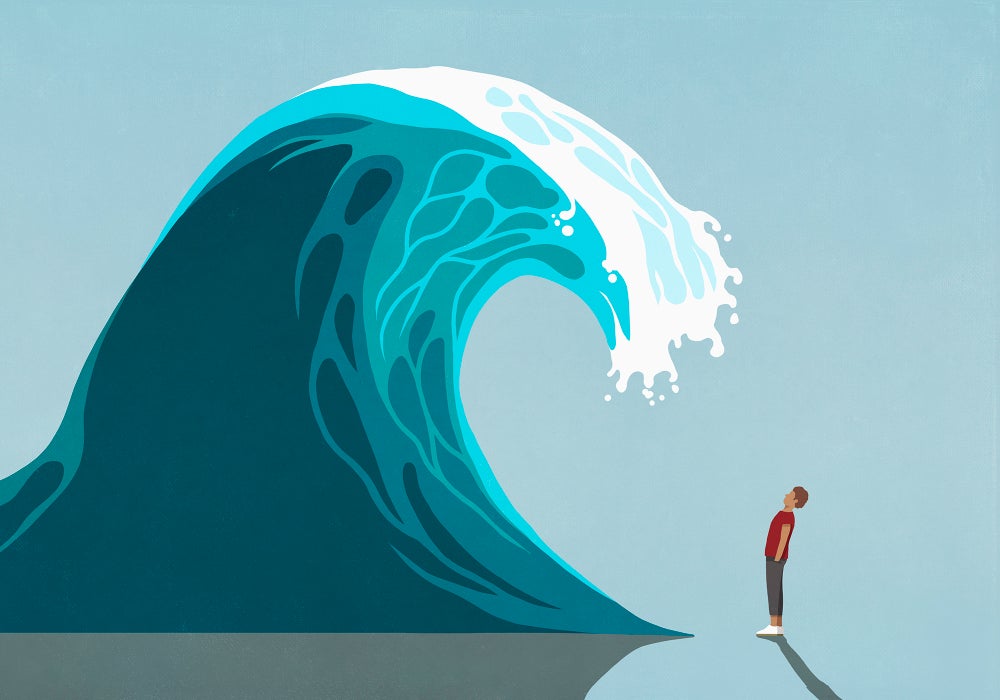 Malte Mueller/Getty Images
.
.
Click the link below for the complete article:
.
__________________________________________
February 22, 2025
Mohenjo
Business, Food For Thought, Human Interest, Political, Science, Technical
amazon, business, Business News, current-events, Future, Hotels, human-rights, medicine, mental-health, research, Science, Science News, technology, Technology News, travel, vacation

Click the link below the picture
.
The day my mom moved in, my 3-year-old spun in circles, singing, thrilled that her Gigi was back for what she assumed was just another visit. My newly walking 1-year-old wobbled after her, babbling, unaware of the shift that was about to redefine our home. In the center of the chaos, my mother smiled, her face and body not yet bearing the visible evidence of the lung cancer that was killing her. She had moved across the country to live with us, preparing to start treatment at our local hospital.
I had imagined this as a time of reconnection — a chance for her to become a steady presence in her grandchildren’s lives, for us to truly know each other as adults after years spent living so far apart. Instead, my days blurred into an exhausting cycle of diaper changes, nap battles, and doctor’s appointments, torn between being the mother my children needed and the daughter my mother deserved. I thought there would be space to simply be with her — to talk, to reminisce, to connect. But caregiving was never still. It was crisis management, the constant triage of needs.
Focusing on both my mom and my kids as much as I wanted to was nearly impossible
When I was focused on my mom, I worried I was neglecting my children; when I was with my children, I felt I was abandoning my mother. Guilt was the main feeling in those days; I never felt like I was fully taking care of or helping anyone who needed me in the capacity they needed. And certainly, I was not taking care of myself.
As the chemo took its toll and my mother grew weaker, my life slowed — necessarily, but unexpectedly. Even as she became less able to care for herself, she found ways to remain present for my children. From her bed, she read to them, her voice softer yet steady. She taught my daughter sign language and helped my son stack blocks into towers, cheering and laughing with him when they toppled over. Though I was busier than ever, life took on a new rhythm, one I had never allowed before. We moved at her pace, sitting longer, staying present.
Then, something would happen that demanded immediate attention. A broken plate. A toddler’s stomach bug. My mom’s fever. Decisions had to be made — should I call her doctor? Should I call 911? In addition to worrying about my children’s sleep, health, and development, I now had to consider what side effects of my mother’s treatment warranted an emergency. What should I do if she stops eating?
I was still trying to make sense of everything when I found myself upstairs, cleaning crayon off the walls, only to realize my mom needed to be rushed to the hospital, where they diagnosed her with sepsis. Why hadn’t I noticed how sick she was earlier? How did I not notice? These questions haunted me for a long time.
.
 The author (not pictured) was a stay-at-home mom with two toddlers while also caregiving for her mom. Ray Kachatorian/Getty Images
.
.
Click the link below for the complete article:
.
__________________________________________
February 21, 2025
Mohenjo
Business, Food For Thought, Human Interest, Political, Science, Technical
amazon, business, Business News, current-events, Future, Hotels, human-rights, medicine, mental-health, research, Science, Science News, technology, Technology News, travel, vacation
Click the link below the picture
.
CLIMATEWIRE | The National Science Foundation went beyond the staff cuts demanded by the Trump administration in a move that set off a frenzied backlash at the science funding agency.
NSF fired about 10 percent of its staff at the end of Tuesday, removing 168 people who included most of the agency’s probationary employees and all of its experts, a class of contract workers who are specialists in niche scientific fields.
The agency didn’t have to fire its experts but decided to in the interest of fairness, a top NSF official told staffers in an emotionally charged hybrid meeting Tuesday morning at its Alexandria, Virginia, headquarters.
“The removal of experts was completely at the agency’s discretion. Because if we’re asked to remove probationers, then we also need to remove at-will employees,” Micah Cheatham, NSF’s chief management officer, said at the tense and tearful hour-long meeting, according to a transcript obtained by POLITICO’s E&E News.
“This is the first of many forthcoming workforce reductions,” he added.
NSF was created by Congress in 1950 to ensure U.S. leadership in science and engineering. The agency now provides roughly a quarter of federal support to America’s colleges and universities for basic research.
E&E News previously reported that NSF expects to cut up to half of its 1,500-person workforce. Scientists and Democratic lawmakers fear that staff losses of that scale could effectively break the nation’s research and innovation pipeline, with disastrous consequences for the U.S. economy and American citizens.
The mass firing at one of the nation’s leading funders of scientific research comes as Elon Musk, the head of the Department of Government Efficiency established by President Donald Trump, races to slash federal spending with the help of the Office of Personnel Management. Musk’s group has initially targeted foreign aid and racial diversity efforts, but nearly all agencies have been impacted by cuts, or expect them to come soon.
A few probationary employees whose work NSF leaders determined was essential were spared from the firings.
“We asked who was mission critical and more than half of people were identified,” Cheatham said. “That was too many.”
Fired NSF staffers were instructed to stop working by 1 p.m. Tuesday, at which point they would be locked out of the agency’s computer network. They had until the end of the day to clean out their desks.
To avoid having the stain of a firing on their resumes, staffers were told they could resign. But then they would not be eligible for unemployment payments.
The announcement prompted outrage, confusion, and concern from people at the meeting, resulting in a string of scathing all-staff emails from impacted workers.
.
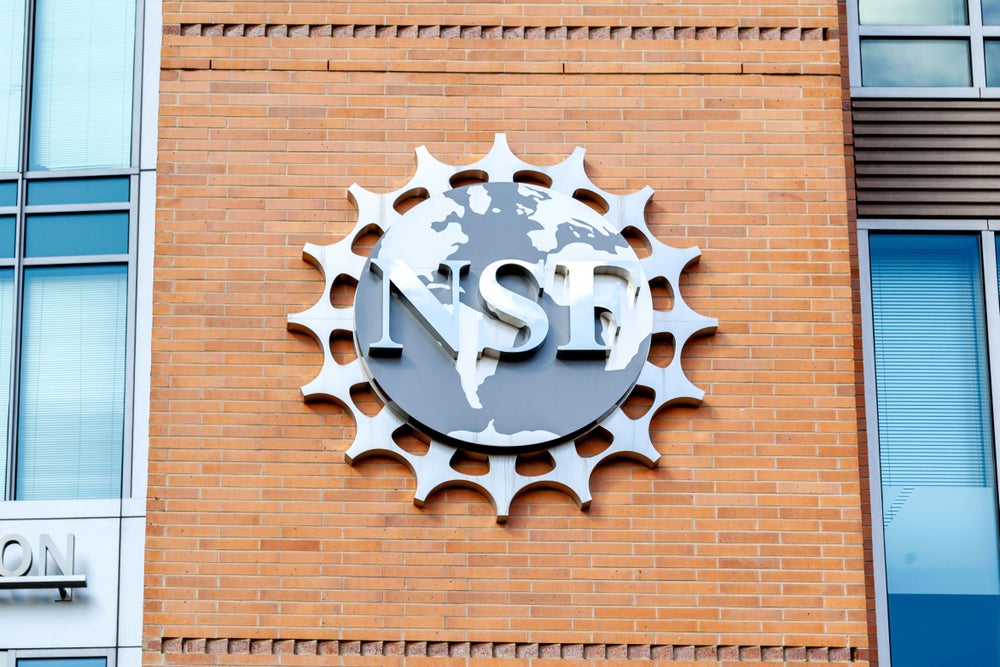
National Science Foundation headquarters shown outside Washington. JHVEPhoto/Alamy Stock Photo
.
.
Click the link below for the complete article:
.
__________________________________________
Older Entries
Newer Entries
 James' World 2