
Click the link below the picture
.
A humpback whale nicknamed Timmy that has been stranded in the Baltic Sea off Germany will be left to die; all rescue efforts have been called off, according to Till Backhaus, environment minister of the German state where the whale is now stranded.
The 12- to 15-meter-long whale became stuck on sandbanks a few times at the end of March—in one incident, it was freed with the help of an excavator that dug an escape channel, and in another, it freed itself. Currently, Timmy is beached on a small island near the port of Wismar, Germany, in the Baltic. Reports suggest the animal, which is thought to be male but whose sex has not been fully confirmed, is exhausted, breathing irregularly, and hardly moving.
Marine biologist and whale conservationist Fabian Ritter has been following the situation in the media and has been in regular contact with those on the ground. Scientific American’s German-language sister publication Spektrum der Wissenschaft spoke with Ritter about the difficult decision to halt rescue efforts and needed changes in policy and individual actions around such incidents.
Experts and others have voiced varying opinions about the state of the whale’s health. Why has that been so difficult to assess?
We are primarily dependent on external signs from the animal’s behavior. Is it breathing regularly, and how forcefully [is it doing so]? What does [its] skin look like? What is its general condition? These are things we can only roughly assess. What we do know, however, is that the humpback whale has endured weeks of suffering because it was entangled in a fishing net, which has certainly weakened it considerably. And there are still pieces of the net in its mouth, which is why it might not be able to eat, even if it wanted to. It is growing weaker and is now likely nearing the end of its life.
Throughout this saga, have you seen any hopeful signs that the whale might pull through?
Five or six days ago, I gave the whale no chance at all—and was then surprised when it freed itself again. But my hopes remained low. In the past few days, it has only circled a few times and then settled down again. This suggests that it is pretty much at its physical and mental end.
If the whale had made it to the open sea, would it be safe?
Had [the whale] gotten moving again and swum in the right direction, [it] would have still had hundreds of kilometers to go to reach the Atlantic. It was certainly within [the whale’s] grasp that [the animal] would have found [its] way. But the net in [its] mouth is likely causing [it] pain and preventing [it] from eating much, if anything. Ultimately, that would be a death sentence, no matter how far [it] manages to swim.
What exactly is the next step? Will this marine mammal just die naturally? There has also been talk of euthanasia.
Euthanasia has been ruled out by all involved. Such an undertaking is logistically too difficult, especially because the animal is currently lying on muddy ground. And then there’s the question of how exactly it would be done. There are three possibilities: One could, for example, inject a high dose of toxin. But no one knows how much a humpback whale would need. The second option is the use of high-caliber firearms. The problem with this is that the shot would have to be extremely precise; otherwise the animal would suffer even more. The third option would be an explosive device. While this would be the most effective, what if cameras were rolling? The world would be watching. No, that wouldn’t be a good solution. [More about whales: Scientists saw a sperm whale giving birth. And then things got weird]
What happens after the death of the marine mammal?
The carcass [will be] hauled onshore with heavy equipment, and veterinarians [will] thoroughly examine it: blood tests, internal injuries, pollutant levels, parasites. Naturally, everyone is interested in determining the actual damage the net caused in its mouth or digestive tract. Afterward, the whale must be butchered and disposed of.
How did the whale get into this predicament? Is there any more information about it now?
The main reason is likely the net. It’s unclear whether [the whale] got entangled in it in the Baltic Sea or already in the North Atlantic. If the latter is true, [the animal] arrived weakened and was therefore already in great distress. Another possibility is that [it] ended up in the Baltic Sea as a stray—perhaps with a preexisting condition and disorientation. Reasons for this could include hearing damage from underwater noise. Sometimes humpback whales simply appear in unexpected areas. Therefore, it’s possible [it] was simply curious and ended up in the Baltic Sea for that reason. Such things happen from time to time.
What is the most likely scenario?
[The whale] probably got lost. I think it’s rather unlikely that [the animal] deliberately swam into the Baltic Sea. What is certain is that when [it] was first sighted [in early March], the net was already wrapped around [its] body. That certainly made [its] predicament worse.
Although the whale has been largely freed from the lines, its situation hasn’t improved. Could there be a deeper problem with the whale’s ability to navigate?
The question is: How exactly does [it] navigate in the Baltic Sea? Does [it] use [its] sense of taste, Earth’s magnetic field, [its] hearing? Or does [it] orient [itself] by water temperature? Experts are debating which is the most important sense for a baleen whale. The fact is, [this whale] is getting weaker, and with that, [its] senses are diminishing. And perhaps [it] is also losing the motivation, the strength, and the ability to decide where to swim.
How do you assess the measures taken to save the humpback whale in retrospect?
That’s a difficult question. From my perspective, the strategy was sound. Giving the animal periods of rest and then motivating it again—that was the right approach. The decision to enter the water with it was rather unwise, however. If you ask whale experts from rescue teams worldwide, they all say the same thing: don’t go into the water with the whale—and certainly not alone. A careless movement could lead one to be struck by a fluke or otherwise injured. There’s no easy solution for such situations. The team from the Institute for Terrestrial and Aquatic Wildlife Research (ITAW), the German Oceanographic Museum and Greenpeace ultimately used a trial-and-error approach to see what could be done. If the whale dies, no one on the rescue team can be blamed afterward. The odds were stacked against them from the start.
And what about the decision not to remove the gillnet from the mouth—was that the right call?
I think they should have tried. When the whale was still in [Timmendorf Strand, Germany], there was at least a chance. But that was only possible with a specialized team and specialized equipment. In hindsight, though, we should be thinking more about what we can do differently in the future to prevent whales from ending up in this situation again. After all, it’s a very visible and tragic victim of fishing.
What types of political action could help these situations?
Marine conservation organizations working to protect whales have long been calling for an end to bottom trawling and gillnet fishing—at least within protected areas. These fishing methods destroy habitats and are responsible for horrendous bycatch. Every year, 300,000 whales and dolphins die worldwide, along with millions of seabirds, not to mention sharks. Thousands of harbor porpoises are killed in nets in Europe every year. And that’s despite the fact that they are a strictly protected species.
How is it even possible that fishing is taking place in a marine protected area?
We marine conservationists have been asking ourselves this question for decades. Fishing is just one of many uses [for protected areas]. Shipping, gravel extraction, tourism, and military exercises also take place in protected areas; some even contain wind farms. It’s absurd what’s going on in these so-called protected areas today.
Do you see any chance of this current case bringing about a change of heart?
Yes, because the connection couldn’t be clearer. Backhaus is now called upon to give serious consideration to the problem of bycatch in gillnet fisheries. I hope that the fate of the lost whale will serve as a wake-up call and motivate people to take action. And by that, I don’t just mean politicians—we are all called upon to act. Ultimately, with every tuna steak, every salmon fillet or every cod on our plates, we are contributing to the plundering of the oceans. At least, that’s the case if the fish don’t come from explicitly sustainable fisheries or aquaculture.
Isn’t the fact that so many people are touched by the whale’s fate a good sign? Is a shift in values perhaps taking place?
I think this could be an opportunity for a shift in values. We should recognize that our emotion reveals an ambivalence. We’re anxiously following the plight of the humpback whale, yet at the same time, we have salmon fillets and sausages sitting in our refrigerators. If the fate of a whale affects us so deeply, then the deaths of the 300,000 marine mammals that perished in nets should also affect us deeply. We urgently need to ask ourselves: How should we treat the oceans and animals? These are indeed profound ethical questions, but the story needs to be brought to this level. If we translate our compassion into action, the whale’s death will not have been in vain.
.
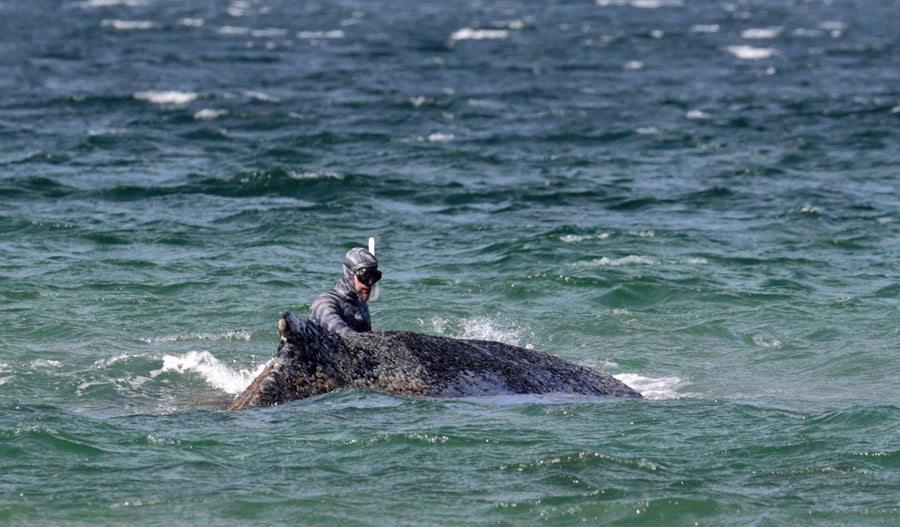
Marine biologist Robert Marc Lehmann tries to help the stranded whale on a sandbank off Niendorf in the Baltic Sea on March 26, 2026. IMAGO/Susanne Hübner, Susanne Huebner via Alamy
.
.
Click the link below for the complete article:
.
__________________________________________
 James' World 2
Leave a comment