
Click the link below the picture
.
Physicists just discovered a brand-new particle that appears to be an exotic cousin to the protons and neutrons that make up atoms.
Those mundane subatomic particles are made up of even smaller building blocks of matter called “up” and “down” quarks, which are the lightest kinds of quarks. But quarks come in heavier flavors as well, including “charm,” “strange,” “bottom”, and “top” (the most massive fundamental particle known).
The new particle, discovered at the world’s largest atom smasher, the Large Hadron Collider (LHC) in Geneva, Switzerland, contains two charm quarks and a down quark. Like protons and neutrons, its total of three quarks classifies it in particle physics as a baryon, which is a type of hadron—or a particle made of quarks. The discovery brings the current tally of known hadrons discovered by LHC experiments to 80.
The new particle, which physicists are calling a doubly charmed baryon, essentially replaces the two up quarks in a proton with charm quarks, giving it about four times the mass of the more common and stable proton.
The LHC accelerates protons to more than 99 percent the speed of light and then slams them together. The protons are destroyed, and the energy of the crash gives rise to new particles in their wake. Every time a doubly charmed baryon was created within the collider, it quickly decayed into lighter particles.
The new particle was discovered by the LHCb experiment, one of nine detectors stationed around the LHC’s 17-mile-long ring. It’s the first new particle seen at the experiment since scientists upgraded LHCb in 2023.
The doubly charmed baryon is only the second baryon with two heavy quarks ever seen—the rest have all contained two up or down quarks and just one of the heavier flavors. The previous heavy baryon was discovered in 2017, also at LHCb, and consists of two charm quarks and an up quark. Despite their similarities, the newfound particle is even less stable than the other heavy baryon, with a lifetime predicted to be about six times shorter.
Finding these kinds of particles helps teach physicists about the strong force, which is the most powerful force in nature and binds hadrons together. The strong force is also the most mysterious and confusing force, governed by a complex theory called quantum chromodynamics. Physicists hope to understand how the strong force holds quarks together and how the composite particles’ properties, such as mass and spin, arise.
Physicists announced the discovery this week at the Moriond particle physics conference in Italy.
.
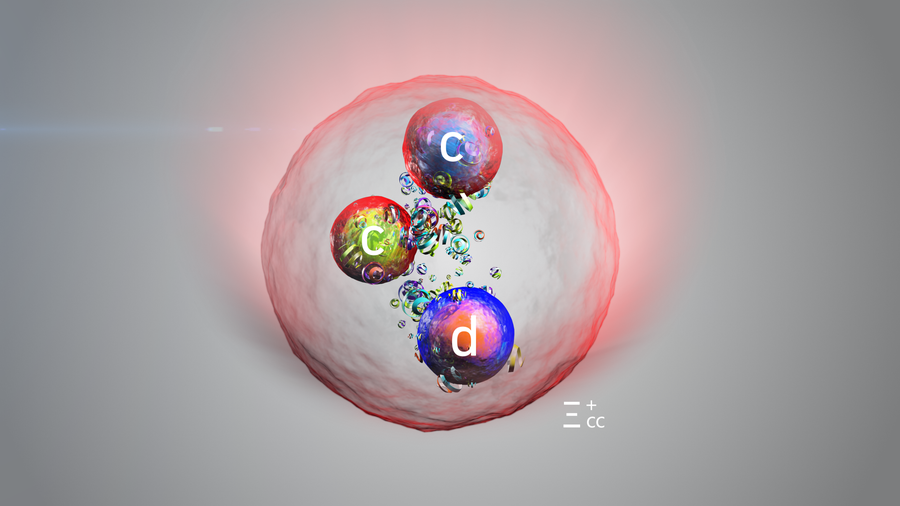
Artist’s impression of the new particle, which contains two charm quarks and one down quark. CERN
.
.
Click the link below for the complete article:
.
__________________________________________
 James' World 2
Mar 24, 2026 @ 04:42:16
Interesting read.
LikeLike
Mar 24, 2026 @ 07:33:26
Thanks you sir, American Scientific articles are so informative!
LikeLiked by 1 person