Tehran has said it will “irreversibly destroy” essential infrastructure across the Middle East, including vital water systems, if the US follows through on Donald Trump’s threat to “obliterate” Iran’s power plants unless the strait of Hormuz is fully opened within two days.
As Iranian missiles struck two southern Israeli cities overnight, injuring dozens of people, and Tehran deployed long-range missiles for the first time, the developments signalled a dangerous potential escalation of the war, now in its fourth week, with both sides threatening facilities relied on by millions of people.
Iran war timeline: civilians bear brunt of US and Israel’s weeks-long campaign
Read more
The speaker of the Iranian parliament, Mohammad Bagher Ghalibaf, said on Sunday that vital infrastructure in the region – including energy and desalination facilities – would be considered a legitimate target and would be “irreversibly destroyed” if his country’s own infrastructure was attacked.
Amnesty International said this month there was a substantial risk that attacks on systems providing essential services such as electricity, heating, and running water would violate international law and “in some cases could amount to war crimes” because of the potential for “vast, predictable, and devastating civilian harm”.
The Iranian military’s operational command headquarters, Khatam al-Anbiya, said Iran would strike “all energy, information technology and desalination infrastructure” belonging to the US and Israel in the region.
The statement also said that if Trump’s threat was carried out, the strait of Hormuz would be “completely closed, and will not be reopened until our destroyed power plants are rebuilt”.
Iran’s president, Masoud Pezeshkian, said “threats and terror” were “only strengthening Iranian unity”, while the “illusion of erasing Iran from the map” showed “desperation against the will of a history-making nation”.
The US president said on Saturday that he was giving Iran 48 hours – until shortly before midnight GMT on Monday – to open the Strait of Hormuz, a vital pathway for the world’s oil flows, or the US would “hit and obliterate” Iranian power plants, starting with the biggest one first”.
The US ambassador to the UN, Mike Waltz, defended Trump’s threat on Sunday, insisting that Iran’s Islamic Revolutionary Guard Corps (IRGC) controlled much of the country’s infrastructure and used it to power its war effort.
He said Trump would start by destroying one of Iran’s largest power plants, but did not identify it. “There are gas-fired thermal power plants and other type of plants,” and “the president is not messing around”, he said.
A No 10 spokesperson said Keir Starmer spoke to Trump on Sunday evening about the need to reopen the strait of Hormuz.
Iran’s representative to the International Maritime Organisation, Ali Mousavi, said on Sunday that the strait was open to all shipping except vessels linked to “Iran’s enemies”, with passage possible by coordinating security arrangements with Tehran.
Iranian attacks have in effect closed the narrow strait, which carries about a fifth of global oil and liquefied natural gas supplies, causing the world’s worst oil crisis since the 1970s and sending European gas prices surging by as much as 35% last week.
Only a relatively small number of vessels, estimated at about 5% of the prewar volume, from countries that Tehran considers friendly – including China, India, and Pakistan – have been allowed to pass.
.
Smoke rises above Tehran after an Israeli airstrike on Sunday evening. Photograph: Anadolu/Getty Images
Film and Writing Festival for Comedy. Showcasing best of comedy short films at the FEEDBACK Film Festival. Plus, showcasing best of comedy novels, short stories, poems, screenplays (TV, short, feature) at the festival performed by professional actors.

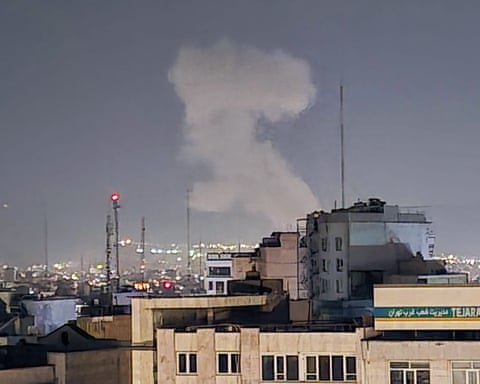 Smoke rises above Tehran after an Israeli airstrike on Sunday evening. Photograph: Anadolu/Getty Images
 James' World 2
Leave a comment