
Click the link below the picture
.
A flashy fireball streaked across the skies above the Midwest on Tuesday, falling to Earth near Lake Erie and Ohio at around 9:00 AM EDT. Some reported hearing a boom loud enough to shake their houses.
The object appears to have been a seven-ton asteroid that spanned nearly six feet in diameter, according to NASA. When it fell, it was traveling at around 40,000 miles per hour in a southeasterly direction before “fragmenting”—blowing up—over Valley City in Ohio. The explosion had the equivalent force of 250 tons of TNT, the agency said, and “may have also shook houses north of Medina.”
The blast sent a wave of pressure toward the ground, which would have been heard by local residents. Some fragments of the meteor fell as meteorites near Medina, NASA said, but it’s unclear if there was any damage as a result of the fireball.
“What occurred this morning was a daylight fireball at least several feet across,” says Robert Lunsford, who helps coordinate fireball reports at the American Meteor Society. “This is large enough to survive down to the lower atmosphere, where the air molecules are dense enough to carry sound. Therefore, people under the path of this fireball heard a delayed sonic boom produced by this fireball.”
Early on, the object didn’t have the characteristics of a piece of space junk—another possible falling space object—astrophysicist Jonathan McDowell noted ahead of NASA’s identification. “Space debris usually has slowed to below supersonic by the time it gets low enough that it would make an audible boom,” McDowell says.
It’s also a mystery where the asteroid came from. Earth is bombarded by falling space dust and rocks all the time, but only some of these are large enough to make it close enough to the ground to be visible in the daytime without first burning up in our atmosphere. If any part of a meteor survives the journey to land on the ground, it becomes a meteorite.
“We receive several reports of daylight fireballs per month from all over the world,” Lunsford says. “If they are large and bright enough, they can be seen against the blue daytime sky. So it’s rare for an individual to see one of these but fairly common over the entire planet. Still, they make up far less than one percent of the total number of fireballs reported to us.”
.
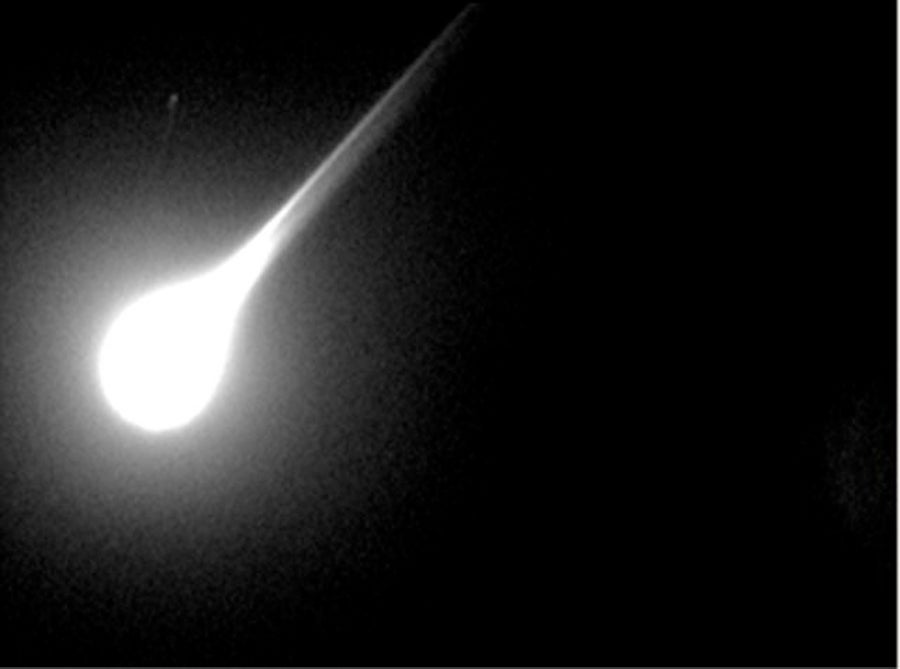
This image, taken with a meteorite tracking device developed by amateur astronomer George Varros, shows a meteorite as it enters Earth’s atmosphere during the Leonid meteor shower on November 19, 2002. Photo by George Varros and Dr. Peter Jenniskens/NASA/Getty Images
.
.
Click the link below for the complete article:
.
__________________________________________
 James' World 2
Leave a comment