
Click the link below the picture
.
Mexico’s president has praised the special forces for “bringing down” the country’s most wanted man, drug lord Nemesio Oseguera Cervantes.
Oseguera, better known as “El Mencho”, died in custody on Sunday, shortly after being captured amid a bloody firefight in Jalisco.
But as the BBC’s Quentin Sommerville found in another Mexican cartel hotspot – Culiacán in northern Sinaloa state – the vacuum left by the removal of a powerful cartel leader can trigger a surge in violence as warring factions battle for control.
Warning: This article contains graphic accounts of cartel violence, which readers may find upsetting.
“The fear is everywhere, and the fear is constant,” said paramedic Héctor Torres, 53, from the front seat of the ambulance in Culiacán.
We had just come from the scene of a shooting inside a garage in the city centre.
The owner was lying dead in his office, blood spreading across the white tiled floor. As Héctor and the other paramedic, Julio César Vega, 28, entered the premises, a woman ran in wailing.
She was the man’s wife, but there was nothing to be done. Héctor checked for vitals and then placed a paper blanket over the corpse.
For the last year and a half, the Sinaloa cartel, one of the world’s largest and most feared drug gangs, has been at war with itself, after the son of one of its leaders betrayed another.
The removal of that cartel leader, Ismael “El Mayo” Zambada, who is now in prison in the US, has wrought mayhem across Sinaloa and provides a warning of the dangers facing the country.
Héctor said the violence in Culiacán had never been so bad or gone on for so long. Last year, their number of call-outs increased by over 70%.
But in the week I spent with Héctor and Julio, almost every incident they responded to ended the same way, with a dead body in a building or by the side of the road, and grief-stricken relatives nearby asking for answers.
Few cartel victims survive, and nowhere is safe; schools, hospitals and even funerals have been attacked.
“Sinaloa cartel was like a family. Everyone was united in a single cartel. They were friends, they ate at the same table,” Héctor explained. “They were like brothers –parents, uncles, sisters – and suddenly they were fighting… and locked in a deadly feud,” he said.
That family business was built into a billion-dollar enterprise producing the deadly drug fentanyl and flooding US streets with opioids, which have cost tens of thousands of lives.
US President Donald Trump declared the cartel, and others, terrorist organisations, and labelled fentanyl a weapon of mass destruction. He’s threatened Mexico with direct military action if it doesn’t bring the drug and the traffickers under control.
Both Héctor and Julio were wearing body armour, 14kg of Kevlar and armour plate.
Julio said it was essential: “We don’t know if the people responsible for the attacks are still at the scene or if they completed their objective and suddenly disappeared. So we run the risk of being caught in the crossfire of an attack and getting injured.”
The sun was beginning to set as we drove back to the paramedic base, and a city that once came alive at night, would soon be deserted. Traffic was slow.
The Mexican government has sent thousands of troops to Sinaloa, and they’d set up checkpoints on most of the roads.
It turned out that when the garage owner was killed, three men were kidnapped from the premises at the same time. The heavily armed soldiers and marines were checking cars for any sign of them.
Warning: The following paragraphs contain descriptions of violence and torture which readers may find upsetting.
Kidnapping in Culiacán can be a fate worse than death.
Earlier in the week, a body had been found dumped on the pavement outside one of the main shopping malls.
From the state of the victim’s corpse, it was clear he’d been tortured. His body was intact, but the skull had been flayed and the eyes removed.
A sign was left with the corpse, in large lettering, a message from one cartel faction to another. It accused the dead man of being a traitor and came with a warning: “We are coming for the rest of you.”
Culiacán is a prosperous city, full of shopping malls, neat parks and fancy car dealerships. Outside the mall, a man in black cycling gear stopped in the rush-hour traffic to stare as the police placed the remains of the man into a body bag.
The next day, the body of another victim – mutilated in the same way – was left by the main road heading north outside of the city. When the forensic team lifted the accompanying sign, it was difficult to read; blood ran down its surface and puddled in the gravel verge.
At each new crime scene, I would meet Ernesto Martínez, who has been reporting on the violence here for 27 years. A 16-year-old boy had been shot dead in the city’s San Rafael neighbourhood; Emmanuel Alexander legs were still tangled in his bike frame as the police marked out the more than a dozen bullet casings around his body.
He’d been killed at close range by a handgun.
Martínez explained that “there used to be more police officers, there were more soldiers, there was more security”.
“You’d find a checkpoint on every corner, and yet the homicides continued; they didn’t decrease, they remained at an average of five or six homicides a day. And the same trend continues.”
So what might end the violence? I met one of the Sinaloa factions to ask that question. Before the meeting, I was told not to bring my phone, nor any tracking devices.
They are vicious criminals, who show little remorse, and they have a simple solution to the killings. The government should step out of the way and let them murder each other – regardless of the threat to bystanders – until one faction is left standing.
They arrived at the meeting fully armed, and donned face masks for the interview, after insisting on having their identities disguised.
When I asked “Marco” (not his real name) if he had any guilt, he said: “Yes, it’s true because a lot of times innocent people die. Children die. There’s a lot of death of innocent people.”
Sitting beside him, “Miguel” (not his real name) was more ruthless: “A lot of people will keep dying because the cartel is still fighting, and it keeps getting worse. The war will continue. Nothing will calm down until there’s only one faction left.”
Reynalda Pulido’s son, Javier Ernesto, disappeared in December 2020. She’s still searching for him, and for others too – and leads the group Mothers Fighting Back.
On a chilly morning, at a petrol station not far from Culiacán, Pulido and a group of other mothers hugged each other before setting out on a search.
The women, more than a dozen, were nearly all wearing white T-shirts with the pictures and names of their missing loved ones.
They began by fixing the pictures of some of the missing to lamp posts, the sound of their tape tearing across the noise of neighbourhood dogs, which barked aggressively when they passed by homes. With them was a military escort, half a dozen heavily armed soldiers, in an armoured truck and pick-up truck with a top-mounted gunner, acting as their convoy.
In a field where buzzards were flying overhead, they used metal probes and pick axes and shovels in their search for remains. They were looking for disturbed soil, indentations in the ground, any sign of a makeshift grave. As they probed the earth, they smelt the dirt, looking for the distinctive odour of human remains.
During a break in the search, Reynalda Pulido told me that when she wakes up every day, she asks God: “Tell me why I’m here?”.
“What gives me strength is realizing that no one else is going to look for them. I realize it because no one is moving to search for the disappeared in Sinaloa. And a mother will always look for her child, no matter if it’s to the ends of the earth, she will look.”
The women had received several tip-offs that a body may have been disposed of in the field, but after hours in the midday sun, they found nothing but animal bones.
I asked Reynalda gently if she thought she would ever find her son. “It’s something I ask myself very often,” she said, wiping tears from her eyes.
“But I’ve already found my son in the 250 bodies I’ve located, and in the thirty-something people I’ve found alive. They are my children, too. And the children of all the families who come to ask me for help become my children. My son is there, in each and every one of them. All of them carry a little piece of my son.”
The root cause of Culiacán’s misery is the fentanyl trade.
In a cartel-owned basement, “Román” (not his real name), who produces the drug, tells me to follow him.
He’d just packed his latest shipment of the drug, more than half a dozen packages of tightly pressed white powder, bound for the United States.
He wore a face mask and gloves while handling the deadly bundles.
When he opened one package, it was pressed solid, the number 300 indented in the surface.
Before, they would ship pills to the US. Now, they send powder, which they believe makes it easier to avoid US Customs.
Each package weighs a kilo and is worth $20,000 (£14,800). But Román explained that, depending on the city it is sent to, it can fetch more. “If we take it to New York, it can go as high as $28,000 or $29,000. The further up it goes, the higher the price, and the greater our profit.”
He takes no responsibility, feels no shame for the business he is in. And he says that whatever the Mexican and United States governments think, the fentanyl will keep flowing.
“Even though the government has intensified the search, they’re coming after us more and getting closer, yes,” he said. “But when it comes to production, we’ve never stopped. Sometimes we do scale back because things get hot, the government gets too close. So we lay low for a few days, but once that problem passes, we either continue or move to other areas.”
The US has labelled you terrorists, we tell him. He replies, blithely: “Well, even though President Donald Trump refers to us as terrorists, I would just remind him that as long as there are consumers, we’re going to keep doing this, but that doesn’t necessarily make us terrorists. As long as people want to consume it, they are free to do so. No one is forcing them. No one forced them to start this vice, to start using this stuff.”
The Mexican government has said it is making progress in its fight against drug trafficking. It says it has cut the fentanyl supply to the US by 50%.
From Culiacán, I travelled to Mexico City. The capital’s airport was noisy with the sound of drilling and plaster being pulled from walls, preparations for World Cup 2026.
At one of her regular news conferences – held before Sunday’s killing of “El Mencho” – I asked President Claudia Sheinbaum what it would take to bring the violence in Sinaloa under control.
She blamed the internal power struggle within the Sinaloa cartel for the surge in violence in the northern state and insisted that her government was “trying to avoid harm to civilians, to the people”.
Back in Sinaloa, I’d had a final call out with the paramedics, Héctor and Julio, to another shooting downtown. As a police helicopter flew overhead, we passed through the crime scene tape to find a man on the pavement bleeding from a bullet wound to the chest. He was still breathing and screaming for help. As Héctor began treating him, Julio raced to another man around the corner, who was critically injured and wasn’t responding.
The fear that the cartel might return, even despite the presence of soldiers and marines around us, added greater urgency to the men’s work.
Both victims were patched up and rushed to a nearby hospital. They were bystanders, it turned out, caught in crossfire. But, still, the military placed an armed cordon around the hospital in case of attack. We would later learn that the men survived.
Both Héctor and Julio removed their blue rubber medical gloves, still wet with blood, and shared a cigarette. “These are the first victims we’ve found alive since November,” Héctor said.
.
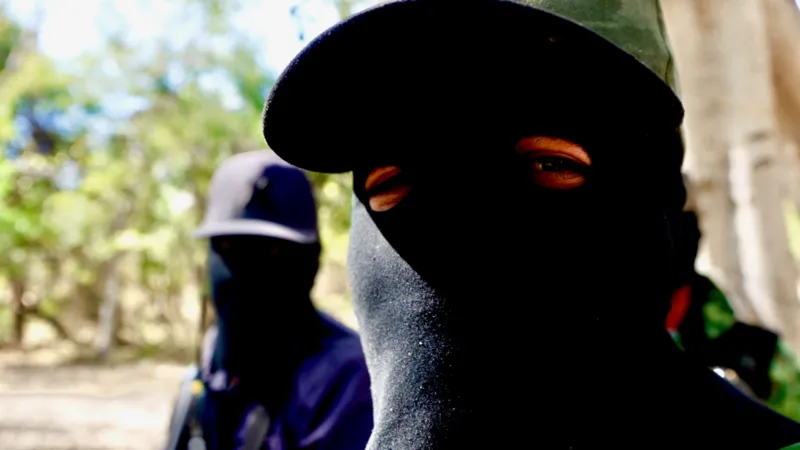
Members of the Sinaloa cartel have split into rival factions engaged in a deadly war, Darren Conway/BBC
.
.
Click the link below for the complete article:
.
__________________________________________
 James' World 2
Leave a comment