
Click the link below the picture
.
Have you ever thought about how your body turns food into energy? Or just how carefully it has to manage that process?
When we eat, the glucose from our food gets stored in the liver as glycogen. And based on our body’s needs, the liver will convert that glycogen back into glucose so that it can travel through the blood and get to our cells, which turn that glucose into energy.
Meanwhile, our pancreas produces a hormone called insulin whose job is to go into the blood and tell our cells to take in that glucose. That also makes insulin a regulator of our body’s blood sugar levels, preventing the complications that can happen when our levels are too high or too low.
When the pancreas stops producing insulin, glucose doesn’t enter our cells. Instead, it accumulates in the bloodstream. In some people, the pancreas stops making insulin altogether. This condition is known as type 1 diabetes.
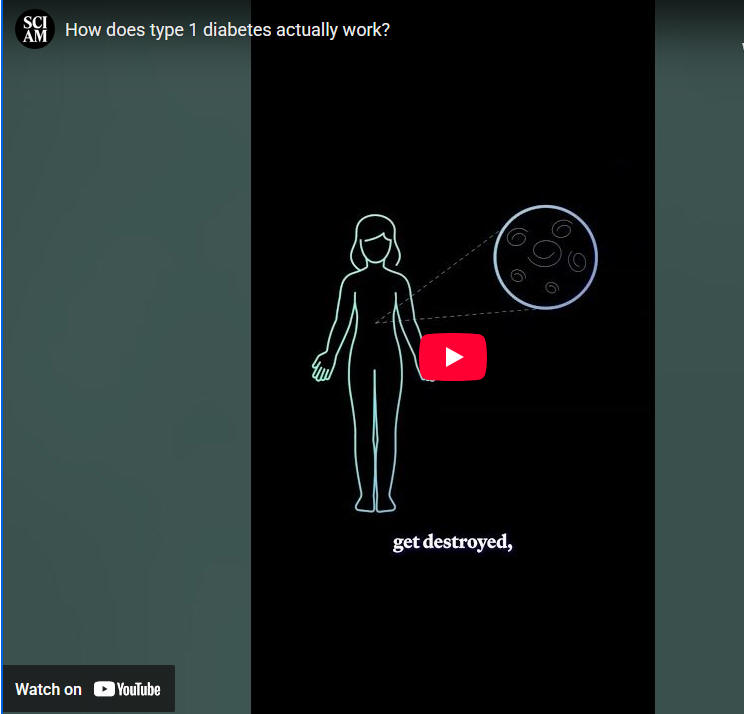
While the exact cause is mysterious, we know the disease happens because immune cells target and attack insulin-producing cells in the pancreas called beta cells. As those cells get destroyed, the body stops producing insulin and loses the key regulator of blood sugar levels. That in turn can drive a number of symptoms, including fatigue and weakness.
Over the 20th and 21st centuries, scientists have developed technologies that have made type 1 diabetes treatable. These include meters to check blood glucose levels and pumps that give small doses of insulin. And with advances in construction and software, these tools have become smaller and more portable. Despite these advances, scientists are still pursuing a cure for type 1 diabetes.
.
 Watch on YouTube
.
.
Click the link below for the complete article:
3 Steps to watch the YouTube Video above:
1 . Click the link below, 2 . Click ‘How does type 1 diabetes actually work’, 3 . click play button.
.
__________________________________________
 James' World 2
Leave a comment