
Click the link below the picture
.
Below the surface, Greenland’s ice appears to be churning up, a process one scientist described as akin to a “boiling pot of pasta”
Hidden underneath the surface of Greenland’s ice, there are strange, vast structures known as “plumes.” But for years, scientists didn’t know how these curious forms came to be—until now. A new study published in the journal Cryosphere reveals that the structures may have been caused by thermal convection in a process similar to the churning of the hot rock in Earth’s mantle.
Convection is caused by temperature differences within a material. Hot material rises, and cool material falls—driving a cycling, or convection. The same phenomenon appears to occur in ice, too, indicating that parts of the ice sheet may be softer than scientists realized. That’s important for one crucial reason: we know that Greenland’s ice sheet is rapidly melting. And as the climate warms, scientists are racing to understand how exactly it will melt and how fast.
“We typically think of ice as a solid material, so the discovery that parts of the Greenland ice sheet actually undergo thermal convection, resembling a boiling pot of pasta, is as wild as it is fascinating,” said Andreas Born, a professor of Earth science at the University of Bergen in Norway, in a statement.
Although the findings do not necessarily mean that the ice sheet will melt faster, they could offer clues as to how it may melt. And that knowledge is critical—the sheet is more than 650,000 square miles in size; by one estimate, if all of it melts, it will raise the planet’s sea levels by a whopping 24 feet.
“Our discovery could be key to reducing uncertainties in models of future ice sheet mass balance and sea-level rise,” Born said in the same statement.
.
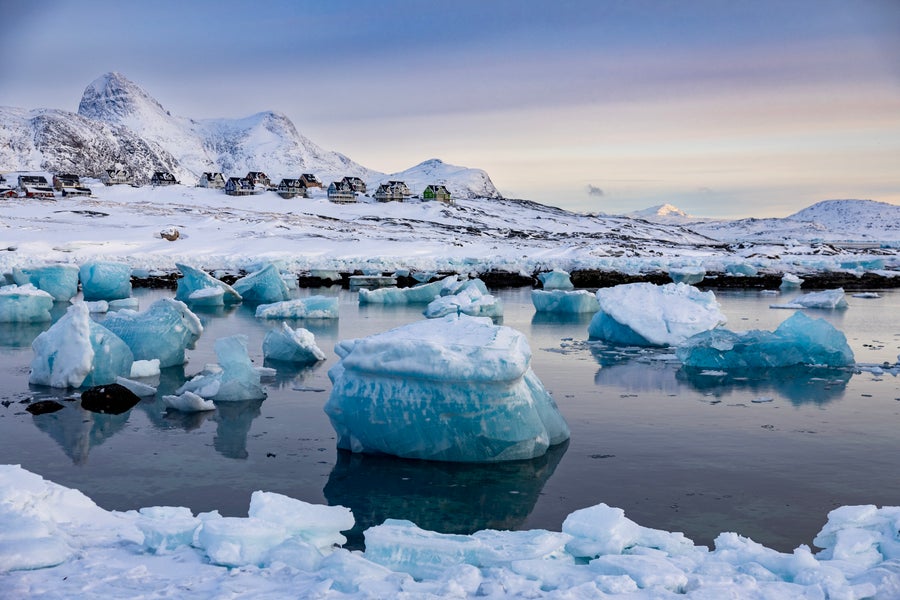 ODD ANDERSEN/Getty Images
.
.
Click the link below for the complete article:
.
__________________________________________
 James' World 2
Leave a comment