
Click the link below the picture
.
Axolotls are famous for their ability to regrow significant parts of their bodies. But according to recent research, these frilly-headed salamanders, which are native to lakes and wetlands around Mexico City, can perform an even more extraordinary biological feat: they can completely regrow their thymus, a complex organ instrumental to the immune system in most vertebrates.
Previous work suggested that some animals can partially regrow thymuses, but the co-authors of the new paper, published in Science Immunology, were surprised to see axolotls completely rebuild the intricately structured organ from nothing.
“Axolotls are legendary for regenerating limbs and parts of the central nervous system,” says study co-author Maximina H. Yun, a biologist at the Chinese Institutes for Medical Research in Beijing. “The realization that these animals can regrow their full thymus from scratch is a breakthrough moment.”
The thymus is responsible for producing the body’s T cells, which help to target and destroy invading pathogens. “In humans and most other vertebrates, the thymus is famous for being one of the first organs to degenerate,” says Turan Demircan, a biologist and regeneration expert at Muğla Sıtkı Koçman University in Turkey who was not involved in the new research. “Until now, it was believed that once this tissue is gone or removed, it cannot be fully rebuilt.”
For the new study, Yun and her colleagues removed the thymus from several juvenile axolotls. After seven days, many of the animals were already budding new thymuses. After 35 days, more than 60 percent of them had fully regenerated the organ. “I was genuinely surprised,” says study co-author René Maehr, a biologist at the University of Massachusetts Chan Medical School. “A full, functional regeneration of a complex immune organ wasn’t something I expected.”
The team next tested the function of the regenerated thymuses by transplanting them into other axolotls. “Remarkably, the transplanted organs integrated perfectly,” Demircan says.
Further analysis identified two key features essential to the regeneration process: the Foxn1 gene, which scientists already knew was involved in thymus development, and a signaling molecule called midkine, which Demircan says appears in human embryos but is largely inactive in adults. The results indicate there may be a biological pathway involving these components that could be useful for treating thymus-related conditions in humans.
“Axolotls are essentially nature’s ‘master key’ for regeneration research,” Demircan says. “If we could reawaken this specific pathway in humans, we might be able to stimulate the thymus to regrow, potentially reversing immune aging or helping patients who have undergone thymectomies.”
According to Yun, researchers might someday tweak human stem cells to emulate the axolotl and recover thymus function. “We are laying the groundwork for transformative therapies that could redefine our approach to immune restoration.”
.
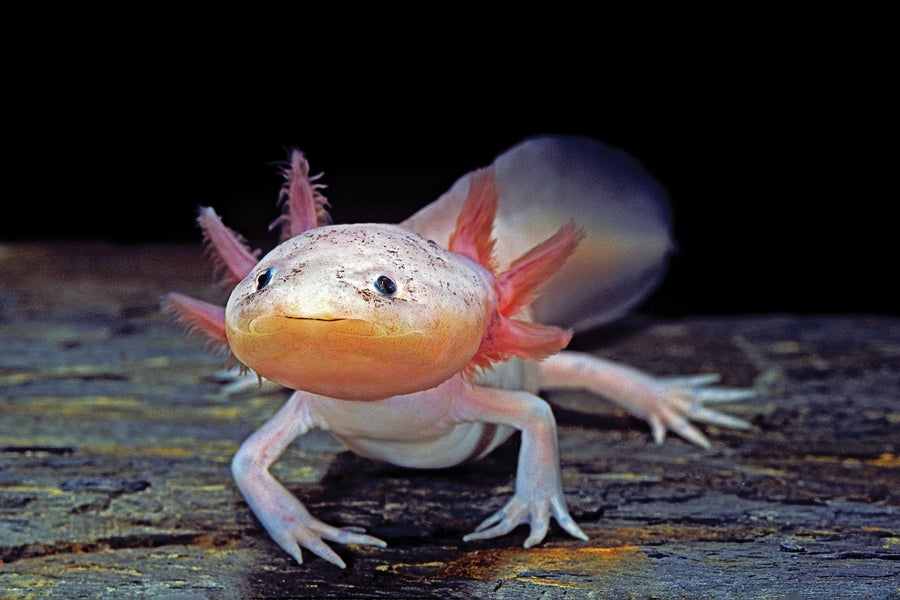 Paul Starosta/Getty Images
.
.
Click the link below for the complete article:
.
__________________________________________
 James' World 2
Leave a comment