The crackdown on dissent and speech in Minnesota this winter follows a pattern that is common in countries that slide from democracy to autocracy: A leader enacts a legally dubious policy. Citizens protest that policy. The government responds with intimidation and force. When people are hurt, the government blames them and lies about what happened.
The New York Times editorial board published an index in October tracking 12 categories of democratic erosion, based on historical patterns and interviews with experts. Our index places the United States on a scale of 0 to 10 for each category. Zero represents the United States before President Trump began his second term — not perfect, surely, but one of the world’s healthiest democracies. Ten represents the condition in a true autocracy, such as China, Iran, or Russia.
Based on recent events, we are moving our assessment of one of the categories — stifling speech and dissent — up one notch, to Level 4:
Stifling speech and dissent
Mr. Trump’s Justice Department has become an enforcer of his personal interests, targeting people for legally dubious reasons while creating a culture in which his allies can act with impunity. The targets include Jerome Powell, the Federal Reserve chairman, and several Democratic. True authoritarians go much further, but Mr. Trump has already undone the post-Watergate depoliticization of the Justice Department.
The wide-ranging abuses in Minnesota are the main reason for the change. The Trump administration is conducting a military-style operation in an American city under dubious pretenses. The stated goal is immigration enforcement, even though the state is home to relatively few undocumented immigrants. The true goal seems to be instilling fear in people who oppose Mr. Trump’s agenda. Federal agents have killed two protesters, Renee Good and Alex Pretti, and assaulted and menaced others. The administration has made clear that the abusers will face no accountability.
The acceleration in the stifling of dissent and speech is broader than what’s happening in Minnesota. Since late last year, the administration has also widened its campaign of investigating perceived enemies, such as Jerome Powell, the Federal Reserve chair. The Department of Homeland Security has used subpoenas that no judge approved to demand information on critics. The F.B.I. searched the home of a journalist who had exposed problems with the administration’s policies.
Our country is still not close to being a true autocracy. Many forms of speech and dissent remain vibrant in the United States, in courts, in Congress, the media, and on the streets. But Mr. Trump and his allies have restricted dissent in fundamental ways. It is a violation of basic American values.
Modern authoritarian takeovers often do not start with a military coup. They instead involve an elected leader who uses the powers of the office to consolidate authority and make political opposition difficult. The repression of speech and dissent is central to this process. Even before recent months, Mr. Trump had done so by punishing law firms that had opposed him, revoking the visas of foreign students who criticized the war in Gaza and contributing to intimidation campaigns against federal judges.
Autocrats use the immense power of law enforcement as a political tool, and Mr. Trump’s Justice Department has become an enforcer of his interests. It targets his perceived enemies, such as Jerome Powell, the Federal Reserve chair, on shaky grounds while dropping legitimate investigations of Mr. Trump’s allies or pardoning them. True authoritarians go much further, but Mr. Trump has undone the post-Watergate bipartisan efforts to depoliticize the Justice Department.
When a democracy slides toward autocracy, the leader often finds ways to neuter the legislature. The Trump administration has violated the law by withholding funding authorized by Congress. Mr. Trump has gutted congressionally authorized agencies, including the U.S. Agency for International Development. He has imposed new taxes — his tariffs — without congressional approval. He has ordered overseas military attacks without consulting Congress in ways that his recent predecessors did.
Would-be authoritarians recognize that courts can keep them from consolidating power, and they take steps to weaken or bypass judges. At times, the Trump administration has openly defied federal judges. A judge in Minnesota recently excoriated Immigration and Customs Enforcement for disobeying nearly 100 orders in January alone. On other occasions, the administration has engaged in gamesmanship, ignoring the spirit of judicial orders.
Autocrats often curtail democracy by declaring an emergency and arguing that the threat requires them to exercise unusual degrees of power. Mr. Trump’s recent predecessors were not perfect on this issue, but he has reached another level. His sweeping tariffs are one example. Justifying deportations by claiming that a Venezuelan gang had taken over American cities is another example.
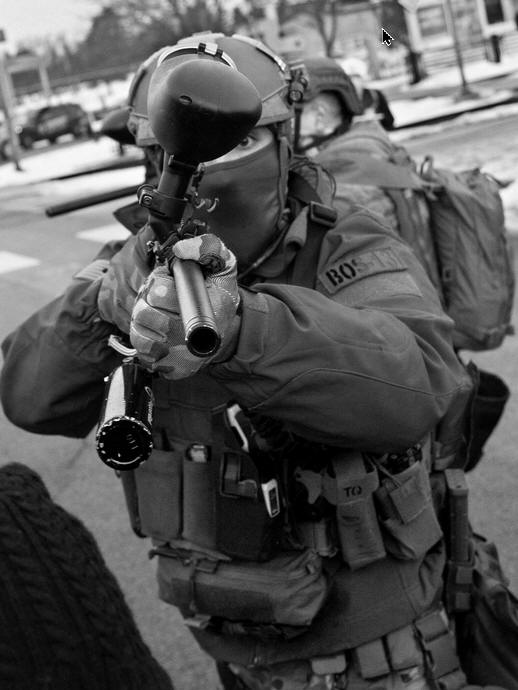
Authoritarians frequently and performatively use the military for domestic control. Mr. Trump deployed the National Guard in Los Angeles to crack down on protests. He has also begun to treat the military as an extension of himself, firing high-ranking officials without good reason and giving overtly political speeches to military readers. ICE is not part of the military, but it is acting largely as a paramilitary force in Minnesota and elsewhere.
Authoritarians tend to demean minority groups, trying to turn them into perceived threats that provide justification for a leader to amass power. Mr. Trump has vilified immigrants and transgender Americans. His appointees and political allies have made blatantly racist, Islamophobic, and antisemitic statements. Mr. Trump has denigrated Somalis in outrageous ways, such as saying, “They contribute nothing. I don’t want them in our country.”
Democratic governments prize accurate information. Authoritarians seek to suppress inconvenient truths. The Trump administration has sought to manipulate government information by, among other things, sidelining scientific experts. The administration has also taken steps to control the media, using the threat of regulatory punishment to silence criticism.
Trying to take over universities
Authoritarians, recognizing that universities are hotbeds of independent thought and political dissent, often single them out for repression. A signature policy of Mr. Trump’s second term has been his attack on higher education. He has cut millions of dollars of research funding, tried to dictate hiring and admissions policies, and taken steps to dictate what colleges can teach.
Creating a cult of personality
Emperors and kings often glorified themselves by displaying their portraits everywhere. The American tradition rejected that hagiography for living presidents — until Mr. Trump. Among recent examples: He rebranded the Kennedy Center to add his own name. The Board of Peace for Gaza will be housed at an institute newly named for him. And the government now sells a so-called gold card, with his face on it, that costs $1 million and offers legal residency to immigrants.
Using power for personal profit
Authoritarians often turn the government into a machine for self-enrichment. Mr. Trump glories in his administration’s culture of corruption. He rewards foreign governments that bestow gifts on him (like a 747 airplane) and approve deals with his company. His family has made hundreds of millions of dollars from crypto. In some cases, he has later helped his benefactors, including by giving pardons.
Manipulating the law to stay in power
Authoritarians change election rules to help their party, and they rewrite laws to ignore term limits. In Mr. Trump’s second term, he has shown worrisome signs of trying to entrench the power of the Republican Party — and recently taken steps to accelerate that campaign. In February, he called for the federal government to take over control of election administration from states. That builds on earlier moves, such as an executive order that would force states to reject some mail-in ballots.
Background and methodology: The clearest sign that a democracy has died is that a leader and his party make it impossible for their opponents to win an election and hold power. Once that stage is reached, however, the change is extremely difficult to reverse.
The 12 benchmarks in this editorial offer a way to understand how much Mr. Trump is eroding American democracy. The categories are based on interviews with legal scholars, political scientists, historians, and other democracy experts. The ratings come from the New York Times editorial board. In our 0-to-10 scales, zero represents roughly where the United States, flawed though it was, had been under presidents of both parties prior to Mr. Trump. Ten represents the condition in a true authoritarian state. Moving even one notch toward autocracy is a worrisome sign.
.
Frontal Assault
.
.
Click the link belowfor the complete article (and charts):
Film and Writing Festival for Comedy. Showcasing best of comedy short films at the FEEDBACK Film Festival. Plus, showcasing best of comedy novels, short stories, poems, screenplays (TV, short, feature) at the festival performed by professional actors.

 Frontal Assault
 James' World 2
Leave a comment