
Click the link below the picture
.
When the 47th solar panel exploded, Henrik Eskilsson began to fear he’d signed on with a madman.
In his SUV, he and Anders Olsson were accelerating across Sweden’s Lunda Airfield, towing a trailer fitted with a steel mast that suspended the panel. As they gained speed, the panel did something unusual: it floated, catching the wind like a hang glider while staying anchored to the mast. The speedometer crept toward 100 kilometers per hour. Behind them, the device began vibrating. Suddenly, it snapped free, tumbled through the air, and shattered on the runway.
Eskilsson, who’d previously founded a company that makes eye-tracking software, stopped the car and contemplated why he’d committed to this quixotic project: to revolutionize solar power for more than half of the people living on Earth. Many areas in the Northern Hemisphere and some in the Southern lie in zones where traditional solar fields are inefficient, especially in winter—but also in the morning and evening. When the sun sits low, its rays hit horizontal panels at a shallow, grazing angle, delivering little energy. Vertical solar panels that track the sun even as it barely clears the tree line have proved too expensive, requiring multiple motors to rotate them, too much concrete to anchor them, and too much steel to keep the wind from tearing them apart.
The shattered prototype was part of Olsson and Eskilsson’s effort to solve this: Vaja, the vertical-tracking start-up they had co-founded in 2023. For years, Olsson had envisioned building solar systems that moved with the wind like leaves in a storm. He and Eskilsson had consulted with mechanical engineers, who said this design would be impossible. Olsson disagreed. Eskilsson trusted him, although he wondered how many more panels would first have to be destroyed.
They got out of the SUV, took brooms from the back and, in the brisk winter afternoon, began sweeping the runway.
Solar is the fastest-growing source of global electricity, accounting for 7 percent of the world’s generation in 2024, up from roughly 1 percent a decade earlier. In the 2010s, utility companies invested heavily in solar farms with fixed-tilt panels—stationary solar arrays oriented toward the equator to catch the sun’s light. Such systems produce the most electricity in the middle of the day. In markets with many solar farms, this is when electricity prices are lowest, making the panels less profitable. Then, as the sun goes down and electricity demand spikes, the panels cease to be productive.
Horizontal trackers address such limitations by following the sun. Mounted on a north-south spine, the panels tilt like a seesaw, turning east at dawn, lying flat at midday, and facing west at sunset. They can deliver up to 35 percent more energy than fixed-tilt systems for a modest bump in cost. Horizontal tracking has “basically exploded over the past 10 to 15 years,” Eskilsson says.
But horizontal trackers suffer from the same latitudinal shortcomings as fixed-tilt: travel north or south from the equator, and the benefits diminish. Between the 30th and 40th parallels north—roughly aligned with Houston and Philadelphia, respectively—the equation shifts to favor vertical trackers: systems designed to intercept the light of a low-hanging sun that would otherwise skim over a horizontal array.
A handful of companies offer static vertical panels. In Europe, Norway’s Over Easy Solar and Germany’s Next2Sun and SOLYCO Solar provide a variety of vertical solar panels that harvest morning, evening, and winter light. Making vertical trackers, which pivot around an upright axis like a revolving door, is far more challenging. All vertical panels catch the wind like sails. Stationary setups can be made to resist powerful gusts, but vertical trackers are more fragile because they are mobile and mounted on a single post. Imagine a heavy roadside sign perched on a pole: the wind doesn’t just push against the sign; it tries to twist the pole, too. Torsion around a vertical post is nastier than around a horizontal tracker’s low-slung backbone, leading more easily to broken panels and motors. Efforts at beefing them up priced them out of existence. “These kinds of vertical trackers, even today, cost like four times as much as horizontal trackers,” Eskilsson says. Developers in the north stuck with static systems, using more panels to make up for lost productivity.
Olsson, now 51 years old, became interested in solar in 2017, before it was common in his country. On a ski trip, he told a friend that Sweden didn’t receive enough sunlight for the technology to work. The friend disagreed and showed him the math. “I realized when I saw the numbers that solar does make sense,” Olsson says. The moment sparked his love for a challenge, and he spent the train ride home writing a business plan.
Soldags, Olsson’s first solar panel company, took off installing panels for consumers, usually on roofs. But two years in, he landed a contract to install panels on the ground, which required anchoring them with concrete blocks. “These things weighed 10 times more than the solar panels,” Olsson says. An engineering physicist by training and a recreational sailor, he knew how much torque wind could exert. Yet nature thrived in it—trees flexed, leaves feathered. Why did he have to burn money to hold panels still?
He shared his thoughts with his friend and fellow sailor Fredrik Lundell, a fluid dynamics professor and aerodynamics expert. As they spoke, they made sketches of a pivoting mount that might allow panels to feather in the wind.
.
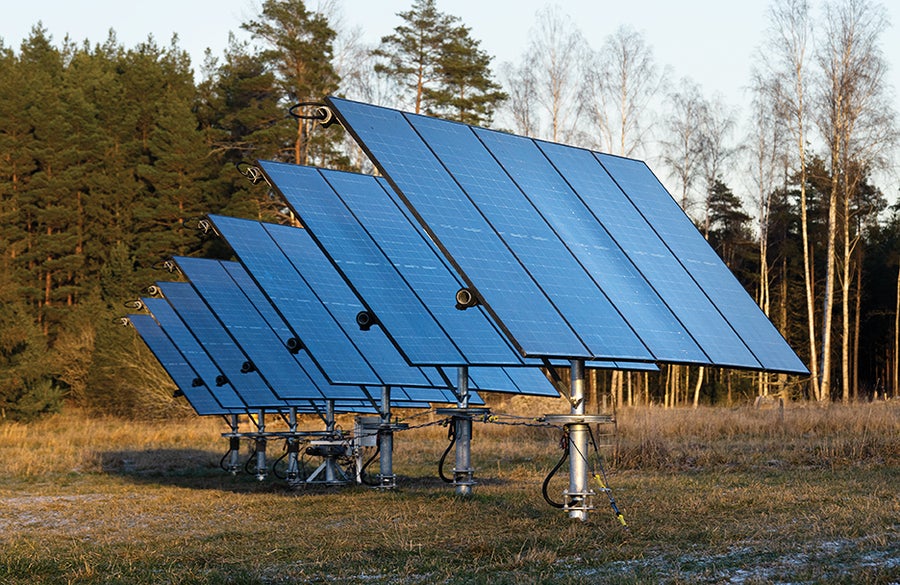
Vertical solar trackers work better the closer you get to the poles—in theory. But before Vaja, they were too fragile to withstand harsh winds. Andréas Lennartsson
.
.
Click the link below for the complete article:
.
__________________________________________
 James' World 2
Leave a comment