
Click the link below the picture
.
Greenland sharks are a biological anomaly. The animals can grow to more than 20 feet long, weigh more than a ton and can live for nearly 400 years, making the species the longest-living vertebrate on the planet—a fact that could help unlock secrets to enhancing longevity.
And now, in a study published this week in Nature Communications, scientists dial in to one of the Greenland shark’s more remarkable features: it has functioning eyes and, more remarkably, maintains its vision well into senescence.
Biologists have long believed these sharks to be practically blind, in part because of their tendency to attract parasites that attack and lodge themselves inside the sharks’ corneas. But this work challenges that belief, the researchers write, showing that even centuries-old Greenland sharks retain a visual system “well-adapted for life in dim light.”
“Evolutionarily speaking, you don’t keep the organ that you don’t need,” said Dorota Skowronska-Krawczyk, an associate professor of physiology and biophysics at the University of California, Irvine, and a co-author of the paper, in a statement. “After watching many videos, I realized this animal is moving its eyeball toward the light.”
Skowronska-Krawczyk and her colleagues analyzed samples taken from sharks that were more than a century old and found no obvious signs of retinal degeneration, which, she notes, is a “remarkable” finding, considering their advanced age.
The researchers say the work offers a jumping off point for future research into how the sharks preserve their vision over such long periods of time, work that could eventually inform studies of age-related vision loss in humans—and how it might be prevented.
“Not a lot of people are working on sharks, especially shark vision,” said Emily Tom, a Ph.D. student at the University of California, Irvine, who is also a co-author of the study, in the same statement.
“We can learn so much about vision and longevity from long-lived species like the Greenland shark,” Tom said.
.
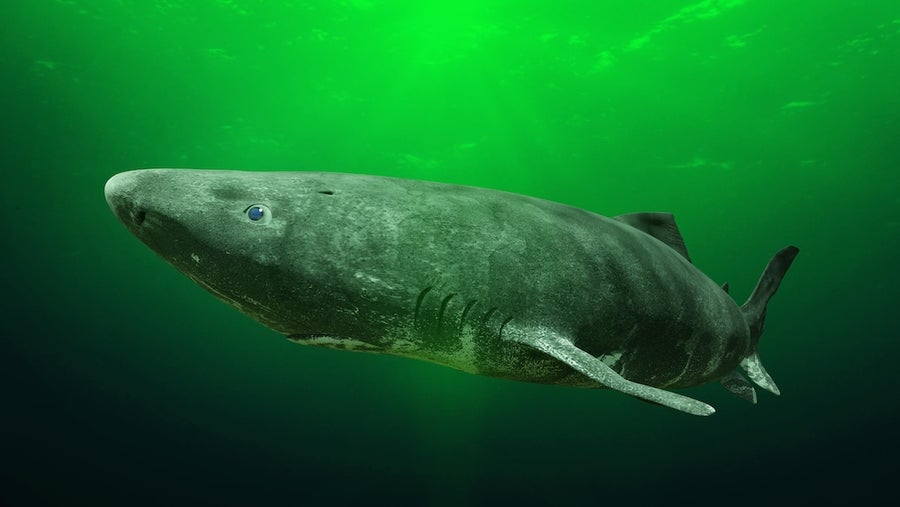
A Greenland shark (Somniosus microcephalus). otted zebra/Alamy Stock Photo
.
.
Click the link below for the complete article:
.
__________________________________________
 James' World 2
Jan 14, 2026 @ 09:39:57
Fascinating and beautifully presented. This piece captures the quiet wonder of the Greenland shark—its immense age, resilience, and the surprising elegance of its biology—with clarity and curiosity. The way scientific discovery is woven with awe makes the research feel alive, not distant. It leaves you thinking not just about sharks, but about time, adaptation, and the possibilities hidden in nature that may one day reshape how we understand aging and vision itself.
LikeLiked by 1 person
Jan 14, 2026 @ 10:49:33
Yes, another great Scientific American article. Sea turtles live long lives also, but not centuries.
LikeLiked by 1 person