Click the link below the picture
.
State and local leaders say they do not believe that the FBI investigation of the shooting death of Renee Nicole Good will be fair and impartial, and are sounding alarms about the impact of federal officials holding onto evidence in a potential prosecution of the ICE agent who killed her.
Minnesota’s lead investigative agency, the bureau of criminal apprehension, initially began investigating the shooting in conjunction with the FBI. But the BCA issued a statement Thursday morning saying that “the US attorney’s office had reversed course: the investigation would now be led solely by the FBI, and the BCA would no longer have access to the case materials, scene evidence or investigative interviews necessary to complete a thorough and independent investigation”.
Hennepin county attorney Mary Moriarty, an elected Democrat and the county’s prosecutor, clarified at a press conference Friday that the BCA – which was established in the wake of the George Floyd case – has a very high investigative standard and that this standard can’t be met when the organization doesn’t have access to all the evidence. It does not preclude an investigation, she said. But a lack of access to evidence hampers the investigation.
“When the BCA came to the scene, the evidence had been taken by the FBI,” she said. “They collected the car and took it wherever the BCA does not have access to the car. And the problem isn’t that the FBI took the car, it’s that the BCA doesn’t have access to the car, or right now, even access to the forensic evaluation that happens as a result of the investigation with that car.”
In a press conference on Friday, the Minneapolis mayor, Jacob Frey, described the federal government’s narrative casting Good as the villain as “garbage” and called on the state to conduct its own investigation. “This is a time to follow the law,” he said. “This is not a time to hide from the facts. This is a time to embrace them, making sure that we’re pushing for transparency every step of the way.”
“The fact that Pam Bondi’s Department of Justice and this presidential administration has already come to a conclusion about those facts is deeply concerning,” he added.
Media reports have identified the agent who shot Good as Jonathan Ross. ICE agents allowed Ross to leave the scene in the moments after the shooting, taking the weapon used in the shooting with him.
“It doesn’t preclude a state investigation, but if the feds are saying, for example, you don’t even get to look at the firearm that was used to kill this person, that would certainly complicate it,” said Eric J Nelson, a defense attorney in Minneapolis with a long record of defending police officers accused of crimes. Nelson represented Derek Chauvin in his murder trial for killing Floyd.
The legal standard for proving a case of excessive force rests on the “objective reasonableness” of the act as given in the Graham v Connor case decided by the US supreme court in 1989. From that case flows policies governing when and how police officers can use force. The standards are essentially the same for both state and federal prosecutions, he said.
The breakdown in cooperation between state and federal agencies in this investigation is “shocking”, Nelson said, and flies in the face of the public’s expectations of legal norms.
“There may be political differences, but ultimately in a question in a case like this, I don’t really think politics should have a place,” he said.
Moriarty and the Minnesota attorney general, Keith Ellison, called on the public to send whatever evidence they have to state and local investigators, given their concerns about access to material held by the FBI.
“We don’t know what we’re going to get now,” Moriarty said. “We think that there may be other evidence out there, video, that kind of thing. We won’t know. And so, as the attorney general and I know, it is critical to preserve evidence.”
Statements by Donald Trump and others about the case amplify the concerns of bias from local leaders.
Trump described the 37-year-old US citizen and mother of three killed by an ICE agent as a “high-level agitator” and “a professional troublemaker”, without evidence. Claims that Good was somehow harassing agents have been widely disputed by both local and state leaders in Minnesota, as well as by eyewitnesses.
Within hours of the shooting, the homeland security secretary, Kristi Noem, declared that the shooting was justified, and that the driver deliberately aimed her car at the officer in an act of “domestic terrorism. Noem also said that state-level prosecutors “don’t have any jurisdiction in this investigation”.
On Thursday, JD Vance said in response to a question about sharing the investigation with Minnesota law enforcement agencies that the agent “is protected by absolute immunity. He was doing his job.”
Attorneys familiar with state and federal law and the prosecution of police officers say that the assertions of the vice-president and Noem are simply untrue.
“Just because the FBI is taking over the investigation, that does not preclude the state from conducting its own investigation,” Nelson said. “Both independent jurisdictions, state and federal, would make a decision about charges. I would expect that the state of Minnesota will continue to conduct its own investigation into this matter.”
The statements by federal officials raise questions about whether a federal investigation would be fair. Frey described the prospects as “pretty grim.
“We know that they’ve already determined much of the investigation,” Frey said, “and even if they haven’t, there is the appearance that there is some conclusion drawn from the very beginning.”
At this unsettling time
We hope you appreciated this article. Before you close this tab, we want to ask if you could support the Guardian at this crucial time for journalism in the US.
In his first presidency, Donald Trump called journalists the enemy; a year on from his second victory, it’s clear that this time around, he’s treating us like one.
From Hungary to Russia, authoritarian regimes have made silencing independent media one of their defining moves. Sometimes, outright censorship isn’t even required to achieve this goal. In the United States, we have seen the administration apply various forms of pressure on news outlets in the year since Trump’s election. One of our great disappointments is how quickly some of the most storied US media organizations have folded when faced with the mere specter of hostility from the administration, long before their hand was forced.
While private news organizations can choose how to respond to this government’s threats, insults, and lawsuits, public media has been powerless to stop the defunding of federally supported television and radio. This has been devastating for local and rural communities, who stand to lose not only their primary source of local news and cultural programming, but health and public safety information, including emergency alerts.
While we cannot make up for this loss, the Guardian is proud to make our fact-based work available for free to all, especially when the internet is increasingly flooded with slanted reporting, misinformation, and algorithmic drivel.
.
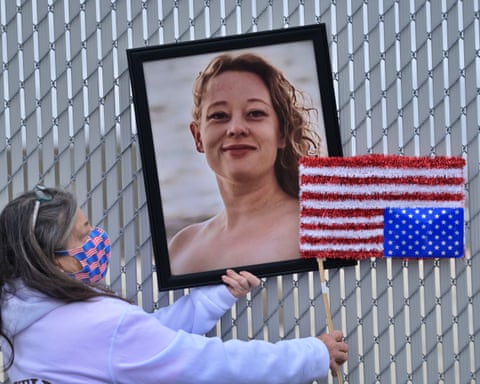 Portrait of Renee Nicole Good outside an immigration detention facility in Broadview, Illinois, on 9 January. Photograph: Anadolu/Getty Images
.
.
Click the link below for the complete article:
.
__________________________________________
 James' World 2
Leave a comment