
Click the link below the picture
.
President Donald Trump’s push to take control of Venezuela’s oil has focused global attention on the South American nation’s vast reserves.
Trump has repeatedly touted Venezuela’s rich oil supply as among the motivations for the January 2 military assault on the country and the capture of its leader, Nicolás Maduro, who has since been charged with drug trafficking and weapons possession.
But just how much oil does Venezuela have, and why?
In 2024, the country claimed more than 300 billion barrels of proven crude oil reserves, the highest of any nation. The runners-up were Saudi Arabia, with more than 260 billion barrels, and Iran, with more than 200 billion barrels. The global total was 1,566 billion barrels.
And the vast reserves are not a coincidence. Geology is very much in Venezuela’s favor, says Luis Zerpa, a petroleum engineer at the Colorado School of Mines. “From the geology side, it just has the perfect location,” he says. And like all fossil fuels, the country’s oil owes its existence to deep time—and the planet’s dynamic surface.
The story of oil begins when land is pushed up in one region, creating a low-lying basin nearby, Zerpa says. Rock is eroded from the higher-elevation land into the basin, which also fills with the organic remains of plants and animals. Over millions of years, enough material piles up above to raise the temperature and pressure to the point that sediments turn into rock and organic material becomes oil and gas.
The balance of oil and gas depends on two factors. The first is how much rock builds up above the material. The so-called oil window occurs at a depth of anywhere between 4,000 and 12,000 feet; below it, organic matter is more likely to turn into gas. The other factor is the origin of the organic material itself—marine plants are more likely to become oil, whereas terrestrial plants are more likely to become gas.
As oil and gas form—and as tectonic plates move—the rock surrounding these deposits begins to fracture. This sets the hydrocarbons free from the source rock in which they formed and enables them to migrate up into more porous rock that then traps them in place.
Venezuela is nestled between the Caribbean and South American plates. And the Nazca plate, which underlies the eastern Pacific Ocean, also shapes the area’s tectonic scene. The jostling of all those plates lifted up the northern Andes and other highlands in the region, while it simultaneously created three sedimentary basins that have produced oil and gas: the Eastern Venezuela Basin in the north, the Maracaibo basin in the northwest, and the Barinas-Apure basin in the west.
Hence, Venezuela’s more than 300 billion barrels of proven crude oil reserves were formed. Here, “proven” means that engineers have drilled enough wells to accurately estimate the extent of oil and gas deposits in the country’s territory.
Getting that oil is a different matter. Venezuela’s production of the fossil fuel peaked around 1970 at around 3.7 million barrels per day, before it fell steeply starting in the late 1970s and continued to drop during the 1980s. It recovered here and there in the mid-1990s and early 2010s. But in 2025, the nation produced only around 1.1 million barrels per day. Analysts expect that any political transition in the wake of Maduro’s capture and arrest will barely raise that output for at least the next two years: aging infrastructure has severely constrained production, and fixing that will take billions of dollars in investment and several years, Reuters has reported.
.
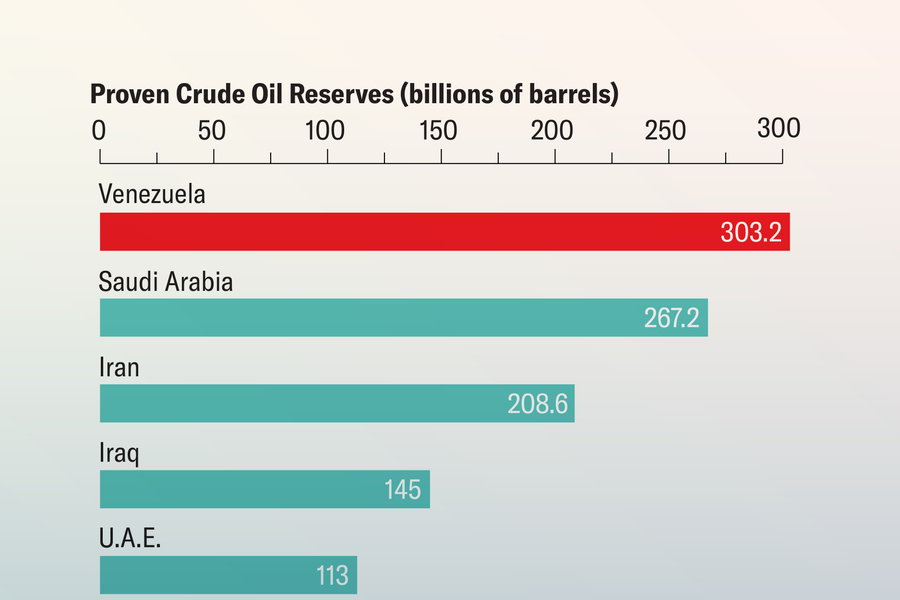 Amanda Montañez; Source: OPEC Annual Statistical Bulletin 2025. Organization of the Petroleum Exporting Countries, 2025 (data)
.
.
Click the link below for the complete article:
.
__________________________________________
 James' World 2
Leave a comment