 x
x
Click the link below the picture
.
As norovirus surged across the U.S. last winter, the only thing more horrifying than descriptions of the highly contagious illness—violent projectile vomiting!—was learning that nothing seemed to kill the microbe that causes it. Hand sanitizers made with alcohol are useless. Water needs to be above 150 degrees Fahrenheit to kill the virus, which is too hot for handwashing. Rubbing with soapy water and rinsing can physically remove the virus from your hands and send it down the drain, but won’t effectively kill it. Bleach dismantles norovirus, but you can’t spray bleach on skin or food or many other things, and norovirus can live on surfaces for weeks.
During the early days of the COVID pandemic, however, I had learned about a disinfecting agent called hypochlorous acid, or HOCl. My dad, a now retired otolaryngologist, had been wondering whether there was something he might put up patients’ noses—and his own—to reduce viral load and decrease the chance of COVID infection without, of course, irritating the mucosa or otherwise doing harm. He was imagining a preventive tool, another layer of protection for health-care workers in addition to masks and face shields.
Hypochlorous acid is a weak acid with a pH slightly below neutral. It should not be confused with sodium hypochlorite (NaClO), the main active ingredient in household bleach products, even though they both involve chlorine. Chemically, they are not the same. Sodium hypochlorite is a strong base with a pH of 11 to 13, and when added to water for consumer products, it can be irritating and toxic. Hypochlorous acid, in contrast, is safe on skin.
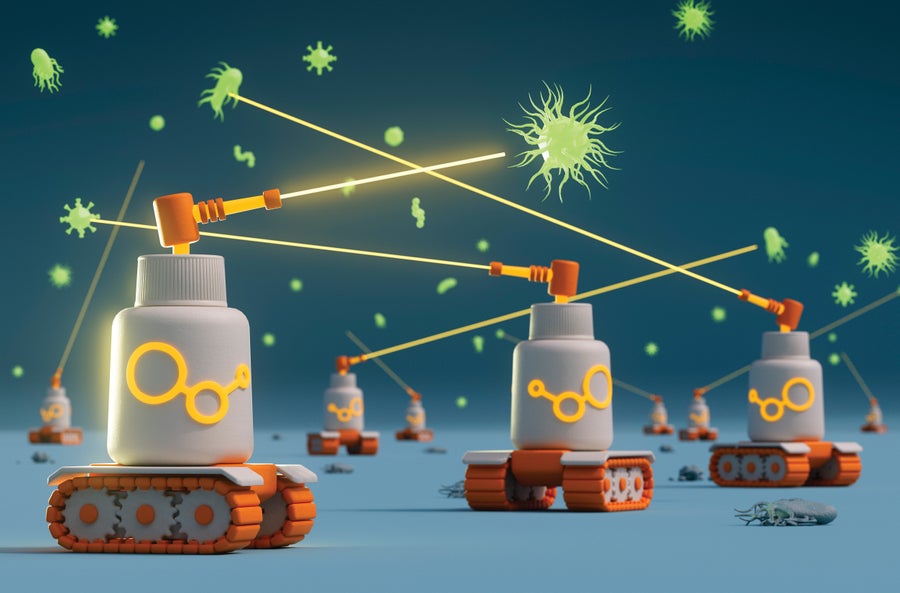
All mammals naturally make hypochlorous acid to fight infection. When you cut yourself, for instance, white blood cells known as neutrophils go to the site of injury, capturing any invading pathogens. Once the pathogen is engulfed, the cell releases biocides, including hypochlorous acid, a powerful oxidant that kills invading microbes within milliseconds by tearing apart their cell membranes and breaking strands of their DNA.
Hypochlorous acid is a well-studied disinfectant that appears to be extremely effective and safe—so why isn’t it a household name?
The synthetic form of hypochlorous acid destroys a broad spectrum of harmful microbes—including highly resistant spores and viruses such as norovirus. Like most disinfectants, it kills pathogens by penetrating their cell walls. But compared with bleach, hypochlorous acid has been shown to be more than 100 times more effective at much lower concentrations, and it works much faster.
Hypochlorous acid isn’t new. It’s listed as one of the World Health Organization’s essential medicines and is approved by the U.S. Food and Drug Administration for use on food products and in certain clinical applications. It’s increasingly used in industrial and commercial settings, such as water-treatment plants, hospitals, and nursing homes. It doesn’t irritate the skin, eyes or lungs. In fact, optometrists use it to clean eyes before procedures, and people have been treating wounds with it for more than a century. It breaks down quickly, doesn’t produce toxic waste, and isn’t harmful to animals or the environment. The U.S. Environmental Protection Agency lists it as a surface disinfectant for the COVID-causing virus SARS-CoV-2.
Hypochlorous acid is a well-studied disinfectant that appears to be extremely effective and safe—so why isn’t it a household name?Scientists have known about the powers of hypochlorous acid for nearly 200 years. In 1834, French chemist Antoine-Jérôme Balard made hypochlorous acid when he added a dilute mix of mercury oxide in water to chlorine gas. Later in the 19th century, English chemist and physicist Michael Faraday developed a technique for synthesizing HOCl from salt and water via a process called electrochemical activation.
Before the advent of antibiotics, hypochlorous acid was a go-to disinfectant. It was used as a wound sanitizer during World War I. The authors of a 1915 article in the British Medical Journal set out to investigate antiseptics that could be used to dress wounds in the field. They compared the efficacy of sodium hypochlorite (bleach) with that of hypochlorous acid and “found that hypochlorous acid is a more potent germicide than its salts.” They “accordingly devised a method in which the free acid is employed as the antiseptic agent.”
For all its benefits, hypochlorous acid solution has one major weakness: it’s highly unstable. It remains stable only in a solution with a pH between about 4 and 6. The solution is still made using salt, water, and electricity through the process of electrolysis. Within minutes of exposure to light or air, hypochlorous acid starts to deteriorate back into salt water, making it useless as a disinfectant. If the solution were to get too acidic, it would start converting into chlorine gas. If it were to get too alkaline, it would gain a higher percentage of hypochlorite. This lack of shelf stability is the biggest reason hypochlorous acid sprays never became a staple of the cleaning-products aisle.
For decades, hypochlorous acid lingered in the background, used as a disinfectant in specific industrial and commercial contexts that could justify a pricey, on-site manufacturing process to create products on demand. But COVID accelerated the need for different methods of disinfection that would be safe, effective, and easy to use in a wide range of environments. According to an article in the magazine Health Facilities Management, during the pandemic, “many countries introduced continuous HOCl misting and fogging tunnels for entry and exit corridors at mass transit facilities.” Since then, use of HOCl in places such as kitchens, gyms, nursing homes, and medical offices has been rising significantly.
Hypochlorous acid consumer products are now proliferating, thanks to the development of new manufacturing processes that reportedly make an extended shelf life possible while keeping costs low. The more reputable of these companies claim their products are effective within two years of the manufacturing date stamped on the bottle if stored correctly (ideally at room temperature, away from sunlight).
Most common are surface sanitizers sold by the bottle and marketed as all-purpose disinfectants for your home, although pure hypochlorous acid isn’t really a cleaner—it’s not meant to get rid of grime and grease. Like all disinfectants, once hypochlorous acid is applied, it must be left to sit for a period of time. But unlike some germicides that require up to 10 minutes to kill harmful stuff, hypochlorous acid requires only one minute. You don’t have to wipe it up, either, but because it doesn’t dry quickly, I found it was easier to do so on hard surfaces such as counters.
A frustrating thing about the finicky nature of hypochlorous acid is that you can’t really decant it from its original bottle into a smaller one without potentially affecting its quality and longevity. When I needed hypochlorous acid that was suitable for air travel, I had to buy a two-ounce bottle of Magic Molecule, an FDA-cleared product launched in 2023. These bottles are conveniently sized but don’t last long, and not being able to refill them results in significant plastic waste.
Other companies have taken a different approach to the shelf-life problem. Force of Nature, for example, sells countertop electrolysis machines for home use. The idea is that you can make as much disinfectant as you need for a week or two, as often as you want, using salt tablets you buy from the company. The process takes about eight minutes. Force of Nature also includes vinegar in its formulation, which gives the product cleansing abilities that the company recommends for use on hard surfaces or carpets. Other businesses sell devices that let you add your own salt. In online forums dedicated to fans of hypochlorous acid, members discuss how they use these devices. Some use pH test strips to make sure each batch of hypochlorous acid is within the correct range. Some people, however, are skeptical that at-home machines can consistently make pure HOCl.
.
 Richard Borge
.
.
Click the link below for the complete article:
.
__________________________________________
 James' World 2
Leave a comment