
Click the link below the picture
.
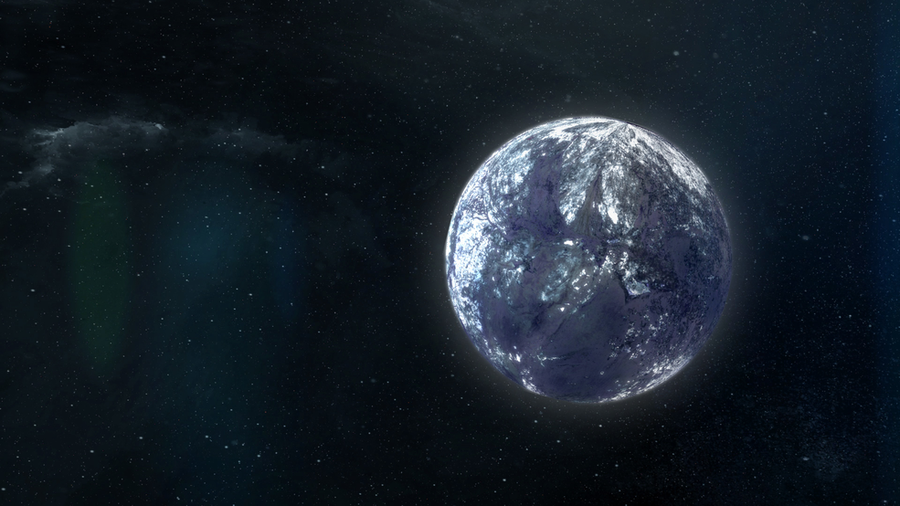
When we imagine a planet, we think of one like ours, orbiting a star. But some have a far lonelier existence, drifting through interstellar space without a sun to call their own. Known as “rogue” or “free-floating” planets, these worlds are often challenging to study. With no known star and no orbit from which to estimate their size, they’ve generally flown under the radar—until now.
In a new study published in Science on Thursday, scientists show how they measured the mass of one such rogue planet for the first time—a breakthrough that could enable further studies of these strange, lonely worlds.
Instead of looking at the planet’s orbit, the research team, led by Subo Dong of Peking University, instead analyzed how the planet’s gravity bent the light from a distant star, in a so-called microlensing event, from two separate vantage points: Earth and the now-retired Gaia space observatory.
The technique resembles how our eyes’ depth perception works, Dong says: the microlensing event was seen by Gaia about two hours later than by scientists on Earth. That difference in time allowed the researchers to measure the planet’s distance and estimate its mass.
“What’s really great about this work, and really noteworthy, is that it’s the first time we’ve got a mass for these objects,” says Gavin Coleman, a postdoctoral researcher at Queen Mary University of London, who authored a related commentary also published in Science but was not involved in the study. “This was purely because the authors had both ground-based observations and Gaia, looking at observations from two different places.”
What they found is that the planet has about the same mass as Saturn. But the findings also offer a hint about its past: “Knowing [its mass] is the starting point,” Dong says. “We can start to understand, okay, what could be the origin, the history of this planet?”
Dong hopes the study offers a jumping-off point for more research to better understand these mysterious cosmic bodies. That pursuit gets a boost later this year from NASA’s Nancy Grace Roman Space Telescope, set to launch in September, says David Bennet, a senior research scientist at the University of Maryland, College Park, and NASA. Able to image the entire sky 1,000 times faster than the Hubble Space Telescope can, Roman could help identify hundreds of rogue planets. And with this work, researchers will have a way to estimate their masses, too.
“The door is open to study this new emerging population of planets,” Dong says.
.
 NASA’s Goddard Space Flight Center
.
.
Click the link below for the complete article:
.
__________________________________________
 James' World 2
Leave a comment