
Click the link below the picture
.
In August, a clandestine team of C.I.A. officers slipped into Venezuela with a plan to collect information on Nicolás Maduro, the country’s president, whom the Trump administration had labeled a narco-terrorist.
The C.I.A. team moved about Caracas, remaining undetected for months while it was in the country. The intelligence gathered about the Venezuelan leader’s daily movements — combined with a human source close to Mr. Maduro and a fleet of stealth drones flying secretly above — enabled the agency to map out minute details about his routines.
It was a highly dangerous mission. With the U.S. embassy closed, the C.I.A. officers could not operate under the cloak of diplomatic cover. But it was highly successful. Gen. Dan Caine, the chairman of the Joint Chiefs of Staff, said at a news conference that because of the intelligence gathered by the team, the United States knew where Mr. Maduro moved, what he ate, and even what pets he kept.
That information was critical to the ensuing military operation, a pre-dawn raid Saturday by elite Army Delta Force commandos, the riskiest U.S. military operation of its kind since members of the Navy’s SEAL Team 6 killed Osama bin Laden in a safe house in Pakistan in 2011.
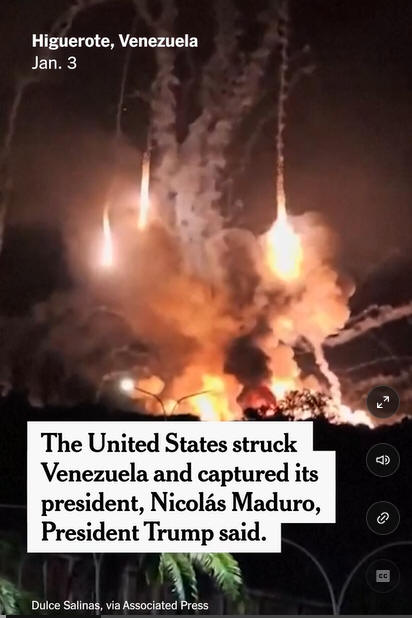
The result was a tactically precise and swiftly executed operation that extracted Mr. Maduro from his country with no loss of American life, a result heralded by President Trump amid larger questions about the legality and rationale for the U.S. actions in Venezuela.
Mr. Trump has justified what was named Operation Absolute Resolve as a strike against drug trafficking. But Venezuela is hardly as big a player in the international drug trade as other countries. Officials had previously told congressional leaders that their objective in Venezuela was not regime change. And Mr. Trump has long said he opposes U.S. foreign occupations.
Yet on Saturday, the president proclaimed that American officials were in charge of Venezuela, and that the United States would rebuild the country’s oil infrastructure.
In contrast to messy U.S. interventions of the past — by the military in Panama or the C.I.A. in Cuba — the operation to grab Mr. Maduro was virtually flawless, according to multiple officials familiar with the details, some of whom spoke on the condition of anonymity to describe the plans.
In the run-up, Delta Force commandos rehearsed the extraction inside a full-scale model of Mr. Maduro’s compound that the Joint Special Operations Command had built in Kentucky. They practiced blowing through steel doors at ever-faster paces.
The military had been readying for days to execute the mission, waiting for good weather conditions and a time when the risk of civilian casualties would be minimized.
Amid the heightened tensions, Mr. Maduro had been rotating between six and eight locations, and the United States did not always learn where he intended to stay until late in the evenings. To execute the operation, the U.S. military needed confirmation that Mr. Maduro was at the compound they had trained to attack.
In the days leading up to the raid, the United States deployed increasing numbers of Special Operations aircraft, specialized electronic warfare planes, armed Reaper drones, search-and-rescue helicopters, and fighter jets to the region — last-minute reinforcements that analysts said indicated the only question was when military action would happen, not if.
The United States had made other moves intended to ratchet up the pressure on Mr. Maduro and prepare for the raid to capture him. A week earlier, the C.I.A. had carried out a drone strike on a port facility in Venezuela. And for months, the U.S. military has conducted a legally disputed campaign that has destroyed dozens of boats and killed at least 115 people in the Caribbean and eastern Pacific.
In recent days, Mr. Maduro tried to head off an American raid, offering the United States access to Venezuelan oil, Mr. Trump said Saturday. A U.S. official said the deal, offered on Dec. 23, would have had Mr. Maduro leave the country for Turkey. But Mr. Maduro angrily rejected that plan, the official said. It was clear, the official added, that Mr. Maduro was not serious.
.
.
.
Click the link below for the complete article:
.
__________________________________________
 James' World 2
Leave a comment