
Click the link below the picture
.
The recent surge in the use of GLP-1 weight-loss drugs has propelled addiction-adjacent terms such as “food noise” and “food cravings” into common vernacular. But can food actually be addictive? Now some neuroscientists and food behavior researchers are trying to understand if food—particularly ultraprocessed foods—can be addictive in the same way as other known substances, such as cigarettes, alcohol, and cocaine.
For foods to be potentially addictive, “they’re created in a way that is most palatable and most delicious,” says Alex DiFeliceantonio, an appetitive neuroscientist at Virginia Tech. “When you look at the food environment, those tend to be ultraprocessed.”
Scientific American spoke with DiFeliceantonio about research unpacking whether food addiction is real, whether certain types of foods might have more addictive qualities, and how related eating disorders can be addressed.
What does it mean to have a “food addiction”?
When we’re thinking about food addiction and looking qualitatively at what people are eating when they are saying that they can’t stop eating, we have to put it in the framework of a substance use disorder. These disorders affect life in an untenable way. Food addiction isn’t in the Diagnostic and Statistical Manual of Mental Disorders (DSM) like substance use disorder is, but there is a proposal to have it put in the DSM.
We typically look to the Yale Food Addiction Scale for clinical evaluation. The scale was designed to assess the same criteria as the substance use disorder criteria in the DSM. The scale also contains what we call clinical indicators that a person is experiencing symptoms of an addiction, and those symptoms are poorly affecting life, such as the ability to engage in social situations or engage in aspects of work or life. If we accept that food addiction exists—if you give the Yale Food Addiction Scale to large population-level studies and do it across multiple countries internationally—we generally find that around 12 percent of people [experience] it.
A combination of factors can lead to an addictive behavior. And the most common is the addictive potential of the substance combined with the vulnerability of the person. We think about both of those things with food, too: ingredients that could have addictive potential and the people who could be most vulnerable. We also look at food attributes, such as high refined carbohydrate content, which is known to trigger reward pathways in the brain
Other aspects of substance-use-disorder criteria include loss of control over intake and highly patterned intake. That’s what we see in binge-eating disorder. Binge-eating disorder and food addiction are not the same thing, but they share similarities. If we look at the foods people report consuming when they binge eat, they tend to be things that would be classified as ultraprocessed—things like pizza, ice cream, candy, chips. They’re very rarely things like fruit, nuts, beans.
What do you consider an ultraprocessed food?
There are multiple definitions. I would say the one most studied and what we use in my lab is the NOVA [“new” in Portuguese] definition; it has four levels, and the fourth is ultraprocessed foods.
The NOVA level-four foods contain ingredients or processing methods that are not available to the home cook. You can think about additives like stabilizers, cosmetic additives that enhance color or flavor, or emulsifiers to maintain texture. If you add vitamin D or calcium—types of nutritional fortification—that doesn’t make a food a NOVA ultraprocessed food by itself. Ultraprocessed might also refer to foods produced with an industrial method, like making starch slurries that are then extruded, puffed, subjected to high heat, or molded in ways that you really wouldn’t be able to make in your kitchen.
Why might ultraprocessed foods in particular fire up reward pathways in the brain?
The current scientific thinking is we have one reward system and lots of different things that can be rewarding. All addictive drugs increase dopamine in the striatum [a brain region beneath the cerebral cortex that is involved in motor and reward processing]. This has been the dogma since 1988 with [a paper by pharmacologists Gaetano Di Chiara and Assunta Imperato]. It’s the same thing [with certain foods]. If you infuse sugar and fat into the oral cavity of an animal, you see an increase in dopamine. If you infuse these things directly into the gut [of animals], you also see increases in dopamine. There is no agreed-upon threshold in which we say a substance that is addictive must increase dopamine in the striatum by x amount.
Modern ultraprocessed foods started to become widespread in the U.S. around the 1950s. Those foods are acting on a reward system that evolved to deal with natural rewards from the environment.
When we’re thinking about food addiction, we know that there are certain levers or ways to highly activate the reward system, and ultraprocessed foods seem to access the most levers. They elevate levels of sodium, fat, and refined carbohydrates in the body. And this is aided in various ways—with emulsifiers, with texture changes, with flavor changes—ultraprocessed foods are made to be the most palatable, the most delicious. We don’t think about broccoli as an addictive substance; we think about foods that contain enough of these potentially addictive nutrients in combination to be addictive substances.
.
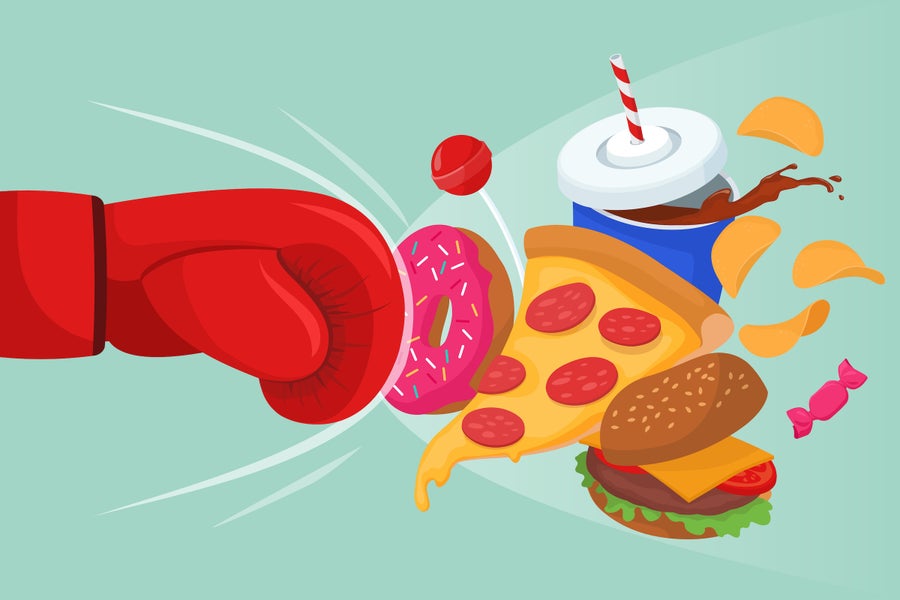
Ultraprocessed foods like donuts and pizza are particularly rewarding to a person’s brain. elenabs/Getty Images
.
.
Click the link below for the complete article:
.
__________________________________________
 James' World 2
Leave a comment