
Click the link below the picture
.
Rachel Feltman: For Scientific American’s Science Quickly, I’m Rachel Feltman.
Headaches are incredibly common, but they’ve gotten surprisingly little attention from scientists.
Here to walk us through what we know—and don’t know—about headache science is Tom Zeller, Jr. He’s a former New York Times reporter and editor and the current editor in chief of Undark. He’s also the author of a new book called The Headache.
Thanks so much for coming on to chat with us today.
Tom Zeller, Jr.: Oh, it’s great to be here. Thanks for having me.
Feltman: So I would love to start with a little bit about what inspired you to write a book about headaches.
Zeller: Sure, well, you probably could guess that I have headaches myself. And not just the ordinary sort of headaches that we all get, but I have something called cluster headache, which is one of the three primary headache disorders—I mean, there are other primary headache disorders, but these are the three main ones: tension-type headache being the most common, migraine being probably the most familiar and most debilitating—and predominantly among women. Cluster headache is far more rare and more common among men, and that’s what I have.
So, you know, it’s an issue that I’ve sort of grappled with for most of my adult life. It’s not something that I ever wrote about as a journalist, or thought that I ever would. But when I started thinking about a book, I realized that I’d kind of been researching this topic for most of my life for other reasons, and so it seemed like a natural fit.
Feltman: And what is the research landscape like when it comes to these, you know, three major headache types?
Zeller: Yeah, it’s surprisingly bleak. I mean, in the book, I focus mostly on migraine because if there is any research being done, it tends to be on that. And to some extent, I think it’s fair to assume that what we learn about migraine will shed light on other headache disorders, too, because there’s sure to be some underlying biology that they all share.
But in general, the surprising thing to me that I discovered was how little we actually know about what’s actually going on inside, like what bits of anatomy are being pulled into the choreography of a migraine attack, what bits of anatomy are more important than others.
And we know some. I mean, the research suggests—there are a lot of good imaging studies that show certain parts of the brain lighting up. There are more recent studies that indicate that certain neurochemicals are in abundant supply in the blood when someone is undergoing an attack. And we also know that the blood vessels may or may not play a role in all of this. But that’s the extent of our knowledge of what’s happening in migraine headache.
Feltman: Yeah, and how is it that we know so little when headaches are so ubiquitous?
Zeller: I think there’s a lot going on. I think one of the most obvious things is that migraine mostly affects women, and I don’t think I’m saying anything that you don’t already know: that women’s health in general has gotten short shrift over the decades. And so to the extent that women were more often presenting in clinicians’ [offices] with migraine over the course of the 20th century, it was not taken very seriously …
Feltman: Mm.
Zeller: And I think that that, in a lot of ways, it bled into decision-making at institutions like the [National Institutes of Health], which is the biggest funder of basic science in the U.S. So I think that’s part of it.
I also think that there’s something sort of cultural about the word “headache.” I mean, we use this word as a metaphor for a mere annoyance: You know, “Doing your taxes is a headache.” “Sitting in traffic is a headache.” And it’s unfortunate that we often have the same word to describe real neurobiological disorders. So that’s at play, too.
And I think a third leg of it is the fact that we all get this thing called headache. If you don’t have enough water, or you’ve skipped lunch, you have a little too much to drink the night before, you get a bit of a headache. So we all sort of think that we know what a headache is, and yet there is this sort of subset of people who have headaches, in a disorder sense …
Feltman: Yeah.
.
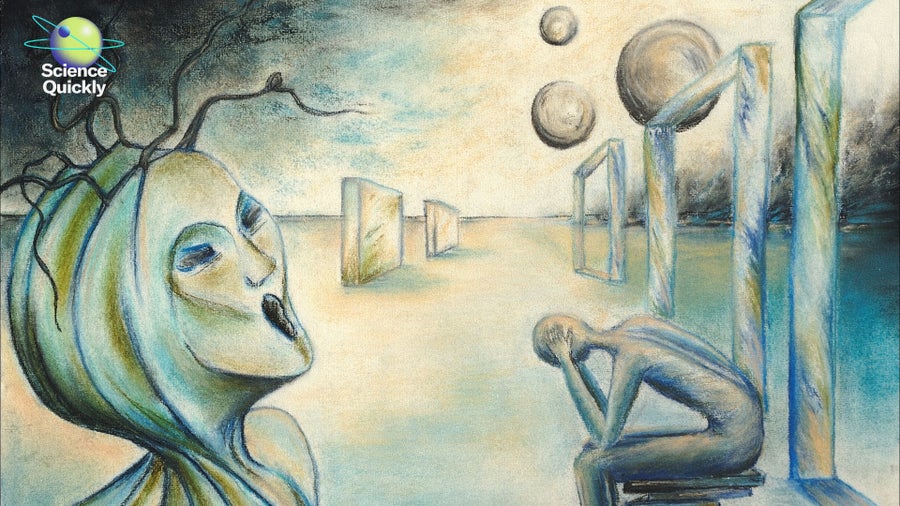 Uncle3105/Getty Images
.
.
Click the link below for the complete article (sound on to listen):
.
__________________________________________
 James' World 2
Leave a comment