
Click the link below the picture
.
Inflammation has two faces. It can be short-lived, like the swelling after a twisted ankle or a two-day fever when you get a mild flu, both part of the healing process. Or it can be a longer-lasting and more damaging affliction—chronic, low-grade inflammation that lingers in the body for years without obvious symptoms, silently harming cells. A steady stream of studies has connected this type of chronic inflammation to many serious conditions, including Alzheimer’s, heart disease, some cancers, and autoimmune illnesses such as lupus.
These findings have begun to reframe how scientists think about disease and some of its causes. They’ve also created a booming market for supplements promising to lower chronic inflammation. These pills, capsules, and powders are projected to become a $33-billion industry by 2027, offering consumers a sense of control over a complex and confusing ailment. Although thousands of products claim to “support immunity” or “reduce inflammation,” most lack solid evidence.
Chronic inflammation is damaging because it involves immune system cells and proteins that typically fight short-term battles against bacteria, viruses, and other pathogens. But when these immune system components stay activated for years, they begin to hurt healthy cells and organs. They are intended to break down invading microbes, but over time their ongoing activity can harm blood vessels, for instance, by damaging normal cells that make up the vessels’ inner linings or promoting the growth of plaques. That can lead to clots that interrupt or cut off blood flow, increasing the risk of heart attacks and strokes.
We reviewed dozens of studies and spoke with researchers to find out whether any supplements demonstrate anti-inflammatory activity not just in laboratory animals and cultured cells but in human trials. Just three compounds, it turns out, have good evidence of effectiveness: omega-3 fatty acids, curcumin, and—in certain ailments—vitamin D.
What is good evidence? We looked for consistent results across several studies that scientists described as large and well designed. Many of the more convincing trials focus on biomarkers that researchers use to track inflammation in the body. These include C-reactive protein (CRP), a molecule produced by the liver when inflammation is active, and cytokines, which are chemical messengers such as interleukin-6 (IL-6) and tumor necrosis factor alpha (TNF-α), both secreted by immune and fat cells.
Still, interpreting these markers isn’t straightforward. “We don’t have a universally accepted or standardized measurement,” says Frank Hu, chair of the department of nutrition at Harvard University. And inflammation involves hundreds of different types of cells and many signaling pathways, adds Prakash Nagarkatti, director of the National Institutes of Health Center of Research Excellence in Inflammatory and Autoimmune Diseases at the University of South Carolina. This complexity makes it difficult to prove that any supplement works consistently.
The compounds that do show promise will not cure cancer or halt dementia. But they may help quiet the kind of underlying inflammation that has been tied to risks of illness.
Among the hundreds of supplements tested for their effects on human health, omega-3 fatty acids are supported by some of the most compelling evidence. And scientists understand why they work. Two of the main types of omega-3s are eicosapentaenoic acid and docosahexaenoic acid, better known as EPA and DHA. The body metabolizes them into signaling molecules that block the production of certain cytokines and disrupt the nuclear factor κB pathway, which governs the expression of genes tied to inflammation.
Multiple studies suggest that omega-3 supplements can reduce markers of chronic inflammation, Hu says, especially among people with underlying health conditions. A large, carefully controlled trial called VITAL (officially the Vitamin D and Omega-3 Trial), which followed more than 25,000 adults for about five years, found that omega-3 supplements slightly reduced CRP in people who rarely ate fish—fish is a natural omega-3 source, so these people were getting almost all their omega-3s from the supplements. The omega-3 supplements also were associated with a 40 percent reduction in heart attacks among those consuming the least fish. “The people who benefit the most from these supplements are people who start out with lower intake,” says JoAnn Manson, an endocrinologist at Harvard Medical School who co-led the study.
Smaller trials have suggested that omega-3 supplementation can reduce certain markers of inflammation—TNF-α, IL-6, CRP, and IL-8—especially in people with conditions such as heart failure, Alzheimer’s, and kidney disease. One 2012 trial found that small amounts—about 1.25 or 2.5 grams per day—lowered IL-6 levels by 10 or 12 percent, respectively, over four months. A similar group got a placebo instead, and their IL-6 levels increased by 36 percent during that period.
.
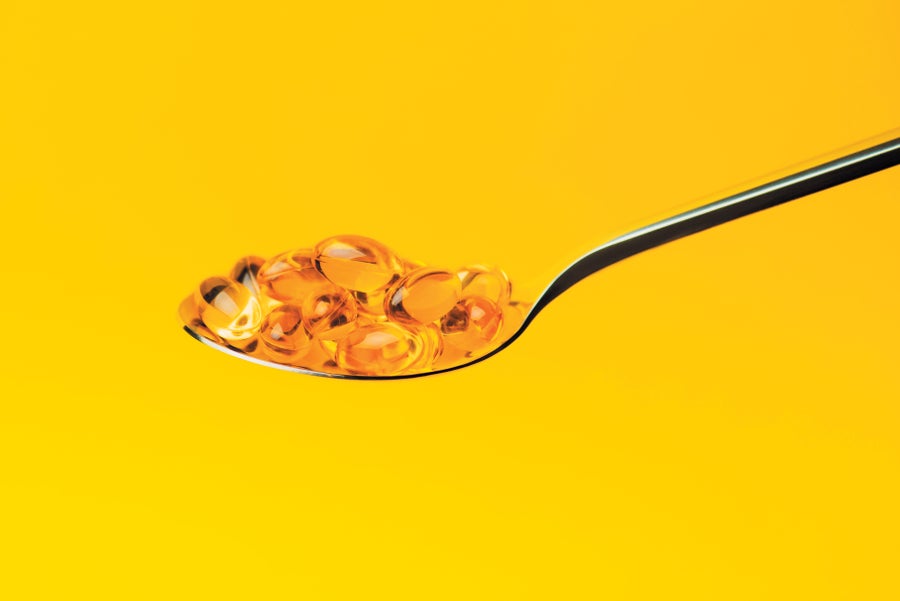
Capsules of omega-3 fatty acids show some of the best evidence as anti-inflammatories. Mensent Photography/Getty Images
.
.
Click the link below for the complete article:
.
__________________________________________
 James' World 2
Leave a comment