
Click the link below the picture
.
About four years ago, Clifford Harper, then 85, announced to his wife that he was quitting alcohol. Harper wasn’t a heavy drinker but enjoyed a good Japanese whiskey. It was the first of a series of changes Linda Kostalik saw in her husband. After he’d cleared out the liquor cabinet, Harper, a prolific academic who has authored several books, announced he was tired of writing. Next, the once daily runner quit going to the gym. Kostalik noticed he also was growing more forgetful.
The behaviors were unusual enough that, at an annual physical, the couple’s physician recommended they consult a neurologist. A battery of medical tests and brain scans revealed that Harper’s surprising actions and memory loss were the result of dementia.
Harper’s neurologist at Oregon Health & Science University (OHSU) asked whether he might like to enroll in a long-running study of dementia in African Americans.* The study’s focus on Black health piqued Harper’s interest, and he decided to participate for as long as he could. “I hope it will help other men like me,” Harper says.
As a Black American, Harper faces a risk of Alzheimer’s disease and other dementias that is twice that of white Americans his age. The reasons for this disparity are still unclear, but researchers know Black Americans are particularly vulnerable to a number of confirmed risk factors, such as living in areas with higher rates of air pollution and encountering difficulties accessing healthy foods and high-quality education. Some studies suggest that experiencing racism and other forms of discrimination contributes to a higher risk of cognitive decline. Race or gender discrimination also raises a person’s risk of heart disease and, as a result, some forms of dementia.
That’s part of what prompted Harper to participate in OHSU’s study, called the African American Dementia and Aging Project (AADAPt), which was established in part to capture the unique history and experiences of Black communities in Oregon. The state’s first constitution banned nonwhite citizens from settling there. The ban was overturned by the early 1900s, and shipyard work during World War II brought an influx of Black workers to the region, but they still faced discrimination and racism in many forms. By the end of the war, racist lending practices—called redlining—led most of the Black community to live in segregated neighborhoods or those that were poor in resources needed for good health, such as parks and grocery stores.
Discrimination in the scientific world, along with other factors such as distrust of researchers, led to underrepresentation of Black communities in brain research. Even today, clinical trials for new treatments of Alzheimer’s include very few people of color. As a result, researchers and doctors are ill-equipped to understand the causes of dementia in these communities. “Not only are there health disparities around rates of Alzheimer’s, but we’ve understudied the Black population in relation to the causes,” says Andrea Rosso, an epidemiologist at the University of Pittsburgh.
Now that Alzheimer’s and some other dementias can be diagnosed early and their progress potentially slowed, figuring out who’s most vulnerable is even more critical. Diagnostic tests and interventions aren’t yet reaching all those who need them. Researchers should include historically minoritized communities in studies of these new frontiers in dementia diagnosis and treatment, says epidemiologist Beth Shaaban of the University of Pittsburgh. If adequate attention isn’t paid to diverse populations, communities that already experience disproportionate rates of dementia will be uninformed about their increased risk, how to lower it, and how to access diagnoses and care. “We are very concerned that these disparities and the rapid evolution of the new technology could leave people behind,” Shaaban says.
AADAPt and other studies aim to correct this inequity. The project seeks to understand the forces driving cognitive decline in Black Americans, identify protective factors that lead to healthy aging, and find practical solutions. The team hopes to eventually use the data to build predictive models that will catch cognitive decline early and potentially help people such as Harper access new medicines and treatments via clinical trials.
At the turn of the century, researchers projected that an aging baby boomer generation would drastically increase the incidence of Alzheimer’s and other forms of dementia. No treatments or protective strategies were known at the time, and the search for solutions focused largely on the tangles of proteins that jammed up brain circuits.
n the past two decades, scientists have discovered that certain drivers of Alzheimer’s may be controllable. In 2011, dementia researcher Deborah Barnes of the University of California, San Francisco, and her colleagues reported that poor education and smoking—things that could be addressed by behavioral changes and social reform—were among the greatest threats to aging brains. In a 2022 follow-up study, Barnes reported other modifiable risk factors for Alzheimer’s, such as midlife obesity and sedentary lifestyle, which can raise a person’s risk for heart disease.
.
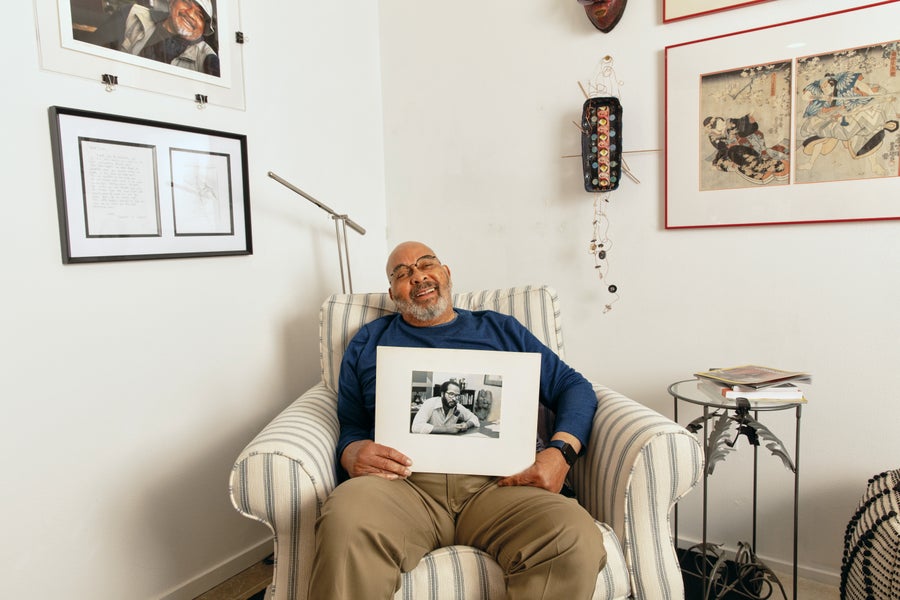
Clifford Harper, seen here holding a photo of himself as a professor, was told by his physician that his cognitive decline might have begun 15 or more years before his memory loss became evident. The delay may be attributed to his education and physical fitness. Gioncarlo Valentine
.
.
Click the link below for the complete article:
.
__________________________________________
 James' World 2
Leave a comment