
Click the link below the picture
.
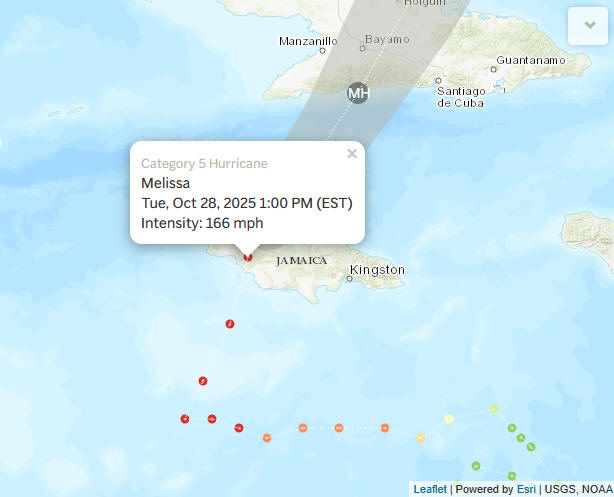
Heavy floodwaters swept across southwestern Jamaica, winds tore roofs off buildings, and boulders tumbled into roads Tuesday as Hurricane Melissa came ashore as a catastrophic Category 5 storm, tied for the strongest landfalling Atlantic hurricanes in history.
The storm landed in southwestern Jamaica near New Hope and is expected to exit around St. Ann parish in the north, forecasters said. The storm is expected to slice diagonally across the island, then head for Cuba. It has been blamed for at least seven deaths so far in the Caribbean — three in Jamaica, three in Haiti, and one in the Dominican Republic.
Landslides, fallen trees and numerous power outages were reported ahead of Melissa’s landfall, with officials in Jamaica cautioning that the cleanup and damage assessment would be slow.
“There is no infrastructure in the region that can withstand a Category 5,” Jamaican Prime Minister Andrew Holness said Monday. “The question now is the speed of recovery. That’s the challenge.”
What to know:
- Storm threatens flooding and landslides: Melissa could cause catastrophic flash flooding and numerous landslides, the U.S. National Hurricane Center warned Monday. A life-threatening storm surge of up to 13 feet (4 meters) is expected across southern Jamaica, and massive wind damage is expected in Melissa’s core.
- Cuba is next at risk: The storm is expected to make landfall late Tuesday or early Wednesday in eastern Cuba, where hundreds of thousands of people have prepared to evacuate. Up to 20 inches (51 centimeters) of rain are forecast in areas, with a significant storm surge along the coast. The hurricane is expected to reach the southeastern Bahamas by Wednesday evening.
- Warming oceans fuel Melissa’s ferocity: The warming of the world’s oceans caused by climate change helped double Hurricane Melissa’s wind speed in less than 24 hours over the weekend, climate scientists said Monday. Scientists said this is the fourth storm in the Atlantic this year to undergo rapid intensification of its wind speed and power.
Evacuations already well underway in Cuba
The president of the Provincial Defense Council and first secretary of the Cuban Communist Party in the eastern province of Santiago de Cuba, Beatriz Johnson Urrutia, said that some 281,000 people have already been evacuated and taken to 101 evacuation centers in that region or are staying with neighbors or relatives.
Some low-lying or coastal communities have been completely evacuated, with only the personnel in charge of safeguarding property remaining.
Of the 16 reservoirs managed by the National Institute of Hydraulic Resources in the province, five are discharging water, with 78% of their capacity accumulated in anticipation of heavy downpours.
Blocked roads and severe flooding seen across Jamaica
Desmond McKenzie, deputy chairman of Jamaica’s Disaster Risk Management Council, noted that extensive damage was reported in the southwestern parish of St. Elizabeth, which he said “is under water.”
He said severe damage also was reported in parts of Clarendon in southern Jamaica.
Almost every parish in the country is experiencing blocked roads, fallen trees, damaged utility poles and excessive flooding, McKenzie said.
He said four main hospitals are damaged, with the storm knocking out power to one of them, forcing officials to evacuate 75 patients.
At least 3 families trapped and unable to be rescued until conditions improve, officials say
Floodwaters trapped at least three families in their homes in the community of Black River in western Jamaica, and crews were unable to help them because of dangerous weather conditions, said Desmond McKenzie, deputy chairman of Jamaica’s Disaster Risk Management Council.
“Roofs were flying off,” he said. “We are hoping and praying that the situation will ease so that some attempt can be made to get to those persons.”
McKenzie said there are no confirmed reports of deaths and stressed that it was too early to talk about the extent of the damage because the storm was still pummeling the island.
.
.
.
Click the link below for the complete article:
.
__________________________________________
 James' World 2
Leave a comment