
Click the link below the picture
.
With each turn of the news cycle, you may wonder how anyone in their right mind, seeing what they’re seeing, could still hold differing political views from your own. I wrestle with some of these feelings myself. When I talk with people on the other side of a debate, I’m often tempted to push them to see things how I do. Or I may stay close to issues where I know we agree, so we can have a conversation that feels safe and easy.
But there is a third option for navigating these conversations: curious exploration. My and my colleagues’ research into the ways brain activity across people aligns or diverges as they converse suggests that seeking to persuade may not be the most fruitful way to approach a conversation. Instead, an open attitude, allowing ourselves to traverse a range of ideas and to learn from other people’s experiences, may be both more enjoyable and productive.
In recent years, neuroscientists have identified an important phenomenon: brain synchrony, in which brain activation in two or more people increases and decreases in similar regions at similar times. When people’s brain activity is in sync, it seems to indicate a common interpretation and understanding of what they are experiencing. For example, when one person tells a story, and another understands it in the same way, the listener’s brain aligns with the speaker’s and even begins to anticipate what will come next. On the other hand, when people interpret the same story in markedly different ways, perhaps because they’ve been given different background information, their brain activity is less synchronized than people who are given the same background facts and therefore share the same assumptions coming in.
These insights apply not only to hearing stories or watching movies but also to responding to news media and political content. Strong political speeches can bring people’s brains into sync with one another, for instance. But people get their news from politically polarized sources, which means that they encounter news coverage of different events and receive diverging analyses of the same events. This shapes their views of those issues and creates conflicting background assumptions when they encounter new political stories. In parallel, studies show divergence in brain responses when people with different political views engage with the news, as though they were making sense of different stories altogether. In research initiated by the late Emile Bruneau at the University of Pennsylvania, who died in 2020, and carried forward by Nir Jacoby, now at Dartmouth College, our team scanned the brains of participants who identified as Democrats or Republicans while they watched video clips of people talking about policies. We found that participants’ brain activation in social and emotional processing systems was more aligned with people from their own party than it was with those from the opposing party.
All of this work hints that our interactions might be more harmonious if we were more in sync with one another. But evidence from a new technique called functional magnetic resonance imaging (fMRI) hyperscanning, which can track brain activity during real conversations, complicates that idea. This method is exciting because it allows researchers to observe two brains in action at the same time. With hyperscanning, we can see how people’s brains respond to one another during real-time conversation. My collaborators and I have been using it to understand the dynamics of good conversations—exchanges where people enjoy themselves, reach consensus on how to solve hard problems or help each other navigate emotional challenges. We’ve discovered that even if one’s goal is to simply enjoy the conversation, sticking to safe topics where everyone is on the same page might not be the best solution. In a hyperscanning study, our team, including psychologists Lily Tsoi of Caldwell University, Shannon Burns of Pomona College, Sebastian Speer, and Diana Tamir, both at Princeton University, gave friends and strangers instructions to get to know each other better. We found that the conversations participants enjoyed the most were not those where their brain activity stayed perfectly in sync the whole time.
Strangers, on average, gradually increased their neural synchrony over the course of a conversation, whereas friends typically started out more in sync with one another early on. Then something interesting happened: after starting off more in sync, friends’ patterns of brain activity in regions that process social interactions began to diverge. They covered more topics and explored wider ground than strangers and, on average, enjoyed the conversations more. Strangers explored fewer topics and had less enjoyable conversations. But some pairs of strangers showed a pattern more like friends. These pairs seemed to use synchrony as a jumping-off point for exploring more ideas rather than an end. In turn, these pairs of strangers, whose brain activity diverged as the discussion unfolded, also rated their conversations as more enjoyable.
And in conversations where people needed to discuss their differences of opinion, we encountered a similarly intriguing finding. In still unpublished work, our team studied what happened as people discussed policy issues, such as the future of higher education and environmental concerns. We coached these participants to enter these conversations in one of two ways: with a goal to compromise or a goal to persuade. When people came into the conversation looking to compromise, we found, this led to more expansive exploration (for example, covering more topics, mental states, and brain patterns). Ultimately, this more expansive exploration led to greater consensus about how to solve large societal problems. On the other hand, the people who came in trying to persuade their partner explored less in their conversations and were ultimately less successful in achieving a shared vision for a path forward.
Recently, I tried to put these findings into practice while speaking with a colleague who held different views than I did and learned how events that had unfolded in his job and community had shaped his opinions and decisions. Although the conversation was tiring and did not end in complete agreement, it renewed our connection to each other and left me open to talking more.
To be sure, individual conversations in isolation can’t fix society’s polarization. Institutions—including media, industry, and government—play a major role in shaping culture, assumptions, and divides. Still, these institutions are also composed of people, and conversations are a key tool for reimagining the world we want together. Our findings suggest one set of possibilities for people navigating conversations with those across divides. We can be more open, curious, and exploratory when speaking with others, rather than avoid controversies or start off pushing our viewpoint.
.
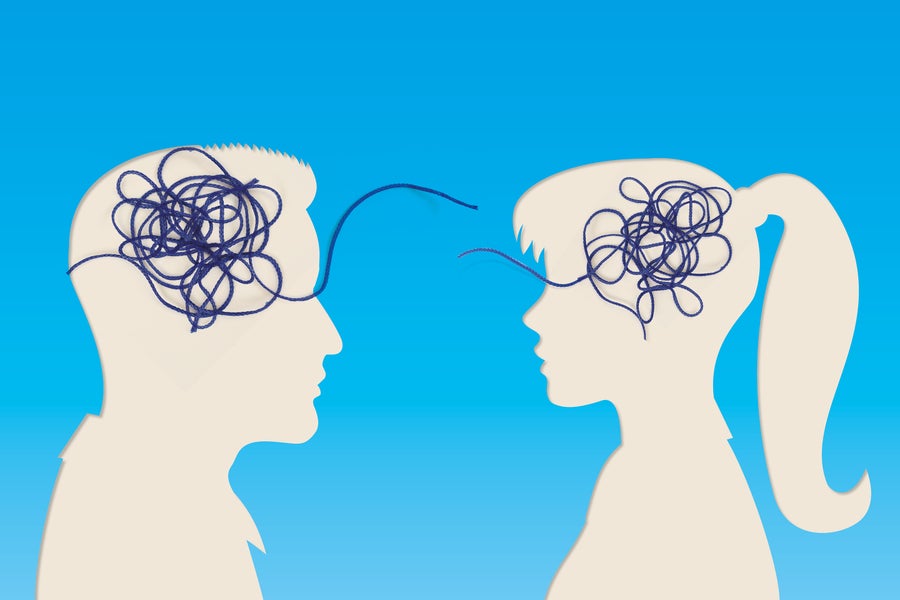
Kaptnali/Getty Images
.
.
Click the link below for the complete article:
.
__________________________________________
 James' World 2
Leave a comment