
Click the link below the picture
.
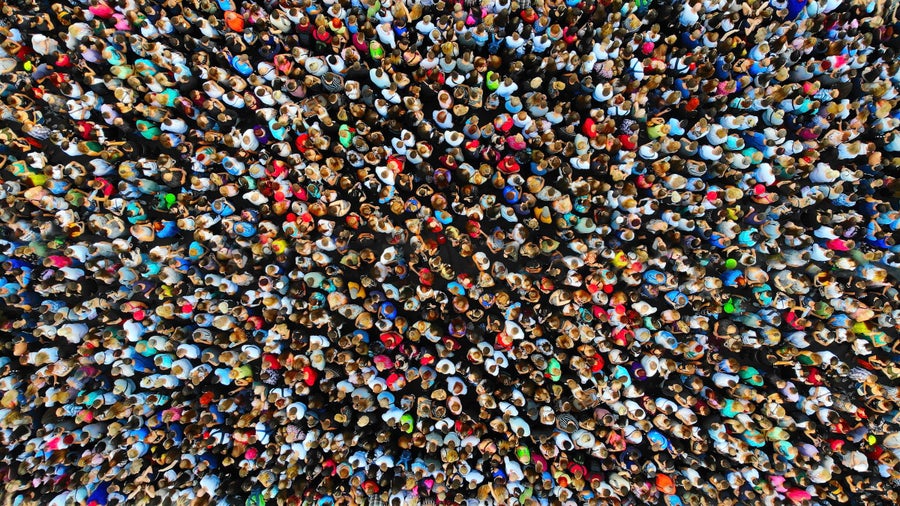
How would you go about answering the question “How many people have ever lived on this planet?” If you type that into Google or an artificial intelligence chatbot, you’ll get an answer pretty quickly—usually 117 billion. That number, at least in my opinion, seems far too small. After all, the world’s population is currently estimated at 8.2 billion people. That means we make up about 7 percent of all people ever born.
The 117-billion figure includes every person who has ever seen the light of day—including those who died young. Life expectancy has increased globally over time, however. As a result, there are other strange population questions to consider. For example, a 2014 article in the Economist stated that half of all people who have ever been age 65 or older are alive today. Can that really be true? And how do you even calculate something like that?
Demographers have been asking such questions for decades. One of the biggest challenges they face is from the data: you need to know how many people have lived at different times, as well as the average life expectancy or birth rate. Such numbers are available today (though records are not always reliable), but less so for centuries past. Statistical analyses and censuses have not been routinely carried out everywhere and across all societies. Demographers must therefore rely heavily on estimates.
And then there are a few fundamental questions to consider. What exactly is meant by “human”? Do we mean all members of the genus Homo who have walked our planet or just Homo sapiens in particular? Given the challenges, it’s astonishing that when estimating all the people who have ever lived, we are usually only presented with one number, 117 billion, rather than a range with a low and a high estimate. I argue that that is entirely appropriate from a scientific point of view and signals that the result is an approximation. The order of magnitude may seem plausible, but the question cannot be answered exactly.
Modeling Population Growth
To realistically assess the 117-billion-person estimate, you first need data. From the 20th century to the present, you can find lots of population figures, thanks to regular censuses conducted in many countries since the 1850s.
Looking further back in history, the number of people living can be roughly estimated based on the size of cities and population density. For even earlier times, archaeological remains offer clues.
Nevertheless, some sources put the world population in the year C.E. 1 at 170 million people and others at 300 million, almost double that number. There is also the question of how far back we should even look. There are estimates in which demographers go back as far as 4.5 million years to consider all members of the genus Homo. Others, however, focus on Homo sapiens and look back between 50,000 and 200,000 years.
Over the years, not only the number of living humans but also the corresponding rate of population growth has changed significantly. The world’s population used to increase very slowly, but seems to have grown faster in recent centuries. That’s because the birth rate has decreased while the death rate has decreased even more—a combination that can be difficult to model.
The growth rate can be assumed to be constant for small time intervals, however. Demographers use that assumption to estimate the number of all living people in a given time interval. You have to divide the period under consideration into different sections; for example, you can start 50,000 years before our era and end in the year 2025. The more subdivisions you make, the more accurate the result.
If we now assume that the birth rate g and death rate s are constant within a section of that timeline, then the population size N changes according to the following differential equation:
Given that g and s are assumed to be constant within an interval, the population size in this area can be modeled using an exponential function: N(t) = N0ekt, where the parameters k (the net growth rate) and N0 (the population size when time t = 0) are determined by the data points.
To determine how many people have ever lived, you have to add up the number of all living people at each point in time t. This can be done by calculating the integral of the piecewise-defined function over t in the respective section:
This approach overestimates the actual answer, though. Think of it this way: If you are reading this article, then you are currently alive; you were most likely already alive 10 years ago, however, and also contributed to the world population back then. The integrated result must therefore be divided by the respective life expectancy of the people who lived during the period in question. At the end, you can add up the results for all time periods and—ta-da!—the result should correspond to the total number of people who have ever lived.
.
 Dmytro Varavin/iStock/Getty Images
.
.
Click the link below for the complete article:
.
__________________________________________
 James' World 2
Oct 05, 2025 @ 04:01:45
Amazing!
LikeLiked by 1 person
Oct 05, 2025 @ 09:49:33
Thanks for your comment!
LikeLike
Oct 05, 2025 @ 09:12:47
💙
LikeLike
Oct 05, 2025 @ 09:31:08
Thanks! I was in Times Square one New Year’s and the crowd was like the illustration in this article.
LikeLike