
Click the link below the picture
.
Maria Branyas Morera lived to the age of 117 with a bit of genetic luck and a healthy diet that included daily yogurts, according to a study published today in Cell Reports Medicine. During her final year — she died on 19 August 2024 — she was verified as the oldest living person, a feat that drew the attention of researchers who explore the biology of ageing.
“We wanted to learn from her particular case to benefit other people,” says Manel Esteller, a physician specializing in genetics at the University of Barcelona in Spain.
At the time, Branyas was living in the small town of Olot, in the Catalonia region of Spain, where she enjoyed reading books, playing with dogs and spending time with friends and family, including her two daughters, both in their 90s. Over several encounters with Branyas and her family, Esteller and his colleagues collected samples of her blood, saliva, urine, and stool that provided insights into her unique physiology, including her genetics, metabolism, and gut microbiome.
The supercentenarian was happy to collaborate. “She was a very humble person,” Esteller recalls. “She said: ‘My only merit is that I’m alive’.”
The researchers compared Branyas’s genetic, metabolomic, and other profiles with those of women of various ages living in the same region. One of the main insights from the work, Esteller says, is that it is possible to distinguish molecular changes that happen in the body because of ageing from those that occur because of poor health.
For instance, the research team learnt that Branyas’s telomeres — the stretches of repetitive DNA that protect the ends of chromosomes — were exceptionally short. Telomeres naturally shorten with age, and unusually short telomeres have been associated with age-related diseases. But Branyas had no such illnesses. “This is telling us that the loss of telomeres is not necessarily associated with disease, it’s simply associated with being old,” Esteller says.
Mayana Zatz, a geneticist at the University of São Paulo in Brazil who studies the genetics of healthy centenarians, says the study is thorough but notes that conclusions that are based on a single individual are limited. “It would be interesting to compare the findings with supercentenarians in other populations,” she says.
Winning the genetics lottery
While analysing Branyas’s genome, the authors spotted genetic variants that are known to protect against cardiovascular disease, cognitive loss, and diabetes. By contrast, they found no variants associated with increased risk for certain deleterious conditions, including Alzheimer’s disease.
The researchers also looked for genes linked to longevity. “She had variants in genes that, in other beings like dogs, worms, and flies, are associated with extreme lifespan,” Esteller says. “She was lucky in the genetics lottery.”
But her luck didn’t end there. Branyas aced her bloodwork; she had low levels of ‘bad’ cholesterol and high levels of ‘good’ cholesterol, which suggests an efficient lipid metabolism. Her inflammation markers were also low, and she had a strong immune system — at the age of 113, she was the oldest person in Spain to have COVID-19 and survive. “Sometimes our immune cells get a little bit unloyal and start to attack our own cells, causing inflammation,” Esteller says. “There was nothing like that.”
Esteller thinks Branyas’s lack of inflammation could be linked to her healthy gut microbiome, which resembled that of a much younger person. He points to her high levels of Bifidobacterium, a genus of beneficial bacteria that was probably boosted by her diet, which included three daily servings of yogurt.
Some of her other lifestyle choices that probably contributed to her longevity included eating a Mediterranean diet and exercising regularly. “Our genes are the cards in a poker game,” Esteller says. “But how we play them is what really matters.”
.
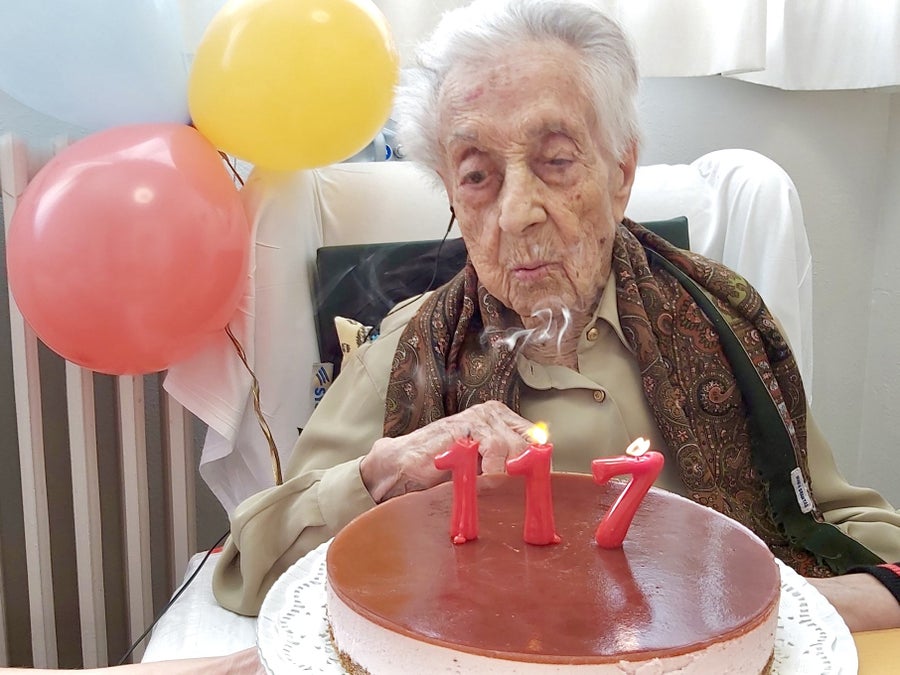
Maria Branyas Morera had been verified as the oldest living person when she died last year at age 117. Xavier Dengra (Public Domain)
.
.
Click the link below for the complete article:
.
__________________________________________
 James' World 2
Leave a comment